South Korea · Jeju Special Self-Governing Province
Jeju Island
Climb Seongsan Ilchulbong for the sunrise on a weekday, 5,000 won, gates open at least 45 minutes before dawn, then eat abalone porridge in the haenyeo house in Ojo-ri. Take the Udo ferry from Seongsan, 10,500 won return, and ride a bicycle round the island, because your car cannot come. Walk the reopened kilometre of Manjanggul, closed on the first Wednesday of the month. Book the Hallasan summit section at visithalla.jeju.go.kr from the first working day of the month before, or walk the Yeongsil trail without a booking. Give the south a day: Jeongbang falls, which drop straight into the sea, the Jusangjeolli columns and the Seogwipo Olle market for hairtail. End the days in the west, at Suwolbong or on the Aewol coast, where the sun goes into the water on every day of the year. Eat black pork once at Donsadon in the city and once anywhere else.
 Korea.net / Korean Culture and Informati / CC BY-SA 2.0 via Wikimedia Commons
Overview
Jeju is a volcano in the sea, 1,833 square kilometres of it, about 85 kilometres off the southern tip of Korea, with Hallasan, the country’s highest mountain at 1,947 metres, in the middle and some 360 smaller cones, the oreum, scattered round it. UNESCO put three pieces of it on the World Heritage list in 2007: the mountain, the Geomunoreum lava tube system with Manjanggul, and Seongsan Ilchulbong, the tuff cone that stands in the sea at the eastern tip and gave the island its most famous dawn. In 2016 UNESCO listed the haenyeo as well, the women who dive without tanks for abalone and sea urchin, and the province counted 2,371 of them still working at the end of 2025, 427 of them aged eighty or more. Koreans come in enormous numbers: 13.86 million visitors in 2025, 11.6 million of them domestic, most arriving on the Seoul Gimpo to Jeju air route, which the OAG ranked the busiest in the world in 2025 with 14.4 million seats. Foreigners were 2.24 million of the total, seven in ten of them Chinese. Almost nobody comes from Israel, and that is partly the point: the island is set up for Korean domestic travel, with the food, the prices and the rhythms that implies, and it rewards a reader who arrives knowing the rules.
Jeju is an easy big nature trip for a couple who want a car, a mountain and a sea, and the hardest to read from abroad, because almost everything about it is written for Koreans. Our take: give it a week, split east and south-west, and plan the light. Seongsan Ilchulbong is the sunrise, and our terrain model says it never fails: from the summit deck, 182 metres up, the sun comes out of open sea on every day of 2026, about a minute before the almanac time, from a bearing of 61 degrees in June to 118 in December, and the gates open at 04:30 in summer, 05:00 in spring and autumn and 06:00 in winter, always before it. The beach below, Gwangchigi, is the better photograph from 13 April to 31 August, when the sun comes up behind the cone itself, up to 24 minutes late. Hamdeok, the north coast’s showpiece beach, is a sunrise trap: Seoubong takes it 6 to 36 minutes late all year. For the sunset go west, and go high: Suwolbong above Chagwido, the rim of Songaksan and the Handam coast at Aewol have open sea under the sun every day of the year, and Saebyeol oreum, the fire-festival hill, sees it set two minutes after the almanac because of its height. Hyeopjae, the postcard beach, works from mid-February to late October. Hallasan’s summit sees the sun five minutes before anywhere else on the island and five minutes after, and the park rules make both unreachable: entry opens at 05:00 and the summit must be empty by 13:30 in winter and 14:30 in summer. Climb it for the crater lake, not the light.
Best for
Couples · Hikers · Food travellers · Families with a car · A week added to a Seoul trip · Sunrise chasers
Daily itinerary
5 to 7 days
Three things. The first is the geometry, which we computed for every day of 2026 against the terrain: Seongsan Ilchulbong earns its name, with open sea under the rising sun on all 365 days and gates that open before dawn in every season, while the famous beaches on the north coast lose the sunrise behind their own headlands, and the sunsets belong to the west coast, where Suwolbong, Songaksan and the Aewol coast have an open-sea horizon all year. The second is that the rules changed this year: Manjanggul reopened on 30 May 2026 after a rockfall closed it for two and a half years, the Hallasan booking now covers only the last stretch to the summit, Udo has banned visitors’ cars until 2029, and the tourist environment levy argued over since 2012 was dropped in the summer of 2026 in favour of higher admission fees that have not yet been set. The third is the food, which is Korean but not Seoul’s: black pork over charcoal, pork-broth noodles, abalone porridge at dawn, hairtail stew in Seogwipo, and tangerines from November.
Best time to visit
Jeju has a humid subtropical climate with a wet summer and a mild, windy winter. The 1991 to 2020 normals for Jeju City give a daily high of 8.6C in January and 30.1C in August, with 1,502 mm of rain a year, most of it from June to September: 171 mm in June, 210 in July, 272 in August and 228 in September, against 56 in December and 68 in January. The south coast is wetter still, Seogwipo takes 1,990 mm a year and 316 mm in August, but it also gets more sun in winter. The jangma, the East Asian monsoon, normally arrives on 19 June and lasts about a month; in 2026 it started on 30 June, the third latest on record. Typhoons are a late-summer risk, mostly August and September. The sea is warmest in August at about 26C and swimmable from July to September; the island’s twelve designated beaches had lifeguards from 24 June to 6 September in 2026. For walking, the oreum and the mountain, April to early June and late September to November are the months, and October, the driest month of the walking season at 95 mm against 228 in September, with the silver grass on the oreum, is the V-TIMES pick.
- January to February: Jeju City highs of 9C to 10C, snow on the mountain and camellias in Andeok and at Camellia Hill. Sunrise at Seongsan between about 07:36 in early January and 07:04 in late February, out of open sea, two to three minutes before Jeju City. From the Handam coast and Suwolbong the sun sets into the sea at about 17:55 in late January. Seollal falls on 6 to 9 February in 2027.
- March to April: Cherry blossom on Jeonnong-ro in the last week of March, canola fields along the east coast through April, the Jeju Fire Festival on Saebyeol oreum in mid-March, 13 to 14 March in 2026, now with lights rather than a real grass fire. Gwangchigi beach starts its summer act on 13 April: the sun rises behind Seongsan Ilchulbong until the end of August.
- May to June: The best green month and the start of the summer gate times at Seongsan, 04:30 from 1 May. The jangma normally begins on 19 June; the summit trails open at 05:00 and the sunrise moves from about 05:46 on 1 May to 05:22 at the solstice, so a legal summit sunrise on Hallasan does not exist in any month. Hyeopjae, Gwakji, Iho Tewoo and even Yongduam in the city have open sea under the sunset from late April.
- July to August: Hot, humid and wet: 210 to 272 mm a month and the Korean holiday crowds. Swim in the mornings, climb nothing at noon, eat in Seogwipo. The sun still sets at about 19:45 in early July; from Udo’s Seobin Baeksa beach it drops into the sea just beyond the Jeju shore in June and July.
- September to October: Our pick, once the typhoon risk passes. Silver grass on the oreum, the buckwheat fields, the Tamna Cultural Festival from 17 October, and 95 mm of rain in October against 228 in September. Gwangchigi goes back to an open-sea sunrise on 1 September; Hyeopjae keeps its sea sunset until 26 October and Gwakji until 9 November.
- November to December: Tangerines everywhere, the Olle Walking Festival in the first week of November, and the clearest skies of the year at Seongsan. From Udo the winter sun sets behind Hallasan, 40 km away, 7 to 14 minutes early. Sunrise at Seongsan 07:31 on 21 December out of open sea; the gates open at 06:00. The Seongsan Sunrise Festival books 500 places for the dawn climb of 1 January.
Things worth knowing
- Seongsan Sunrise Festival (31 December to 1 January): the 33rd edition ran into 1 January 2026 with 500 places on the dawn climb; the festival site publishes the next edition in December.
- Jeju Fire Festival, Saebyeol oreum (mid-March; 13 to 14 March in 2026): the grass fire that used to burn the whole hill is now a light-and-fireworks show. The 2027 dates were not out when we checked.
- Jeonnong-ro Cherry Blossom Festival, Jeju City (27 to 29 March 2026): the city’s main avenue under the king cherries.
- Canola flower fields (late March to April): the yellow fields along the east coast around Seongsan and Seopjikoji; many are private and charge a small fee to walk in.
- Tamna Cultural Festival, Jeju City (17 to 21 October 2026): the 65th edition, held alongside the National Sports Festival, which Jeju hosts the same week.
- Jeju Olle Walking Festival (5 to 7 November 2026): the 16th edition, walked on routes 19 and 20 on the north-east coast.
- Jeju 4.3 memorial day (3 April): the anniversary of the 1948 uprising and massacre, marked at the Peace Park in Bonggae-dong.
Where to stay
 Abasaa · Public domain via Wikimedia Commons
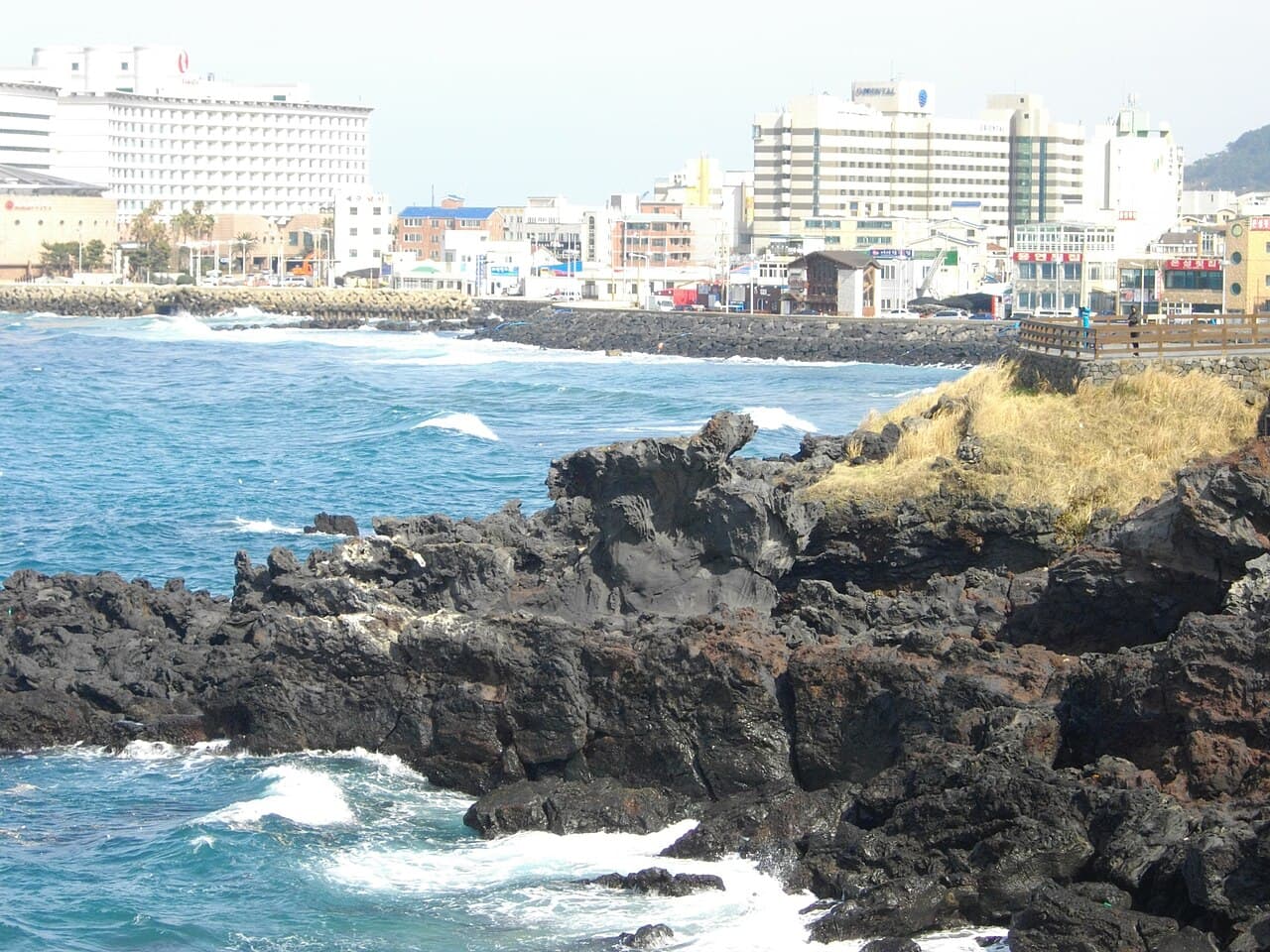
Jeju City: Tapdong, Yeon-dong and the airport side
The capital on the north coast, about half a million people, with the airport inside the city, the Dongmun market and its night stalls near the old harbour at Tapdong, the Yongduam dragon-head rock on the shore road, and Yeon-dong, the neon district of hotels, duty-free shops and the Grand Hyatt’s tower, ten minutes from the terminal. The black-pork street is here, and so is the bus terminal from which the 281 climbs to the Seongpanak trailhead.
Best for: The first or last night · Dongmun night market · Black pork · No car
A working Korean city: traffic, high-rises and a grey north-coast sea. The sunset from Yongduam goes into open sea only from 25 April to 17 August; in December the shore takes it 11 minutes early. The sunrise is behind the city.
 kyaw thuwai · Pexels
Seongsan and the east coast
The end of the island where the sunrise peak stands in the sea, with the Udo ferry port below it, the haenyeo houses of Ojo-ri and Jongdal-ri, the canola fields of spring, Seopjikoji’s headland with Tadao Ando’s Glass House, and, inland, the Geomunoreum lava tubes with Manjanggul at Woljeong-ri. The villages are small and the stays are guesthouses, the Phoenix Island resort and the Playce Camp hotel.
Best for: Sunrise · Udo · Couples · The lava tube
An hour to seventy-five minutes from the airport by car, more by bus, and quiet at night. From Jongdal-ri the sun rises behind Udo most of the year, 2 to 7 minutes late; only from 14 to 29 December does it clear the island. Sunsets here go behind the island, and behind Hallasan itself in winter.
 Grapesurgeon · CC BY-SA 4.0 via Wikimedia Commons
Hamdeok, Gimnyeong and Woljeong-ri
The north-east coast’s string of white-sand, turquoise-water beaches thirty to forty minutes east of the city: Hamdeok, with Seoubong hill at its end and the cafes of Delmoondo and the Odrang bakery behind it, then Gimnyeong, Woljeong-ri with its cafe strip, and the Manjanggul turn-off. It is the family coast and the summer-crowd coast.
Best for: Beach days · Cafes · Families · Between the city and Seongsan
Beautiful at noon, but the light is wrong at both ends of the day. At Hamdeok the sun rises behind Seoubong 6 to 36 minutes late on every day of the year and sets behind the shore to the west except for a few weeks in May and late July; Woljeong-ri gets an open-sea sunrise only from 11 May to 2 August. Summer weekends are packed.
 Jocelyndurrey
This photo was taken with Samsung Galaxy Note II · CC BY-SA 4.0 via Wikimedia Commons
Jocelyndurrey
This photo was taken with Samsung Galaxy Note II · CC BY-SA 4.0 via Wikimedia CommonsSeogwipo
The southern city, 180,000 people, warmer and sunnier than the north, with the Olle market, the harbour and Saeyeongyo bridge to Saeseom island, Jeongbang falls dropping into the sea at the edge of town, Cheonjiyeon falls lit until 22:00, and Oedolgae rock on the coast path west of town. The Jeju Olle route 7 starts here, and the Olle Travel Centre is in the middle of it.
Best for: A southern base without a resort · Hairtail and abalone · The Olle trails · Waterfalls
Hilly, and the harbour faces south: from the bridge the sun sets behind the land to the west up to 48 minutes early in June, with a sea sunset only from mid-January to late February and late October to late November. Oedolgae does better: early January to mid-February and late October to early December.
 Ken Eckert · CC BY-SA 4.0 via Wikimedia Commons
Jungmun
The resort strip west of Seogwipo, built in the 1980s on the cliffs above Saekdal beach: the Shilla, Lotte and Parnas side by side, Hidden Cliff above the Yerae valley, the thatched Seaes villas, the Jusangjeolli basalt columns and Cheonjeyeon falls a short walk away, and the 600 airport limousine along the resort road.
Best for: Resort pools · Honeymoons · Families · The Jusangjeolli columns
Expensive and self-contained, and the Shilla has a casino. The beach is in a cove between cliffs, so by our model the sun leaves it 20 to 40 minutes early most of the year and goes into the sea only around the December solstice. Drive west for the evening.
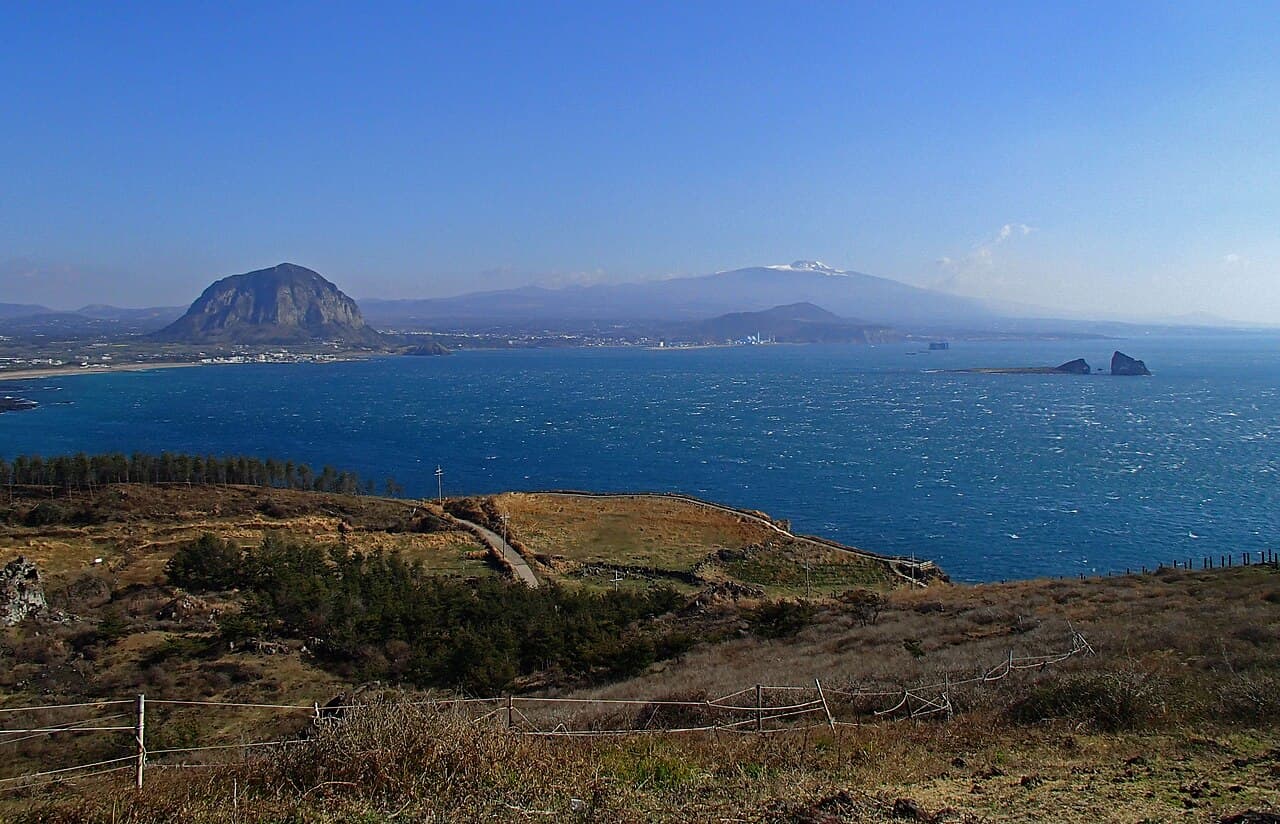
 Korea.net / Korean Culture and Information Service · CC BY-SA 2.0 via Wikimedia Commons
The south-west: Sanbangsan, Songaksan and Moseulpo
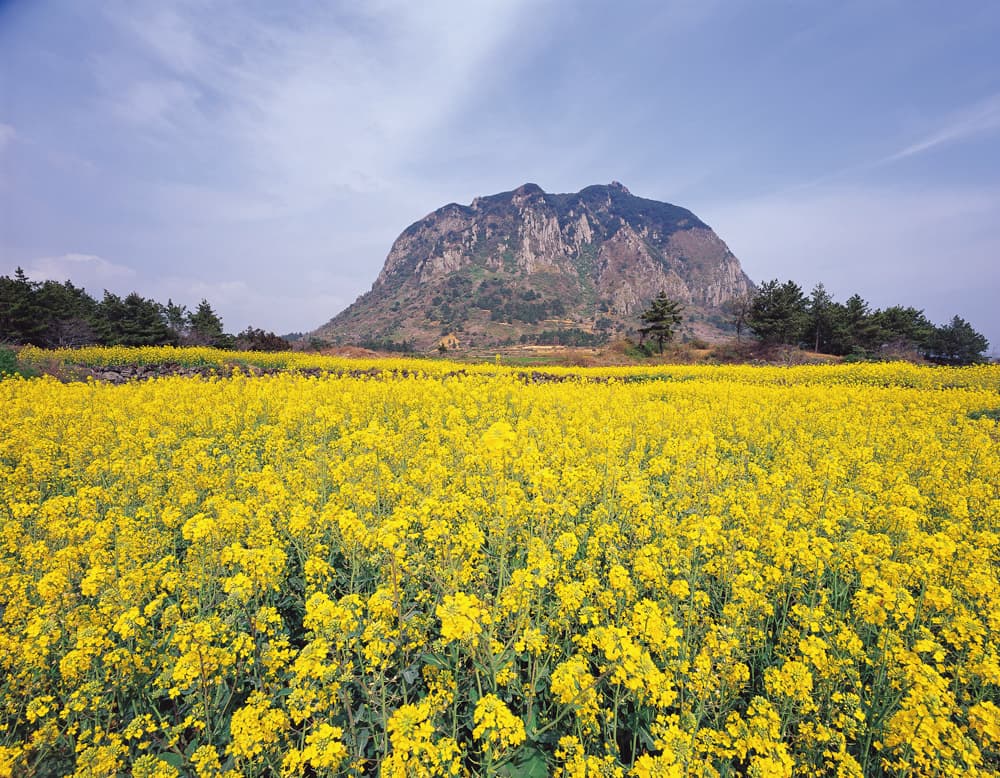
The bell-shaped dome of Sanbangsan above Sagye beach, the Yongmeori coast below it, which closes at high tide, the low crater of Songaksan on the sea with the Olle route 10 over its rim, the Moseulpo fishing harbour, the O’sulloc tea fields, and inland the Itami Jun buildings of the Podo hotel and the Shinhwa World theme-park complex. This is where the island looks west to the sea.
Best for: Sunsets · Olle route 10 · Tea fields · Architecture
Spread out, with no town centre; a car is essential. Sagye beach itself loses the sunset behind the shore to the west, by our model 13 to 43 minutes early, while the Songaksan rim, a few minutes away, has open sea under it every day of the year.
 Lcarrion88 · CC BY-SA 4.0 via Wikimedia Commons
Hallim, Hyeopjae and Aewol
The west coast forty minutes from the airport: Hyeopjae and Geumneung, the island’s clearest shallows, facing Biyangdo, the Hallim park, then the coast road north through Gwakji beach, the Handam walkway and the cafe cliffs of Aewol, where the island’s coffee-with-a-sea-view photographs are taken. Villa de Aewol and a crowd of pensions sit on the road.
Best for: The sunset coast · Cafes with a view · Snorkelling shallows · An easy base near the airport
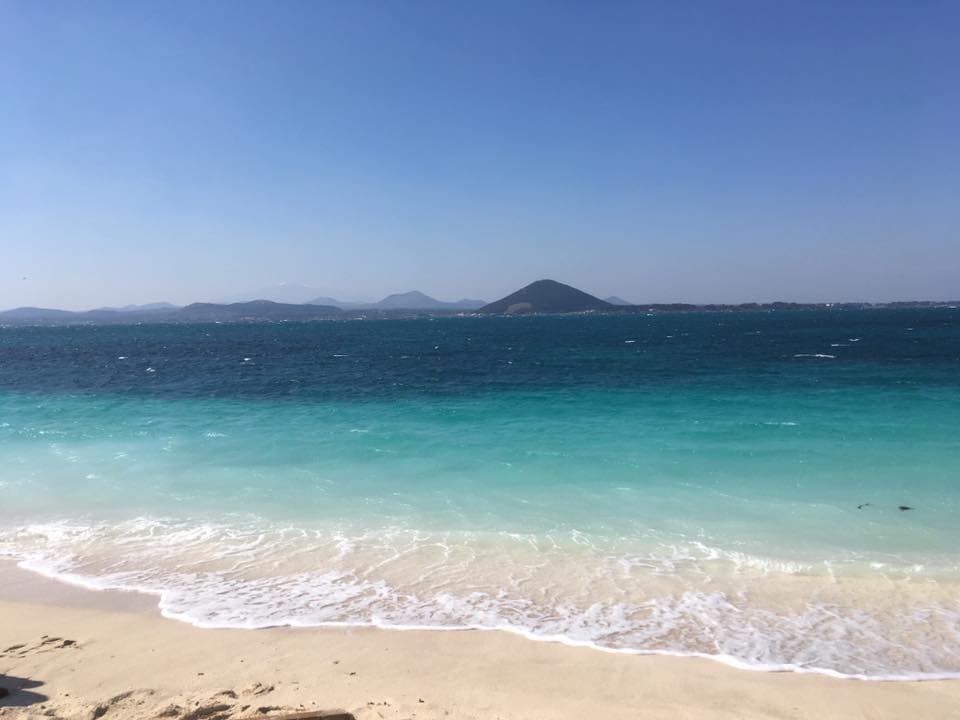
Cafe traffic on weekend afternoons, and a sea that is shallow rather than dramatic. Hyeopjae has open sea under the sunset from 16 February to 26 October; the Handam coast all year and Gwakji from 1 February to 9 November. In midwinter the beach loses the sun behind the low shore to the south-west, though that part of our model is near-field and low confidence.
 Morales9199 · CC BY-SA 3.0 via Wikimedia Commons
Udo
The cow-shaped island fifteen minutes by ferry from Seongsan, 6 square kilometres, 1,800 people and 1.2 million visitors in 2024: the white-sand beach of Seobin Baeksa, the black-sand cove of Geommeolle, the Udobong cliffs and the peanut ice cream the island is known for. Visitors’ cars are banned until 31 July 2029, so it is seen by bicycle, electric scooter or the loop bus.
Best for: A day by bicycle · Beaches · Udobong sunrise · A night away from everything
The 2025 timetable ran sailings from Seongsan until 18:30 and the last boat back from Udo leaves earlier, above all in winter, so check it at the port on the way out; a sunset on Udo means sleeping on Udo, and only guests of island lodgings may bring a rental car, electric ones excepted. From Udobong the sun rises out of open sea all year; from Seobin Baeksa it sets behind Hallasan in winter.
Where to sleep
Grand Hyatt Jeju
luxury · Jeju Dream Tower, Yeon-dong, Jeju City
Best for: Very large rooms · A first or last night by the airport · Pools in the city
- 1,600 suites in the twin towers of Jeju Dream Tower, standard rooms of 65 square metres that the hotel calls the largest in Korea
- A sky pool, an indoor pool, a Korean jjimjil spa and a free airport shuttle from 06:00 to 22:00, ten minutes from the terminal
- The restaurants and shops of the complex downstairs
- A 1,600-room tower in the neon district, nowhere near a beach
- The Dream Tower casino is in the same building
- Rates are not published on its pages
The Shilla Jeju
resort · Jungmun
Best for: The classic Jungmun resort · Families with small children · Pools in every season
- Open since 1 July 1990, 429 rooms on the Jungmun cliffs
- Indoor and outdoor pools with an adults-only pool zone beside the family pool, a spa, and a kids’ cabin and club
- Walking distance to Jusangjeolli and the Jungmun beach path
- A 1990 building, however often renewed
- A casino on the sixth floor
- Jungmun’s cove loses the sunset early; the resort faces south
Parnas Hotel Jeju
luxury · Saekdal-dong, Jungmun
Best for: The newest of the Jungmun big four · An infinity pool over the sea · Couples
- Rooms with terraces above Jungmun Saekdal beach, an infinity pool and a spa
- Family and accessible room types
- Package rates printed on its own site, roughly 316,000 to 385,000 won when we checked
- The room count is not published
- Resort pricing all year
- Like all of Jungmun, no sea sunset most of the year
Hidden Cliff Hotel & Nature
design · Yerae, above Jungmun
Best for: Design and quiet · The long infinity pool · Couples
- 250 rooms in a minimalist building 90 metres up on the Yerae cliff, next to a firefly sanctuary
- A 47-metre infinity pool, the longest in Korea by the hotel’s account, with a spa and aroma treatments
- A five-star government rating and a short drive to Jungmun’s beach and columns
- On a cliff, not a beach
- The pickup shuttle must be booked two weeks ahead and does not run on Tuesdays or Fridays
- A 250-room hotel, however calm the design
The Seaes Hotel & Resort
unique · Jungmun, on the coast path
Best for: Sleeping under a thatched roof · Privacy · Honeymoons
- Stand-alone villas with basalt walls and the thatched roofs of old Jeju farmhouses, on 43,000 square metres of coast with its own walk to the sea
- Pool suites and canopy suites, and a private sauna spa
- The quiet end of Jungmun, between the big hotels and the sea
- No big pool complex and no room count published
- Its website does not load reliably; phone 064-735-3000 to book
- Villas priced at the top of Jungmun
Haevichi Hotel & Resort Jeju
resort · Pyoseon, south-east coast
Best for: The east coast with a real pool · Fine dining at Milieu · Between Seongsan and Seogwipo
- An outdoor twin pool facing the sea, open 09:00 to 22:00, plus an indoor pool, a sauna and Spa Ara
- Milieu, its French tasting-menu restaurant, is the island’s fine-dining table
- Pyoseon beach and the Jeju Folk Village next door, and Seongsan 25 minutes away
- Far from both the airport and Jungmun
- The outdoor pool closes for works from 26 October to 8 November 2026 and on listed days each month
- The room count is not on its pages
WE Hotel Jeju
unique · Hallasan foothills above Seogwipo
Best for: A wellness stay in the forest · Hikers who want the mountain at the door · Silence
- A health resort run with the Halla Medical Foundation’s WE Hospital, with volcanic bedrock water and 210,000 square metres of forest
- A wellness programme built around the hospital’s staff
- Twenty minutes from the Donnaeko and Yeongsil trailheads
- 39 kilometres from the airport, with no town and no beach nearby
- A hospital on the premises, which not every guest wants
- A car is essential
Podo Hotel
design · Pinx resort, Andeok, south-west uplands
Best for: Architecture · A hot spring · A night of complete quiet
- Itami Jun’s design, a cluster of thatched-roof forms named after a bunch of grapes, on the SK Pinx golf estate
- A hot spring, with its own page on the hotel’s site
- An architectural-art guide programme for guests
- Very few rooms, so it books out; the count is not on its pages
- On a golf resort inland, far from the coast and from any restaurant you did not plan
- Priced as the design landmark it is
Phoenix Island
resort · Seopjikoji, Seongsan
Best for: Sleeping on the sunrise headland · Tadao Ando’s Glass House · Families in condos
- A resort on the Seopjikoji headland itself, with Seongsan Ilchulbong across the bay and the open-sea sunrise at the end of the garden
- Tadao Ando’s Glass House and the Yumin Art Nouveau Museum on the grounds
- Heated indoor and outdoor pools all year
- A condominium resort, with pool fees for guests beyond a room’s capacity
- It traded as Phoenix Jeju Seopjikoji until recently and many maps still say so
- Sunsets are behind the island
Playce Camp Jeju
value · Seongsan village
Best for: A cheap bed under the sunrise peak · Younger couples · Pet owners
- A half-hour walk or a five-minute drive to the Seongsan Ilchulbong gate and the Udo ferry
- Standard rooms up to duplexes and a penthouse, plus pet-friendly rooms
- Run by the Phoenix group, with its own reservations line
- A hostel-like social hotel with few facilities
- Several pages of its website return errors
- Seongsan village is quiet after dark
Marriott Resort, Jeju Shinhwa World
family · Andeok, south-west
Best for: Families with a theme park in mind · A big-brand resort · Rainy days
- One of four hotels on the Shinhwa World estate, which has more than 2,000 rooms in all, a theme park and a water park
- Guests use the Mosil Clubhouse pool
- Fifteen minutes from the O’sulloc tea fields and Songaksan
- A huge inland complex with no beach
- A casino operates on the estate
- The Jeju you came for is outside the gates
Maison Glad Jeju
value · Yeon-dong, Jeju City
Best for: A mid-priced city hotel with a pool · The night before an early flight · Dog owners
- A patio pool, sauna and gym in the middle of the Yeon-dong district
- Rates printed on its site, about 145,000 to 260,000 won a night when we checked, with bed and breakfast from 192,000
- Pet rooms and a pet ground, which is rare on the island
- A city hotel with no sea
- Yeon-dong is neon and traffic
- The room count is not on its pages
Shilla Stay Jeju
value · Noyeon-ro, Jeju City
Best for: A clean business hotel near the airport · Solo travellers · A one-night stop
- The Shilla group’s business brand, a few minutes from the terminal
- A gym and breakfast
- Rates that undercut the resorts by a wide margin
- No pool
- A business hotel, with the view that implies
- A fake “official” site with a .com-hotel.info address copies its name; book on shillahotels.com
Tops10 Villa de Aewol
boutique · Aewol coast road
Best for: The sunset coast · Sea and mountain views · A base forty minutes from the airport
- On the Aewol coast road with the sea on one side and Hallasan on the other
- An outdoor pool open in spring, summer and autumn
- The Handam walkway and the Aewol cafes within a few minutes
- The pool closes in winter and the room count is not published
- Its website’s security certificate had expired when we checked
- Weekend cafe traffic on the coast road
Essential experiences
 Dasha Klimova · Pexels
Seongsan Ilchulbong
The sunrise peak: a tuff cone 182 metres high that erupted out of a shallow sea about 6,700 years ago, with a grassy crater 600 metres across and cliffs on every side but the one that joins it to the island. A wooden stair climbs to the summit deck in 30 to 40 minutes; the base and the Umutgae shore are free. Adults pay 5,000 won, youth and children 2,500, parking is free, and the gates open before dawn in every season: 04:30 from May to August, 05:00 in March, April, September and October, 06:00 from November to February. Closed on the first Monday of the month, or the next day if that is a holiday. By our model the sun rises out of open sea from the top on every day of the year, about a minute before the almanac. The haenyeo of Seongsan give a free diving demonstration on the shore below, in the afternoon; the time printed varies between sources, so ask at the gate.
Jeju World Natural Heritage: Seongsan Ilchulbong ↗View on map ↗
 Yoo Chung · CC BY-SA 2.5 via Wikimedia Commons
Hallasan and Baengnokdam
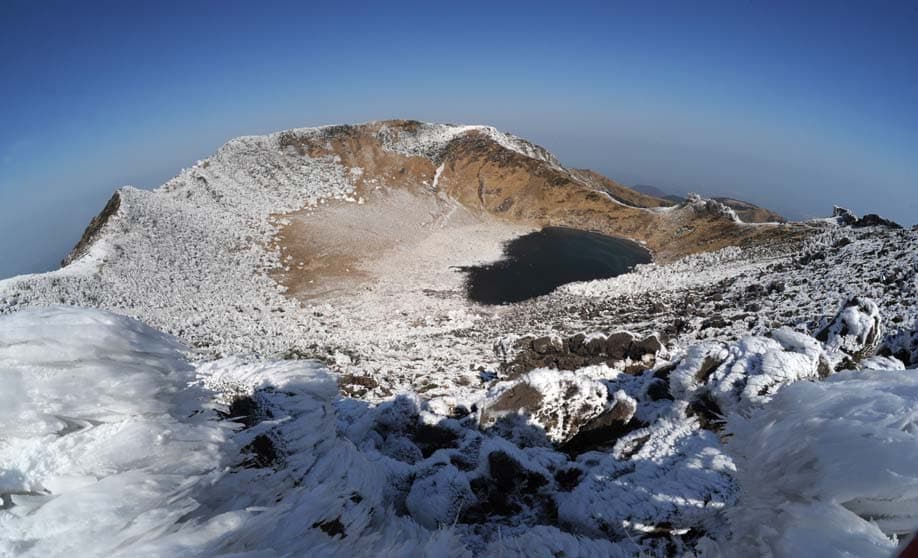
Korea’s highest mountain, 1,947 metres, a shield volcano whose summit crater holds the Baengnokdam lake, and a national park with five trails. Only two reach the top: Seongpanak, 9.6 km and about four and a half hours up, and Gwaneumsa, 8.7 km and about five hours. Since April 2025 a booking is required only for the final stretch of each, from Jindallaebat and from Sambakbong to the summit, with 1,000 places a day on Seongpanak and 500 on Gwaneumsa, split since December 2025 into two entry bands, 05:00 to 08:00 and 08:01 to 11:30. Book at visithalla.jeju.go.kr from 09:00 on the first working day of the previous month, up to four people, one booking a week, and carry the QR code; a no-show without cancelling bans you for three months. Entry is free; parking is 1,000 won for the first hour. Yeongsil, 5.8 km, and Eorimok, 6.8 km, climb past Witse oreum without a booking. The summit must be left by 13:30 from October to March and 14:30 from April to September, and the trails close in weather warnings, 30 cm of snow in a day or winds of 14 metres a second. The Gwaneumsa summit section reopened on 24 September 2026 after rockfall works.
Hallasan trail reservation ↗Hallasan National Park trails ↗View on map ↗
 Gary Cycles · CC BY 2.0 via Wikimedia Commons
Manjanggul lava tube
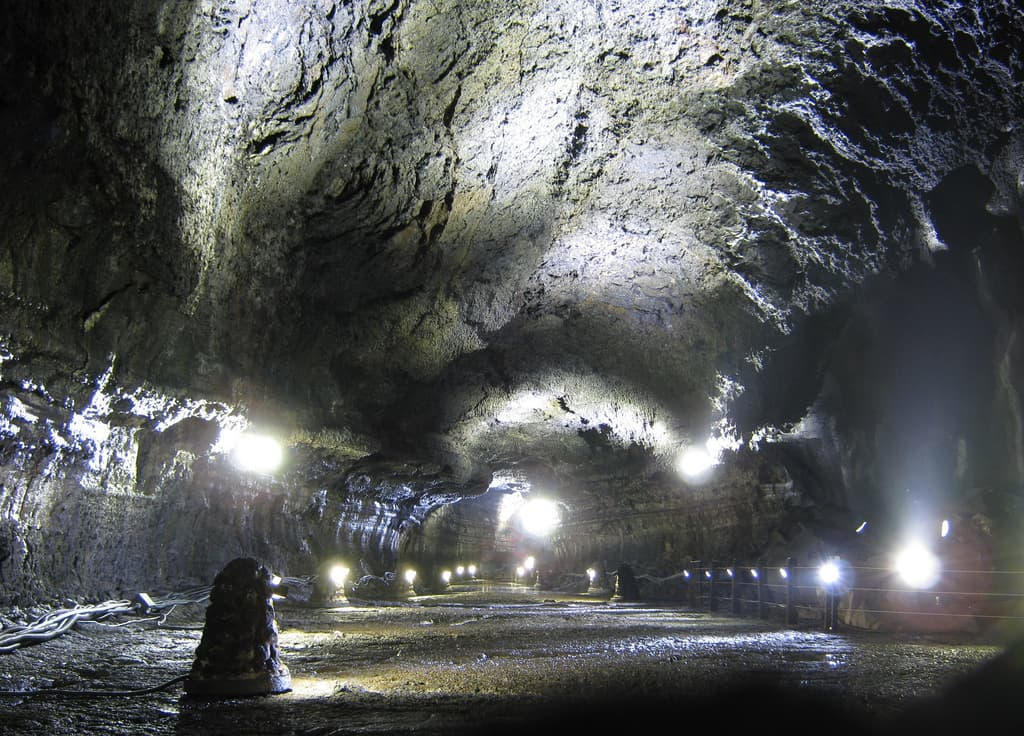
The showpiece of the Geomunoreum lava tube system and the reason UNESCO called it the finest in the world: a tube about 7.4 km long, up to 23 metres wide and 30 high, with a 7.6-metre lava column at the end of the public kilometre, the tallest known. A rock of 70 cm fell near the entrance on 29 December 2023 and the cave closed for two and a half years; it reopened on 30 May 2026 with new decking and low lighting after works the province costed at about 12.1 billion won. Open 09:00 to 18:00, tickets and entry until 17:00, closed the first Wednesday of the month; adults 4,000 won, youth and children 2,000, with a free 135-space car park. Take a layer: it is cool inside all year.
 Liszt uhm · CC BY-SA 3.0 via Wikimedia Commons
Geomunoreum
The cone that made the lava tubes, walked only with a guide: 50 people a group, 11 groups a day, departures every half hour from 09:00 to 14:00, 2,000 won for adults and 1,000 for youth, closed on Tuesdays and on the Seollal and Chuseok holidays. Book online or by phone by 17:00 the day before. The trail is a quiet forest walk over the oreum’s rim with the tube system beneath your feet.
 Abasaa · Public domain via Wikimedia Commons
Udo
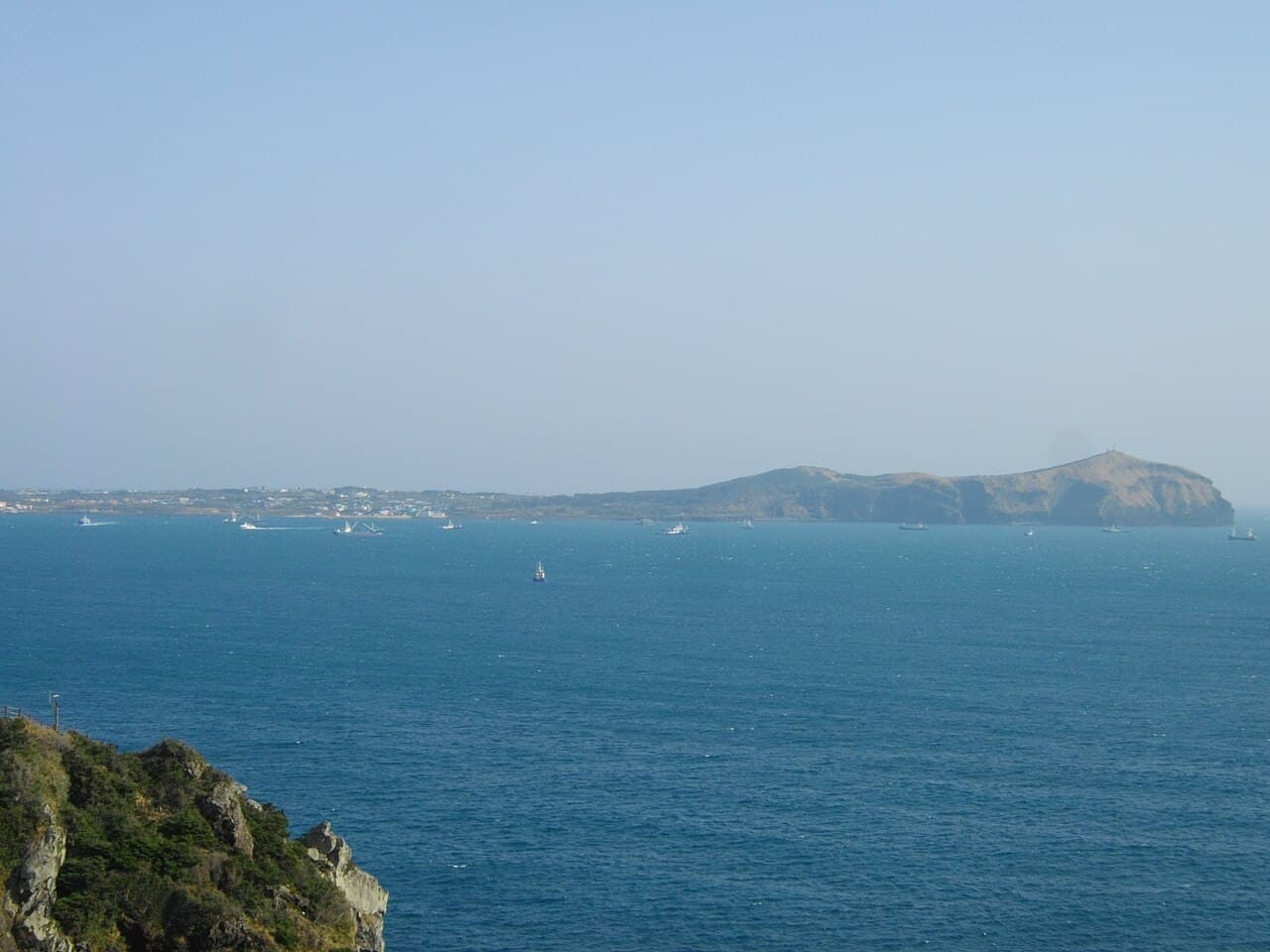
The island off Seongsan, reached by ferry from Seongsan port, 10 to 15 minutes, every 10 to 30 minutes from 07:30 to 18:30 in the 2025 timetable, about 10,500 won return for adults in 2025 plus the 1,000-won marine park fee, or six sailings a day from Jongdal port. Visitors’ cars are banned from 1 August 2026 to 31 July 2029, with exceptions for electric and hydrogen rentals, small charter buses and guests sleeping on the island, so hire a bicycle or an electric scooter at the port, or ride the loop bus. Seobin Baeksa is the white-sand beach on the west shore, Geommeolle the black-sand cove under the Udobong cliffs, and the peanut ice cream at Jimmy’s by Geommeolle is the island’s food. About 1.2 million people came in 2024.
 Republic of Korea from Seoul, Republic of Korea · CC BY-SA 2.0 via Wikimedia Commons
The haenyeo and the Haenyeo Museum
The women divers of Jeju, listed by UNESCO in 2016, dive to about ten metres without tanks for abalone, sea urchin and conch, a minute at a time, up to seven hours a day and ninety days a year, and whistle the sumbisori when they surface. The province counted 2,371 active divers at the end of 2025, down from 2,623 a year earlier, with 1,075 in their seventies and 427 aged eighty or more. See them at work from the east-coast shore in the morning, at the Seongsan demonstration in the afternoon, and at the Haenyeo Museum in Hado, open 09:00 to 18:00, tickets until 17:00, closed Mondays, 1 January, Seollal and Chuseok, 1,100 won for adults from outside Jeju and free for children of twelve and under. Eat what they catch in the haenyeo houses they run, at Ojo-ri and Jongdal-ri.
 song songroov · CC BY 3.0 via Wikimedia Commons
Seopjikoji
The low headland south of Seongsan with the sunrise peak across the water, a lighthouse on its rock, canola fields in April and Tadao Ando’s Glass House at its tip, inside the Phoenix Island resort but open to walkers. Our model has the sun rising out of open sea from the lighthouse hill on every day of the year, on the almanac time to the minute, which makes it the easiest sunrise on the island and the best place to photograph Ilchulbong in the first light.
 Photo and Share CC · CC BY 2.0 via Wikimedia Commons
Jeongbang falls
The waterfall that drops 23 metres straight into the sea at the edge of Seogwipo. Open 09:00 to 17:50, last entry 17:30, adults 2,000 won and youth 1,000. The best light is the morning, when the sun is over the water behind you; by our model the sun rises out of open sea from this shore only in midwinter, from early November to early February, and behind the headland to the east otherwise.
 Sgroey · CC BY-SA 4.0 via Wikimedia Commons
Cheonjiyeon falls
Seogwipo’s other waterfall, in a wooded gorge a short walk from the harbour, lit at night and open 09:00 to 22:00, last entry 21:20, which makes it the evening walk after dinner at the Olle market. The admission fee is not printed on the tourism office’s page; expect a small charge at the gate.
 Bernard Gagnon · CC0 via Wikimedia Commons
Jusangjeolli cliff
Hexagonal basalt columns stacked along the Jungmun shore like organ pipes, seen from a deck above the waves. Open 09:00 to 17:50, adults 2,000 won and youth 1,000; a ten-to-thirty-minute walk from the Jungmun hotels. Big swells in a southerly wind make it.
 Bernard Gagnon · CC0 via Wikimedia Commons
Yongmeori coast and Sanbangsan
The dragon’s-head shore under the dome of Sanbangsan: layered tuff cliffs eaten into shelves and caves by the sea, walked on a path along the water that closes whenever the tide is high or the swell is up. Open 09:00 to 17:00, adults 2,000 won, and the same-day status is posted on the site’s Instagram account or by phone before you drive out.
 Unknown · CC BY-SA 3.0 via Wikimedia Commons
The Jeju Olle trail
The walking route round the whole island, 27 courses and 437 km, founded in 2007 by the journalist Suh Myung-sook after the Camino and marked by blue and orange ribbons and the ganse, a small blue pony. Route 1 runs 15.1 km from Siheung to Gwangchigi beach past Seongsan Ilchulbong, four to five hours; route 7, 12.9 km from the Olle Travel Centre in Seogwipo past Oedolgae, is the classic coast walk; route 10, 15.6 km from Hwasun to Moseulpo over Songaksan, is the sunset one. Stamp a passport at the start, middle and end of each course; a detour on route 2 was posted on 29 September 2026.
 Integral · CC BY-SA 2.0 kr via Wikimedia Commons
Sangumburi and the oreum
Of the 360-odd parasitic cones, three are the ones to climb. Sangumburi is a flat-floored explosion crater, a maar, ringed by silver grass in autumn: open 09:00 to 18:40 from March to June and in September and October, 09:00 to 17:40 otherwise, 7,000 won for adults and 6,000 for youth, the dearest of the public sites. Saebyeol oreum, 519 metres, is the fire-festival hill in the west, free, and the best sunset summit by our model, with open sea under the sun every day and the sunset two minutes after the almanac because of the height. Yongnuni oreum in the east, 247 metres, free, has an open-sea sunrise all year, a minute early.
 Little forest 작은 숲 · Pexels
Bijarim forest
A forest of some 2,800 nutmeg-yew trees, many of them centuries old, on a flat volcanic-cinder path that takes an hour at a stroll; the cool walk on a hot day and the green one in rain. Open 09:00 to 18:00, last entry 17:00, adults 3,000 won and youth 1,500. Ten minutes from Manjanggul.
 Matt Kieffer · CC BY-SA 2.0 via Wikimedia Commons
O’sulloc Tea Museum and the tea fields
The green tea plantation of the Amorepacific cosmetics group in the south-west, with a museum, a tea house and the Innisfree house next door, open 09:00 to 18:00 and until 19:00 in summer. The tea fields are the photograph; the green-tea ice cream is why most people stop. Admission is not printed on the tourism office page, and the grounds have been free to walk.
 골뱅이 · CC BY-SA 3.0 via Wikimedia Commons
Camellia Hill
A private garden of camellias in the south-west that blooms from December into March and fills early summer with hydrangeas; the winter reason to come. Open 08:30 to 18:30 from March to October and 08:30 to 18:00 from November to February, 12,000 won for adults.
 Ayn tran · CC BY-SA 4.0 via Wikimedia Commons
Jeju 4.3 Peace Park
The memorial to the uprising and massacre that began on 3 April 1948 and ran into 1949, in which the national commission confirmed 14,373 civilian deaths, 86 percent of them at the hands of the security forces, with total estimates from 14,000 to 30,000 on an island of about 300,000; President Roh Moo-hyun apologised for the state in 2003. The park and the memorial hall in Bonggae-dong are free, open 09:00 to 18:00 with last entry at 17:00, closed on the first and third Mondays. The island’s history is unreadable without it, and the ceremony on 3 April is the island’s day of mourning.
 thddbwnd · CC BY 3.0 via Wikimedia Commons
Dongmun market and the night market
The city’s main market by the old harbour, 1945 vintage, open daily from about 07:00 to 21:00 for tangerines, dried fish, hairtail and black pork, with the night market of food stalls by gate 8 from 18:00 in winter and 19:00 in summer until midnight: flame-seared abalone sushi, black-pork skewers, grilled lobster and tangerine juice. It is the place for the first evening, within a short taxi ride of every city hotel.
 Yoo Chung / CC BY-SA 3.0 via Wikimedia Commons
 Korea Heritage Service / Public domain via Wikimedia Commons
Food & drink
 makafood · Pexels
Jeju black pork (heuk-dwaeji)
The island’s breed, with the skin left on and grilled over charcoal or yeontan briquettes, dipped in melchijeot, the salted-anchovy sauce that is Jeju’s alone. Sold by the geun, 400 or 600 grams, at Donsadon, or by the 200-gram portion for about 20,000 won at the certified cheaper places the city lists.
 신동혁 · CC0 via Wikimedia Commons
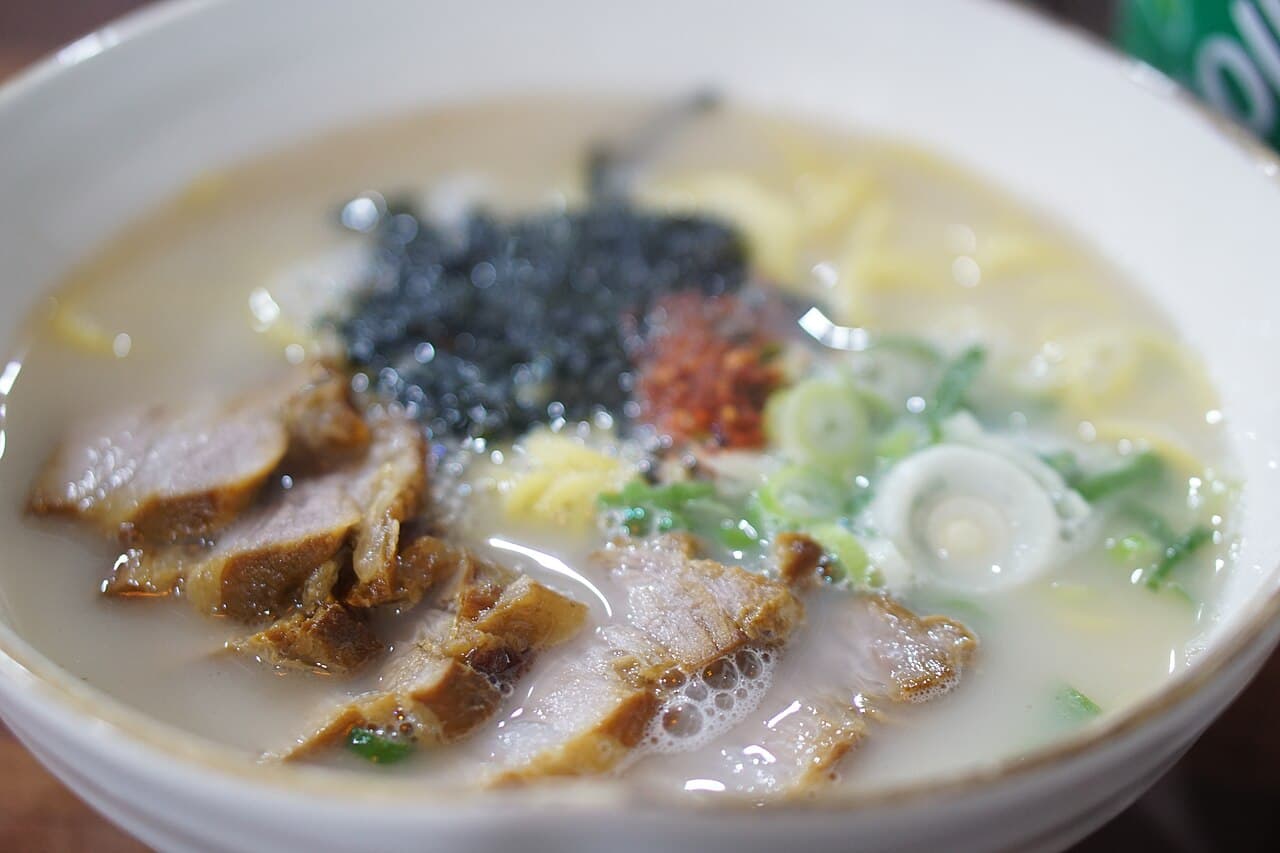
Gogi-guksu
Thick wheat noodles in a milky pork-bone broth with slices of boiled pork, the island’s comfort bowl and its hangover cure, eaten at breakfast as readily as lunch. Olle Guksu in Yeon-dong is the famous one, closed on Sundays; Samdae Guksu stays open until past one in the morning.
 bryan... · CC BY-SA 2.0 via Wikimedia Commons
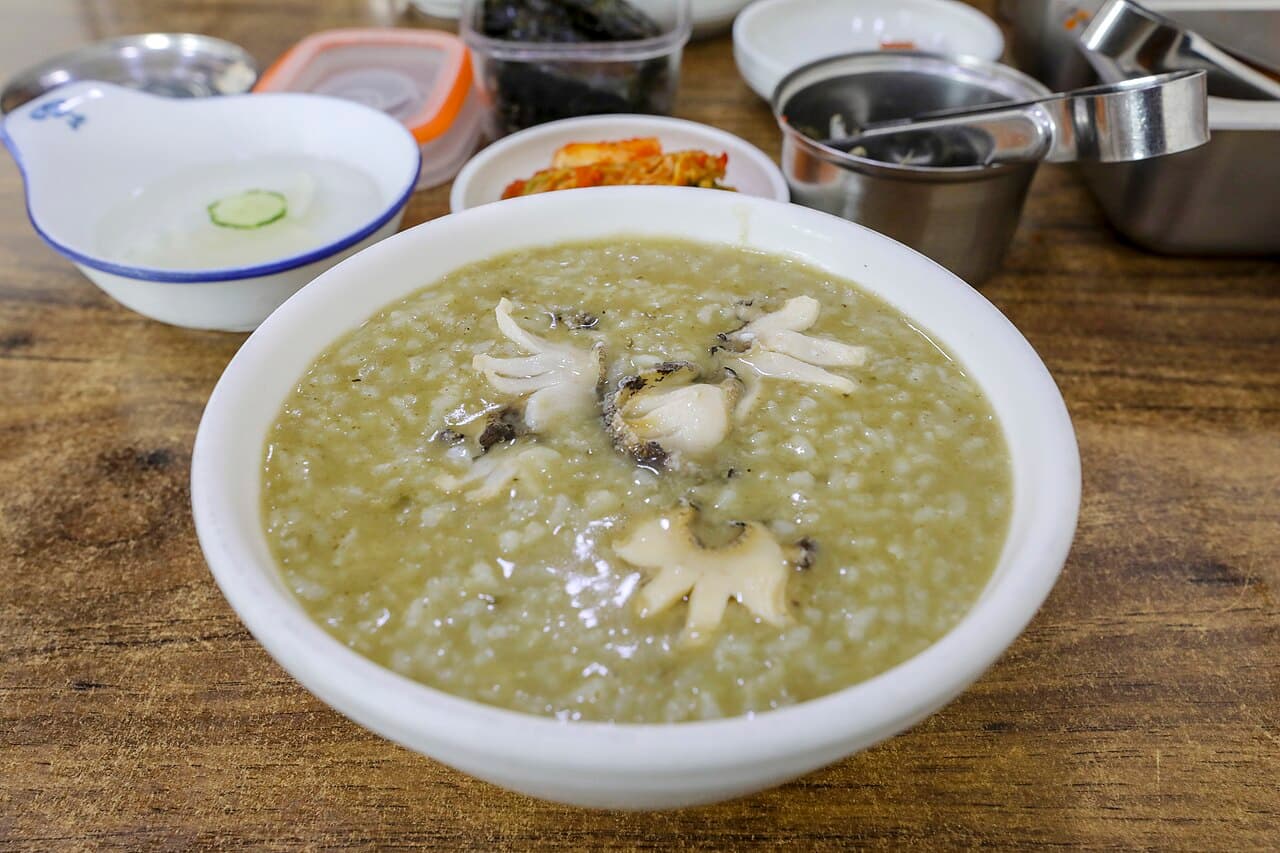
Jeonbok-juk and jeonbok dolsot-bap
Abalone porridge, cooked with the liver so it turns green-grey, which is the point, and abalone stone-pot rice. The haenyeo houses on the east coast serve it from early morning; it is the Seongsan sunrise breakfast.
 lazy fri13th · CC BY 2.0 via Wikimedia Commons
Galchi-jorim and galchi-guk
Hairtail, the silver ribbon fish of the south coast, braised with radish and chilli or, more surprisingly, in a clear soup with pumpkin and cabbage. Seogwipo is its town; Negeori Sikdang by the Olle market has served it for decades.
 makafood · Pexels
Haemul-ttukbaegi and mulhoe
A bubbling stone pot of shellfish, crab, shrimp and abalone in a spicy soybean broth, and in summer mulhoe, raw fish in an icy, vinegared broth, the Jeju version made with jari, a small damselfish, bones and all.
 Masood Aslami · Pexels
Tangerines, hallabong and omegi-tteok
The gamgyul tangerine season runs from November into January and the fat, knobbed hallabong follows in winter; both go into juice, chocolate and ice cream. Omegi-tteok is the millet rice cake rolled in red beans, sold at the markets, and Udo’s peanut goes into ice cream and makgeolli.
Meals are shared from the middle of the table and the grill is tended by staff at the good pork houses; order by weight and let them cut. Water, side dishes and the lettuce are included and refilled. Many restaurants close one weekday and some close for a week around Chuseok and Seollal; the hours on the tourism office’s pages are old, so phone. Pay at the counter, by card almost everywhere; there is no tipping. Dinner is early, 18:00 to 20:00, and last orders at 20:00 are normal outside the city.
Where to eat
Donsadon
institutionThe black-pork house most often named first, grilling skin-on pork over yeontan coals and serving it by the geun, 400 or 600 grams, with the staff doing the cutting. No reservations; open 12:00 to 22:00 and closed on Tuesdays.
Last researched 2026-10-01
Olle Guksu
institutionThe pork-noodle bowl of Jeju City, listed among the Koreat top ten of the island in 2016 and still the bowl to start with. Closed on Sundays.
Last researched 2026-10-01
Ojo Haenyeo-ui Jip
casualThe haenyeo house of Ojo-ri, run by the village divers’ cooperative on the lagoon between Seongsan and the main road: abalone porridge for breakfast, sea urchin and raw abalone later. It opens early, which is why it belongs to the morning you climb Ilchulbong.
Last researched 2026-10-01
Sambo Sikdang
institutionAn old Seogwipo kitchen for the south-coast dishes: abalone ttukbaegi, okdom, the red tilefish, grilled, and jari mulhoe when the damselfish are in. Last orders at 20:00, closed on the second and fourth Wednesdays.
Last researched 2026-10-01
Negeori Sikdang
institutionThe hairtail house at the Seogwipo crossroads: galchi-guk, the clear soup, galchi-jorim, the braise, and the long grilled fish. Open every day, last orders 20:40.
Last researched 2026-10-01
Myeongjin Jeonbok
casualThe abalone restaurant of the north-east coast road, known for the stone-pot rice and the porridge. Closed on Tuesdays, last orders 20:00.
Last researched 2026-10-01
Delmoondo
cafeThe bakery cafe on Hamdeok beach, open from 06:00 to midnight every day, with a pub, Beach Wave, from 18:00 that checks ID. Early coffee here is the consolation for a beach that hides its own sunrise.
Last researched 2026-10-01
Jimmy’s Natural Ice Cream
street-foodThe peanut ice cream of Udo, by the black-sand cove under Udobong, open every day in season. Peanuts are the island’s crop.
Last researched 2026-10-01
Milieu
fine-diningA fine-dining room, French tasting menus built on Jeju seafood and vegetables at the Haevichi resort: eight courses at 250,000 won, five at 160,000, a children’s course at 60,000, dinner only from 18:00 to 22:00, closed on Wednesdays and Thursdays. A 30,000-won deposit a head is kept on a no-show.
Last researched 2026-10-01
Samdae Guksu Hoegwan
budgetThe late-night gogi-guksu house of the city, open until 01:20 and every day of the year, for the bowl after the Dongmun stalls or before a dawn drive east.
Last researched 2026-10-01
Sunrises
 Sukkim1996 · CC BY-SA 4.0 via Wikimedia Commons
Seongsan Ilchulbong
Korea’s best-known sunrise, and one the land never blocks. From the summit deck, 182 metres up, our terrain model has the sun coming out of open sea on every day of 2026, about a minute before the almanac time, on bearings from 61 degrees in June to 118 in December: 05:22 on 21 June, 06:19 on 21 September, 07:31 on 21 December. The gates open at 04:30 from May to August, 05:00 in March, April, September and October, and 06:00 from November to February, so there is always time to climb the 30-to-40-minute stair; arrive at the gate when it opens on a clear morning, and expect company. Closed the first Monday of the month.
All year; the clearest skies are from October to February · A wooden stair with handrails, 5,000 won; the base and the Umutgae shore below are free · From the top the sun comes straight out of the water; for the cone in the frame go to Gwangchigi beach or Seopjikoji instead
 Republic of Korea from Seoul, Republic of Korea · CC BY-SA 2.0 via Wikimedia Commons
Gwangchigi beach
The beach below the peak, where Olle route 1 ends, is the picture. By our model the sun rises out of open sea from the sand from 1 September to 12 April, about on the almanac time, and from 13 April to 31 August it comes up behind Seongsan Ilchulbong itself, 1.6 km away, as much as 24 minutes late in early July: the silhouette with the rim on fire, and the rock pools in the foreground at low tide. Free, with no gate.
Mid-April to August for the sun behind the cone; September to April for a clean sea sunrise · Free beach with parking · Low tide exposes the green algae-covered rocks that the photographs show; check the tide
 Coman Yu · Pexels
Seopjikoji
The headland south of the peak, with a lighthouse on its rock and Tadao Ando’s Glass House at the tip. From the lighthouse hill our model has the sun out of open sea on all 365 days, on the almanac time, with Seongsan Ilchulbong to the left of the frame. It is the easy sunrise, no stairs and no ticket, and in April the canola fields behind you are yellow before the sun is up.
All year; April for the canola · Free; a gentle path from the car park, about 15 minutes to the lighthouse · The cone sits well to the left of the sun all year, so this is a side-lit view of Ilchulbong rather than a sun-behind-the-cone picture
 Sohyeon Bak · CC BY-SA 3.0 via Wikimedia Commons
Udobong, Udo
The cliff-top at the south end of Udo, about 130 metres up, has open sea under the rising sun all year, about a minute before the almanac, with the lighthouse and the whole of Jeju’s east coast behind you. It is only for people sleeping on Udo, because the first ferry from Seongsan leaves at 07:30 and lands after the sun in every month.
All year · A path from the Udobong car park; bicycles stop at the bottom
 tom Lok · Pexels
The sunrises that do not work: Hamdeok, Jongdal-ri and Woljeong-ri
A warning card. Hamdeok, the north coast’s favourite beach, faces north with Seoubong hill at its east end: our model has the sun rising behind the hill on every day of the year, 6 to 36 minutes late, worst in June. Woljeong-ri gets an open-sea sunrise only from 11 May to 2 August, and 3 to 7 minutes late otherwise. From the Jongdal-ri shore, where the haenyeo work, the sun rises behind Udo for most of the year, 2 to 7 minutes late, and clears it only from 14 to 29 December. Drive the extra ten minutes to Seongsan.
Hamdeok never; Woljeong-ri May to early August
Sunsets
 Jjw · CC BY-SA 4.0 via Wikimedia Commons
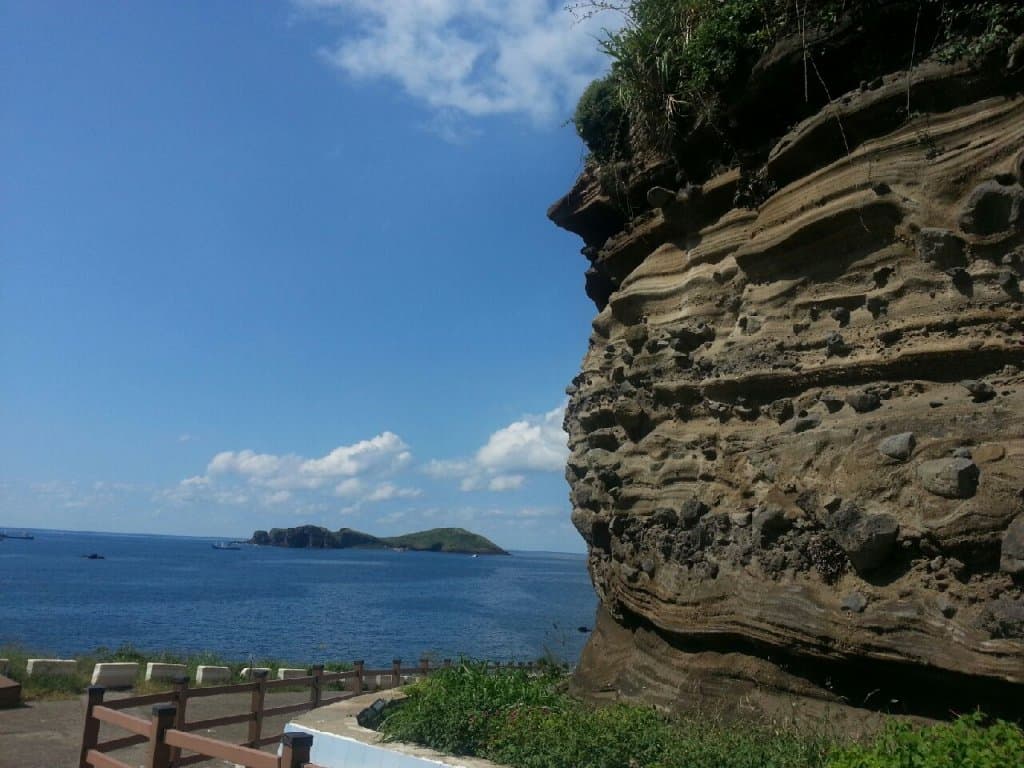
Suwolbong
The low cliff above the Jaguri shore at the far west of the island, about 77 metres up with Chagwido island off the coast, is the sunset we would plan around. Our model has open sea under the sun from the top on every day of 2026, about on the almanac time: 17:56 on 21 January, 18:48 on 21 March, 19:48 on 21 June, 18:34 on 21 September, 17:32 on 21 December. From the Jaguri car park at sea level it is nearly as good, except that from 18 March to 8 May and 4 August to 25 September the sun sets behind Chagwido itself, up to 10 minutes early, which is its own kind of picture.
All year · Free; a short climb from the Jaguri car park, with a geo-trail along the cliff · Chagwido sits under the sun from the shore in spring and late summer
 Veronica · Pexels
The Handam coast, Aewol
The walkway along the Aewol cliffs, and Gwakji beach just south of it, face north-west over open sea. From the Handam path our model has the sun setting into the water on every day of the year, about on the almanac time; from Gwakji beach from 1 February to 9 November, and within about a minute of the almanac even in midwinter. This is the easy sunset: forty minutes from the airport, with the cafes behind you.
All year · Free, flat and paved along the Handam walkway
 Mohit Hambiria · Pexels
Songaksan
The low crater on the south-western corner, walked on Olle route 10, with the Gapado and Marado islands to the south and open sea to the west. From the rim path, about 95 metres up, the sun sets into the sea on every day of 2026, about on the almanac time. Sagye beach below, with the dome of Sanbangsan behind it, loses the sun behind the shore to the west, by our model 13 to 43 minutes early, so climb.
All year · Free; the loop path on the rim is about an hour, with sections closed from time to time for erosion
 Djalma Paiva Armelin · Pexels
Hyeopjae beach
The west coast’s postcard: white sand, turquoise shallows and Biyangdo across the water. By our model the sun sets into open sea from the beach from 16 February to 26 October, about on the almanac time. In winter it drops behind the low shore to the south-west up to 15 minutes early, though that is near-field terrain in the tiles and we hold it at low confidence; the Handam coast is twenty minutes north and sure.
Mid-February to late October · Free beach with parking and the Hallim park beside it
 HiHoHo · CC BY-SA 3.0 via Wikimedia Commons
Saebyeol oreum
The fire-festival hill in the west, 519 metres at the summit, with silver grass in autumn and a steep twenty-minute climb. From the top the sun goes into the sea on every day of the year, and because of the height it does so two minutes after the almanac time, the latest of the sunsets in this guide outside Hallasan. The whole west coast is below you.
All year; October and November for the silver grass · Free; a steep grass path, muddy after rain
 Korea.net / Korean Culture and Information Service · CC BY-SA 2.0 via Wikimedia Commons
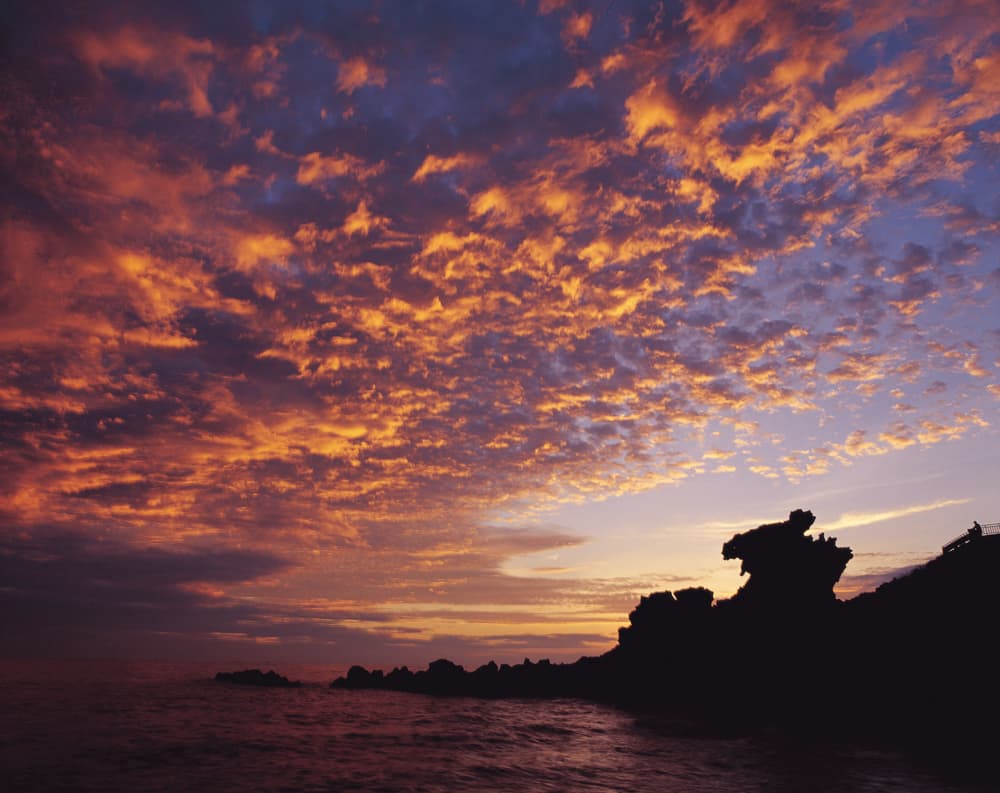
The city sunsets: Yongduam and Iho Tewoo
For a night in Jeju City. From the Yongduam dragon-head rock our model has an open-sea sunset from 25 April to 17 August and the shore taking it up to 11 minutes early in December; from Iho Tewoo beach by the airport, with its horse-shaped lighthouses, from 4 April to 8 September, and up to 6 minutes early in winter. From Udo’s Seobin Baeksa beach, by contrast, the winter sun sets behind Hallasan 40 km away, 7 to 14 minutes early, which is worth a night on the island in itself.
Late April to mid-August · Both free and on the city bus routes
Day trips
 Sohyeon Bak · CC BY-SA 3.0 via Wikimedia Commons
Udo by bicycle
The ferry from Seongsan port, about 10,500 won return for adults in 2025 plus the 1,000-won marine park fee, 10 to 15 minutes, every 10 to 30 minutes from 07:30 to 18:30 in the 2025 timetable, then a hired bicycle or electric scooter for the 17-km loop: Seobin Baeksa beach, the Udobong lighthouse, Geommeolle cove and the peanut ice cream at Jimmy’s. Your rental car stays on Jeju until 2029 unless it is electric or you are sleeping on Udo. Check the time of the last boat back at the port on the way out, or stay for the sunset behind Hallasan.
15 minutes by ferry from Seongsan · A full day
Korea Heritage Service · Public domain via Wikimedia CommonsHallasan to the crater lake
The Seongpanak trail, 9.6 km and about four and a half hours up, with the booked section from Jindallaebat to Baengnokdam, or the steeper and emptier Gwaneumsa trail, 8.7 km and about five hours, reopened to the summit on 24 September 2026. Start at 05:00 when the trail opens, by car to the Seongpanak car park, or on the first bus 281 from Jeju bus terminal at 06:00, which arrives about 06:45, and be off the summit by 13:30 in winter and 14:30 in summer. Without a booking, walk Yeongsil, 5.8 km, past Witse oreum.
45 minutes by bus 281 from Jeju bus terminal to Seongpanak · A full day, 8 to 10 hours on the summit trails
 Lcarrion88 · CC BY-SA 4.0 via Wikimedia Commons
The south-west loop
From Jungmun or Seogwipo: the Jusangjeolli columns at opening, the tea fields and museum at O’sulloc, Camellia Hill in winter, the Yongmeori coast if the tide allows, lunch in Moseulpo harbour, and the climb of Songaksan for the sunset into open sea, with Gapado and Marado off to the south. Olle route 10 does the coast part on foot, 15.6 km from Hwasun to Moseulpo.
20 to 40 minutes between stops by car · A full day
 Olga Lipunova · CC BY-SA 3.0 via Wikimedia Commons
The lava country
Manjanggul in the morning, closed the first Wednesday, then Bijarim forest ten minutes away, Yongnuni oreum for the view east, and the haenyeo museum at Hado, closed Mondays, before the coast road down to Seongsan through Jongdal-ri. With a booking made the day before, swap Bijarim for the guided walk on Geomunoreum, closed Tuesdays.
40 minutes from Jeju City to Manjanggul · A full day
After dark
 Abasaa · Public domain via Wikimedia Commons
Dongmun night market
marketThe food stalls by gate 8 of the Dongmun market in Jeju City, from 18:00 in winter and 19:00 in summer until midnight: abalone sushi seared with a torch, black-pork skewers, grilled lobster tails, tangerine juice and omegi-tteok. Go hungry and early.
Black pork over charcoal
diningDinner at a black-pork house is the island’s evening: skin-on pork cut by the staff, melchijeot anchovy sauce, soju. Donsadon in the city, or any place on the Heuk-dwaeji street near Tapdong.
 Norton Ip from Hong Kong · CC BY-SA 2.0 via Wikimedia Commons
Cheonjiyeon falls by night
walkSeogwipo’s gorge waterfall is lit until 22:00, last entry 21:20, a twenty-minute walk from the Olle market after dinner.
 by karendotcom127 · CC BY 2.0 via Wikimedia Commons
The haenyeo houses at dusk
diningOn the east coast the divers’ cooperatives sell what came in that morning until early evening; a plate of raw abalone and sea urchin at a plastic table on the shore at Ojo-ri or Jongdal-ri as the light goes off Udo.
Daily itinerary
Seven days: the sunrise coast, the mountain and the sunset coast
The plan we recommend: a first night in Jeju City after the connection from Seoul, two nights in the east at Seongsan or Pyoseon, three in the south-west at Jungmun, Seogwipo or Andeok, and the car for all of it. It is written for a Wednesday, Thursday or Friday arrival, which keeps Donsadon and Myeongjin Jeonbok clear of their Tuesday closing days, keeps the first Monday of the month away from Seongsan and the first Wednesday away from Manjanggul, and assumes the Hallasan booking was made on the first working day of the previous month.
- 1
Seoul to Jeju City
relaxedLand at Incheon, take the all-stop AREX train to Gimpo, about 40 minutes, and the next of the shuttle flights to Jeju, which leave every few minutes, about an hour in the air. There is no direct flight from Israel in 2026; El Al plans a Seoul route from March 2027.Gogi-guksu at Olle Guksu in Yeon-dong, ten minutes from the airport, or Samdae Guksu if it is Sunday.Collect the car, or settle into a city hotel and walk the Yongduam shore. Buy a Tmoney card at a convenience store for the buses.Yongduam, if it is between late April and mid-August; otherwise skip it.Black pork at Donsadon, closed Tuesdays, then the Dongmun night market for dessert.Jeju City is the only sensible first night: the airport, the market, the pork street.Estimate: Jeju 4.3 Peace Park on the way out of the city tomorrow
- 2
The lava country to Seongsan
moderateManjanggul at 09:00, before the coaches, then Bijarim forest.Abalone stone-pot rice at Myeongjin Jeonbok on the coast road, closed Tuesdays.The Haenyeo Museum at Hado, closed Mondays, then Yongnuni oreum for the view down the east coast, and Jongdal-ri to watch the divers come in.None worth driving for on this coast; the sun goes behind the island.Raw abalone and sea urchin at a haenyeo house in Ojo-ri, or the Playce Camp bar in Seongsan.All on the coast road east; sleep in Seongsan for tomorrow’s gate.Estimate: Geomunoreum guided walk, booked by 17:00 yesterday, closed Tuesdays
- 3
Seongsan Ilchulbong and Udo
fullAt the Ilchulbong gate when it opens, 04:30 in summer, 05:00 in spring and autumn, 06:00 in winter; the sun rises out of open sea from the top on every day of the year. Breakfast on abalone porridge at Ojo Haenyeo-ui Jip.On Udo, by bicycle.The 17-km loop of Udo: Seobin Baeksa, Udobong, Geommeolle and Jimmy’s peanut ice cream, back on the last boat, whose time you checked at the port.Stay on Udo if you want the winter sun setting behind Hallasan; otherwise ride back.Seongsan or the Haevichi resort at Pyoseon.Leave the car at Seongsan port; it cannot board.Estimate: Seopjikoji instead of the climb for a stair-free sunrise with the cone in the frame
- 4
Hallasan
fullSeongpanak at 05:00 with the booked QR code, 9.6 km to Baengnokdam.Packed, at the crater rim; nothing is sold on the mountain.Off the summit by 13:30 from October to March or 14:30 from April to September, three to four hours down, then the drive round to Seogwipo or Jungmun.Oedolgae on the Seogwipo coast path if it is early January to mid-February or late October to early December; otherwise rest.Hairtail at Negeori Sikdang by the Olle market, open every day until 20:40.From Seongsan to Seongpanak is about 50 minutes; from the trailhead to Seogwipo about 40.Estimate: Yeongsil past Witse oreum, no booking, 5.8 km, if the summit was not available
- 5
Seogwipo and Jungmun
moderateJeongbang falls at 09:00 and the Olle market, then Olle route 7 west along the coast past Oedolgae, as far as you like.Sambo Sikdang in Seogwipo, closed the second and fourth Wednesdays, for abalone ttukbaegi.The Jusangjeolli columns and Cheonjeyeon falls at Jungmun, and the resort pool.Drive west to the Songaksan rim, open sea every day of the year.Moseulpo harbour, or back at the resort.Jungmun to Songaksan is 25 minutes.Estimate: Milieu at Haevichi for the big dinner, booked, not Wednesday or Thursday
- 6
The south-west and the west coast
moderateO’sulloc tea fields at opening, then the Yongmeori coast if the tide is right, or Camellia Hill in winter.In Moseulpo or at the Podo hotel if you are sleeping there.North up the west coast: Hyeopjae and Geumneung for a swim in season, the Hallim park, and the cafes of Aewol.Suwolbong above Chagwido, or the Handam walkway at Aewol: open sea all year from both.Aewol, where the cafes turn into restaurants.Sleep in Aewol or Hallim, forty minutes from the airport, or return to Jungmun.Estimate: Saebyeol oreum for the sunset in silver-grass season, a steep twenty minutes up
- 7
The 4.3 Peace Park and the flight
relaxedThe Jeju 4.3 Peace Park in Bonggae-dong, free, open from 09:00 and closed the first and third Mondays, a twenty-minute detour east of the airport.Gogi-guksu near the airport.Return the car and fly to Gimpo, then AREX to Incheon, allowing three hours between the two airports.Estimate: Sangumburi crater in October for the silver grass, 7,000 won
Four days: the sunrise, the lava tube and one sunset
A long weekend from Seoul: one night in Jeju City and two in the east, with a car. No Hallasan summit, which needs the booking a month ahead and a full day.
- 1
City
relaxedFly in from Gimpo and collect the car.Yongduam and the Tapdong shore, or the 4.3 Peace Park.Iho Tewoo beach by the airport, April to early September.Donsadon, then the Dongmun night market.Estimate: Olle Guksu for lunch on the way from the airport
- 2
East
moderateManjanggul, then Bijarim.Myeongjin Jeonbok.The Haenyeo Museum and Yongnuni oreum; sleep in Seongsan.A haenyeo house in Ojo-ri.Estimate: Hamdeok beach for a swim in summer, not for the light
- 3
Sunrise and Udo
fullSeongsan Ilchulbong at the opening of the gate, then abalone porridge.Udo by bicycle, back on the last boat, whose time you checked at the port.Seongsan.The car waits at Seongsan port.Estimate: Seopjikoji sunrise and canola fields in April
- 4
West and home
moderateDrive the south coast to Jusangjeolli and O’sulloc.Moseulpo.Hyeopjae for a swim, then the airport, forty minutes; or the Handam sunset at Aewol before a late flight.Estimate: Songaksan rim for the sunset if the flight is late enough
Getting around
- There is no direct flight from Israel to Korea in 2026. Korean Air stopped flying Tel Aviv in October 2023 and had not resumed when we checked; the Israel Airports Authority board for 30 September to 4 October 2026 carried no Seoul row. El Al plans Tel Aviv to Seoul three times a week from March 2027, subject to regulatory approval, and the Israeli Foreign Ministry row for Korea already tells travellers to apply for the electronic entry permit from January 2027. For now connect through a European or Gulf hub, or through Bangkok, Hong Kong or Tokyo, into Seoul Incheon.
- Israelis enter Korea without a visa for 90 days. Israel is on the K-ETA list, the online travel authorisation, 10,000 won and up to 72 hours to process, valid three years, but the Korean embassy in Tel Aviv states that Israeli passport holders are temporarily exempt from it in 2026, and the Israeli embassy in Seoul puts the exemption, for tourism, at entries through 31 December 2026; Korea’s Foreign Ministry list of 25 exempt countries of 30 December 2025 does not name Israel, so if you travel without one, carry the embassy notice. Without a K-ETA, file the free e-Arrival Card online within three days before landing, or fill the paper form. Holders of an Israeli travel document rather than a passport need a visa. The K-ETA system is offline for maintenance on 8 and 9 October 2026.
- Jeju is a domestic flight from Seoul, and the world’s busiest route in 2025: 14.4 million seats and about 39,000 a day between Gimpo and Jeju on seven airlines, about an hour in the air. Incheon to Jeju direct exists but only twice a week, on Jeju Air since May 2026, so cross to Gimpo on the all-stop AREX train, about 40 minutes, and allow three hours between arrival and the domestic departure. Jeju also has direct international flights from Shanghai, Taipei, Osaka, Hong Kong, Singapore, Tokyo and Fukuoka.
- From Jeju airport, which sits inside the city: the 600 limousine bus to Jungmun and Seogwipo, 1,300 to 5,500 won by distance, the 800 to the Seogwipo terminal, the city buses to Yeon-dong and the terminal, and taxis at 4,300 won for the first two kilometres. The rental-car lots are off-airport with shuttles.
- The buses were rebuilt in 2017 into a numbered system: 1xx express routes across the island, 2xx trunk routes round it, 3xx and 4xx city routes, 810 and 820 tourist loops through the oreum country, and the 600 and 800 airport limousines. Trunk, branch and loop buses cost 1,150 won by card or 1,200 in cash; express buses 2,000 won by card for the first 20 km rising to 3,000, and 3,000 in cash. Buy a Tmoney card for 3,000 to 5,000 won at any convenience store and tap on and off. Bus 281 from the Jeju bus terminal to the Seongpanak trailhead runs every 10 to 14 minutes from 06:00 to 22:00.
- A car is the way to see Jeju, and it is cheap: small cars from under 20,000 won a day out of season on the comparison sites, far more in July and August. Korea accepts an international driving permit under the 1949 Geneva convention or the 1968 Vienna convention, valid for a year from entry, alongside your Israeli licence. Speed cameras are everywhere and the limits low; rental cars were in 2,414 accidents on the island from 2021 to 2025, 11.4 percent of all Jeju crashes, with 26 deaths, so the police do not joke about it. Navigation is by Naver Map or Kakao Map, since Google Maps still does not route in Korea; the apps work in English.
- Taxis: 4,300 won for the first two kilometres, then 100 won per 126 metres, 20 percent more from 23:00 to 04:00, 1,000 won for a phone booking; the Kakao T app, or its foreigner version k.ride, which takes foreign cards, calls them. A taxi from the airport to Seongsan comes to about 45,000 to 55,000 won on the tariff; to Seogwipo about 40,000.
- Udo: ferries from Seongsan port every 10 to 30 minutes from 07:30 to 18:30 in the 2025 timetable, 10 to 15 minutes, about 10,500 won return for adults in 2025 plus the 1,000-won marine park fee, or six sailings a day from Jongdal. Visitors’ cars are banned on Udo until 31 July 2029, except electric and hydrogen rentals, charter minibuses and cars of guests staying on the island; bicycles, electric scooters and a loop bus are at the port.
Things worth knowing
- · Flying Incheon to Jeju. The direct flight is twice a week; cross to Gimpo, where they leave every few minutes.
- · Arriving on the first Monday of the month for Seongsan or the first Wednesday for Manjanggul. Both are closed.
- · Turning up at the Hallasan summit trails without the booking for the last section, or after the trailhead cutoff, 11:30 from October to March and 12:30 from April to September at Seongpanak and Gwaneumsa, with the booked bands ending at 11:30.
- · Planning a sunrise on Hallasan. Entry opens at 05:00, less than an hour before the sun even in June, the top is four to five hours up, and the summit must be empty by early afternoon.
- · Waiting for the sunrise at Hamdeok. Seoubong takes it 6 to 36 minutes late on every day of the year.
- · Watching the sunset from Jungmun beach or Sagye. Drive to Songaksan, Suwolbong or Aewol.
- · Driving onto the Udo ferry. Visitors’ cars are banned until 2029; electric rentals are the exception.
- · Walking the Yongmeori coast without checking the tide. It closes at high water.
- · Using Google Maps to drive. It does not route in Korea; download Naver Map or Kakao Map before you land.
- · Booking only Jeju City. The island’s two ends are an hour and a half apart, and the light is in the east at dawn and the west at dusk.
Budget
| Low | Expected | Comfortable | |
|---|---|---|---|
| Accommodation style / per night | ₩60,000≈ $45 | ₩180,000≈ $134 | ₩450,000≈ $336 |
| Food style / per day | ₩25,000≈ $19 | ₩55,000≈ $41 | ₩150,000≈ $112 |
| Local transport / per day | ₩3,000≈ $2 | ₩15,000≈ $11 | ₩70,000≈ $52 |
| Estimate / per day | ₩0≈ $0 | ₩8,000≈ $6 | ₩25,000≈ $19 |
Estimate · KRW · 2026-10-01. Quoted in Korean won per person per day, except accommodation, which is per room per night on a double-occupancy basis; our estimates, not published rates. At the ECB reference rate of 30 September 2026, 1,539 won to the euro and about 1,355 to the dollar, 10,000 won is roughly 22 to 23 shekels. The low accommodation band is a guesthouse in Seongsan or Aewol out of season, the expected band a city hotel with a pool or an east-coast resort midweek, the comfortable band a Jungmun resort or the Podo hotel. Food is cheap by Israeli standards: a bowl of gogi-guksu under 10,000 won, black pork about 20,000 won a portion at the certified cheaper houses and double that at Donsadon by weight, Milieu 160,000 to 250,000 won a head. Transport at the low band is the bus with a Tmoney card; the comfortable band is a mid-size rental with insurance and fuel. Attractions are mostly 2,000 to 5,000 won; Sangumburi at 7,000 and Camellia Hill at 12,000 are the dear ones, and a rise at the heritage sites is expected in 2027. · 1 USD = ₩1,341 (14 Oct 2026)
Things worth knowing
Frequently asked questions
Is there a direct flight from Tel Aviv to Seoul?
Not in 2026. Korean Air suspended its Tel Aviv route in October 2023 and had not brought it back when we checked, and the Israel Airports Authority board for the first days of October showed no Seoul flight. El Al plans Tel Aviv to Seoul from March 2027, three times a week, subject to regulatory approval. Until then connect through a European or Gulf hub or through Bangkok, Hong Kong or Tokyo, then take the AREX train to Gimpo for the Jeju shuttle flights.
Do Israelis need a K-ETA for Korea?
Israel is on the K-ETA list, but the Korean embassy in Israel says Israeli tourists are temporarily exempt in 2026, the Israeli embassy in Seoul puts the exemption at 31 December 2026, and the Israeli Foreign Ministry tells travellers to apply from January 2027. Korea’s own list of 25 exempt countries does not name Israel, so carry the embassy notice. The permit costs 10,000 won, takes up to 72 hours and lasts three years. If you travel without one in 2026, fill in the free e-Arrival Card online within three days of landing; if you want certainty, apply anyway.
Where is the best sunrise on Jeju?
Seongsan Ilchulbong, and the geometry agrees: from the summit deck the sun rises out of open sea on every day of the year, about a minute before the almanac time, and the gates open before dawn in every season. For the cone itself in the picture, stand on Gwangchigi beach between mid-April and the end of August, when the sun comes up behind it, or on the Seopjikoji lighthouse hill any day. Hamdeok, the famous beach, is a sunrise trap: its hill takes the sun 6 to 36 minutes late all year.
Where does the sun set into the sea?
The west. By our terrain model Suwolbong above Chagwido, the Songaksan rim, the Handam coast at Aewol and the summit of Saebyeol oreum all have open sea under the setting sun on every day of 2026; Hyeopjae beach from mid-February to late October, Gwakji from February to early November. Jungmun beach, Sagye and Seogwipo harbour lose it behind the headlands for most of the year, and from the east coast it sets behind the island, behind Hallasan itself in winter.
Do I need to book Hallasan?
Only for the last stretch to the summit on the Seongpanak and Gwaneumsa trails, from Jindallaebat and Sambakbong up to Baengnokdam: 1,000 and 500 places a day, booked at visithalla.jeju.go.kr from 09:00 on the first working day of the previous month, in two entry bands, 05:00 to 08:00 and 08:01 to 11:30, with a QR code sent by text. Yeongsil, Eorimok and Donnaeko need nothing. Entry is free; parking is paid.
Is Manjanggul open?
Yes, since 30 May 2026, after a rockfall at the entrance closed it from 29 December 2023. Open 09:00 to 18:00 with tickets until 17:00, closed on the first Wednesday of the month, 4,000 won for adults, with about a kilometre of the tube walkable to the 7.6-metre lava column.
Can I take my rental car to Udo?
No, unless it is electric or hydrogen, or you are staying overnight on Udo. Visitors’ cars are banned from 1 August 2026 to 31 July 2029. Leave the car at Seongsan port, take the ferry, 10,500 won return in 2025, and hire a bicycle or an electric scooter on the island.
Do I need a car on Jeju?
For the island as we describe it, yes: the sunrise and sunset points, the oreum and the trailheads are an hour and a half apart and the buses are slow. Korea accepts an international driving permit under either the Geneva or the Vienna convention with your Israeli licence, small cars start under 20,000 won a day out of season, and the roads are easy but heavily camera-enforced. Use Naver Map or Kakao Map; Google Maps does not give driving directions in Korea. Without a car, base in Jeju City and Seogwipo and use the 600 limousine and the 281 to Hallasan.
Is there kosher food on Jeju?
No. There is no synagogue, Chabad house or kosher restaurant on Jeju. Chabad of Korea in Seoul, now at 29 Jangmun-ro in Yongsan, runs the only kosher restaurant in Seoul and sells packaged kosher food online; order before you fly south, and rely on fruit, rice and the tangerines on the island.
When is the best time to visit Jeju?
October, then April to early June. October is the driest month of the walking season, 95 mm against 228 in September, with only December and January drier, silver grass on the oreum, a sea still at 22C and the Tamna Cultural Festival; spring has the cherry blossom in late March and the canola fields in April. Avoid late July to mid-August, when the Korean holidays and the monsoon coincide, and the Seollal and Chuseok weeks.
Is Jeju safe for Israelis?
Israel’s National Security Council lists South Korea with no travel warning, and we found no reported incident against Israeli tourists in Korea in 2024 to 2026. The usual advice applies: stay away from demonstrations, which on Jeju are rare, and keep conversations about military service to yourself, as the NSC suggests. The practical risks are the roads, the rip currents and the mountain weather.
Sources (68)
- Seongsan Ilchulbong admission: adults KRW 5,000 (groups 4,000), youth and children KRW 2,500; parking free; closed the first Monday of each month · government · 2026-10-01
- Seongsan Ilchulbong hours: November to February 06:00 to 18:00, March to April and September to October 05:00 to 19:00, May to August 04:30 to 20:00, ticket sales ending an hour before closing; closed the first Monday of the month; address 284-12 Ilchul-ro, telephone 064-783-0959; summit climb 30 to 40 minutes · tourism-board · 2026-10-01
- Manjanggul reopened on 30 May 2026 after closing on 29 December 2023; ticketing 09:00 to 17:00, open until 18:00 · government · 2026-10-01
- Manjanggul: open 09:00 to 18:00, ticketing and entry until 17:00, closed the first Wednesday of each month; address 182 Manjanggul-gil, Gujwa; telephone 064-710-7903 · tourism-board · 2026-10-01
- A 70 cm rock fell from 5 m above the Manjanggul entrance on 29 December 2023, damaging stair railings; the cave reopened on 30 May 2026 after about 30 months with new decking and lighting along the 1 km public section; it typically draws about 500,000 visitors a year · reputable-local · 2026-10-01
- Seongsan Ilchulbong and Manjanggul admission rose on 1 July 2019 for the first time since 2006: Seongsan adults KRW 2,000 to 5,000, youth, soldiers and children KRW 1,000 to 2,500; Manjanggul adults KRW 2,000 to 4,000, youth, soldiers and children KRW 1,000 to 2,000 · reputable-local · 2026-10-01
- Hallasan trail reservation: only the Seongpanak and Gwaneumsa trails require a booking, for the Jindallaebat to summit and Sambakbong to summit sections; booking opens 09:00 on the first working day of the previous month, up to 4 people, one booking a week, QR code by SMS; no-show penalties of 3 months then 1 year · national-park · 2026-10-01
- From 1 December 2025 the Hallasan reservation entry bands are 05:00 to 08:00 (Seongpanak 800, Gwaneumsa 400) and 08:01 to 11:30 (Seongpanak 200, Gwaneumsa 100); notice dated 24 October 2025 · national-park · 2026-10-01
- From 22 April 2025 the Hallasan reservation system applies only to the Jindallaebat to Baengnokdam (Seongpanak) and Sambakbong to Baengnokdam (Gwaneumsa) sections; the lower 7.3 km and 6 km can be walked without a booking; daily limits 1,000 and 500 · reputable-local · 2026-10-01
- Hallasan seasonal control times from 1 October 2026: entry from 05:00; Seongpanak and Gwaneumsa cutoff 11:30 in winter and 12:30 in summer; leave the summit by 13:30 in winter and 14:30 in summer; closures in weather warnings, 30 cm of snow in a day or winds of 14 m/s · national-park · 2026-10-01
- The Hallasan Museum is closed until 30 November 2026; notice dated 22 September 2026 · national-park · 2026-10-01
- Geomunoreum trail: reservation by phone or online by 17:00 the day before; departures every 30 minutes 09:00 to 14:00, 11 groups of 50; closed Tuesdays, Seollal and Chuseok; adults KRW 2,000, youth KRW 1,000 · government · 2026-10-01
- Jeju Volcanic Island and Lava Tubes: three component sites, Geomunoreum lava tube system, Mount Halla and Seongsan Ilchulbong, 18,846 ha, criteria vii and viii · unesco · 2026-10-01
- UNESCO inscribed the Culture of Jeju Haenyeo, women divers, on the Representative List of the Intangible Cultural Heritage of Humanity in 2016: diving to 10 m without oxygen masks, up to 7 hours a day and 90 days a year, about a minute per dive, with the sumbisori on surfacing · unesco · 2026-10-01
- Jeju haenyeo statistics at the end of 2025: 2,371 active divers (2,623 in 2024), 7,482 including retired; 427 active divers aged 80 or more and 1,075 aged 70 to 79 · government · 2026-10-01
- Haenyeo Museum, Hado: open 09:00 to 18:00, tickets until 17:00; closed Mondays, 1 January, Seollal and Chuseok; adults from outside Jeju KRW 1,100, 12 and under free · government · 2026-10-01
- Udo: ferries from Seongsan and Jongdal, 10 to 15 minutes; marine park fee adults KRW 1,000; about 1.218 million visitors in 2024; outside vehicles restricted 1 August 2026 to 31 July 2029 with exceptions for 16-seat charter buses, electric or hydrogen rentals, mobility-needs rentals and rentals for guests staying on Udo · tourism-board · 2026-10-01
- Jeju recorded 13,861,748 visitors in 2025; Chinese visitors were 70.2 percent of foreigners at 1,588,107, followed by Taiwan at 10.4 percent · reputable-local · 2026-10-01
- Jeju 2025 provisional visitor totals: 13.85 million (+0.6 percent), 11.60 million domestic (-2.2 percent) and 2.244 million foreign (+17.7 percent, the highest in nine years) · reputable-local · 2026-10-01
- On 4 September 2026 Governor Wi Seong-gon said the tourist environment conservation levy was hard to win consent for and proposed higher admission fees at public sites such as Seongsan Ilchulbong, with part of the revenue for an environment fund · reputable-local · 2026-10-01
- Jeju Province said in July 2026 it would abandon the environmental conservation fee, first discussed in 2012, and review raising entrance fees at tourist facilities, with no sites or amounts named · reputable-local · 2026-10-01
- Jeju City climate normals 1991 to 2020: mean daily maximum 8.6C in January and 30.1C in August; precipitation 67.5 mm in January, 171.2 in June, 210.2 in July, 272.3 in August, 227.8 in September, 95.1 in October and 55.6 in December; 1,502 mm a year; sea temperature about 26.1C in August and 21.8C in October; station at Ildo 1-dong · independent-travel · 2026-10-01
- Seogwipo climate normals 1991 to 2020: mean daily maximum 10.8C in January and 30.1C in August; precipitation 315.7 mm in August and 1,989.6 mm a year; 2,074.6 sunshine hours a year; population 180,909 in 2024 · independent-travel · 2026-10-01
- Jeju’s jangma normally begins on 19 June; in 2026 it began on 30 June, the third latest on record · reputable-local · 2026-10-01
- Jeju’s 12 designated beaches opened from 24 June to 6 September 2026, 75 days, with 276 lifeguards · reputable-local · 2026-10-01
- Jeju’s beaches drew 1.606 million visitors in summer 2026, up 11 percent, with Hamdeok about 700,000 · reputable-local · 2026-10-01
- The 2026 Jeju Fire Festival was held on 13 and 14 March at Saebyeol oreum with a digital burning of the oreum (LEDs, media art and fireworks) instead of a real grass fire · reputable-local · 2026-10-01
- The 19th Jeonnong-ro Cherry Blossom Festival ran from 27 to 29 March 2026 · tourism-board · 2026-10-01
- The 65th Tamna Cultural Festival runs 17 to 21 October 2026 alongside the National Sports Festival · reputable-local · 2026-10-01
- The Seongsan Sunrise Festival runs 31 December to 1 January; the 33rd edition offered 500 dawn-climb places · event-organizer · 2026-10-01
- The Jeju Olle trail has 27 routes totalling 437 km; route 1 Siheung to Gwangchigi 15.1 km; route 7 Olle Travel Centre to Seogwipo Bus Terminal 12.9 km; route 10 Hwasun to Moseulpo 15.6 km; a route 2 detour was posted 29 September 2026 · official · 2026-10-01
- The Jeju Olle Trail was established in 2007 by Suh Myung-sook; ganse pony markers and blue and orange ribbons mark the way; a passport is stamped at the start, middle and end of each route · independent-travel · 2026-10-01
- The Jeju uprising ran from 3 April 1948 to 13 May 1949; the National Committee confirmed 14,373 civilian deaths, 86 percent at the hands of the security forces; total estimates 14,000 to 30,000; President Roh Moo-hyun apologised in 2003 · independent-travel · 2026-10-01
- The Jeju 4.3 Peace Park and Memorial Hall, 430 Myeongnim-ro, Jeju City, are open 09:00 to 18:00 with last admission at 17:00, closed the first and third Mondays of each month · museum · 2026-10-01
- Jeju bus fares: trunk, branch and tourist-loop buses KRW 1,150 by card and 1,200 cash; express KRW 2,000 by card for the first 20 km up to KRW 3,000; airport limousine 600 KRW 1,300 to 5,500 · government · 2026-10-01
- Jeju taxi fares since 1 July 2024: KRW 4,300 for the first 2 km, then KRW 100 per 126 m; 20 percent surcharge 23:00 to 04:00 · government · 2026-10-01
- Jeju to Seoul Gimpo was the world’s busiest airline route in 2025 with 14.4 million seats, about 39,000 a day, on 7 airlines; press release 22 December 2025 · independent-travel · 2026-10-01
- Jeju Air restarted Incheon to Jeju on 12 May 2026 after ten years at two round trips a week · reputable-local · 2026-10-01
- Rental cars were involved in 2,414 accidents on Jeju in 2021 to 2025 with 26 deaths and 4,032 injured, 11.4 percent of all Jeju crashes · reputable-local · 2026-10-01
- The Israel Airports Authority flight board rows from 30 September to 4 October 2026 (2,747 rows, last modified 1 October 2026) contain no Seoul or ICN flight; queries for ICN, SEOUL, KE and OZ return 0 rows · government · 2026-10-01
- Israel’s ambassador said in February 2025 that talks with Korean Air on resuming direct flights, suspended in October 2023, were ongoing with no date confirmed · reputable-local · 2026-10-01
- El Al plans flights to Seoul from March 2027, three a week, subject to regulatory approvals · reputable-local · 2026-10-01
- The Israeli National Security Council dataset lists South Korea (קוריאה הדרומית) with “אין אזהרות”, no warnings; the Foreign Ministry row says to apply in full for the online entry permit from January 2027 before arrival on the official site; North Korea is level 4; dataset last modified 14 September 2026 · government · 2026-10-01
- The Korean embassy in Israel states that in 2026 Israeli passport holders are temporarily exempt from the K-ETA; Israeli travel document (teudat maavar) holders need a visa; K-ETA holders are exempt from the arrival card; travellers using a direct flight to Jeju Island are not required to apply for K-ETA; the fee is KRW 10,000; notice updated 25 December 2025 · government · 2026-10-01
- The Embassy of Israel in Seoul states that Israeli citizens entering Korea for tourism are exempt from submitting a K-ETA until 31 December 2026; last updated 2 January 2026 · government · 2026-10-01
- The K-ETA eligible-country list includes Israel with a permitted stay of 90 days; the fee is KRW 10,000, assessment typically takes 72 hours or less and approval is valid for three years · government · 2026-10-01
- Korea’s Foreign Ministry list of countries under the temporary K-ETA exemption from 1 April 2023 to 31 December 2026 names 25 countries and regions and does not include Israel; notice dated 30 December 2025 · government · 2026-10-01
- The e-Arrival Card is free and can be submitted from three days before arrival in Korea · government · 2026-10-01
- Chabad of Korea is at 29 Jangmun-ro, Yongsan-gu, Seoul, under Rabbi Osher Litzman, and states that the one kosher restaurant in Seoul is at Chabad, with Shabbat and holiday meals, kosher meal delivery and a mikvah · reputable-local · 2026-10-01
- Israel’s Foreign Ministry called a West Bank video with a Holocaust comparison posted by President Lee Jae-myung on 10 April 2026 unacceptable · reputable-local · 2026-10-01
- ECB euro reference rates of 30 September 2026: KRW 1,539.06, USD 1.1355, ILS 3.4901 · government · 2026-10-01
- Bank of Israel representative rates of 30 September 2026: USD 3.063, EUR 3.4752; the Korean won is not listed · government · 2026-10-01
- Tmoney cards cost KRW 3,000 to 5,000 at GS25, CU and 7-Eleven nationwide; WOWPASS is a prepaid card for foreigners · tourism-board · 2026-10-01
- Seoul’s 2026 navigation guide says Google Maps does not work properly in Korea and recommends Naver Map or KakaoMap, with Kakao T for taxis · tourism-board · 2026-10-01
- Korean public holidays: Seollal 17 February 2026 and 7 February 2027; Buddha’s Birthday 24 May 2026 and 13 May 2027; Chuseok 25 September 2026 and 15 September 2027; Children’s Day 5 May; National Foundation Day 3 October; Hangul Day 9 October · independent-travel · 2026-10-01
- Jeju Air Flight 2216 crashed at Muan International Airport on 29 December 2024 with 179 dead; a preliminary report was issued 27 January 2025 and no final report had been published · independent-travel · 2026-10-01
- Seongsan Ilchulbong is 182 m high, formed about 6,700 years ago by Surtseyan eruption on a shallow seabed, with a crater 600 m across; it opens from one hour before sunrise · independent-travel · 2026-10-01
- Hallasan is 1,947 m, with five trails of which only Gwaneumsa and Seongpanak reach the summit; Baengnokdam is the crater lake · independent-travel · 2026-10-01
- Manjanggul reopened on 30 May 2026 after two years and five months; the Jeju World Heritage Office completed improvements of about 12.1 billion won (121억) in March 2026; a free car park of 135 spaces; admission is charged by adult, youth/military and child categories · reputable-local · 2026-10-01
- Udo covers 6.18 square kilometres with a population of about 1,862; its beaches include Seobin Baeksa and Geommeolle; restrictions on visitor vehicle rentals date from about 2017 · independent-travel · 2026-10-01
- Anti-Israel activists harassed Israel’s ambassador Rafi Harpaz at a Seoul restaurant in April 2025 · reputable-local · 2026-10-01
- The K-ETA portal notice board lists a system shutdown on 8 and 9 October 2026 and, on 20 March 2026, an extension of the temporary K-ETA exemption period · government · 2026-10-01
- The Jeju Olle Foundation’s banner for the 16th Jeju Olle Walking Festival gives 5 to 7 November 2026 on routes 19 and 20 · event-organizer · 2026-10-01
- The NSC page for South Korea says no travel warning applies in terms of terrorism, that the Foreign Ministry advises avoiding certain areas at times of political tension, and lists the standard precautions including avoiding demonstrations and not discussing service in Israel’s security forces; hotline 02-6667444 · government · 2026-10-01
- Jeju International Airport handled 29.1 million passengers in 2023, is one end of the world’s busiest route to Seoul Gimpo, and has international services to Shanghai, Taipei, Osaka, Hong Kong, Singapore, Tokyo and other East and South-East Asian cities · independent-travel · 2026-10-01
- Visit Jeju’s list of certified good-value black pork restaurants in Jeju City gives about KRW 20,000 per 200 g portion, or KRW 6,800 per 100 g plus a KRW 4,000 table charge · tourism-board · 2026-10-01
- AWS Terrain Tiles (terrarium format, zoom 11 and 12, SRTM-derived elevation) support the horizon profiles cast every 0.25 degrees from every Jeju viewpoint in this guide out to 165 km · independent-travel · 2026-10-01
- Solar positions and almanac sunrise and sunset times follow the NOAA solar calculator equations, giving sunrise 06:28 and sunset 18:19 in Jeju City on 1 October 2026 (KST) · government · 2026-10-01