Japan · Okinawa Prefecture
Okinawa
Naha for Kokusai-dori, the rebuilt Makishi market, Tsuboya pottery street and Shuri Castle on its hill. The south for Sefa Utaki, the Chinen sunrise over Kudaka Island and the Peace Memorial Park. Chatan for American Village and an easy sunset. The Onna coast for the resort hotels and Cape Manzamo. The Motobu peninsula for Churaumi Aquarium, Bise village, Nakijin Castle and the bridge to Kouri Island. Yanbaru in the north for forest and Cape Hedo. The Kerama Islands for the water.
 CEphoto, Uwe Aranas / CC BY-SA 3.0 via Wikimedia Commons
Overview
Okinawa is Japan with a different history, a different kitchen and a different sea. For four and a half centuries it was the Ryukyu Kingdom, trading between China, Japan and Southeast Asia from a castle on a hill above Naha; it was the scene of the last great land battle of the Pacific war; it was run by the United States until 1972 and still carries the largest share of American bases in Japan. All of that is visible from a rental car in a single day. Around it is a coral sea with reefs a short swim from the sand, an island forest in the north that UNESCO added to its natural list in 2021, and a string of small islands to the west, the Keramas, that give some of the clearest water in the country an hour from the capital by boat. It is not a resort island that happens to be in Japan. It is its own place, and a guide should treat it that way.
Pick the month before the hotel. Late October to early December is the window we would book: the typhoon count has fallen to 0.3 in November, the sea is still warm enough to swim, the heat of the summer has broken (Naha averages highs of 28.1C in October and 25.0C in November) and the rainy season is six months away. If you can arrange it, arrive after 23 November and book the Shuri Castle main hall the moment its release opens; for December 2026 that already happened on 1 September and 1 October, and from January 2027 each month goes on sale at 13:00 Japan time on the first day of the month two months before. If summer is the only option, it works, but buy flexible fares, keep a day in hand at the end of the trip, and swim inside the nets. Winter is warm by Japanese standards and grey by Okinawan ones: Naha gets 93 hours of sunshine in January against 227 in July.
Best for
Couples who want sea and culture in one week · Families with a car · Divers and snorkellers · History, including the hard parts · Food that is not mainland Japanese · Winter warmth without a long-haul beach
Daily itinerary
6 to 8 days
Two calendars run the island and neither is in the brochure. The first is the weather: the Japan Meteorological Agency counts an average of 7.7 typhoons a year passing within 300 km of an Okinawa station (a storm that spans two months counts in both), 2.2 of them in August, 1.9 in September and 1.1 in October, and the rainy season runs from about 10 May to 21 June in a normal year (in 2026 it ran from about 4 May to about 29 June). The second is administrative, and this autumn it is unusually busy. The rebuilt main hall of Shuri Castle, burned in 2019, opens to the public on 23 November 2026, and seeing inside it needs a timed ticket booked in advance. Sefa Utaki doubles its fee on 1 October and closes most of its grounds for conservation work from 2 November. The ferry to Tokashiki rises about 30 percent on 1 October. Okinawa Prefecture starts charging an accommodation tax on 1 February 2027. A trip planned from last year's articles will be wrong in several places.
Best time to visit
Okinawa is subtropical. The Japan Meteorological Agency's 1991-2020 normals for Naha give mean daily highs from 19.8C in January to 31.9C in July and lows from 14.9C to 27.0C, with 2,161 mm of rain a year. May and June are the rainy season, normally from about 10 May to 21 June. July to October is typhoon season, with August the peak month for approaches, and September is statistically the wettest month after June at 275 mm. From October to January the wind at Naha blows most often from the north-north-east, which is part of why the winter months are cooler, breezier and duller than the pictures suggest; July is the sunniest month of the year by a wide margin.
- January to February: Highs about 20C, lows about 15C, about 93 hours of sunshine a month. Whale watching off the Keramas, cherry blossom in the north from late January. Not beach weather for most people.
- March to April: Warming, bright, calm, and no typhoons. Good for walking, the gusuku castles and the north. The sea is still cool; the Keramas are clear.
- May to June: The rainy season, normally about 10 May to 21 June, with 245 to 284 mm a month. Golden Week at the start of May is expensive. The end of June is the start of summer proper.
- July to August: Hot, humid, sunny, highs about 32C, and the start of typhoon season: 1.5 approaches in July and 2.2 in August on average. The domestic holiday peak. Swim inside the nets while the box jellyfish advisory runs.
- September to October: Still hot in September and the second-wettest month, with 1.9 typhoon approaches on average; October cools to highs of 28C with 1.1. The Naha Great Tug-of-War is on 10 to 12 October 2026.
- November to December: Our pick. Highs 25C in November and 21.5C in December, typhoons rare, the domestic crowds gone. The rebuilt Shuri Castle main hall opens on 23 November 2026.
Things worth knowing
- Naha Great Tug-of-War, 10 to 12 October 2026, with the tug itself on the Sunday, 11 October: a rice-straw rope around 200 m long hauled by thousands of people on Route 58 in central Naha. Join in; pieces of the rope are taken home for luck.
- Shuri Castle Festival, 1 to 3 November 2026, with the Ryukyu court procession along Kokusai-dori on 2 November.
- Reopening of the Shuri Castle main hall (Seiden), 23 November 2026, after a completion ceremony on 22 November, when the whole park is closed. Timed tickets only for the interior.
- Humpback whale season around the Kerama Islands, with the Zamami association's boat season running from 8 January to 25 March in 2026; expect similar dates in 2027.
- Hikanzakura cherry blossom on Mount Yaedake in Motobu and around Nago from late January into February; the 2027 festival dates had not been announced when we published.
- Okinawa Marathon, 21 February 2027.
- Irei no Hi, 23 June: Okinawa Memorial Day, marking the end of organised fighting in the Battle of Okinawa, observed at the Peace Memorial Park at Mabuni. A prefectural holiday.
Where to stay
 Davina · Pexels
Naha: Kokusai-dori, Makishi and Tsuboya
The capital's centre is a mile of souvenir shops on Kokusai-dori and, on either side of it, the parts worth your time: the covered arcades of Heiwa-dori, the rebuilt Makishi public market where you buy fish downstairs and have it cooked upstairs, and Tsuboya, the pottery quarter with kilns and small shops on a stone-paved street. The monorail runs from the airport through the middle of it and up to Shuri. Two or three nights here cover the city, the castle and the south without a car.
Best for: First nights · Food · No car needed · Evenings out
Kokusai-dori itself is loud and commercial; it closes to traffic on Sundays from 12:00 to 18:00 as a transit mall. Naha has a city beach at Naminoue, but nobody comes to Naha for the sea.
 Alex Dos Santos · Pexels
Shuri
The old royal capital on the hill east of central Naha: the castle, the stone-paved Kinjo-cho lane that ran down from it, the royal mausoleum at Tamaudun and the Zuisen awamori distillery. Quieter, greener and older than the city below, and connected to it by the monorail. Most people visit for half a day; a night here puts you at the castle gate before the tour buses.
Best for: History · Walking · The castle early in the morning
Few hotels and almost nothing open after dinner. The castle area is expected to be very busy after the main hall reopens on 23 November 2026; the park itself recommends public transport.
 Yun Li · Pexels
Chatan and American Village
Twenty-two kilometres north of the airport on the west coast, beside Kadena Air Base and Camp Foster, a waterfront district of shops, restaurants and a big wheel built on reclaimed land, with two man-made beaches, Sunset Beach and Araha Beach. It is where Okinawa and the base community meet, and where many residents go for an evening. Good for a family base with a car, and the easy place for a sunset near Naha.
Best for: Families · Sunsets · Casual food · Evenings
The beaches are artificial and the setting is suburban. Route 58 through Chatan is slow at rush hour.
 William Chen · Pexels
Yomitan
A village of sugarcane, pottery and low cliffs on the west coast, with Cape Zanpa and its lighthouse at the tip, the Yachimun no Sato potters' village inland, the ruins of Zakimi Castle, and two large resorts at Gima. Closer to the airport than the Onna coast and a little less built up.
Best for: Pottery · Quiet · Sunsets from the cliffs · Resorts closer to the airport
Not much to do in the evening outside the hotels. The cliff coast at Zanpa is for looking, not swimming.
 Robert Yang · Pexels
The Onna coast
The resort coast: about 25 km of west-facing shoreline between Yomitan and Nago with the island's densest run of large beach hotels, Cape Manzamo in the middle, and the Blue Cave dive and snorkel site at Cape Maeda. Most of the sunset hotels on the island are here, and the ray cast finds open water at every sunset bearing of the year from Manzamo. An hour from the airport, an hour from the aquarium.
Best for: Beach hotels · Snorkelling · Sunsets · Families
The hotels are the destination: villages are small and independent restaurants spread along the main road. Many hotel beaches are private or managed, and some are man-made.
 663highland · CC BY 2.5 via Wikimedia Commons
Nago and Busena
Nago is the northern city and the gateway to Yanbaru and the Motobu peninsula, with the Orion brewery tour, the Busena marine park and the hotels on the Busena and Kise capes. A good middle base if you want both the north and the resort coast in reach.
Best for: A central base for the north · The brewery · Families
Nago city is functional rather than pretty. From the airport it is about 80 minutes by expressway without traffic.
 Ryutaro Tsukata · Pexels
The Motobu peninsula: Churaumi, Bise, Sesoko and Kouri
The north-west peninsula packs in most of what people come north for: Churaumi Aquarium inside the Ocean Expo Park, the fukugi-tree lanes of Bise village next to it, Emerald Beach, Nakijin Castle on its ridge, Sesoko Island off the west coast and Kouri Island off the north, each reached by bridge. JUNGLIA, the theme park that opened in July 2025, is inland on the Nago side. Two nights here make the aquarium and the castle easy mornings instead of a two-hour drive each way.
Best for: The aquarium · Families · Beaches · Nakijin and Kouri · Escaping Naha traffic
Two hours from the airport by car in normal traffic. From Emerald Beach the sun sets behind Ie Island from early April to early September, so for a summer sea sunset drive 20 minutes to Sesoko Beach, or plan it for a night on the Onna coast.
 Image Science and Analysis Laboratory, NASA-Johnson Space Center. "The Gateway to Astronaut Photography of Earth." · Public domain via Wikimedia Commons
Yanbaru, the north
The forested northern third of the island: steep, wet, thinly populated, and inscribed by UNESCO in 2021 with Amami, Tokunoshima and Iriomote for its endemic species, among them the flightless Okinawa rail. Cape Hedo at the northern tip looks across to Yoron Island. Most visitors come for a day from Nago or Motobu; a night in the north means small guesthouses and a very early forest walk.
Best for: Forest · Birdwatching · Cape Hedo · Empty roads
Two and a half hours from the airport. Few restaurants and petrol stations; fill up in Nago. Habu snakes live here: stay on trails and do not reach into vegetation.
 Kugel~commonswiki · CC BY-SA 4.0 via Wikimedia Commons
The south: Nanjo and Itoman
The southern end of the island is where the Ryukyu Kingdom kept its holiest site, Sefa Utaki, and where the Battle of Okinawa ended, at the cliffs of Mabuni, now the Peace Memorial Park. Between them are Chinen Misaki Park with the sunrise over Kudaka Island, the Gyokusendo cave at Okinawa World, Hyakuna beach and a few small, quiet hotels. Everything is under 50 minutes from the airport.
Best for: History · Sunrises · Quiet · A first or last day near the airport
Very few places to stay and to eat in the evening. Sefa Utaki is partly closed for conservation works from 2 November 2026 to 5 January 2027.
 Skyler Sion · Pexels
The Kerama Islands
An archipelago 30 to 40 km west of Naha, a national park since 2014, with some of the clearest water in Japan and reefs that start at the beach: Zamami, Aka, Geruma and Tokashiki are the inhabited ones. Fast boats take 40 to 50 minutes from Tomari port. A day trip works; a night is better, because the day boats leave just as the islands empty.
Best for: Snorkelling and diving · Whales in winter · Beaches · A night off the main island
Ferries are weather-dependent and fill in summer; book ahead. Small inns rather than hotels. The Tokashiki fares rise about 30 percent on 1 October 2026.
Where to sleep
Halekulani Okinawa
luxury · Nakama, Onna coast
Best for: The benchmark on the island · Couples · Serious dining without leaving
- About a mile of natural coastline inside the Okinawa Kaigan Quasi-National Park, not a built beach
- Five pools, among them the Orchid Pool, and five dining venues including SHIROUX and a sunset bar, SPECTRA
- 360 rooms, suites and five villas: large, but spread out
- No published rates
- The Orchid Pool closes for maintenance from 16 to 19 February 2027
- An hour and more from Naha
Hyatt Regency Seragaki Island, Okinawa
resort · Seragaki, Onna coast
Best for: A beach on its own small island · Families · Snorkelling from the sand
- Sits on Seragaki, a small island joined to the coast by a bridge, with its own natural beach
- 343 rooms, 23 of them in a separate Beach House a few steps from the sand
- Teppanyaki and Ryukyu kaiseki rooms alongside the all-day restaurant
- Hyatt's site blocked our reads on publish day, so these details come from its indexed pages rather than a live read
- Big and busy in the Japanese holidays
- No published rates
ANA InterContinental Manza Beach Resort
family · Manza peninsula, Onna coast
Best for: Families · The view of Cape Manzamo · Choice of restaurants
- On its own peninsula facing Cape Manzamo across the bay, with a private beach
- Twelve dining venues, including a Ryukyu restaurant, a sushi and teppan counter and a grill
- Manza Kids Playland, an indoor play space for the rainy days
- A large 1980s resort, however refreshed
- Scheduled short power outages for maintenance on 5 November 2026 and 25 February 2027
- No published rates
The Moon Beach Museum Resort
resort · Maekaneku, Onna coast
Best for: A natural crescent beach · Families · Value for the coast
- A crescent-shaped natural beach with direct access, one of the older and better-sited hotels on the coast
- Four places to eat including a Japanese and Okinawan restaurant, Yuragizuki
- Closer to the airport than most of the Onna resorts
- Renamed: older guides and booking sites call it Hotel Moon Beach
- Room count and pool details were not on the pages we read
- An older building
Rizzan Sea-Park Hotel Tancha Bay
value · Tancha, Onna coast
Best for: A big beach hotel at a lower price · Families · Swimming in winter
- Directly on its own natural beach
- A heated pool that runs all year, which matters from December to March
- A local Okinawan company rather than an international chain
- A renovation programme is under way, with renovated room categories sold alongside older ones: check which you are booking
- The site is Japanese-first with thin English
- Large and busy in the holidays
 663highland · CC BY 2.5 via Wikimedia Commons
The Busena Terrace
luxury · Busena cape, Nago
Best for: The classic Okinawa grand hotel · Couples · A base for the north and the coast
- On the Busena cape with its own beach and pools, beside the Busena marine park and its underwater observatory
- The hotel that housed the leaders and delegations of the 2000 G8 summit, held at the Bankoku Shinryokan next door
- Half way between the resort coast and the Motobu peninsula
- No published rates; the English path of its site returned an error and the Japanese root is the one that works
- Room count not stated on the pages we read
- Short planned power outages for electrical inspections in December 2026 and January 2027
The Ritz-Carlton, Okinawa
luxury · Kise, Nago
Best for: A small luxury hotel · Golfers · Couples who do not need a beach at the door
- Only 97 rooms, on a hill above the Kise golf course and the sea
- Teppanyaki, Italian and a breakfast and dinner room, recently refreshed
- Indoor and outdoor pools, which count in the winter months
- Not on the beach: Kise beach is nearby, not below the room
- No published rates
- Nago is quiet in the evening
 Abasaa · Public domain via Wikimedia Commons
Orion Hotel Motobu Resort & Spa
family · Bise, Motobu peninsula
Best for: Churaumi on foot · Families · Two nights in the north
- Next to Emerald Beach in the Ocean Expo Park, about seven minutes' walk from Churaumi Aquarium
- Pools that look out to Ie Island, and a kids' playroom
- Three restaurants including an Okinawan izakaya
- From its own beach the sun sets behind Ie Island from early April to early September
- Two hours from the airport
- Its old domain names no longer resolve: use okinawaresort-orion.com
 Hoshino Resorts · CC BY-SA 3.0 via Wikimedia Commons
HOSHINOYA Okinawa
romantic · Gima, Yomitan
Best for: Privacy · Couples · A Japanese luxury hotel rather than an international one
- 100 suites, all on the ground floor and all facing the sea, inside a walled enclosure modelled on a gusuku
- Oceanfront Tida villas with private pools
- Its own typhoon-season booking terms for check-outs between 31 May and 1 December, which is honest about the calendar
- The coast in front is reef and rock rather than a swimming beach
- No published rates
- Very quiet by design
 Waei · CC BY-SA 3.0 via Wikimedia Commons
Hotel Nikko Alivila
resort · Gima, Yomitan
Best for: Families · A Mediterranean-style resort closer to the airport · Rainy days with an indoor pool
- An outdoor garden pool and an indoor pool
- Five restaurants plus a lounge and bar
- About an hour from the airport
- Room count and beach status were not stated on the pages we read
- No published rates
- Yomitan is quiet at night
Hilton Okinawa Chatan Resort
family · Mihama, Chatan
Best for: Families · American Village on foot · A sunset beach nearby
- Five minutes' walk to American Village and Sunset Beach
- Indoor and outdoor pools with a children's waterslide, plus access to the pools at the DoubleTree next door
- Forty minutes from the airport
- No beach of its own
- Hilton's site blocked our reads; details are from its indexed pages
- A suburban setting, not a resort coast
 Abasaa · Public domain via Wikimedia Commons
Hyatt Regency Naha, Okinawa
design · Makishi, Naha
Best for: Two or three nights in the city · The market and Tsuboya on foot · No car
- In Makishi, a walk from Kokusai-dori, the public market and the Tsuboya pottery street
- 294 rooms, an outdoor pool, and an Italian grill on the 18th floor
- Close to Makishi monorail station for the airport and Shuri
- A city hotel: no beach
- Hyatt's site blocked our reads; details are from its indexed pages
- Kokusai-dori noise on the nearer side
Hyakuna Garan
boutique · Tamagusuku, Nanjo, south coast
Best for: Adults only · The south and the sunrise · A last night near the airport
- Seventeen rooms facing the sea beside Hyakuna beach, about 35 minutes from the airport
- No children under 13
- The only address on this list within a short drive of Sefa Utaki and the Chinen sunrise
- Its booking site blocked our reads, so the details come from its listings rather than its own pages
- The south has almost nothing open in the evening
- Third-party rates only
Essential experiences
 Alexander Synaptic · CC BY-SA 4.0 via Wikimedia Commons
Shuri Castle
The palace of the Ryukyu kings on the hill above Naha, part of the UNESCO Gusuku sites, burned to the ground in 1945, rebuilt in 1992, and burned again on 31 October 2019. The rebuilt main hall, the Seiden, is complete: the ceremony is on 22 November 2026 and the public opening on 23 November. From that day seeing inside the hall needs an admission ticket with a timed interior reservation, at no extra charge; the tickets for 23 November to 31 December went on sale in two batches on 1 September and 1 October at 13:00 Japan time, and from January 2027 each month opens at 13:00 on the first day of the month two months ahead. A ticket without the reservation still covers the rest of the paid area and the exterior of the hall from a raised viewing deck. The paid area costs 400 yen for adults until 22 November and 1,000 yen from 23 November, and opens 8:30 to 19:00 from April to November and 8:30 to 18:00 from December to March, last entry 30 minutes before. The whole park is closed on Sunday 22 November 2026 for the completion ceremony. The park estimates 90 to 120 minutes for a visit including the hall and recommends the monorail over driving.
Shuri Castle Park: tickets and main hall reservations ↗View on map ↗
 William Warby · Pexels
Okinawa Churaumi Aquarium
One of the largest aquariums in the world, in the Ocean Expo Park on the Motobu peninsula, built around the Kuroshio Sea tank with its whale sharks and manta rays. Open 8:30 to 18:30 with last entry at 17:30, longer in Golden Week and the summer holidays; adults 2,180 yen, high school students 1,440 yen, children 710 yen. The old 16:00 discount ticket no longer exists. The aquarium says it has no planned closures before 31 March 2027 other than for typhoons. Go at opening or in the last two hours; the middle of the day belongs to the tour buses.
 Hyppolyte de Saint-Rambert · CC BY 4.0 via Wikimedia Commons
Sefa Utaki
The most sacred site of the Ryukyu Kingdom: a path through forest and limestone to a series of worship places, ending at a triangular cleft in the rock from which you look out to Kudaka Island, where the kingdom believed its gods first came ashore. It is a UNESCO site and still a place of prayer. Three changes matter this autumn. The adult fee rises from 300 yen to 600 yen on 1 October 2026. From 2 November 2026 to 5 January 2027 conservation works close almost the whole site, entry becomes free, and you can go only as far as the entrance gate and its Kudaka Island prayer point. And the site closes completely for its twice-yearly rest days, which follow the lunar calendar, on the first three days of the fifth and tenth lunar months; in 2026 the second closure is 9 to 11 November, inside the works period. Tickets come from a machine by the ticket office at the Nanjo regional produce centre, a walk of several minutes from the site; hours are 9:00 to 18:00 from March to October and to 17:30 in winter.
 Kentagon · CC BY-SA 4.0 via Wikimedia Commons
Nakijin Castle (Nakijin Gusuku)
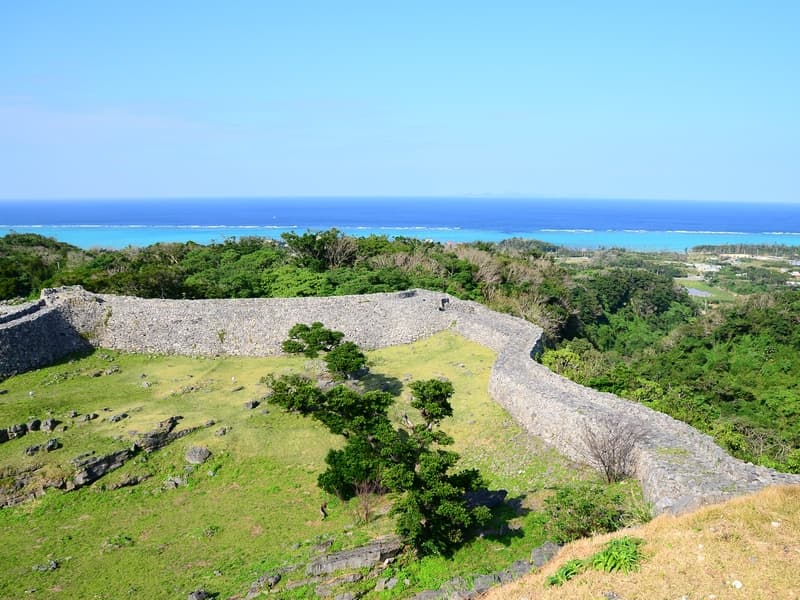
The finest of the gusuku ruins: long curving limestone walls following a ridge above the north-west coast, built by the kings of the northern Hokuzan kingdom before Ryukyu was unified, and inscribed by UNESCO in 2000 with the other gusuku sites. The view from the top takes in the East China Sea and Ie Island. Open every day, 8:00 to 18:00 from September to April and to 19:00 from May to August, last entry 30 minutes before; adults pay 1,000 yen since September 2025, junior and senior high 500 yen. Late afternoon light on the walls is the picture.
 天王星 · CC BY-SA 3.0 via Wikimedia Commons
Katsuren Castle (Katsuren Gusuku)
One of the oldest of the UNESCO gusuku, on a ridge above the east coast at Uruma, climbing in terraces to a summit with a view both ways across the island. Less visited than Nakijin and more dramatic in its setting. Open every day 9:00 to 18:00, last admission 17:30; adults 600 yen. Pair it with the drive across the sea road to Henza, Hamahiga and Ikei islands.
 Jackvista2007 · CC BY-SA 3.0 via Wikimedia Commons
Cape Manzamo
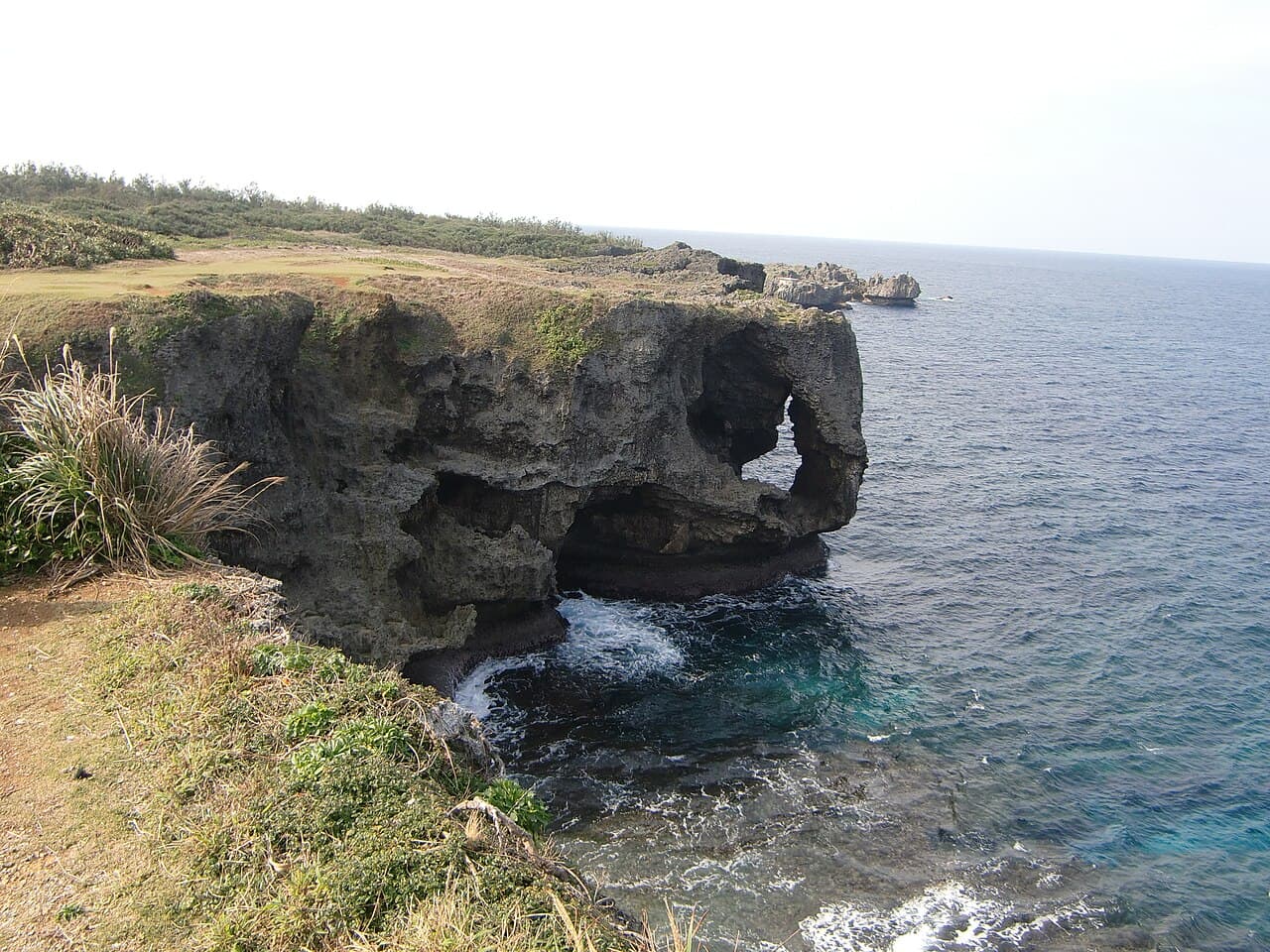
A grassy clifftop on the Onna coast ending in a rock shaped like an elephant's trunk, named by a Ryukyu king who said the meadow could seat ten thousand. A visitor centre with a food court now manages it: 100 yen per person, open 8:00 to 20:00 from March to October and 8:00 to 19:00 from November to February, so the sunset falls inside opening hours on every day of the year. Free parking. Our terrain ray cast finds open sea at every sunset bearing.
 Lover of Romance · CC BY-SA 3.0 via Wikimedia Commons
Himeyuri Peace Museum
The museum of the Himeyuri student corps: 222 schoolgirls and 18 teachers mobilised as army nurses in 1945, 136 of whom died, most of them in the days after the corps was disbanded on 18 June. It stands beside the cave where the largest single loss happened and tells the story in their own words and photographs. The hardest and most necessary hour on the island. Open every day 9:00 to 17:25, last admission 17:00; adults 450 yen.
 CEphoto, Uwe Aranas · CC BY-SA 3.0 via Wikimedia Commons
Okinawa Peace Memorial Park
The park on the cliffs of Mabuni where the Battle of Okinawa ended in June 1945, with the Cornerstone of Peace: rows of granite walls carrying the names of more than 242,000 people who died, Okinawan, Japanese, American, British, Korean and Taiwanese, soldier and civilian alike. The prefectural Peace Memorial Museum is on the same site; its own site did not load for us, so check its hours before you go. The park grounds are free. On 23 June, Okinawa Memorial Day, the prefecture holds its memorial ceremony here.
 663highland · CC BY 2.5 via Wikimedia Commons
Okinawa Prefectural Museum and Art Museum
The prefecture's museum in the new Omoromachi district of Naha, the best single introduction to the Ryukyu Kingdom, its trade, its crafts and its fall, in a building designed after a gusuku. Open Tuesday to Thursday and Sunday 9:00 to 18:00 and Friday and Saturday to 20:00, closed on Mondays unless they are public holidays; the permanent collection costs 530 yen for adults. A rainy-day plan and a good first morning.
 Kugel~commonswiki · CC BY-SA 4.0 via Wikimedia Commons
Makishi Public Market
Naha's first public market, rebuilt and reopened in March 2023. The system is the point: buy fish, lobster, sea grapes or Agu pork on the ground floor, then carry it upstairs and pay a restaurant to cook it. Open 8:00 to 22:00 with individual shops setting their own hours, the upstairs restaurants taking last orders at 20:00; closed on the fourth Sunday of each month except in December. Note that kosetsu-ichiba.com is a different shopping complex; the market is at makishi-public-market.jp.
 Kugel~commonswiki · Public domain via Wikimedia Commons
Kouri Island
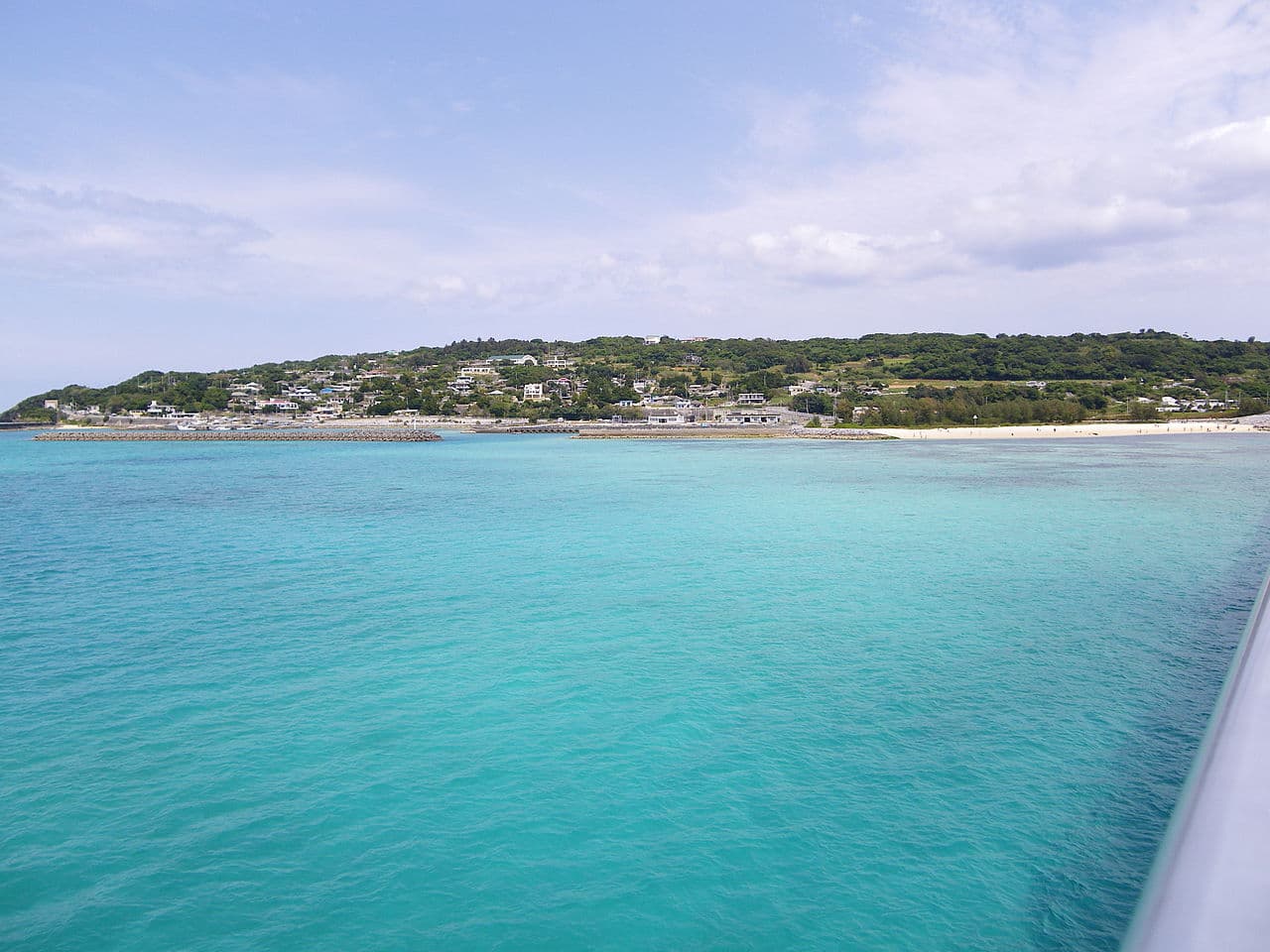
A small round island off the north coast of the Motobu peninsula, joined to Yagaji Island and the main island by a toll-free bridge of about two kilometres over pale turquoise shallows. The drive across is the reason to come; the heart-shaped rock at Tinu beach on the north side is the second. Go early or late, because the island is small and the car parks fill by mid-morning in the holidays.
 沖縄ダイビングスクール ワールドダイビング · Pexels
Okinawa World and Gyokusendo cave
A limestone cave of about five kilometres, of which close to a kilometre is walkable, inside a theme park in the south with a reconstructed village, craft workshops and an Eisa drum show. Open 9:00 to 17:30 with last entry at 16:00; 2,000 yen for adults with the cave included. Better than it sounds, especially on a wet day.
JUNGLIA Okinawa
A theme park of rides and set pieces in the Yanbaru-edge forest between Nago and Nakijin, opened in July 2025. The one-day ticket on the park's own page is 8,800 yen for adults and 5,940 yen for children of 4 to 11; overseas buyers are pointed to third-party sites, and travel press reports a lower resident price that the page itself does not show. Hours change by date. Worth it for families with teenagers who have done the aquarium; otherwise the forest itself is free.
 Skyler Sion · Pexels
Cape Hedo and Yanbaru
The northern tip of the island: a grassy limestone headland with the sea on three sides and Yoron Island, which is already Kagoshima Prefecture, on the horizon. Behind it is the Yanbaru forest, part of the UNESCO natural site inscribed in 2021 for its endemic species, including the flightless Okinawa rail. The cape is free and always open. It is about two and a half hours from the airport, so it belongs to a night in Nago or Motobu, not a day from Naha.
UNESCO: Amami-Oshima, Tokunoshima, northern Okinawa and Iriomote ↗View on map ↗
 663highland / CC BY 2.5 via Wikimedia Commons
 Taisyo / CC BY-SA 3.0 via Wikimedia Commons
Food & drink
 Blue Lotus from Okinawa · CC BY 2.0 via Wikimedia Commons
Okinawa soba
Thick wheat noodles, not buckwheat, in a pork and bonito broth, topped with soki (stewed spare rib) or three-layer pork belly, with red pickled ginger and a chilli-infused awamori called koregusu on the table. The island's everyday lunch.
 User:Jpatokal · CC BY-SA 3.0 via Wikimedia Commons
Goya champuru
Bitter melon stir-fried with island tofu, egg and pork or Spam. Champuru means mixed; it is the home dish, and the bitterness is the point.
 Blue Lotus from Okinawa · CC BY 2.0 via Wikimedia Commons
Rafute
Pork belly braised slowly in awamori, soy and brown sugar until it falls apart. A dish of the old court kitchen that every izakaya now serves.
 Jpatokal · CC BY-SA 3.0 via Wikimedia Commons
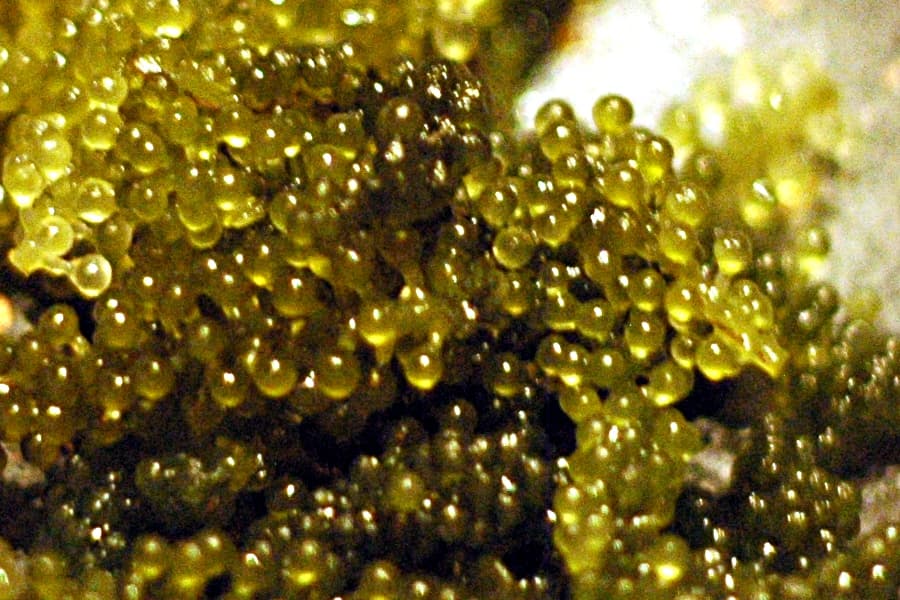
Umibudo
Sea grapes: a seaweed of tiny green beads that pop, eaten cold with a vinegar or ponzu dip. Farmed on the Onna coast. Eat it the day it is served; it wilts in the fridge.
 Ocdp · CC0 via Wikimedia Commons
Jimami tofu
A set peanut pudding with the texture of silken tofu, served with a sweet soy sauce. Neither a tofu nor a dessert, and good.
 pelican from Tokyo, Japan · CC BY-SA 2.0 via Wikimedia Commons
Taco rice
Taco filling, cheese, lettuce and salsa on rice, invented in 1984 in Kin town beside Camp Hansen to feed off-duty Marines cheaply. It is now on school menus.
 663highland · CC BY 2.5 via Wikimedia Commons
Awamori
Okinawa's distilled spirit, made from long-grain rice with black koji and aged in clay pots; aged awamori is called kusu. Stronger than mainland shochu and meant for sipping or with water.
Agu pork
An Okinawan heritage pig, fattier and sweeter than ordinary pork, usually eaten as shabu-shabu or grilled. Everything from the pig is used on the island, including the ears, as mimiga.
 Rashed Hossain · Pexels
Sata andagi
Deep-fried dough balls, crisp outside and dense inside, sold warm in paper bags at markets and roadside shops.
 咲淚 月雨 · Pexels
Blue Seal ice cream
The ice cream that came with the American administration and never left: purple sweet potato and salt cookie are the local flavours.
Lunch is the cheap meal: an Okinawa soba shop or a set lunch costs a fraction of dinner. Many small restaurants take cash only and close one day a week, often Wednesday or Sunday, and soba shops often close when the broth runs out. Tipping is not done anywhere in Japan. At an izakaya you will usually get a small charged appetiser, the otoshi, without ordering it. At a sanshin live house the music is part of the bill. Many restaurants close early on typhoon days and some close for the whole storm.
Where to eat
Kishimoto Shokudo
institutionA soba shop in Motobu open since 1905, famous for a broth recipe more than a century old and noodles made the old way with wood-ash water rather than kansui. The main shop in Toguchi opens 11:00 to 17:00, or until the soba runs out, and is closed on Wednesdays; the Yaedake branch nearby opens daily to 19:00. It has no website, so these hours come from local listings. Expect a queue at lunch and bring cash.
Last researched 2026-09-22
Yunangi
institutionA Naha izakaya that has served Okinawan home and court cooking for more than fifty years: rafute, champuru, jimami tofu, soba. It no longer serves lunch: dinner only, listed as 17:30 to 22:00, closed on Sundays and public holidays. It has no site of its own that we could confirm, so call before you go (098-867-3765).
Last researched 2026-09-22
 さかおり (talk) · CC BY-SA 3.0 via Wikimedia Commons
Makishi Public Market, upstairs
marketBuy on the ground floor, from the fish stalls with parrotfish, lobster and sea grapes, and have it cooked by one of the restaurants upstairs for a per-dish fee. The upstairs restaurants take last orders at 20:00. Closed on the fourth Sunday of the month except in December. Ask the price per kilo before the fishmonger starts cutting.
Last researched 2026-09-22
Okinawa-en
modernA yakiniku and shabu-shabu house near Makishi station specialising in Agu pork and island beef. Lunch 11:30 to 15:00 with last orders at 14:30, dinner 17:00 to 23:00 with last orders at 22:00, and no regular closing day. The sanshin live house Mion is in the basement of the same building, which makes an evening of it.
Last researched 2026-09-22
Shimauta Live Obaa no Ie Mion
barA basement izakaya where sanshin players and singers perform five sets a night, at 19:00, 19:45, 20:30, 21:15 and 22:00. Open 17:00 to 23:30 with last orders at 22:00. The music comes with the banquet courses, at 4,950 or 5,800 yen including tax; expect the room to be on its feet for the kachashi dance at the end.
Last researched 2026-09-22
King Tacos, Kin main store
street-foodTaco rice was invented in 1984 at Parlor Senri in Kin, the town outside Camp Hansen; Parlor Senri closed in 2015 and the family's King Tacos carries the recipe on, with this Kin shop as the first of several branches. It opens daily at 10:30; listings disagree on the closing time, from 21:00 in one to 3:00 in another, so the late-night version is not one to count on. Order the taco rice with cheese and vegetables and share it.
Last researched 2026-09-22
A&W
casualA&W has been in Okinawa since 1963, nine years before the island went back to Japan, and it has stayed part of the island's roadside ever since. Go to a drive-in branch rather than a mall counter; the Makiminato one in Urasoe opens from early morning to 2am. Hours vary by branch and are posted on the chain's site.
Last researched 2026-09-22
Sunrises
 そらみみ · CC BY-SA 4.0 via Wikimedia Commons
Chinen Misaki Park: the sun over Kudaka Island
Kudaka is the island the Ryukyu Kingdom held to be the landing place of its gods, and Sefa Utaki was built to face it. From the clifftop park at Chinen Misaki, a few minutes' drive from Sefa Utaki, the island lies low on the eastern horizon between bearings of about 86 and 106 degrees, five to eight kilometres out. By our calculation the sun comes up beyond it from about 10 February to 28 March and again from about 15 September to 2 November, and over its middle from about 7 to 15 March and 29 September to 7 October. Kudaka is flat, about 20 m at most, so the sun rises from the open sea just behind it rather than out of the land: the island is a dark line in front of the sunrise, which is the better picture.
Mid-September to early November, and mid-February to late March · About 45 minutes from Naha by car. No bus runs this early. · A longer lens compresses Kudaka against the sun. Keep well back from the cliff edge in the dark.
 Kugel~commonswiki · CC BY-SA 4.0 via Wikimedia Commons
Cape Hedo: open sea every morning
At the northern tip the ray cast finds nothing but ocean across the whole sunrise arc, from about 63 degrees at the June solstice to about 116 at the December one. Few people are there at dawn, because it is two and a half hours from Naha; from a night in Kunigami or Nago it is the sunrise to get up for.
Year-round · About an hour from Nago by car. · The limestone pinnacles on the headland give you the foreground.
Sunsets
Cape Manzamo and the Onna coast: open sea all year
The sunset bearing in Okinawa swings from about 244 degrees at the December solstice to about 297 at the June one, and from the top of Manzamo's cliff the terrain ray cast finds open water across all of it; so it does from Cape Zanpa in Yomitan. That is the case for staying on this coast. Manzamo also stays open past sunset on every day of the year, to 20:00 from March to October and 19:00 from November to February, which is not something we can say of every viewpoint on the island.
Year-round · About 65 minutes from the airport by car, a few minutes from the Onna resorts. · Stand at the southern end of the clifftop path to get the elephant-trunk rock in silhouette against the sea.
 Naha Mama Pavilionz · CC0 via Wikimedia Commons
Senaga Island, by the airport: the sun behind the Keramas
Senaga, the small island joined to the coast just south of the airport runways, has a hillside of terrace shops built for the sunset and the planes. From its western shore the Kerama Islands, 20 to 36 km away, stand above the sea horizon between bearings of about 267 and 284 degrees. So the sun sets behind the Keramas rather than into the sea from about 13 March to 21 April and from about 21 August to 30 September; in the last week of September you are still inside that window. For the rest of the year it goes down into open water. Both are good; they are not the same picture.
Year-round; behind the islands mid-March to late April and late August to the end of September · About 15 minutes from Naha Airport by car; a good last evening before an early flight. · Planes on final approach to the runway give you a second subject; a longer lens on the Kerama silhouette gives the first.
 そらみみ · CC BY-SA 4.0 via Wikimedia Commons
Chatan Sunset Beach: Tokashiki in winter
The man-made beach at American Village is where Naha goes for a sunset, and it faces open sea for most of the year. The exception is Tokashiki, the largest Kerama island, about 41 km away on a bearing of about 249 to 255 degrees. The sun sets behind it from about 25 January to 11 February and from about 30 October to 17 November.
Year-round; behind Tokashiki from late January to mid-February and from the end of October to mid-November · About 40 minutes from the airport; walk-on from the Chatan hotels. · The breakwater and the Ferris wheel of American Village make the foreground.
 Hyppolyte de Saint-Rambert · CC BY 4.0 via Wikimedia Commons
Emerald Beach and Bise: Ie Island in summer
From the beach beside Churaumi, Ie Island fills the western horizon seven to eleven kilometres out, with its single peak, the 172 m Tatchu, sticking up out of the middle. The ray cast puts the island across the sunset from about 2 April to 9 September, which is most of the aquarium's high season; the sun goes down behind the peak itself for about a week around 30 April to 5 May and again around 7 to 12 August. From mid-September to late March the sun sets into open water to the left of the island. Either way this is one of the best sunset beaches in the north.
Mid-September to March for the sea; early May and mid-August for the sun on the Tatchu · About two hours from the airport; next door to the Orion Hotel Motobu. · The Tatchu is the reason to be here in early May and mid-August: it is a small, sharp cone on a flat island.
 Snap55 · CC BY 3.0 via Wikimedia Commons
Sesoko Beach: the sun behind Minna
The long beach on the west side of Sesoko Island, over the bridge from Motobu, looks across to Minna, a low, flat island about 3.5 km out. The sun sets behind Minna from about 1 to 23 March and from about 19 September to 12 October, and into the open sea the rest of the year. In late September you are inside the window.
Year-round; behind Minna in March and from late September to mid-October · About ten minutes from Motobu port across the Sesoko bridge. · Minna's low line on the horizon is the subject; the water here is famously clear in the foreground.
Day trips
 João Mira · Pexels
The Kerama Islands: Zamami, Aka or Tokashiki
The best water within an hour of Naha. Boats leave Tomari port in Naha. To Zamami and Aka the village runs the Queen Zamami fast boat, 3,950 yen one way, and the slower Ferry Zamami, 2,900 yen, plus a 100 yen island tax; in September the ferry left at 10:00 and the fast boat twice a day. To Tokashiki, the Marine Liner fast boat takes about 40 minutes and the ferry about 70, and both rise about 30 percent on 1 October 2026: the adult ferry return goes from 3,210 to 4,180 yen and the fast boat return from 4,810 to 6,270 yen, plus a 100 yen environmental tax. Sailings are decided each morning at 8:00 and cancel in rough seas. Online booking opens about two months ahead for Zamami; book in summer and keep the island trip early in your stay so a cancelled boat can be moved.
40 to 50 minutes by fast boat, 70 minutes to 2 hours by ferry · A full day, or better a night
Zamami village: ferry fares ↗Tokashiki village: timetable and fares ↗View on map ↗
 Abasaa · Public domain via Wikimedia Commons
The Motobu loop: Churaumi, Bise, Nakijin and Kouri
The north-west in one day, best from a base on the peninsula. The aquarium at 8:30 opening, then the fukugi-tree lanes of Bise village next door on foot or by rented bicycle, soba at Kishimoto Shokudo if it is not a Wednesday, Nakijin Castle in the afternoon light, and the bridge to Kouri Island before the sunset back at Emerald Beach or Sesoko. From Naha it is a long day of four hours in the car; from Motobu it is easy.
About two hours from Naha; minutes from a Motobu base · A full day
 kamiosaki · CC BY-SA 3.0 via Wikimedia Commons
The south: Sefa Utaki, Chinen, the Peace Memorial Park and Himeyuri
A day of the sacred and the tragic, all within 50 minutes of Naha. Start at Chinen Misaki Park for the sunrise over Kudaka, then Sefa Utaki when it opens at 9:00: in full until 1 November, only to the gate from 2 November to 5 January. Lunch at a cafe on the southern cliffs, then the Himeyuri Peace Museum and the Peace Memorial Park at Mabuni in the afternoon. Okinawa World and the Gyokusendo cave fit between them if it rains.
Under 50 minutes from Naha by car to any stop · A full day
 Kugel~commonswiki · CC BY-SA 4.0 via Wikimedia Commons
Ie Island from Motobu
A flat farming island with one sharp peak, the Tatchu, that you can climb in twenty minutes for a view back over the Motobu peninsula. The village ferry takes about 30 minutes from Motobu port and costs 730 yen one way for adults; it sails from Motobu at 9:00, 11:00, 15:00 and 17:00 and back from Ie at 8:00, 10:00, 13:00 and 16:00, with an extra sailing in summer. Foot passengers need no booking; cars do. Rent a bicycle or a scooter at the port.
About 30 minutes by ferry from Motobu port · Half a day or a full day
 N · Public domain via Wikimedia Commons
The east coast sea road and Katsuren Castle
From Uruma the Kaichu-doro causeway runs across the shallows to Henza, then by bridge to Miyagi, Ikei and Hamahiga islands: a drive over the sea with small beaches and a sacred cave at the end. Combine it with Katsuren Castle above the start of the road, open 9:00 to 18:00, 600 yen. Stop in Kin for taco rice on the way.
About an hour from Naha to Katsuren · Half a day
After dark
Sanshin live music in Naha
local-experienceThe three-stringed sanshin and the island songs are the sound of Okinawa, and the live houses around Kokusai-dori play them several times a night; Mion in Makishi has five sets from 19:00. The evening ends with the whole room doing the kachashi hand dance.
 Naha Mama Pavilionz · CC0 via Wikimedia Commons
Makishi market dinner
dinnerPick your fish downstairs and eat it upstairs, among families and office groups. Last orders upstairs at 20:00, so this is an early dinner.
Sunset at Cape Manzamo
sunset-venueThe one viewpoint on the island that is open past sunset on every day of the year and faces open sea at every sunset bearing. 100 yen.
 Naha Mama Pavilionz · CC0 via Wikimedia Commons
American Village after dark
nightlifeChatan's waterfront of bars, restaurants and neon beside the sea, where Okinawans, base families and visitors all end up on a Friday. Loud and cheerful; it is the island's easiest night out outside Naha.
Daily itinerary
Seven days: Naha and the south, then the west coast and the north
The shape we would book for a first trip. Three nights in Naha without a car for the city, the castle and the Keramas, then the car and the south on the way north: one night on the Onna coast and two on the Motobu peninsula, so the aquarium is an easy morning. With an eighth day, add a second Onna night. The weekdays matter: the prefectural museum is shut on Mondays and Kishimoto Shokudo on Wednesdays, so this plan lands on Monday and runs to Sunday. From 23 November 2026 the Shuri day needs a timed main hall ticket bought in advance.
- 1
Land in Naha
relaxedArrive at Naha Airport, usually via Tokyo. The monorail from the domestic terminal runs straight into the city; buy the two-day pass, 1,800 yen for 48 hours from purchase, which covers today and Shuri tomorrow.Okinawa soba near Kokusai-dori.Tsuboya pottery street and the Heiwa-dori arcades.Not your sunset day; the city faces the port.The Makishi market: buy downstairs, eat upstairs, last orders 20:00.Sanshin live music at Mion, sets from 19:00.Monorail and on foot; no car in Naha.Estimate: If you land late, skip the market and go straight to Mion, which serves food to 22:00.
- 2
Shuri
moderateMonorail to Shuri. Shuri Castle at 8:30 opening; from 23 November 2026 book the main hall interior for a morning slot. Walk down the Kinjo-cho stone lane afterwards.In Shuri, or back in the centre.Tamaudun, the royal mausoleum, and the Zuisen awamori distillery for a tour and a tasting.Senaga Island by taxi, about 25 minutes, for the sun over or behind the Keramas and the planes.Yunangi, dinner only and closed on Sundays and public holidays.Free.Monorail to Shuri; taxi to Senaga.Estimate: From mid-March to late April, and from late August to the end of September, Senaga puts the sunset behind the Kerama Islands.
- 3
The Keramas
moderateThe fast boat from Tomari port to Zamami or Tokashiki. Book ahead in summer, and check the 8:00 sailing decision.On the island.Snorkel from the beach: Furuzamami on Zamami or Aharen on Tokashiki.On the boat home, or stay the night if you can.Back in Naha; Okinawa-en for Agu pork shabu-shabu.Collect the rental car this evening so tomorrow can start before dawn.Taxi or a short walk to Tomari port.Estimate: In rough weather the boats cancel: spend the day at the prefectural museum instead, open on a Wednesday, and keep the Keramas for a later trip.
- 4
The south, then north
fullLeave Naha about an hour before sunrise for Chinen Misaki Park, then Sefa Utaki at 9:00 (only to the gate from 2 November to 5 January).On the southern cliffs.The Himeyuri Peace Museum and the Peace Memorial Park, then the expressway north to the Onna coast, about 70 minutes.Cape Manzamo, open past sunset every day.At the hotel or along the coast road.Free.Car from here on. The pre-dawn start misses the Naha rush hour; the south is quiet roads.Estimate: If the day is too full, drop the sunrise and start at Sefa Utaki.
- 5
Onna coast
moderateThe Blue Cave at Cape Maeda with a snorkel operator, early and only if the sea is calm.Taco rice at King Tacos in Kin, 25 minutes across the island.Katsuren Castle and the sea road to Hamahiga, or simply the hotel beach.Cape Zanpa or back at Manzamo.On the Onna coast road.Drive on to the Motobu peninsula, about an hour, for two nights there.Car. Check out of the Onna hotel in the morning; everything today is under an hour apart.Estimate: With children, a day at the hotel pool and beach is the right answer.
- 6
The Motobu loop
fullChuraumi Aquarium at 8:30 opening, then the fukugi lanes of Bise.Kishimoto Shokudo, not on a Wednesday; this plan lands it on a Saturday.Nakijin Castle, then the bridge to Kouri Island.Emerald Beach or Sesoko Beach; check the sunset notes for which island the sun is behind this month.An izakaya in Motobu or at the hotel.Free.Everything today is within 20 minutes of a Motobu base.Estimate: JUNGLIA instead of Nakijin and Kouri, for families with older children.
- 7
Back south and home
relaxedA last swim at Emerald Beach, then the expressway south: the airport is about two hours from Motobu.A&W at Makiminato on the way, for root beer and a burger.Return the car near the airport and fly. Allow for the rental shuttle and the Route 58 traffic.Expressway to Nishihara, then the city roads; return the car with a full tank.Estimate: With an evening flight, Senaga Island for the sunset is 15 minutes from the airport.
Four days: Naha and one base in the north, for a short winter trip
For a long weekend or a trip added to mainland Japan. One night in Naha and two on the Motobu peninsula, with the car from the second morning. In winter this is the right shape: the beaches matter less, the castles and the aquarium more, and the whales are off the Keramas.
- 1
Naha
moderateLand and take the monorail into the city.Shuri Castle; from 23 November 2026 with a main hall slot booked ahead.Senaga Island by taxi.The Makishi market.Monorail and taxi. - 2
North by the south
fullPick up the car. Sefa Utaki and Chinen, or the prefectural museum if it is raining and not a Monday.Expressway north to Motobu, about two hours, stopping at Cape Manzamo.Manzamo.Motobu.Car. - 3
The Motobu loop
moderateChuraumi at 8:30.Kishimoto Shokudo, not on a Wednesday.Nakijin Castle and Kouri Island.Emerald Beach.Motobu.Car, short distances.Estimate: In January to March a whale-watching trip is worth a morning, but most leave from Naha and Zamami, so fit it into day 1 rather than here.
- 4
Home
moderateCape Hedo at sunrise if you are keen, about an hour and a half from Motobu; otherwise Ie Island by the 9:00 ferry and back at 13:00.Drive south, return the car and fly.Allow two hours from Motobu to the airport plus the rental return.
Getting around
- There is no nonstop flight between Tel Aviv and Okinawa. The practical route from Israel is El Al's nonstop to Tokyo Narita, which ran on most days of the publication week, and a domestic flight on to Naha; the Ben Gurion flight board also carries El Al and Thai services to Bangkok. Naha's international flights run to Seoul, Taipei, Hong Kong and Shanghai, which are the other realistic connections.
- Israeli passport holders can visit Japan without a visa for up to 90 days as tourists. Japan's planned electronic travel authorisation, JESTA, is not in operation for 2026 or 2027 travel.
- Japan's departure tax rose from 1,000 yen to 3,000 yen per departure on 1 July 2026. It is normally inside the ticket price; tickets issued on or before 30 June 2026 keep the old rate.
- Naha Airport is at the southern edge of Naha, 8 km from Kokusai-dori. The Yui Rail monorail starts at the domestic terminal and runs through the city to Shuri and Tedako-Uranishi; buses and the rental car shuttles leave from the terminal kerb.
- Okinawa Prefecture introduces an accommodation tax on 1 February 2027: 2 percent of the room charge per person per night, capped at 2,000 yen. In the municipalities that co-implement it, which on the prefecture's list include Onna, Chatan, Nago and Motobu, the same 2 percent is split between the town and the prefecture. It is added at the hotel.
- Rent a car for everything outside Naha. Japan drives on the left and accepts only International Driving Permits issued under the 1949 Geneva Convention, in booklet form; ask for that format when you apply. The expressway runs about 57 km from Naha IC to Kyoda near Nago; the full run costs 1,610 yen cash or 1,040 yen with an ETC card under a special discount that runs to 31 March 2027, and most rental firms will fit a card for a small fee.
- Traffic is the island's real problem. Route 58, the west-coast artery through Naha, Urasoe and Chatan, is slow at weekday rush hours; use the expressway for anything north of Chatan and leave Naha before 7:30 or after 9:30.
- The Yui Rail monorail covers Naha only: 19 stations from the airport to Tedako-Uranishi via the centre and Shuri. A one-day pass is 1,000 yen and a two-day pass 1,800 yen, counted as 24 or 48 hours from purchase rather than calendar days. OKICA and Suica both work.
- Buses: the 117 expressway bus runs from the airport to the aquarium in about 2 hours 15 minutes for 2,550 yen, and airport limousine buses serve the Onna and Nago resorts. Useful if you are not driving, slow if you are in a hurry.
- Taxis on the main island start at 650 yen for the first 1.65 km since 24 August 2026, still cheaper than Tokyo. Cards are widely accepted in Naha, less so in the north.
- Ferries leave Tomari port in Naha for the Keramas, and Motobu port for Ie Island. Sailings are decided on the day and cancel in rough seas and typhoons.
Things worth knowing
- · Planning the Shuri Castle main hall without a booking. From 23 November 2026 the interior needs a timed ticket bought in advance; without one you see the hall only from outside.
- · Booking August or September without a plan for a typhoon: flights, ferries, the monorail and buses stop when a storm arrives, and shops close. Buy flexible tickets and keep a spare day at the end.
- · Staying in Naha and day-tripping to Churaumi. It is about two hours each way; sleep on the Motobu peninsula for at least two nights.
- · Quoting last year's prices: Sefa Utaki doubles on 1 October 2026, the Tokashiki boats rise about 30 percent the same day, Shuri Castle goes from 400 to 1,000 yen on 23 November, taxis rose in August and the departure tax tripled in July.
- · Swimming outside the nets from June to September, when the prefecture's box jellyfish advisory runs. Carry vinegar to the beach.
- · Expecting a winter beach holiday. Naha gets 93 hours of sunshine in January and a steady north wind; winter is for castles, food and whales.
Budget
| Low | Expected | Comfortable | |
|---|---|---|---|
| Accommodation style / per night | ¥9,000≈ $57 | ¥32,000≈ $202 | ¥90,000≈ $569 |
| Food style / per day | ¥3,000≈ $19 | ¥8,000≈ $51 | ¥18,000≈ $114 |
| Local transport / per day | ¥1,000≈ $6 | ¥8,000≈ $51 | ¥16,000≈ $101 |
| Estimate / per day | ¥600≈ $4 | ¥2,500≈ $16 | ¥9,000≈ $57 |
Estimate · JPY · 2026-09-22. Priced in yen, at about 180 to the euro, 157 to the US dollar and 1.93 shekels per 100 yen on the Bank of Israel's representative rate of 18 September 2026. The low band is a business hotel or guesthouse in Naha with the monorail, buses and soba lunches; the expected band is a four-star beach hotel with a rental car, fuel and tolls; the comfortable band is a luxury resort, two cars or a driver, and dinners out. These bands are our estimates from the prices in this guide rather than a published index. Add from 1 February 2027 the prefectural accommodation tax of 2 percent, capped at 2,000 yen per person per night, and 3,000 yen of departure tax per person inside your air fare. Consumption tax is 10 percent and is inside displayed prices; from 1 November 2026 tax-free shopping becomes a refund after export, so you pay the full price in the shop and are refunded once customs confirms the goods left with you. · 1 USD = ¥158 (14 Oct 2026)
Things worth knowing
Frequently asked questions
When is the best time to go to Okinawa?
Late October to early December, with March and April as the second choice. The typhoon count falls from 1.1 in October to 0.3 in November, highs are 25 to 28C, the domestic holiday crowds are gone, and the rainy season of May and June is far off. July and August are the sunniest months but also the peak of the typhoon season and of Japanese domestic travel.
Can we see inside the rebuilt Shuri Castle?
From 23 November 2026, yes, with a timed reservation made in advance on the Shuri Castle Park site at no extra charge. Tickets for 23 November to 31 December went on sale in two batches, on 1 September and 1 October at 13:00 Japan time; from January 2027 each month opens at 13:00 on the first of the month two months ahead. Adults pay 1,000 yen from that date. Before 23 November, or without a reservation, you can visit the rest of the castle and see the hall from a viewing deck.
Do we need a car in Okinawa?
For anything beyond Naha, yes. The monorail covers only the city and the airport, and the island's beaches, castles and the aquarium are spread over 100 km. Bring an International Driving Permit issued under the 1949 Geneva Convention in booklet form, remember Japan drives on the left, and ask the rental company for an ETC card for the expressway.
How do we get to Okinawa from Israel?
With a change of plane. El Al flies nonstop from Tel Aviv to Tokyo Narita, and from Tokyo Okinawa is a domestic flight. Seoul, Taipei and Hong Kong also have flights to Naha, but none of them has a nonstop from Tel Aviv, so they add a connection. Israelis need no visa for up to 90 days, and Israel's National Security Council has no travel warning for Japan.
What happens if a typhoon comes during our trip?
Flights, ferries, buses and the monorail stop, most shops and restaurants close, and you stay indoors until it passes, usually a day or two. The risk is highest from July to October, with August the peak month. Buy flexible tickets, keep the Kerama day early in the trip so it can be moved, keep a spare day before an international connection, and watch the Japan Meteorological Agency's forecast in the days before you fly.
Which coast has the best sunset?
The Onna coast and Yomitan: from Cape Manzamo and Cape Zanpa the sun sets into open sea on every day of the year, and Manzamo stays open past sunset all year. Near Naha, Senaga Island and Chatan are good too, but the Kerama Islands sit on the horizon, so for part of the year the sun goes down behind them. In the north, Ie Island blocks the summer sunset from the beach by Churaumi.
Is the sea safe for swimming?
Yes, at managed beaches and with sense. From June to September swim inside the nets because of box jellyfish, and carry vinegar. Watch for currents at the reef edge, wear reef shoes, and do not touch crown-of-thorns starfish or cone shells. Typhoon swell can make even a calm-looking beach dangerous for a day or two after a storm.
Sources (14)
- The Israel National Security Council travel-warnings dataset on data.gov.il, resource last modified 14 September 2026, lists Japan with the NSC recommendation to take normal precautions and no travel warning (level 1), and the Foreign Ministry advice to stay alert and follow the media · government · 2026-09-22
- Shuri Castle Park announced on 4 June 2026 that the completion ceremony of the rebuilt main hall will be held on Sunday 22 November 2026 and the hall opened for use on Monday 23 November 2026, a national holiday · official · 2026-09-22
- Shuri Castle Park states that the park is closed on Sunday 22 November 2026, and lists paid-area hours of 8:30 to 19:00 from April to November and 8:30 to 18:00 from December to March with last entry 30 minutes before closing, and adult admission of 400 yen until 22 November 2026 · official · 2026-09-22
- The Japan Meteorological Agency 1991-2020 normals for Naha give mean daily maxima from 19.8C in January to 31.9C in July, mean daily minima from 14.9C to 27.0C, annual precipitation of 2,161.0 mm with 284.4 mm in June and 275.2 mm in September, sunshine from 93.1 hours in January and February to 227.0 in July, and a most frequent wind direction of north-north-east from October to January · government · 2026-09-22
- The Japan Meteorological Agency 1991-2020 normals for typhoons approaching the Okinawa region (centre within 300 km of a station) are 0.4 in May, 0.6 in June, 1.5 in July, 2.2 in August, 1.9 in September, 1.1 in October and 0.3 in November, 7.7 a year · government · 2026-09-22
- The Japan Meteorological Agency gives the 2026 Okinawa rainy season as beginning around 4 May, six days earlier than the normal of around 10 May, and ending around 29 June, eight days later than the normal of around 21 June · government · 2026-09-22
- Sefa Utaki lists admission of 300 yen for adults and 150 yen for children, revised from 1 October 2026 to 600 yen and 300 yen, with groups of 20 adults or more at 500 yen · official · 2026-09-22
- Sefa Utaki opens 9:00 to 18:00 with ticket sales 8:45 to 17:15 and last entry 17:30 from 1 March to 31 October, and closes to everyone every year on the first to third days of the fifth and tenth lunar months · official · 2026-09-22
- The Ie village ferry from Motobu port costs 730 yen one way for adults and 1,390 yen return, sails from Motobu at 9:00, 11:00, 15:00 and 17:00 and from Ie at 8:00, 10:00, 13:00 and 16:00, takes about 30 minutes, and requires reservations for vehicles only · ferry · 2026-09-22
- The Ministry of Foreign Affairs of Japan lists Israel among the countries and regions whose nationals are exempt from visas for short-term stays of up to 90 days · government · 2026-09-22
- The National Tax Agency describes the switch of the export sales (tax-free shop) system to a refund method, under which tax-free shops sell at tax-inclusive prices and refund the consumption tax after customs confirms export, applying to sales from 1 November 2026 · government · 2026-09-22
- Bank of Israel representative exchange rates published 18 September 2026: 1 US dollar = 3.028 shekels, 1 euro = 3.476 shekels, 100 yen = 1.928 shekels · government · 2026-09-22
- The Zamami Whale Watching Association ran its 2026 whale-watching season around Zamami from 8 January to 25 March · tourism-board · 2026-09-22
- Shuri Castle Park lists the Shuri Castle Festival for 1 to 3 November 2026 with the Ryukyu court procession on Kokusai-dori on 2 November · event-organizer · 2026-09-22