Czechia · Bohemia
Prague
Come in May, June or September, sleep in Vinohrady, Karlin or the quiet end of Mala Strana rather than the party blocks, cross Charles Bridge before 8am, take the first hour after opening at the Old Town Hall for the half-price early-bird ticket, ride the rebuilt Petrin funicular on a 24-hour pass if it has resumed carrying passengers, eat where the tank beer is, and give one full day to Kutna Hora.
 Moyan Brenn from Italy / CC BY 2.0 via Wikimedia Commons
Overview
Prague is the great European city that the twentieth century forgot to knock down. It was bombed, but by accident and not to rubble: American B-17s aiming for Dresden dropped some 152 tons on the city on 14 February 1945, killing 701 people and burning out the Emmaus Monastery, and the Old Town Hall lost its whole eastern wing to fire in the Uprising that May. What the war did not take, four decades of socialism had no money to modernise, and what survived is a thousand years of architecture standing shoulder to shoulder in one bend of the Vltava: Romanesque cellars under Gothic houses under Baroque facades under Art Nouveau shopfronts, with a castle complex on the ridge above that has been the seat of Bohemian power since the ninth century. The historic centre has been on the UNESCO list since 1992. What makes it more than a film set is that the city still works: trams run every few minutes through streets built for carts, the pubs pour the pale lager that Plzen invented in 1842 and the rest of the world has been copying ever since, at prices that still surprise Western Europeans, and the neighbourhoods a tram ride from the postcard are where the actual city lives.
Prague is, for our money, the best-value grand city in Europe after Budapest, and the gap has narrowed because Prague got more expensive faster. Three nights is the honest minimum and five is the pleasant number. Our plan: base yourself one tram stop outside Prague 1 and treat the old centre as somewhere you walk into at 7am and out of at 7pm; buy the transport pass in the app rather than on paper, because the 2026 tariff prices every short-term app ticket below its paper twin and because the 24-hour and 72-hour passes are the only short-term tickets that cover the Petrin funicular; spend the money you save on one serious dinner, one river hour and the Kutna Hora train. Skip the ghost tours, the Segway substitutes, the euro-priced menus and every currency exchange window that does not publish its rate in Czech and English. The city rewards early mornings more than any capital we plan trips to, and it punishes improvisation on exactly four things: the Sedlec ossuary, Karlstejn's Tour II, the Michelin tables and a bed in December.
Best for
First-time visitors to Central Europe · Couples · Architecture and history travelers · Beer drinkers who care about how it is poured · Long-weekend city breaks · Travelers who want grandeur without Western European prices
Daily itinerary
3 nights for the classic city; 4 to 5 to add Kutna Hora or a Bohemian castle and give the left bank a whole unhurried day
Most beautiful cities make you choose between the sight and the life. Prague does not: the Charles Bridge is a working footpath, the Old Town Hall still marries people in the rooms you tour, the ossuary at Sedlec is a functioning church. The catch is that the compact centre absorbs a lot of people, and 2026 is the year the city stopped being polite about it. Organised pub crawls are banned between 10pm and 6am, shared e-scooters were removed from the whole city on 1 January, drinking alcohol in public is prohibited at the places the city ordinance designates across the historic core, and the transport tariff was rewritten to reward the app and punish the paper ticket. None of that spoils the trip. It just means the rules are now specific, and knowing them is the difference between a smooth week and a 1,200 CZK conversation with a plain-clothes inspector.
Best time to visit
Prague has four distinct seasons and no closed one. May, June and September are the sweet spot: 18 to 25 degree days, long light on the river, terraces out, and the castle gardens open. July and August are warm, busy and increasingly prone to 33 degree afternoons, which matters in a city of stone with limited shade. October is beautiful and cheaper. November is grey and the low point of the year. December belongs to the Christmas markets and its own small high season, and January and February are cold, dark, quiet and the least expensive weeks to sleep in the centre.
- December to February: Cold and short-lit, with the Christmas markets on Old Town Square and Wenceslas Square running 28 November 2026 to 6 January 2027. January and February are the cheapest and emptiest weeks of the year. Castle gardens close for winter, historical interiors keep shorter hours, and the concert calendar is the compensation.
- March to May: The city thaws unevenly: March is still winter, April swings between 8 and 20 degrees, and by mid-May the gardens, terraces and river boats are all running. Late May is arguably the single best fortnight of the Prague year, before the summer crowd density arrives.
- June to August: Long days, everything open late, the beer gardens at Letna and Riegrovy sady at their best, and the highest visitor density of the year in the old centre. Heat above 32 degrees is now normal in stretches; plan the castle and the bridge for mornings and the parks for evenings.
- September to November: September holds summer light with a thinner crowd and is the month we would book. October fades gently and gives the parks their best colour. November is the year low point: grey, wet and quiet, until the markets switch on at the end of the month.
Things worth knowing
- Christmas markets (28 November 2026 to 6 January 2027 on Old Town Square and Wenceslas Square, daily; smaller neighbourhood markets at Peace Square, Republic Square and Tyl Square run shorter windows and close on 24 December). The Old Town tree lighting is on opening day. Evenings are the atmosphere and the crush; the Peace Square market in Vinohrady is the one locals actually shop at.
- Prague Spring International Music Festival (May): the classical flagship, traditionally opening on 12 May with Smetana's Ma vlast at the Municipal House. Tickets for the headline nights go months ahead; the mid-programme concerts are affordable and still world class.
- Easter markets (spring, dates move with the calendar): the same squares as December, with painted eggs, pomlazka switches and lamb on the grill. Smaller and much less oversubscribed than the Christmas run.
- Karlstejn Wine Festival (27 September 2026): the castle village below Karlstejn fills for the harvest weekend and charges an entry fee to the village itself. Excellent if you are going for it, worth avoiding if you wanted a quiet castle morning.
- Signal Festival (October): a light-and-projection festival that turns facades across the centre and Karlin into screens for four nights. Free to walk, extremely busy, and the best reason to be in Prague in late autumn.
- Czech Beer Festival and the pivovar calendar (May, plus brewery open days year round): the country that has led the world in beer consumption per head since 1993 takes its calendar seriously. Check individual brewery taprooms rather than the big tented events, which are more fairground than beer.
Where to stay
 A.Savin · FAL via Wikimedia Commons
Stare Mesto (Old Town)
The medieval core between the river and Na Prikope: Old Town Square with the astronomical clock, the lanes of Josefov running north into the Jewish Quarter, the Charles Bridge at the western edge, and a street plan that has not been rationalised since the fourteenth century. Everything a first-timer came for is inside a fifteen-minute walk, and so is most of the city's tourist pricing.
Best for: First-time visitors · Walking to everything · The Jewish Quarter on foot · Travelers with three nights and no patience for logistics
The most touristed prices in Czechia, and the blocks around Dlouha and Dusni are genuinely loud from Thursday to Saturday. Drinking alcohol in public is prohibited at the places the city ordinance designates across the core and quiet hours start at 10pm, which does not stop the noise from reaching a street-facing window.
 Karelj · Public domain via Wikimedia Commons
Mala Strana and Hradcany
The left bank under the castle: Baroque palaces with embassy flags, the Wallenstein and Vrtba gardens behind high walls, Kampa island in the mill stream, the Lennon Wall, and the climb up Nerudova to the castle gates. Hradcany above it is quieter still, the monastery-and-lookout quarter around Strahov and Loreta. This is where Prague is prettiest and where the evening dies earliest.
Best for: Romantic quiet after dark · Morning photographers · Gardens and palaces · Second visits
Restaurant density is a fraction of the right bank's and much of what is there is priced for the castle queue. The hill is real: staying in Hradcany means a climb or a tram every time you come home. Nerudova at midday is a conveyor belt.
 ŠJů. Later versions were uploaded by Che at cs.wikipedia. · Public domain via Wikimedia Commons
Vinohrady
The nineteenth-century apartment quarter east of the National Museum: wide tree-lined streets, Namesti Miru with its neo-Gothic church and its metro stop, Riegrovy sady sloping down to a beer garden with one of the best free castle views in the city, and the densest run of good neighbourhood restaurants, wine bars and bakeries in Prague. Fifteen minutes on foot or one metro stop from Wenceslas Square.
Best for: A base that feels like a city rather than a set · Food and wine bars · Value against Prague 1 rates · Stays of four nights and up
Not a sight in itself, so you commute to the monuments every morning, pleasantly. The blocks closest to Wenceslas Square shade into the tackier end of Nove Mesto; aim east of Namesti Miru.
 I would appreciate being notified if you use my work outside Wikimedia. More of my work can be found in my personal gallery. · CC BY-SA 3.0 via Wikimedia Commons
Karlin
The flood-rebuilt district east of the centre, and the clearest evidence that Prague has a present tense: Belle Epoque blocks restored after the 2002 Vltava flood, offices and studios in old factories, the Vitkov hill and its enormous equestrian statue above, and the city's most interesting eating between Krizikova and Karlinske namesti. Two metro stops from Republic Square on the B line.
Best for: Design hotels and apartments · The best casual eating in the city · Runners and cyclists on the river path · Travelers who have done the old centre
Almost nothing here is historic in the way visitors mean, and the walk to Old Town Square is twenty-five minutes. It is a place you eat and sleep in, not one you sightsee in.
 Slyronit · CC BY-SA 4.0 via Wikimedia Commons
Nove Mesto (New Town)
Charles IV's fourteenth-century city extension, which is why the boulevards are wide and the squares enormous: Wenceslas Square running up to the National Museum, the Dancing House on the embankment, the Naplavka riverside with its Saturday farmers market and summer bar boats, and a good stock of business hotels at prices the Old Town cannot match.
Best for: Value hotels within walking distance of everything · The Naplavka riverside · Rail arrivals, since the main station sits here · Travelers who want a metro line at the door
Wenceslas Square is a boulevard, not a piazza, and its lower half carries the city's worst concentration of tourist-trap restaurants, currency windows and street touts. The blocks around the main station are the least appealing in central Prague after dark.
 User:Aktron · CC BY-SA 3.0 via Wikimedia Commons
Letna and Holesovice
North of the river across the Cechuv or Stefanik bridges: Letna Park on its plateau with the giant metronome where a Stalin monument once stood, beer gardens under the chestnuts, and behind it Holesovice, the old docks-and-slaughterhouse quarter that now holds the DOX contemporary art centre, the Vnitroblock complex and the market halls. Trams every few minutes to the centre.
Best for: Sunset over the whole city for the price of a beer · Contemporary art and design · Families who want park space · Quieter, cheaper rooms ten minutes from Old Town
Holesovice is patchy street by street and still half industrial in places. Letna's beer gardens are seasonal and cash-friendly rather than card-first. Everything involves crossing the river, which is charming until it is midnight and raining.
Where to sleep
 ŠJů (cs:ŠJů) · CC BY-SA 3.0 via Wikimedia Commons
Augustine, a Luxury Collection Hotel, Prague
luxury · Mala Strana, Letenska, below the castle
Best for: A stay inside a working monastery complex · Left-bank quiet with the castle above · Travelers who want architecture rather than a view
- Built into a thirteenth-century Augustinian monastery across seven historic buildings, with an active monastic wing still next door: the frescoes, vaults and cloister courtyards are the reason to book, not the marketing
- The 101 rooms are individually laid out around courtyards, the chapel and the castle side, which means no two are the same and the odd shapes are the charm
- The St Thomas brewery bar in the cellars pours to the monks' historic recipe, and the location puts the Wallenstein Garden, Charles Bridge and the castle climb all within ten minutes
- Monastery geometry means some rooms are dark or awkward; ask which courtyard or aspect you are getting rather than booking a category blind
- Mala Strana empties in the evening, so most dinners involve a bridge or a tram, and the hill starts the moment you turn uphill
Mandarin Oriental, Prague
luxury · Mala Strana, Nebovidska, off Kampa
Best for: The quietest luxury address in the centre · A spa inside a Renaissance chapel · Couples who want to hear nothing at night
- A fourteenth-century Dominican monastery turned into a low-rise hotel around gardens and courtyards, a genuine pocket of silence three minutes from Kampa and the Charles Bridge approach
- The spa occupies the shell of a Renaissance chapel with the excavated Gothic floor visible under glass, which is a more interesting room than most museums charge for
- Service and scale are boutique rather than grand-hotel: this is the option for travelers who find palace lobbies tiring
- No river or castle view to speak of; the drama here is interior and horticultural, so pay for the building, not the window
- Left-bank isolation again: dinner in the Old Town, Vinohrady or Karlin means a bridge crossing every evening
Fairmont Golden Prague
design · Old Town riverside, namesti Curieovych, facing the Vltava
Best for: River and castle views from a high floor · Brutalist architecture done seriously · Travelers who want six restaurants in the building
- The 1968 to 1974 InterContinental by Karel Filsak, the first international five-star in Czechoslovakia and the first American investment in the Eastern Bloc, reopened on 15 April 2025 as Fairmont's first Central European hotel after a total rebuild
- The river-facing rooms among the 320 keys give you the Vltava, the bridges and the castle ridge through floor-to-ceiling glass, which is the view most Old Town hotels cannot offer at any price
- Six restaurants and bars and a rooftop under one roof: the most self-contained hotel in central Prague, and useful on a February night
- A large hotel, and it feels like one: the intimacy of the Mala Strana conversions is not on offer here
- The Brutalist mass is polarising from outside, and the immediate riverside block is more traffic than romance until you are inside or above it
Aria Hotel Prague
boutique · Mala Strana, Trziste, beside the Vrtba Garden
Best for: Music-themed boutique warmth · Private access to a UNESCO Baroque garden · Couples on the left bank
- A small music-themed hotel where the four floors are keyed to classical, jazz, opera and contemporary music, with a music director and a listening library: committed enough to be charming rather than decorative
- Guests get private access to the neighbouring Vrtba Garden, a terraced Baroque garden inside the UNESCO-listed centre that the public pays to enter and that closes long before the evening light does
- The CODA restaurant and roof terrace carry a place in the MICHELIN Guide 2026 selection, and the terrace looks over Mala Strana roofs to the castle
- Small rooms in a small building; the drama is the garden and the terrace, not the square metres
- The theme is total, from floor names to in-room playlists, which delights most guests and wears on a few
Golden Well Hotel (U Zlate studne)
boutique · Mala Strana, U Zlate studne, on the castle slope
Best for: A terrace view most hotels in Prague cannot offer · A dead-end lane with no through traffic · Anniversaries
- A Renaissance house wedged against the castle wall at the top of a cul-de-sac, so the terrace and the upper rooms look straight down over the Palace Gardens and across the whole right bank
- A room count in the low twenties, which is the scale at which a hotel can still be run personally, on a lane with no through traffic
- Breakfast on the terrace in warm months is the hotel meal-with-a-view we would plan this stay around
- The approach is a steep cobbled lane with steps: not a hotel for heavy luggage, tired knees or a late-night taxi that wants to reach the door
- Very few rooms, so the good categories go months ahead in the shoulder seasons
Hotel Josef
design · Old Town, Rybna, between Josefov and Republic Square
Best for: Design per koruna · A central base without palace prices · Independent travelers who want small, modern and quiet
- Eva Jiricna's glass-and-white design hotel from 2002, still the cleanest modern statement in the Old Town and still better looking than most of what has opened since
- The position is the practical sweet spot: five minutes to Old Town Square, five to Republic Square and the B line, and one street off the Dlouha bar spine rather than on it
- Prices sit a full band below the five-star conversions for a location that is functionally identical
- Minimalist to the point of austere: no lobby theatre, no spa, and the small rooms are genuinely small
- A courtyard-facing room is worth asking for; the street side picks up late-night foot traffic heading home from Dlouha
Essential experiences
 ktanaka · CC BY 3.0 via Wikimedia Commons
Prague Castle and St Vitus Cathedral
The largest ancient castle complex in the world by area on the Guinness World Records measure, a walled town of courtyards, palaces and churches that has been the seat of Bohemian power since the ninth century and is still the office of the Czech president. The Main Circuit ticket, around 450 CZK for adults with roughly 300 CZK reduced and 950 CZK family rates, covers the four interiors that matter: St Vitus Cathedral, the Old Royal Palace, St George's Basilica and the Golden Lane, and it is valid over two consecutive days with one entry per interior. The grounds and courtyards are free and the gardens are free too when they are open, which is a seasonal April to October affair subject to weather and state visits. The historical buildings keep 9am to 5pm hours from April to October and 9am to 4pm from November to March. Two things changed the experience recently: the blanket security screening introduced after 2016 has been scrapped in favour of random checks and retractable barriers, which removed the entrance queues that used to eat an hour, and the castle promptly recorded around nine million visitors in 2025, its busiest year. Go at opening or after 4pm, and use the Prasny most or the Old Castle Steps rather than the main gate at midday.
Prague Castle official site ↗Prague Castle visitor information ↗View on map ↗
 Richard Mortel from Riyadh, Saudi Arabia · CC BY 2.0 via Wikimedia Commons
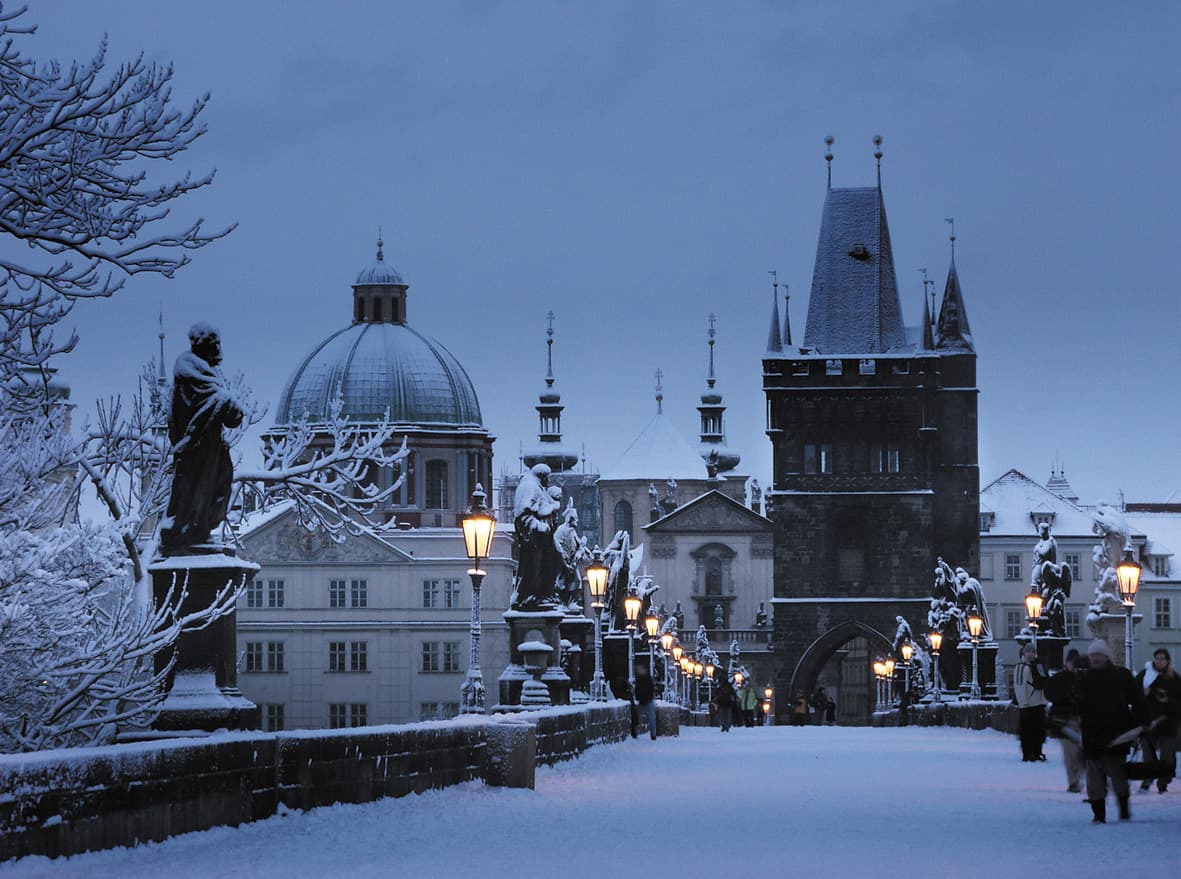
Charles Bridge
The 1357 stone bridge that Charles IV laid the foundation stone for, 516 metres of sandstone on sixteen arches, lined with a Baroque statue gallery added mostly between 1683 and 1714 and guarded by towers at both ends. Almost all the statues on the parapet today are copies; the surviving originals are split between the National Museum Lapidarium at the Exhibition Grounds and the Vysehrad casemates. The bridge is under a long incremental restoration programme running through the coming decade, carried out in sections so that it stays open and walkable throughout, so expect a hoarded stretch of balustrade rather than a closure. The honest advice is about hours, not tickets: it is free, and between about 10am and 7pm in summer it is a slow-moving crowd with caricaturists in it. Before 7am it is one of the great walks in Europe, with mist off the water and the castle catching the first light. The Old Town Bridge Tower, ticketed and run by Prague City Tourism, gives the classic elevated view back along the deck.
 Uoaei1 · CC BY-SA 4.0 via Wikimedia Commons
Old Town Hall and the Astronomical Clock
The clock has stood on this wall since 1410, which makes it the oldest astronomical clock anywhere still in operation, though not continuously: it stopped in 1865 before the watchmaker Ludvik Hainz rescued it, and the apostle figures burned with the town hall in May 1945 and were recarved by Vojtech Sucharda in 1948. Every hour between 8am and 11pm the twelve apostles process past the windows while Death rings his bell and a crowd of several hundred looks up for forty-five seconds. The show is short and the tower is the actual attraction: a lift or a ramp takes you up to a gallery with the best framed view of Old Town Square and the tiled roofs beyond. Admission is 350 CZK basic, 230 CZK reduced, 280 CZK for 16 to 26 year olds and 750 CZK family, with the tower lift charged at 100 CZK on top and guided tours of the historical interiors at 150 CZK for circuit A (the Gothic chapel, the state rooms and the underground) or 100 CZK for circuit B (the underground alone), which run only at announced times and are payable on the day at the desk rather than online. The single best-value fact in Prague: there is an early-bird discount of 50 percent off the admission fee every day during the first hour after opening, which is 9am from April to December and 10am from January to March. Prague City Tourism is the only official seller, in its own offices and online through ColosseumTicket; tickets bought elsewhere may not be valid.
 Jim Linwood · CC BY 2.0 via Wikimedia Commons
The Jewish Museum in Prague and Josefov
Not one building but a route: the Maisel, Pinkas, Klausen and Spanish synagogues, the Ceremonial Hall and the Old Jewish Cemetery, all on one ticket at 600 CZK for adults, 400 CZK for students under 26 and 200 CZK for children aged 7 to 15, valid across three opening days with one visit per site. The Pinkas Synagogue carries the names of roughly 80,000 Czech and Moravian Jewish victims of the Shoah handwritten on its walls, with the children's drawings from the Terezin ghetto upstairs; the Old Jewish Cemetery holds twelve layers of burials under leaning stones because the community was never allowed more ground. The Old-New Synagogue, completed around 1270 and the oldest synagogue in Europe still in active use, is administered separately by the Prague Jewish Community and needs its own ticket. Critical planning note: the museum is closed every Saturday and on Jewish holidays, which in 2026 means 13 and 21 and 27 September and 4 October. Hours run 9:00 to 19:00 from May to August, 9:00 to 18:00 from 1 September to 17 October, and 9:00 to 16:30 from 18 October, with ticket sales stopping thirty minutes before closing.
Jewish Museum in Prague, admission ↗Jewish Museum in Prague, opening hours ↗View on map ↗
 MedaBleda, Prague City Tourism · CC BY-SA 4.0 via Wikimedia Commons
Petrin hill, the tower and the rebuilt funicular
The wooded hill on the left bank, with orchards, the medieval Hunger Wall, a mirror maze, an observatory and the 1891 lookout tower that is a knowing 63.5-metre quotation of the Eiffel: at an eighth of the height, but standing on a hill, its top ends up a little higher above sea level than the Paris original's. Tower admission is 250 CZK basic, 170 CZK reduced, 200 CZK for 16 to 26 year olds and 500 CZK family, plus 150 CZK for the lift to the 51-metre platform, with the same 50 percent early-bird discount in the first hour after opening and a 300 CZK combined ticket with the mirror maze. The 2026 story is underneath: the funicular from Ujezd, out of service since the September 2024 rainfall wrecked the track and the slope, has been fully rebuilt with two new 120-passenger cars with glass roofs, and the operator expects trial passenger service at the turn of summer and autumn 2026. The standalone fare rises from 60 to 100 CZK, 90 CZK in the PID Litacka app, on 1 September 2026. Until then and after, the walk up through the orchards from Ujezd takes about twenty-five minutes.
Petrin Tower, Prague City Tourism ↗Petrin funicular, DPP ↗View on map ↗
 Nikolai Kolosov · Pexels
Vysehrad
The other castle, and the one visitors miss: a rock fortress on the right bank two kilometres upstream, wrapped in Baroque ramparts, with the neo-Gothic Church of St Peter and St Paul at its centre and the Slavin cemetery around it where Dvorak, Smetana, Capek and Mucha are buried. The casemates run inside the walls and hold several of the original Charles Bridge statues. Entry to the grounds is free, the ramparts give a long unbroken view down the Vltava to the castle, and on a summer evening it is families and picnics rather than tour groups. This is where we would spend a slow late afternoon on a third or fourth day, reached by tram or by walking the river path from Naplavka.
 Milan Chudoba · Pexels
Strahov Monastery and Loreta
The two high points of Hradcany, ten minutes apart on foot. Strahov is a Premonstratensian monastery founded in 1143 whose Theological and Philosophical halls are among the most photographed library rooms in the world, all globes, frescoed ceilings and gilded spines; the halls are viewed from the doorway rather than walked through, which surprises people, and the monastery brewery next door pours its own beer with a terrace view. Loreta is a Baroque pilgrimage complex around a replica of the Holy House of Nazareth, with a carillon of twenty-seven bells that plays on the hour and a treasury containing a monstrance set with more than six thousand diamonds. Both sit above the castle, so a sensible morning runs Strahov, Loreta, then downhill through the castle rather than uphill into it.
 Elijah Cobb · Pexels
Municipal House and the Art Nouveau centre
The 1912 Obecni dum beside the Powder Tower is the best single building in Prague for the century the guidebooks skip: a full Art Nouveau gesamtkunstwerk with Alfons Mucha frescoes in the Mayor's Hall, Smetana Hall as its concert heart, and a ground-floor cafe and restaurant that let you sit inside the architecture for the price of coffee. The National Committee met here on 28 October 1918 and passed the law that founded independent Czechoslovakia. Guided tours cover the interiors that concerts do not reach, and the Prague Spring festival traditionally opens in Smetana Hall. Combine it with the Mucha Museum and a walk up Parizska for the same period at street level; the Art Nouveau layer is where Prague stops being medieval and starts being modern.
 Hynek Moravec · CC BY 3.0 via Wikimedia Commons
Letna Park and the metronome
The plateau across the river from the Old Town, reached by stairs from Cechuv Bridge or gently from Hradcanska metro. Where the giant metronome ticks now, the largest group statue of Stalin in the world stood from 1955 until it was dynamited in 1962, and the plinth is still the city's favourite skateboard and sunset spot. Below and behind it, Letenske sady runs a kilometre of chestnut avenues to a beer garden of picnic tables looking straight down the line of Vltava bridges. Free, open, and the answer to where to be at 7pm in June. Bring cash: the garden counters are quicker with coins than cards.
 ŠJů (cs:ŠJů) · CC BY-SA 3.0 via Wikimedia Commons
Naplavka riverside
The stone embankment below Rasinovo nabrezi, where the old ice-store vaults in the river wall have been converted into bars, galleries and a wine room behind big round glass doors. Saturday mornings hold the city's best farmers market, running along the water from about 8am to 2pm; summer evenings fill the steps and the moored boats with people who live here. It is a fifteen-minute walk from the Dancing House to Vysehrad along the water, no ticket, no queue, and the clearest available evidence that Prague is a city rather than an exhibit.
 Vladimír Stránský · Pexels
Wenceslas Square and the National Museum
Not a square but a 750-metre boulevard laid out as a horse market by Charles IV, running up to the National Museum's neo-Renaissance bulk. This is where modern Czech history happened: the 1968 protests, Jan Palach's self-immolation in January 1969 marked by a memorial in the pavement below the museum ramp, and the crowds of November 1989 that ended communist rule. The museum reopened in 2018 after a seven-year reconstruction and its dome walkway gives an unusual axial view straight down the boulevard. The lower half of the square is the least attractive commercial stretch in central Prague and the highest-density trap for exchange windows and menu touts; walk it for the history and eat elsewhere.
 Valerii Tkachenko · CC BY 2.0 via Wikimedia Commons
Wallenstein Garden and the Mala Strana gardens
Behind the Senate on Letenska, the 1620s Wallenstein Garden opens free to the public in season: a Baroque terraced garden with a monumental sala terrena loggia, a wall of artificial dripstone grotto full of hidden faces, a pond, and peacocks that have no interest in you at all. The bronzes on the parterre are copies; the Swedes took the originals in 1648 and they are still in Sweden. Nearby, the Vrtba Garden climbs the hillside in three terraces to a view over Mala Strana roofs, and the Palace Gardens under Prague Castle link several Baroque terraces into one ticketed climb from Valdstejnska up to the castle. Between them these are the quietest half-hours available inside the UNESCO centre.
Wallenstein Garden, Senate of the Czech Republic ↗View on map ↗
 lienyuan lee / CC BY 3.0 via Wikimedia Commons
 Estec Co.Ltd, Prague Hotel Operator / CC BY 3.0 via Wikimedia Commons
Food & drink
 Patrick-Emil Zörner (Paddy) · CC BY-SA 2.0 de via Wikimedia Commons
Svickova na smetane
The Sunday-lunch heavyweight and the dish to judge a Czech kitchen by: beef sirloin braised with root vegetables, the sauce blitzed smooth and finished with cream, served with bread dumplings, a spoon of cranberry and a curl of whipped cream on top. The sweet-savoury combination reads oddly on paper and works completely on the plate.
 Ray Swi-hymn from Sijhih-Taipei, Taiwan · CC BY-SA 2.0 via Wikimedia Commons
Vepro knedlo zelo
Roast pork, bread dumplings and sauerkraut, so central to the national self-image that the phrase is used to mean ordinary Czech life. Judge it on the cabbage, which should be sharp enough to cut the fat rather than sweetened into submission.
 Pohled 111 · CC BY-SA 4.0 via Wikimedia Commons
Gulas with bread dumplings
Czech goulash is a thick beef stew, darker and less paprika-forward than the Hungarian version, eaten with dumplings and raw onion and designed around beer. Pub goulash and restaurant goulash are two different foods; the pub one is usually better.
 SMAZENYSYR2025 · CC0 via Wikimedia Commons
Smazeny syr
A slab of Edam breaded and deep-fried, served with tartare sauce and chips. Nobody claims it is refined; it is the national hangover dish, the standard vegetarian option on an old-school menu, and the thing Czechs order at 2am from a window.
 Jakub Holzer (WMCZ) · CC BY-SA 4.0 via Wikimedia Commons
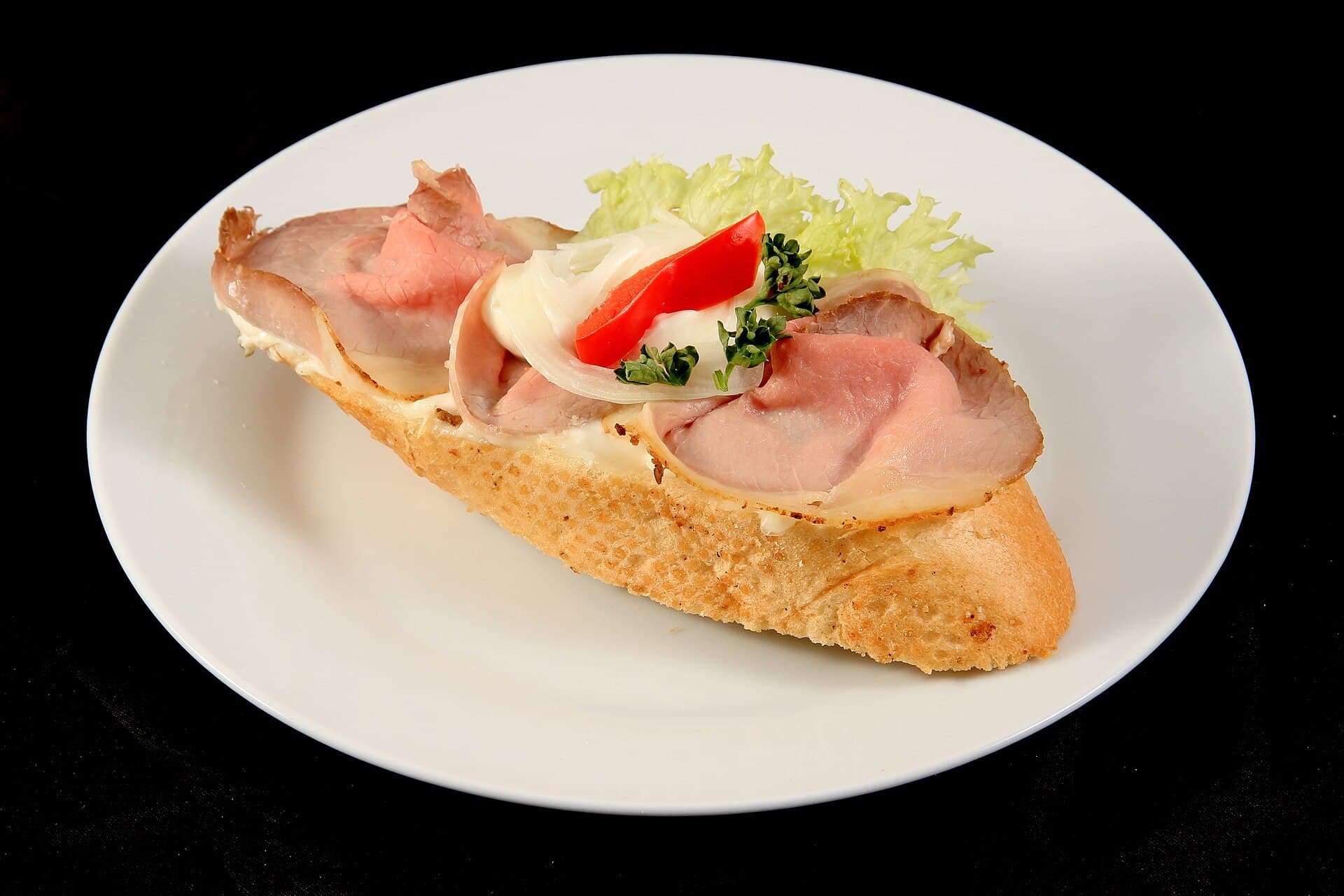
Chlebicky
Open sandwiches on a slice of white bread, built up with potato salad, ham, egg, salami or fish and finished with a garnish, sold from delicatessen counters by the piece. A first-republic institution, best from a proper lahudky counter rather than a supermarket chiller, and the cheapest good lunch in the city.
 Hert Niks · Pexels
Trdelnik, and why it is not Czech
The sugar-crusted chimney of dough sold on every corner of the Old Town is not a Prague tradition, whatever the stall signs claim: it is a recent import marketed at visitors, and the ice-cream-filled version is younger still. Eat one if you want one. Just do not mistake it for the local pastry, which is the kolace, a soft round bun with a well of poppy seed, plum or curd.
 https://www.flickr.com/photos/martavasco · CC BY-SA 2.0 via Wikimedia Commons
Tank beer (tankove pivo)
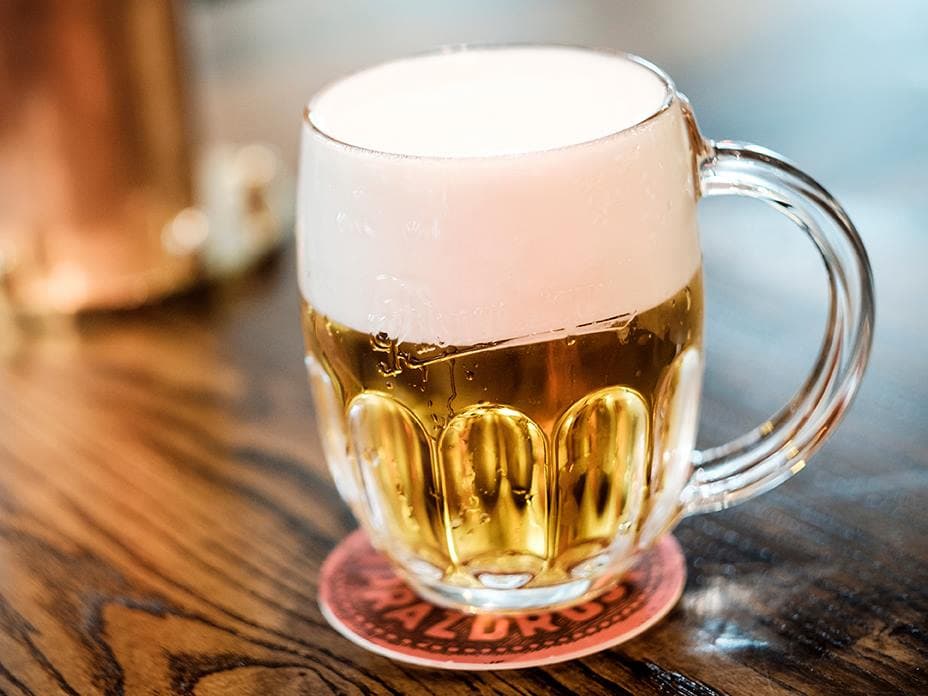
The thing Prague genuinely does better than anywhere: unpasteurised lager delivered by tanker into steel tanks in the pub cellar and pushed out under a bag of sterile air, not carbon dioxide. It has a short shelf life, which is why only busy pubs can pour it. Look for the tank in the room or the word tankova on the door.
 Steven Walling · CC BY-SA 4.0 via Wikimedia Commons
The pour, which is the point
Order by the pour, not just the beer. Hladinka is the standard glass with three fingers of dense foam, snyt is a smaller beer with a big head for a slower conversation, and mliko is a glass of almost pure sweet foam, drunk fast as a last round. Asking for one by name in a Pilsner pub is the fastest way to be taken seriously.
Prague eats early: kitchens fill from 6pm and many stop taking orders by 10. Book anything good two or three days ahead and the starred rooms weeks ahead. Beer arrives before you order it in a traditional pub and the tally is chalked on a paper slip at your table, so keep it. Tipping is by rounding up or about 10 percent, handed over when you state the total rather than left on the table; say the figure you want to pay as you hand across the money. Pay in koruna always: any terminal or menu offering a euro price is running a conversion margin against you, and dynamic currency conversion at the card machine is the most common quiet overcharge in the city. Cards are accepted almost everywhere, but beer gardens, market stalls and a few old pubs are still cash-first. Lunch menus, denni menu, are the value play at two courses for less than a single evening main at the same address.
Where to eat
Lokal Dlouhaaa
casualThe Ambiente group's flagship modern pub: a long tiled hall with fast unpasteurised Pilsner Urquell from the tank, a short blackboard of Czech classics that changes through the day, and prices that stay honest despite an address one minute from Old Town Square. Ask for a hladinka, or a snyt if you want to talk more than drink. Book or arrive before 7pm; it fills every night.
Last researched 2026-08-31
Field
fine-diningRadek Kasparek's one-star restaurant in a quiet Josefov street, doing modern cooking built on Czech and Central European produce with an a la carte alongside the tasting menu, which is the more flexible way into Prague fine dining. Open Monday to Friday 11:00 to 14:30 and 18:00 to 22:30, weekends from noon, smart casual, and not suitable for children under six. Reservations are held for fifteen minutes only, so be on time.
Last researched 2026-08-31
 Cloudz679 · CC0 via Wikimedia Commons
La Degustation Boheme Bourgeoise
fine-diningOldrich Sahajdak's one-star kitchen builds its tasting menu from nineteenth-century Bohemian cookbooks and Czech producers, served across a counter that faces the pass. The menu runs 3,500 CZK, with wine pairings at 2,000 CZK for the house selection or 3,700 CZK for the renowned-terroir flight and a non-alcoholic pairing at 1,300 CZK. Set menu only, one sitting, book weeks ahead. This is the meal that makes the argument for Czech cuisine as a cuisine.
Last researched 2026-08-31
 ŠJů (cs:ŠJů) · CC BY-SA 3.0 via Wikimedia Commons
Cafe Savoy
institutionAn 1893 cafe restored to its coffered gold ceiling, doing a serious breakfast, a proper patisserie counter and a Viennese-adjacent menu without the theatrical pricing of the Old Town institutions. Ten minutes from Charles Bridge on the left bank and a different city in temperature. Book breakfast at weekends; walk in on a weekday morning.
Last researched 2026-08-31
Kantyna
casualA butcher shop and canteen in a former bank hall: you queue at the counter, choose the cut by weight, take a paper slip and eat at long communal tables under the coffered ceiling with a beer from the tank. Steaks, tartare, sausages and soup, all Czech-sourced, all cheaper than the equivalent sit-down room. Cash and card both work; the slip system confuses first-timers for about four minutes.
Last researched 2026-08-31
Eska, and Stangl above it
modernWorth stating clearly because most guides still describe this wrong: after the 2023 renovation, the ground floor of Eska in Karlin operates as a bakery with brunch and a shop, open 8:00 to 18:00 on weekdays and from 9:00 at weekends, built around the three-stage rye sourdough loaf they call bread 33. The tasting restaurant moved upstairs and is now Stangl, named for head chef Martin Stangl, which holds one Michelin star in the 2026 Czechia selection. So: come in the morning for bread and eggs, or book the first floor for dinner. Do not turn up at 8pm downstairs expecting the old restaurant.
Last researched 2026-08-31
Sunrises
 Dilek Tunç · Pexels
Charles Bridge before seven
The most photographed bridge in Central Europe is genuinely empty at 6am, and in autumn there is mist coming off the Vltava under it. Walk east to west so the castle is ahead of you catching first light, then keep going into Mala Strana while the lanes are still shuttered. By 9am the same 516 metres is a slow-moving crowd. This is the strongest argument for jet lag in Prague.
Year-round; September and October for river mist · Tram 17 or 18 to Karlovy lazne, or a ten-minute walk from anywhere in the Old Town.
 User:Miaow Miaow · Public domain via Wikimedia Commons
Vysehrad ramparts at first light
The Baroque walls above the river face north-west down the whole line of the Vltava, so at sunrise the castle ridge two kilometres away lights up while you are still in shadow. The ramparts and grounds are open and free at that hour, and joggers and dog walkers own them; the Slavin cemetery keeps its own posted hours and opens later, so save it for the way back. Follow the river path back into town for breakfast at Naplavka.
Year-round; spring and autumn for clean light · Metro C to Vysehrad, then five minutes on foot, or twenty-five minutes along the embankment from the Dancing House.
 ŠJů (cs:ŠJů) · CC BY-SA 3.0 via Wikimedia Commons
Tram 22 up to the castle with the commuters
Board tram 22 on the left bank and ride it up through Mala Strana and the hairpins to Prazsky hrad or Pohorelec while the city is still going to work. The route climbs past the Baroque palaces, threads under the castle walls and delivers you to Hradcany before the ticket offices open, for the price of a single ticket in the app. Sit on the right going up. The cheapest good view in the city.
Year-round · Tram 22 runs from about 4:30am; a 30-minute app ticket at 36 CZK covers the ride.
Sunsets
Letna beer garden as the bridges light up
The plateau above the river looks straight down the row of Vltava bridges, so the sun drops behind the castle ridge to your right while the bridge lamps come on one by one below. Picnic tables, chestnut trees, a beer counter and no ticket. Come an hour before sundown for a table on the front row of the terrace, and bring a layer: the plateau is windier than the streets below.
April to October; the garden is seasonal · Stairs up from Cechuv Bridge, or level access from Hradcanska metro and tram.
 Chmee2 · CC BY-SA 3.0 via Wikimedia Commons
Riegrovy sady looking at the castle
The Vinohrady park slopes west, which means the whole castle ridge and the cathedral silhouette sit exactly in the sunset from a grassy bank that half the neighbourhood is lying on. This is the local version of the postcard, with a beer garden behind it, and it costs nothing. Twenty minutes on foot from Wenceslas Square, or one metro stop and a short walk.
April to October · Metro A to Jiriho z Podebrad or Namesti Miru, then eight minutes on foot.
 Ввласенко · CC BY-SA 3.0 via Wikimedia Commons
The Old Town Bridge Tower at golden hour
The Gothic tower at the Old Town end of Charles Bridge puts you directly above the deck, so you get the statues, the crowd, the river and the castle in one frame as the light goes orange. Ticketed and run by Prague City Tourism, with the same 50 percent early-bird discount logic across their towers, and small enough that late afternoon fills up. The single best paid view of the bridge itself, as opposed to from it.
Year-round
 Sergey Ashmarin · CC BY-SA 3.0 via Wikimedia Commons
Petrin hill above the orchards
The western slope of Petrin is orchard and meadow, and the benches along the path from the Hunger Wall face out over Mala Strana with the castle to the right and the whole right bank beyond. Free, quiet, and usually shared with a handful of locals rather than a crowd. With the funicular back in service the climb is optional; without it, allow twenty-five minutes up from Ujezd and time it before dark.
Year-round; May for blossom on the orchard terraces · Funicular from Ujezd when running, or walk up through the Kinsky and Petrin gardens.
Day trips
 Perituss · CC0 via Wikimedia Commons
Kutna Hora
The medieval silver town an hour east, rich enough in the fourteenth century to mint the coin that ran Central Europe and now a UNESCO site with two very different draws. St Barbara's Cathedral is a soaring late-Gothic miners' church on a terrace above the valley; the Sedlec ossuary, twenty minutes away at the other end of town, is a chapel decorated with the bones of some forty thousand people. The ossuary now runs strict timed entry with a capped capacity, tickets sold only online or at the Sedlec Information Centre on Zamecka, and photography is banned entirely inside. It is a working church and a tomb, and it asks to be treated as one. The most rewarding single day trip from Prague, and the one that most needs booking.
About 55 to 65 minutes by direct train from Praha hlavni nadrazi to Kutna Hora hlavni nadrazi, then a local shuttle train or a fifteen-minute walk to Sedlec · Full day
 Richard Mortel from Riyadh, Saudi Arabia · CC BY 2.0 via Wikimedia Commons
Karlstejn Castle
Charles IV's hilltop fortress forty minutes by train southwest, built in the 1340s to hold the imperial crown jewels and the relic collection, and restored in the nineteenth century into the fairy-tale silhouette every Czech calendar uses. Tour I covers the state rooms and needs no great planning; Tour II reaches the Chapel of the Holy Cross with its walls of semi-precious stone and painted panels, runs a small daily capacity in season only, and must be booked well ahead. Note that the castle village charges its own entry fee during the Karlstejn Wine Festival on 27 September 2026. The train drops you in the valley; the walk up takes twenty to thirty minutes through the souvenir gauntlet.
About 40 minutes by train from Praha hlavni nadrazi to Karlstejn, plus a 20 to 30 minute uphill walk · Half day
 Hans Weingartz=Leonce49 · CC BY-SA 2.0 de via Wikimedia Commons
Terezin
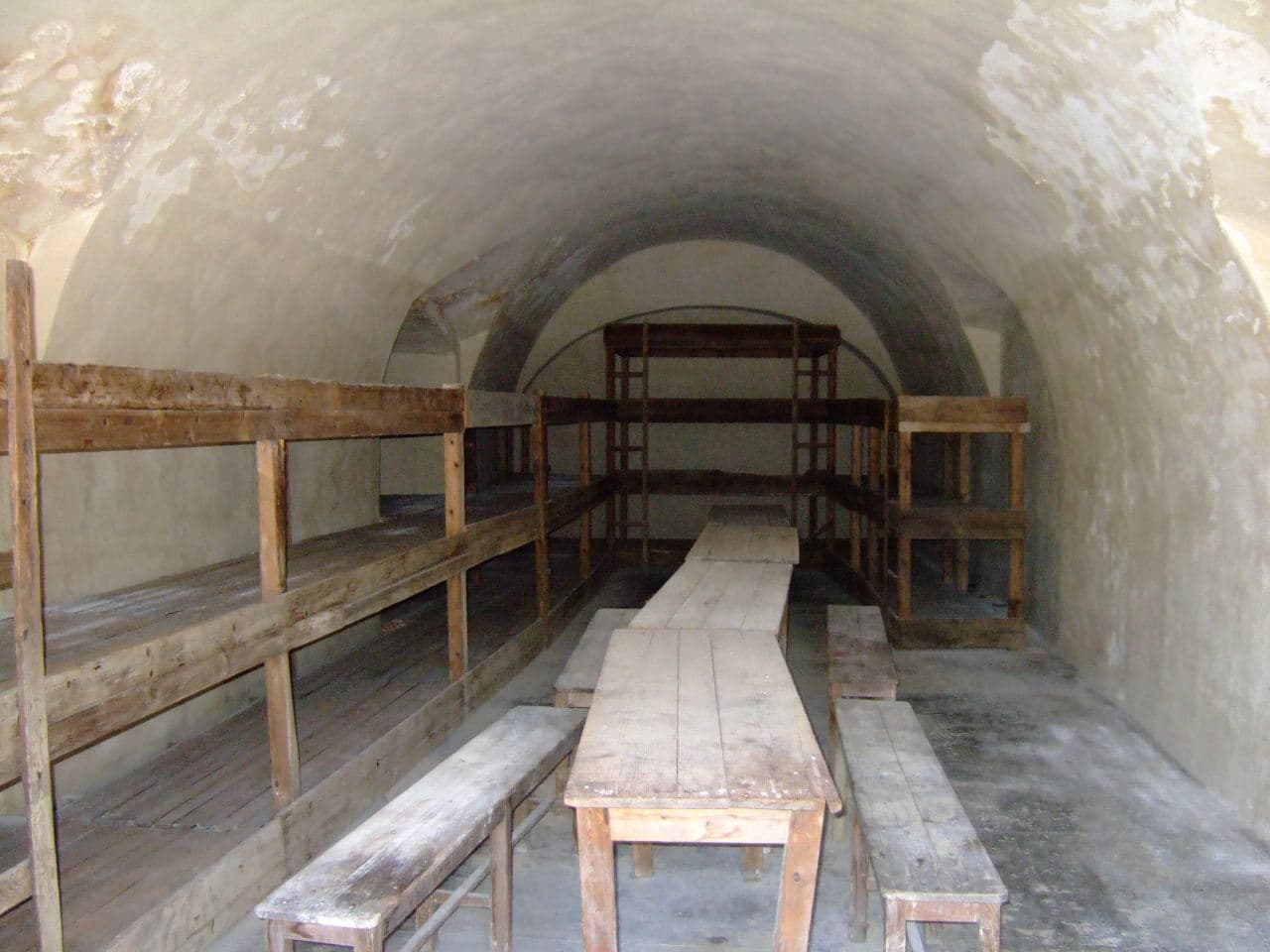
An hour north, the eighteenth-century garrison town the Nazis turned into a ghetto and transit camp, through which around 150,000 Jews passed on the way to the extermination camps in the east. The Terezin Memorial covers the Small Fortress, the Ghetto Museum and the Magdeburg Barracks, and the site is documented with unusual care because the SS used Terezin as a propaganda showpiece and filmed it. This is a heavy day and not a sightseeing one; go with time, go with the audio guide or a serious guide, and leave the afternoon after it unscheduled. Many visitors pair it with the Pinkas Synagogue and the Terezin children's drawings in Prague, in either order.
About 1 hour by direct bus from Prague Nadrazi Holesovice · Half to full day
 Magda Ehlers · Pexels
Cesky Krumlov
The Renaissance river town in South Bohemia wrapped in a double loop of the Vltava under a castle with a painted tower, and the most photographed small town in the country. It is genuinely beautiful and genuinely far: about two and a half to three hours each way by bus, which makes a day trip five to six and a half hours of travel for four or five hours on the ground. Our honest read is that it deserves an overnight rather than a day, and that if you only have three nights in Prague, Kutna Hora is the better use of the day. If you do go, take the direct RegioJet or FlixBus from Na Knizeci or Florenc rather than the train, which has an awkward timetable for a day return.
About 2 hours 25 minutes to 3 hours 10 minutes each way by direct bus · Overnight preferred; a very long full day if you must
 Max Hauner · CC BY-SA 4.0 via Wikimedia Commons
Bohemian beer country: Plzen and the brewery towns
Pilsner Urquell was first brewed in Plzen in 1842 and invented the pale lager the entire world now drinks, and the brewery tour there ends in the historic cellars with an unfiltered, unpasteurised glass poured straight from an oak lager barrel, which is the one you cannot buy anywhere else. Plzen is about an hour and a half by train or bus from Prague. Closer alternatives if the day is short: the Budweiser Budvar brewery at Ceske Budejovice on the way to Cesky Krumlov, or the small monastery brewery at Strahov inside Prague itself. Book the English-language tour slot online; they sell out in summer.
About 1 hour 30 minutes each way to Plzen by train or bus · Half to full day
After dark
 Margo Evardson · Pexels
A tank beer evening, done as a route
barNot a pub crawl, which is now regulated for good reason, but three stops at a walking pace: a modern tank pub for the correct pour, an old room with a paper tally and no English menu, and a small brewery taproom for something that is not a pale lager. Order by pour name, keep the slip, tip by rounding when you say the total. The rule that matters after 10pm is the quiet-hours one: Prague is a residential city above the ground floor.
 Elijah Cobb · Pexels
A concert in a building worth the ticket
cultureThe Rudolfinum on the river, Smetana Hall inside the Municipal House, the State Opera and the National Theatre all sell seats at prices Vienna and Paris cannot approach, and the buildings alone repay the evening. Check the actual house calendars rather than the leaflets pressed on you in the Old Town, which mostly sell short tourist recitals in churches at inflated prices. Dress smart-casual, arrive early and walk the foyers.
 Efrem Efre · Pexels
The centre after the day-trippers leave
walkBetween about 9pm and midnight the Old Town lanes, the Charles Bridge and the castle steps empty out and light up, and the walk from Old Town Square over the bridge and up to the castle viewpoint is the best free hour in Prague. Almost everything is floodlit, the trams still run, and the crowd thins street by street the further you get from Dlouha. Take the same route you did at 10am and it is a different city.
 Thomas Ronveaux · Pexels
An hour on the water
cultureThe Vltava at night gives you the bridges, the castle and the Old Town from the angle the city was designed to be seen from. The plain one-hour sightseeing boats cover much the same stretch of river as the dinner cruises for a good deal less money, and the small wooden boats that thread the Certovka mill stream under Kampa are the more atmospheric version. Book a departure late enough to be fully dark in summer.
Daily itinerary
Three days in Prague: the two banks and the hill
The classic city for first-timers, arranged so that the famous places happen at the hours they are bearable: the bridge and the castle early, the museums at midday, the hills at sunset, dinner off the tourist spine.
- 1
Old Town, Josefov and the first crossing
fullOld Town Square at the 9am opening for the early-bird half-price tower ticket, then the astronomical clock on the hour from below and the lanes of the Old Town on foot.Chlebicky from a lahudky counter, or the two-course denni menu at a bistro off the square.The Jewish Museum route through Josefov: Pinkas, the Old Jewish Cemetery, the Spanish Synagogue. Not a Saturday, and not 13, 21 or 27 September or 4 October 2026, when it is closed.The Old Town Bridge Tower for the view down Charles Bridge, then walk the bridge as the lamps come on.Lokal Dlouhaaa for tank Pilsner and the Czech canon, booked a day ahead.The Old Town lanes after nine, when they empty and light up.Entirely on foot, so buy single 36 CZK app tickets for any hop today. For a three-night trip the arithmetic favours two 24-hour app passes on days 2 and 3 at 140 CZK each, 280 CZK in all, over one 72-hour pass at 340 CZK whose third day you would waste. Either covers the funicular; singles beat both only if you make seven journeys or fewer.Estimate: Saturday or a Jewish holiday: swap Josefov for the Municipal House tour and the Mucha Museum, and move the museum route to day 3.
- 2
The left bank, top down
fullTram 22 up to Pohorelec, then Strahov's library halls and Loreta before the coaches, walking downhill into the castle rather than up into it.A canteen or cafe inside Hradcany, or descend to Mala Strana and eat properly on Malostranske namesti's side streets.Prague Castle Main Circuit: St Vitus, the Old Royal Palace, St George's Basilica, Golden Lane. The ticket is valid two consecutive days, so there is no need to force all four now.Petrin: the funicular from Ujezd if it is running, otherwise the twenty-five-minute walk up, for the orchard benches and the tower.Cafe Savoy at the foot of the Legion Bridge, or back across the river to Kantyna.An hour on the water, or a concert at the Rudolfinum if the calendar cooperates.Tram 22 up, gravity down, funicular or feet on Petrin, tram or a bridge back. The 24-hour pass covers all of it including the funicular.Estimate: Rain: give the whole afternoon to the castle interiors and the National Gallery at the Schwarzenberg Palace, both indoors, and take the view from the Municipal House cafe instead.
- 3
The city that is not medieval
moderateVysehrad ramparts and the Slavin cemetery, free and quiet, then the river path north along the water.Naplavka: the Saturday farmers market if the timing lands, otherwise the vaults and the boats.Karlin: bread and coffee at Eska, then Vitkov hill, or trade the whole afternoon for the National Museum and Wenceslas Square.Letna beer garden as the bridge lamps come on, or Riegrovy sady if you are based east.Field or Stangl if the trip earns a one-star finale, booked weeks ago; otherwise a Vinohrady bistro.One last crossing of Charles Bridge after ten.Metro C to Vysehrad, walk the embankment, metro B or tram to Karlin, tram to Letna. Nothing today needs a taxi until the airport does.Estimate: Flying out in the afternoon: invert the day, do Vysehrad at 7am, then metro A to Nadrazi Veleslavin and bus 119. Allow about an hour from a central hotel door to the terminal, plus whatever check-in window your airline asks for.
Five days: Prague, a Gothic day out and the beer country
The three-day city at a civilised pace, plus the Kutna Hora ossuary booked properly and either Karlstejn or Plzen. The version that turns a city break into a small Bohemian holiday.
- 1
Arrive and calibrate on the river
relaxedLand, bus 119 to Nadrazi Veleslavin and metro A into the centre, about 40 minutes on a single 90-minute app ticket at 46 CZK. Do not start the 72-hour pass yet: activate it tomorrow morning so its 72 hours cover days 2, 3 and 4 rather than expiring mid-afternoon on day 3.First chlebicky or a lunch menu near the hotel.The embankment end to end: the Dancing House, Naplavka, then north through the Old Town to get the geography into your legs.Charles Bridge at dusk, walked slowly.Lokal Dlouhaaa, or a Vinohrady bistro if you are based east.An early night; tomorrow starts at nine.Bus 119 plus metro A costs less than a quarter of the Airport Express; the AE doubled to 200 CZK in January 2026 and does not accept normal passes. Buy the arrival ride as a single ticket and hold the 72-hour pass back for tomorrow.Estimate: Late arrival? Skip the embankment walk and put it on day 2 before the museum.
- 2
Old Town and Josefov in full
fullOld Town Hall at opening for the early-bird half-price ticket and the tower.Denni menu off the square.The Jewish Museum route through Josefov, the Art Nouveau blocks along Parizska while you are on them, then east across the Old Town to the Municipal House.The Old Town Bridge Tower.Field, booked ahead, or La Degustation if the set menu appeals.A concert at the Rudolfinum or Smetana Hall.All on foot. Watch the Josefov closures: Saturdays and Jewish holidays.Estimate: If it is a Saturday, run day 4 today and move this forward.
- 3
Hradcany, the castle and Petrin
fullTram 22 to Pohorelec, Strahov and Loreta, then downhill to the castle gates.Mala Strana side streets rather than Nerudova.The castle Main Circuit, unhurried. If you run out of afternoon, the ticket is valid again tomorrow, but day 4 is built around a timed Sedlec slot that cannot be moved, so keep the leftover interiors for the open afternoon on day 5 instead.Petrin by the funicular if it has resumed carrying passengers, otherwise the twenty-five-minute walk up from Ujezd, then the orchard benches and the tower if the queue is short.Cafe Savoy or a left-bank room; Mala Strana closes early, so book.The mill-stream boats under Kampa, or the bridge again after ten.Tram 22 up, funicular on the pass if it is running, tram 9, 12, 15, 20 or 22 along the left bank. The 24-hour and 72-hour passes cover the funicular; 30-minute and 90-minute tickets never have.Estimate: Funicular still not running: walk up from Ujezd through the Kinsky gardens, 25 minutes, and take the tower off the list if legs are done.
- 4
Kutna Hora, booked in advance
fullTrain from Praha hlavni nadrazi, about an hour, then the Sedlec ossuary on the timed ticket you bought weeks ago. Photography is not permitted inside, so put the phone away at the door.In the historic centre, up the hill from Sedlec.St Barbara's Cathedral and the terrace walk, then the Italian Court or the silver-mine tour if there is time.Back on the train, resting honest legs.Kantyna or Karlin, ten relaxed minutes from most bases.A quiet beer and an early night.The ossuary sells only online or at the Sedlec Information Centre on Zamecka; the capacity is capped and it does sell out. Book before you book the hotel breakfast.Estimate: Prefer castles to bones? Swap the whole day for Karlstejn with Tour II booked, which is a half day and leaves the afternoon in Prague.
- 5
The other Prague and the send-off
moderateVysehrad at opening, then the river path and Naplavka.Eska in Karlin for bread and eggs, or the Naplavka market on a Saturday.Your pick: the National Museum, or DOX and the market halls in Holesovice.Letna or Riegrovy sady, whichever is closer to your bed.Stangl above Eska as the finale, or a last svickova somewhere unpretentious.A final walk over the bridge, which is the correct closing image.Metro and trams throughout; metro A to Nadrazi Veleslavin then bus 119 back to the airport, about an hour from a central hotel door to the terminal, plus whatever check-in window your airline asks for.Estimate: Want Plzen instead? It needs the whole day, about three hours of return travel plus a prebooked brewery tour, so give it day 5 in place of everything above and fly out on day 6. · Early flight: do Vysehrad the evening before and give the morning to packing and one last coffee at Cafe Savoy.
Getting around
- Vaclav Havel Airport Prague (PRG) sits 17km west of the centre and has no rail or metro link, which is the single most important thing to know about arriving here. The cheap and fast route is bus 119 to Nadrazi Veleslavin and metro A into town, about 40 minutes in total and covered by an ordinary 90-minute ticket at 50 CZK on paper or 46 CZK in the PID Litacka app. Bus 100 runs to Zlicin on metro B for the same fare if your hotel is south. The dedicated Airport Express coach to the main station doubled from 100 to 200 CZK on 1 January 2026 and normal passes are not valid on it, which makes it poor value for most travelers.
- Taxis and ride-hailing from the airport run roughly 600 to 900 CZK to the centre depending on traffic and time. Use the official taxi ranks outside the terminals or an app; never accept a car from someone approaching you inside the terminal.
- International trains arrive at Praha hlavni nadrazi, an Art Nouveau station with a modern concourse grafted underneath and a metro C stop inside it. Vienna is about four hours, Berlin about four and a quarter, Dresden about two and a quarter, Budapest about seven. The Prague to Vienna and Prague to Dresden corridors are frequent enough to make a two-city trip easy.
- Long-distance buses use Florenc and Na Knizeci (Andel, metro B). RegioJet and FlixBus dominate the domestic and cross-border routes and are usually cheaper and no slower than the train to Cesky Krumlov and Plzen.
- The whole network is one integrated system (PID): three metro lines, a very dense tram network including 24-hour night trams, buses, funicular and some suburban trains. It is fast, frequent and one of the best-run transport systems in Europe. Prague-only fares from 1 January 2026: 30 minutes 39 CZK on paper or 36 CZK in the app, 90 minutes 50 CZK or 46 CZK, 24 hours 150 CZK or 140 CZK, 72 hours 350 CZK or 340 CZK. SMS tickets are the worst of the three channels: 42 CZK for 30 minutes and 55 CZK for 90, and 150 and 350 CZK for the day passes, which merely matches paper rather than beating it. They also work only on Czech mobile networks.
- Buy in the PID Litacka app. The 2026 tariff was deliberately designed so the app is cheaper than paper on every single ticket type, paper rose 25 to 30 percent and SMS by as much as 35 percent, and the app removes the validation step that catches most visitors out. A paper ticket must be stamped in the yellow validator on your first boarding or at the metro entrance; an unvalidated ticket is treated as no ticket.
- The 24-hour and 72-hour passes are the only short-term tickets valid on the Petrin funicular; the 30-minute and 90-minute tickets are explicitly not. That is the buying decision for anyone planning to ride it, because the standalone funicular fare goes to 100 CZK, or 90 CZK in the app, from 1 September 2026.
- Inspectors are plain-clothed, numerous and completely unmoved by tourist explanations. The 2026 penalty for travelling without a valid ticket is 1,200 CZK paid on the spot, 1,500 CZK if you pay within 15 days and 2,000 CZK after that. Large luggage and dogs need their own 25 CZK ticket.
- Shared e-scooters are gone. Prague banned shared e-scooter rentals across the entire city from 1 January 2026 after years of pavement complaints and accidents, so operators including Lime and Bolt no longer run here. Shared bikes remain, with tighter parking rules.
- Trams are the sightseeing you get for free: 22 climbs to the castle through Mala Strana, 17 runs the right bank along the river, 2 and 18 thread the centre. Night trams take over from about midnight, all crossing at Lazarska, and they run every 30 minutes.
- Taxis are metered and legal, but Prague's taxi trade has a long history with visitors: use Bolt or Uber, or a rank outside a hotel, and never a car offered to you on the street outside a bar.
Things worth knowing
- · Paying in euros, or accepting the card machine's offer to charge in your home currency. Czechia uses the koruna and will for the foreseeable future, and every euro price or dynamic conversion offer carries a margin. Always choose CZK on the terminal.
- · Changing money at a street exchange window near the sights. Czech law since 1 April 2019 gives you three hours to cancel a bureau-de-change transaction of up to 1,000 EUR and be refunded at the previous day's Czech National Bank rate, and that right must be printed on the rate board and the receipt in Czech and English. If it is not, walk away. Better still, withdraw from a real bank ATM and skip the windows entirely.
- · Riding without validating a paper ticket. Buying it is not enough; it must be stamped on first use, and the 1,200 CZK on-the-spot fine is the most common bad memory visitors take home from Prague.
- · Buying the Airport Express out of habit. It doubled to 200 CZK in January 2026 and does not accept passes; bus 119 plus metro A costs 46 CZK in the app and is barely slower.
- · Booking Sedlec ossuary tickets on arrival. Capacity is capped, entry is timed, and tickets are sold only online or at the Sedlec Information Centre. Turning up at the door in summer means not getting in.
- · Planning a Josefov day on a Saturday. The Jewish Museum sites are closed every Saturday and on Jewish holidays, which in 2026 includes 13, 21 and 27 September and 4 October.
- · Assuming Eska in Karlin is still an evening restaurant. Since 2023 the ground floor is a bakery and brunch room closing at 6pm, and the tasting restaurant upstairs is Stangl.
- · Booking a room on the Dlouha and Dusni bar spine and expecting to sleep. The pub crawls are banned between 10pm and 6am and public drinking is prohibited at the designated places across the core, but the quarter is still loud on a Friday. Choose Vinohrady, Karlin, Letna or a courtyard-facing room.
- · Following anyone who offers to take you to a club, a strip bar or a better exchange rate. Selling tours on the street in the city centre is illegal in Prague 1, and the bill at the other end of a street promoter's invitation is the oldest story in this city.
Budget
| Low | Expected | Comfortable | |
|---|---|---|---|
| Accommodation style / per night | CZK 2,200≈ $101 | CZK 5,200≈ $239 | CZK 18,000≈ $826 |
| Food style / per day | CZK 500≈ $23 | CZK 1,400≈ $64 | CZK 5,000≈ $230 |
| Local transport / per day | CZK 50≈ $2 | CZK 140≈ $6 | CZK 900≈ $41 |
| Estimate / per day | CZK 200≈ $9 | CZK 800≈ $37 | CZK 2,200≈ $101 |
Estimate · CZK · 2026-08-31. Accommodation is per room per night for two sharing. At the Czech National Bank rate of 24.150 CZK to the euro on 28 August 2026, 5,200 CZK is about 215 EUR and buys a good four-star double in or beside the centre; the palace conversions in Mala Strana price internationally and the 18,000 CZK line reflects them. Food splits sharply: a chlebicky counter and a pub lunch menu keep a day under 500 CZK, while the five Prague restaurants with Michelin stars price in euros in all but name (La Degustation's menu alone is 3,500 CZK before wine). Transport is close to free by Western European standards; the 72-hour app pass at 340 CZK covers three days including the funicular. The line items that inflate a real budget are the castle and museum tickets for two, the Jewish Museum at 600 CZK a head, river cruises, and the Old Town's beer pricing, which can be triple the neighbourhood rate two tram stops away. A tourist accommodation fee of 50 CZK per person per night, about 2 EUR, is added on top of room rates and remains one of the lowest in urban Europe, though Prague 1 has been lobbying to raise it toward the roughly 175 CZK European average. · 1 USD = CZK 22 (15 Oct 2026)
Things worth knowing
Frequently asked questions
How many days do you need in Prague?
Three nights covers the classic city properly: one day for the Old Town and Josefov, one for the castle and the left bank, one for Vysehrad, Karlin and the parts that are not medieval. Four or five nights add Kutna Hora or a Bohemian castle, a second look at the castle on the same two-day ticket, and the slower pace the city actually rewards. Prague also pairs easily with Vienna at about four hours by train, or Dresden at two and a quarter.
When is the best time to visit Prague?
May, June and September for the best weather-to-crowd ratio, with late May and September the two windows we would book first. April and October are quieter, cooler and cheaper. July and August are warm, long-lit and at peak density. December has the Christmas markets from 28 November to 6 January and its own price spike, and January to March is the cheapest, coldest and emptiest version of the city. There is no closed season.
Is the Petrin funicular running again?
It is coming back. The funicular has been out of service since September 2024, when extreme rainfall damaged the track and the whole Petrin slope, and it has been fully rebuilt with two new cars carrying 120 passengers each under glass roofs. The operator expects trial passenger operation at the turn of summer and autumn 2026, and the new single fare of 100 CZK, or 90 CZK in the PID Litacka app, takes effect on 1 September 2026. Check the DPP page before you plan a day around it, and note that only the 24-hour, 72-hour and long-term passes cover it: the 30-minute and 90-minute tickets never have.
How should you get from Prague airport to the centre?
Bus 119 to Nadrazi Veleslavin then metro A, about 40 minutes for 46 CZK on a 90-minute ticket in the PID Litacka app. There is no train or metro at the airport: the rail spur planned off the Kladno line is still years from service, and metro line D, whose Olbrachtova to Nove Dvory section is under construction on a 72-month programme with passenger service targeted for the 2030s, does not go there anyway. The Airport Express coach doubled to 200 CZK on 1 January 2026 and does not accept passes, so it is now poor value unless you are going directly to the main station with luggage. A taxi or Bolt runs roughly 600 to 900 CZK.
Which transport ticket should you buy?
The 72-hour pass in the PID Litacka app at 340 CZK if you are staying three days or more, or the 24-hour at 140 CZK for a short stay. The 2026 tariff was designed to price every short-term app ticket below its paper equivalent, and buying in the app removes the validation step that generates most of the fines visitors collect. The passes are also the only short-term tickets valid on the Petrin funicular. If you are walking almost everywhere, single 30-minute tickets at 36 CZK in the app are fine.
Where should you stay in Prague for the first time?
The Old Town if you have three nights and want to walk out of the door into it, choosing a courtyard-facing room off the Dlouha and Dusni bar spine. Vinohrady for a real neighbourhood with the best food density, fifteen minutes on foot from the centre and a full price band cheaper. Karlin for design hotels and eating, two metro stops out. Mala Strana for beauty and quiet, accepting that dinner usually means crossing a bridge and that the hill is real.
Is Prague expensive?
Against Western European capitals, no. Transport, museums, pubs and everyday eating all run clearly cheaper than Vienna or Paris, and the 46 CZK ninety-minute ticket is among the best transport value in Europe. The exceptions price internationally: the five Michelin restaurants, the palace hotels, river dinner cruises, and Old Town beer, which can be three times the rate two tram stops away. A couple eating well but not grandly lives comfortably on 2,000 to 3,500 CZK a day plus the room, and the 50 CZK per person per night accommodation fee is still among the lowest in urban Europe.
Is Prague safe?
One of the safer European capitals for visitors: violent crime against tourists is rare and the centre is busy late. The real risks are commercial rather than physical. Pickpockets work the 22 tram, Charles Bridge and the Old Town crush; street exchange windows and dynamic currency conversion skim the unwary; and the classic clip-joint bar at the end of a street promoter's invitation still exists. Never follow a promoter, never take an unbooked taxi from outside a bar, always choose koruna at the card machine, and standard city sense covers the rest.
Do you need to book anything ahead in Prague?
Four things. The Sedlec ossuary at Kutna Hora, which is timed, capacity-capped and sold only online or at its own information centre. Karlstejn's Tour II if you want the Chapel of the Holy Cross, which runs a small seasonal capacity. The starred restaurants, weeks out. And a hotel bed in December, which is the tightest month of the year. Prague Castle, the Old Town Hall and the Jewish Museum all absorb walk-ups if you arrive at opening.
What is closed on which days?
The Jewish Museum sites in Josefov close every Saturday and on Jewish holidays, which in 2026 means 13, 21 and 27 September and 4 October. Most Czech museums close on Mondays, including the National Gallery collections; Prague Castle's interiors, the Old Town Hall and Petrin Tower are open daily. Prague Castle historical buildings run 9am to 5pm April to October and 9am to 4pm November to March; the Old Town Hall runs 9:00 to 20:00 April to December and 10:00 to 19:00 January to March. Always check the specific site the week before, because winter hours move.
Can you drink the tap water, and how does tipping work?
Tap water is safe and good across Prague, though restaurants will still try to sell you a bottle, so ask specifically for tap water. Tipping is by rounding up or roughly 10 percent, and the mechanism matters more than the number: when the server tells you the total, say the amount you want to pay as you hand over the cash or before the card goes in the machine, rather than leaving coins on the table afterwards. In pubs the tally is kept on a paper slip at your table; keep it, and check it before you settle.
Sources (18)
- Prague-only PID fare pricelist from 1 January 2026 including funicular validity by ticket type and the 25 CZK luggage and dog fare · transport-operator · 2026-08-31
- 2026 PID tariff changes and penalty amounts for travelling without a valid ticket · transport-operator · 2026-08-31
- Petrin funicular suspended since September 2024 storm damage, full reconstruction and new cars, trial passenger operation expected at the turn of summer and autumn 2026 · transport-operator · 2026-08-31
- Old Town Hall and Astronomical Clock 2026 opening hours, admission prices, tower lift fee, guided circuit surcharges and the 50 percent early-bird discount in the first hour after opening · tourism-board · 2026-08-31
- Petrin Tower 2026 admission, lift fee, combined tickets and the 9 Prague Sights in 365 Days ticket at 990 CZK · tourism-board · 2026-08-31
- Jewish Museum in Prague admission prices and three-opening-day ticket validity across the museum's synagogues, the Ceremonial Hall and the Old Jewish Cemetery · official · 2026-08-31
- Jewish Museum in Prague 2026 seasonal opening hours, closure every Saturday, and the 2026 Jewish holiday closure dates of 13, 21 and 27 September and 4 October · official · 2026-08-31
- Sedlec ossuary timed capacity-capped ticketing sold only online or at the Sedlec Information Centre, 220 CZK adult admission, photography ban, luggage rules and reconstruction running to at least 2030 with no barrier-free access from 1 October 2025 · official · 2026-08-31
- MICHELIN Guide Czechia 2026 starred list: nine starred restaurants nationally, Papilio in Vysoky Ujezd the only two-star, with Field, La Degustation Boheme Bourgeoise, Levitate, Stangl and Casa De Carli holding one star in Prague · official · 2026-08-31
- Czech National Bank reference exchange rates for 28 August 2026 · government · 2026-08-31
- Czech National Bank consumer rules for bureau-de-change clients including the three-hour right to cancel an exchange of up to 1,000 EUR · government · 2026-08-31
- Prague ban on shared e-scooter rentals across the entire city from 1 January 2026 · government · 2026-08-31
- Historic Centre of Prague inscribed on the UNESCO World Heritage List in 1992 · unesco · 2026-08-31
- Prague Castle removed its blanket entrance security checks and recorded a record year of around nine million visitors in 2025, some 700,000 above 2024 · reputable-local · 2026-08-31
- Czech beer consumption fell 3.2 percent to 121 litres per person in 2025, an all-time low, while Czechia remained the world leader in per-head beer consumption for a 32nd consecutive year, a run the association dates to the early 1990s, with domestic production down 4.3 percent to 19.96 million hectolitres · reputable-local · 2026-08-31
- Prague banned organised night-time pub crawls between 10pm and 6am from November 2024, with fines for organisers of up to 100,000 CZK · tourism-board · 2026-08-31
- Prague accommodation fee remains 50 CZK per person per night, with Prague 1 lobbying for an increase toward the roughly 175 CZK European city average · reputable-local · 2026-08-31
- Fairmont Golden Prague reopened on 15 April 2025 in the former InterContinental Prague, the 1968 to 1974 Brutalist building by Karel Filsak, as Fairmont's first Central European hotel with 320 rooms and six restaurants and bars · official · 2026-08-31