France · Ile-de-France
Paris
Split your stay between the Right Bank (Le Marais for food and history, Montmartre for hills and light) and the Left Bank (Saint-Germain-des-Prés and the Latin Quarter for bookshops, cafes and the Sorbonne). Book the Louvre, Versailles and the Notre-Dame towers ahead.
 Shuichi Aizawa / CC BY 2.0 via Wikimedia Commons
Overview
Paris works on a first visit and on a tenth. The Louvre and the Eiffel Tower live up to their names, but most of the city’s character sits in its neighborhoods, each with its own market, pace and light. The Seine runs through all of it, and its historic banks are listed by UNESCO. From Tel Aviv it is one of the easiest trips in Europe: El Al, Air France, Arkia and Transavia fly nonstop from Ben Gurion.
If you only take one thing from this guide: book the Louvre, Versailles and any tower climb before you land, and give Montmartre a whole evening instead of a rushed midday stop. After 6pm the crowds thin and the light softens.
Best for
First-time visitors · Couples · Museum lovers · Food and wine · Walkers and people-watchers
Daily itinerary
4 to 6 days
Few cities fit this much art, architecture and food into a center you can cross on foot. One afternoon can take you from a Gothic cathedral to the Impressionists to a neighborhood market without a taxi.
Best time to visit
April to June and September to October are the easiest months: mild weather, gardens in bloom or turning color, and noticeably thinner queues than the July to August peak, when many small restaurants close for the owners’ own holiday.
- April to May: Chestnut blossoms, mild days, occasional rain; a strong pick for gardens and terraces.
- June: Long daylight, warm but rarely oppressive; Fête de la Musique fills the streets on the 21st.
- July to August: Peak tourist season and heat; some independent restaurants close for summer holidays.
- September: Back-to-school energy, mild weather, one of the best all-round months.
- October: Crisp air, autumn color in the parks, thinner crowds before the holiday season.
Things worth knowing
- Fête de la Musique (June 21): free live music across every arrondissement.
- Bastille Day (July 14): military parade on the Champs-Élysées and fireworks at the Eiffel Tower.
- Nuit Blanche (early June; 6 June in 2026): a free all-night contemporary art event across the city.
Where to stay
Le Marais
Narrow medieval lanes, Renaissance mansions, the Jewish quarter around Rue des Rosiers, and the Place des Vosges. Paris’s best concentration of small boutiques, falafel counters and hidden courtyard cafes.
Best for: First-time visitors · Food · Shopping · Architecture
Very busy on weekends; many shops close on Saturdays for Shabbat around Rue des Rosiers.
Saint-Germain-des-Prés
The Left Bank’s literary heart: historic cafes (Les Deux Magots, Café de Flore), the Musée d’Orsay nearby, and some of the city’s best food shopping around Rue de Buci and Rue de Seine.
Best for: Couples · Cafes and bookshops · Museums
The famous cafes are priced for the address, not the coffee; better tables are a few streets back.
Montmartre
A hilltop village with a working vineyard, the Sacré-Cœur basilica, and the steep, stepped streets that inspired a century of painters. Best experienced in early morning or evening once the day-trip buses thin out.
Best for: Views · Romance · Art history
Place du Tertre is a tourist trap for portraits and prices; the surrounding streets are the real draw.
Latin Quarter
The old university district around the Sorbonne and the Panthéon, with Shakespeare and Company, the Jardin du Luxembourg nearby, and cheap, dense student-era eating streets.
Best for: Students at heart · History · Value dining
Rue de la Huchette is a tourist-menu strip; walk a block or two further for better food at similar prices.
Where to sleep
Hôtel du Petit Moulin
boutique · Le Marais
Best for: Design lovers · Couples · Le Marais base
- Interiors by Christian Lacroix, with every room decorated differently
- Set in what the hotel calls the oldest bakery in Paris, from the time of Henri IV, behind a listed 1900 shopfront
- In the upper Marais, within walking distance of most of the center
- Small rooms typical of historic Marais buildings
- No elevator to every floor
- Street noise on lower floors
Hôtel Emile
boutique · Le Marais
Best for: Couples · Design on a mid-range budget · Le Marais base
- Contemporary design at a fair price for the location
- Most rooms have a balcony over the Saint-Paul church or the Marais streets
- Saint-Paul Métro (line 1) at the door, and a walk to the Pompidou and Place des Vosges
- Compact rooms
- Breakfast is included only when you book on the hotel’s own site
Hôtel Saint Germain
boutique · Saint-Germain-des-Prés / Rue du Bac
Best for: Couples · A quiet Left Bank base · Museum-hopping
- A former 17th-century mansion at 88 Rue du Bac
- Close to the Musée d’Orsay and Le Bon Marché
- Only 29 rooms, some over a tree-lined courtyard or a private terrace
- Some rooms face Rue du Bac rather than the courtyard
- Entry-level rooms are small, from 12 square meters
- No pool or spa
Hôtel Particulier Montmartre
unique · Montmartre
Best for: A special occasion · Design lovers · Privacy
- Just five suites, 35 to 85 square meters, each designed with visual artists
- Set in a protected garden, the last piece of the old Maquis de Montmartre
- Tucked between Avenue Junot and Rue Lepic, away from the Sacré-Cœur crowds
- Very few rooms, books out early
- Expensive for what is essentially a five-room house
- Not walkable to central sights, a short taxi or funicular away
Hôtel du Levant
value · Latin Quarter
Best for: Budget-conscious couples · A Left Bank base · Families
- Run by the same family since 1920
- Two blocks from the Seine, a short walk from Notre-Dame
- Breakfast built around regional produce
- Simple rooms, not design-forward
- Some street noise from Rue de la Harpe
Essential experiences
Eiffel Tower
The 1889 iron tower that defines the skyline; book lift or stair tickets in advance and go early or late to avoid the longest queues.
Musée du Louvre
The world’s most-visited museum: the Mona Lisa, the Venus de Milo, and enough galleries to fill several days. Closed on Tuesdays, open until 9pm on Wednesdays and Fridays. Since 14 January 2026 adults from outside the European Economic Area, Israelis included, pay 32 euros (22 euros for EEA residents), and booking a time slot is recommended for everyone.
Musée d’Orsay
The Impressionist and Post-Impressionist collection, in a converted Belle Époque train station on the Left Bank. Closed on Mondays and open until 9:45pm on Thursdays; a full ticket is 16 euros online or 14 euros at the desk, the same price for every nationality.
Notre-Dame de Paris
The Gothic cathedral, open again since December 2024 after the 2019 fire. Entry is free every day; free time slots are released on the official site a few hours ahead, and tickets resold elsewhere are worthless. The towers reopened in September 2025 and need a paid online booking (16 euros, 424 steps).
Official Notre-Dame de Paris site ↗Towers of Notre-Dame ↗View on map ↗
Basilique du Sacré-Cœur
The white-domed basilica on top of Montmartre. The nave is free; the dome is a climb of about 300 narrow steps with no lift, for an 8 euro contribution and a 360-degree view of Paris.
Paris, Banks of the Seine (UNESCO)
The stretch of riverbank from the Île Saint-Louis to the Eiffel Tower, inscribed as a single UNESCO World Heritage site since 1991, covering Notre-Dame, the Louvre and the Grand Palais.
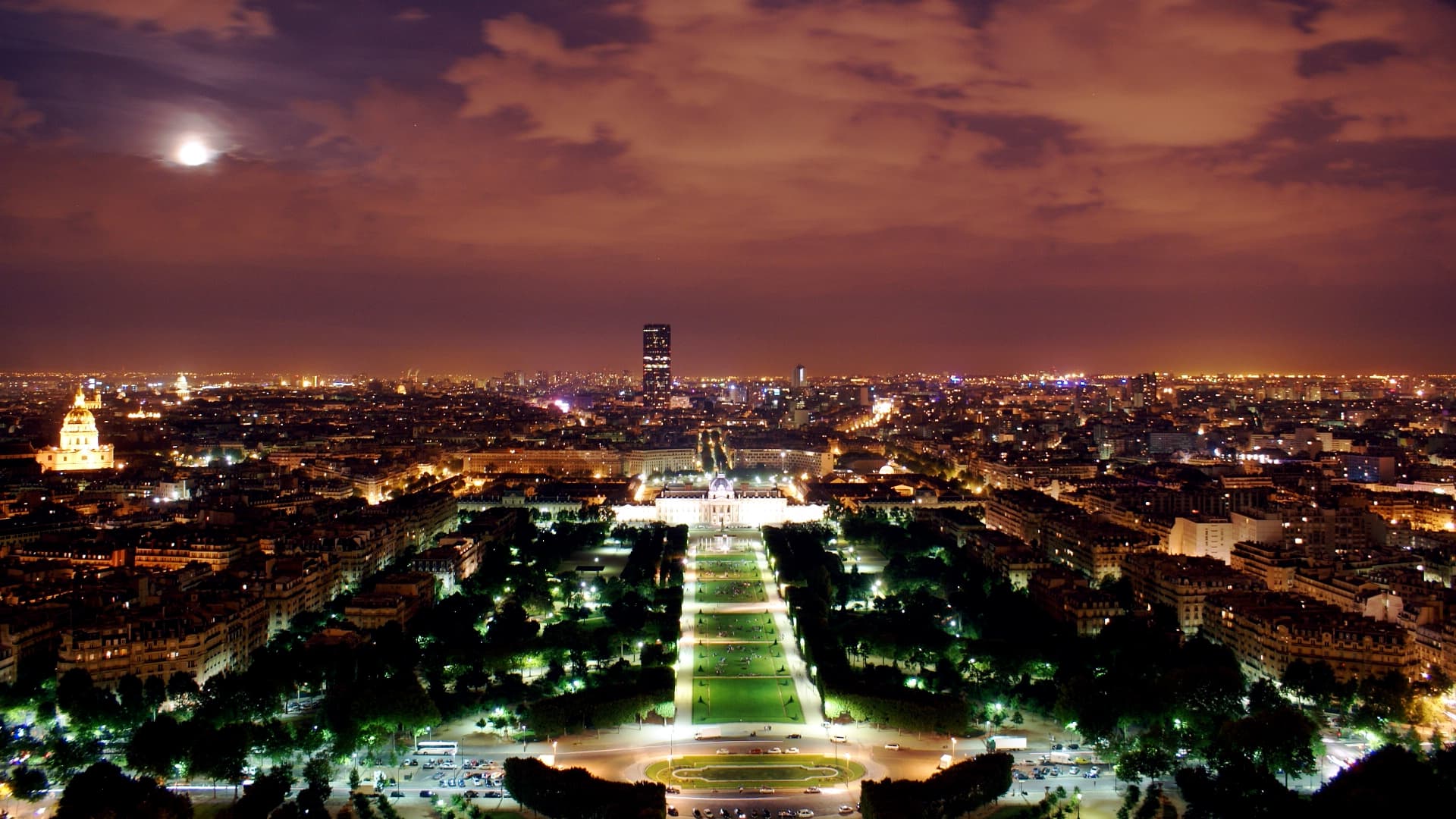
Palais de Chaillot and Trocadéro
The esplanade facing the Eiffel Tower across the Seine, widely considered the best framed view of the tower, day or night.
 Diliff, edited by Fir0002 / CC BY 2.5 via Wikimedia Commons
 Benh LIEU SONG / CC BY 2.5 via Wikimedia Commons
Food & drink
Steak frites
The bistro staple: a simple cut of beef with hand-cut fries, done well at neighborhood addresses far from the boulevards.
Onion soup gratinée
Beef broth, caramelized onions and melted cheese under a toasted crust; a classic late-night order.
Croissant and pain au chocolat
Judge a Paris bakery by these two before anything else; the good ones sell out by mid-morning.
Coq au vin
Chicken braised in red wine with mushrooms and lardons; a Sunday-dinner dish still found on traditional menus.
Macarons
The delicate almond-meringue sandwich cookie, associated with the grand Right Bank patisseries.
Lunch runs roughly noon to 2:30pm and dinner from 7:30pm; many kitchens close between services, so plan around the gap rather than fighting it.
Where to eat
Chez Janou
institutionA long-running Marais bistro just off Place des Vosges, with a terrace and a big bowl of chocolate mousse for dessert.
Last researched 2026-10-02
Marché des Enfants Rouges
marketParis’s oldest covered market, dating to the 17th century, with stalls covering Moroccan, Japanese and French cooking side by side.
Last researched 2026-07-15
Café de Flore
cafeThe famous Left Bank cafe once frequented by Sartre and de Beauvoir; go for the atmosphere and a coffee, not for value.
Last researched 2026-10-02
Sunrises
Pont Alexandre III and the Seine
The ornate 1900 bridge catches the first light along the river, with the Eiffel Tower and Invalides framed at either end.
Year-round
Montmartre vineyard and Rue Saint-Vincent
The small working vineyard just below Sacré-Cœur catches early light with almost no one else around before the day-trip crowds arrive.
April to October
Sunsets
Sacré-Cœur and the Montmartre steps
The parvis in front of the basilica fills with locals and visitors alike as the sun drops over the city spread out below.
Year-round · Shoots best looking south over the rooftops toward the Eiffel Tower.
Trocadéro esplanade
The classic view straight across the Seine to the illuminated Eiffel Tower, best in the last hour before dark when the tower’s hourly lights begin.
Year-round
Arc de Triomphe rooftop
The roof terrace looks down the Champs-Élysées one way and across to the Eiffel Tower the other, so the tower is in the view rather than under your feet.
Year-round · Ticketed (16 euros, free for EU residents under 26) and reached by a long spiral staircase; the terrace can be windy, so bring a layer.
Day trips
Château de Versailles
Louis XIV’s palace and gardens, with the Hall of Mirrors and the Trianon estate, and the most popular day trip from Paris. The palace is closed on Mondays. The full-day Passport costs 35 euros at the standard rate, and every visitor, free admissions included, has to book a time slot.
About 40 minutes by RER C to Versailles Château Rive Gauche · Full day
Giverny (Monet’s house and gardens)
Claude Monet’s home and water-lily gardens in Normandy, the setting for his most famous late paintings.
About 50 minutes by train to Vernon plus a short bus or bike ride · Half to full day
Fontainebleau
A vast royal château, less crowded than Versailles, surrounded by a forest popular for walking and bouldering.
About 40 minutes by Transilien from Gare de Lyon · Half to full day
After dark
Seine river cruise at dusk
boatA one-hour boat trip past the illuminated monuments, timed to catch the Eiffel Tower’s hourly light show after dark.
Evening in Le Marais
walkA wander through the lit-up medieval lanes, a falafel on Rue des Rosiers or a proper bistro dinner, then a nightcap on Place des Vosges.
Daily itinerary
Five days in Paris: Right Bank, Left Bank, and Versailles
Two nights near Le Marais, two near Saint-Germain or the Latin Quarter, with a day trip to Versailles. Walk and use the metro; skip a car entirely.
- 1
Le Marais and Île de la Cité
relaxedArrive, settle in, coffee in Le Marais.Marché des Enfants Rouges.Notre-Dame, then a wander through Île Saint-Louis for ice cream.Pont Alexandre III as the light turns golden over the Seine.Chez Janou or a backstreet Marais bistro.A slow walk through the lit lanes of Le Marais.Entirely walkable; no metro needed today.Estimate: Swap Notre-Dame for the Musée Picasso if it is very crowded.
- 2
The Louvre and Trocadéro
fullTimed-entry visit to the Louvre; do not try to see everything.Near the Tuileries.Walk the Tuileries to Place de la Concorde and along the Seine.Trocadéro esplanade facing the Eiffel Tower.Dinner in the 16th or back toward Saint-Germain.Seine river cruise if timing allows.Metro between the Louvre and Trocadéro.Estimate: Climb the Eiffel Tower itself instead of viewing it from Trocadéro.
- 3
Saint-Germain and Musée d’Orsay
moderateMusée d’Orsay for the Impressionists.Rue de Buci or Rue de Seine.Jardin du Luxembourg and a browse through Saint-Germain bookshops.A proper Left Bank bistro dinner.A drink at a Saint-Germain cafe.Very walkable; metro if legs are tired.Estimate: Add the Musée Rodin if the Orsay queue is long.
- 4
Versailles
fullRER C to Versailles; palace interiors first.On the Versailles estate or in Versailles town.The gardens and, time allowing, the Trianon estate.Back in Paris, near your hotel.Early night after a long day of walking.RER C both ways on ordinary Métro-Train-RER tickets; book the palace slot in advance, and avoid Mondays, when it is closed.Estimate: Rent a bike inside the gardens to cover more ground with less walking.
- 5
Latin Quarter and departure
relaxedA last coffee near the Panthéon, then browse Shakespeare and Company.A bistro on a backstreet off Rue de la Huchette.The Jardin des Plantes or a final wander before heading to the airport.Departure.Leave buffer time: RER B to CDG or Métro line 14 to Orly, both on the 14 euro airport ticket.Estimate: If time allows, add a half-day trip to Giverny and shift departure to day 6.
Getting around
- Charles de Gaulle (CDG) and Orly (ORY) are the two main airports, 30 to 60 minutes from the center. RER B runs to CDG and Métro line 14 to Orly, both on the 14 euro Paris Region-Airports ticket. Taxis charge fixed fares in 2026: 56 euros between CDG and the Right Bank, 65 euros to the Left Bank, 45 and 36 euros from Orly. The Roissybus from Opéra stopped running on 1 March 2026.
- From Tel Aviv: the Israel Airports Authority board for 1 to 5 October 2026 showed El Al several times a day to CDG (also sold under Air France, Aeromexico and SAS codes), Air France daily (AF963 out, AF966 back), Arkia (IZ741 and IZ743) a few times a week, and Transavia France to Orly. On Saturday 3 October only Air France and Transavia left for Paris.
- Gare du Nord, Gare de Lyon and other mainline stations connect Paris to the rest of France and to London, Brussels and beyond by high-speed rail.
- The Métro covers the whole city. Since the fare reform one Métro-Train-RER ticket (2.55 euros in 2026) covers any rail trip in the region except the airports, Versailles included. Load tickets on a Navigo Easy card (2 euros) or a phone; tapping a bank card works on most buses and at Orly but costs more (3.35 euros a rail trip).
- RER regional trains reach Versailles, Disneyland Paris and the airports.
- Vélib bike-share and a genuinely walkable center make a car unnecessary and often slower.
Things worth knowing
- · Not booking the Louvre, Versailles or the Notre-Dame towers in advance and losing hours to queues.
- · Planning a museum day without checking closures: the Louvre shuts on Tuesdays, the Musée d’Orsay and Versailles on Mondays.
- · Trying to see the Louvre in one rushed morning instead of picking a few wings.
- · Renting a car for a trip that never leaves central Paris.
Budget
| Low | Expected | Comfortable | |
|---|---|---|---|
| Accommodation style / per night | €90≈ $101 | €180≈ $202 | €380≈ $426 |
| Food style / per day | €30≈ $34 | €55≈ $62 | €110≈ $123 |
| Local transport / per day | €8≈ $9 | €15≈ $17 | €40≈ $45 |
| Estimate / per day | €10≈ $11 | €30≈ $34 | €60≈ $67 |
Estimate · EUR · 2026-07-15. Accommodation is per room per night (two sharing), before the Paris tourist tax, which in 2026 adds 5.53 euros per adult per night at a 3-star hotel, 8.45 at a 4-star and 11.70 at a 5-star. Local transport figures assume Métro and RER, not taxis. Shoulder-season figures; July/August and December run higher. At the Bank of Israel rate of 1 October 2026, one euro was 3.483 shekels. · 1 USD = €1 (10 Oct 2026)
Things worth knowing
Frequently asked questions
How many days do you need in Paris?
Four to six days is comfortable. Four covers the core sights and one neighborhood in depth; six adds a day trip to Versailles or Giverny without rushing.
What is the best area to stay in Paris for the first time?
Le Marais or Saint-Germain-des-Prés both put you within walking distance of major sights, good food and the Métro. Montmartre is charming but further from the center.
When is the best time to visit Paris?
April to June and September to October: mild weather, good light, and noticeably fewer crowds than July and August, when many small restaurants also close.
Do you need to book the Louvre in advance?
You should. The Louvre recommends a time slot for every visitor, including free admissions, and walk-up queues can take hours. Since January 2026 adults from outside the European Economic Area, Israelis included, pay 32 euros. It is closed on Tuesdays.
Where is the best sunset view in Paris?
Trocadéro for the classic framed view of the Eiffel Tower, and the steps of Sacré-Cœur in Montmartre for a wide panorama over the whole city. The Tour Montparnasse deck closed in March 2026; the Arc de Triomphe roof is the nearest high alternative.
Do Israelis need a visa or ETIAS for Paris?
No visa for stays of up to 90 days in any 180. ETIAS was not running as of 2 October 2026 and no applications were being taken, so there is nothing to buy. Since April 2026 your fingerprints and photo are recorded at the border under the EU Entry/Exit System.
Is Paris safe for Israeli and Jewish travelers?
The Israeli National Security Council rates France level 2, an occasional threat, and recommends extra precautions because of antisemitic hostility toward Israelis and Jews. Stay alert, keep Israeli symbols low-key in crowds and avoid demonstrations. The Jewish sites in the Marais are open and well used.
Sources (20)
- Paris, Banks of the Seine is a UNESCO World Heritage site (inscribed 1991) · unesco · 2026-07-15
- Official Paris tourism information and events calendar · tourism-board · 2026-07-15
- Château de Versailles official visitor information · official · 2026-07-15
- Notre-Dame de Paris reopened after restoration; towers reopened September 2025 · official · 2026-07-15
- Towers of Notre-Dame (Centre des monuments nationaux): €16, free for EU residents under 26, online booking, 424 steps · official · 2026-10-02
- Château de Versailles 2026: Palace 9am to 6:30pm, closed Mondays, 25 December, 1 January and 1 May; Passport €35 standard, €32 reduced; all visitors book a time slot · official · 2026-10-02
- From 14 January 2026 the Château de Versailles charges visitors from outside the EEA more than EEA residents (€35 against €32 in high season) · reputable-local · 2026-10-02
- Paris Montparnasse observatory (56th floor) closed to the public on 31 March 2026 for a renovation lasting several years · official · 2026-10-02
- Arc de Triomphe rooftop: €16, free for EU residents under 26 · official · 2026-10-02
- Nuit Blanche 2026 took place on the night of Saturday 6 to Sunday 7 June 2026 · municipal · 2026-10-02
- Paris tourist tax from 1 January 2026, per adult per night including all surcharges: 3-star €5.53, 4-star €8.45, 5-star €11.70, palaces €15.93 · municipal · 2026-10-02
- Israeli National Security Council: France level 2 (occasional threat, take extra precautions); Foreign Ministry row: stay alert and follow the media; resource last modified 14 September 2026 · government · 2026-10-02
- NSC France page: escalating antisemitic hostility toward Israelis and Jews, France prominent; mainly verbal harassment, threats, incitement and vandalism, sometimes physical assault; avoid displaying Israeli symbols and discussing security service with strangers; police 112 · government · 2026-10-02
- ETIAS is currently not in operation and no applications are collected; the EU will announce the start date several months ahead · government · 2026-10-02
- The EU Entry/Exit System started on 12 October 2025 and has been fully operational at all external borders since 10 April 2026, recording fingerprints and facial images instead of stamps · government · 2026-10-02
- Bank of Israel representative rate updated 1 October 2026: EUR 3.4826 shekels · government · 2026-10-02
- Mémorial de la Shoah, 17 rue Geoffroy l’Asnier, 75004: open Sunday to Friday, free without reservation · museum · 2026-10-02
- mahJ, Hôtel de Saint-Aignan, 71 rue du Temple, 75003: Tuesday to Friday 11am to 6pm, weekends 10am to 6pm, closed Mondays · museum · 2026-10-02
- Grande Synagogue de la Victoire, 44 rue de la Victoire, 9th arrondissement · municipal · 2026-10-02
- Consistoire de Paris and its Beth Din, which supervises most kosher establishments in Paris · official · 2026-10-02