France · Vaucluse, the Alpilles and Aix
Provence
Fly to Marseille, on El Al direct from Tel Aviv, or take the train from Paris to Avignon in about three hours. Pick up a car. Stay in the Luberon for three or four nights and plan the days around the markets: Gordes on Tuesday mornings, Roussillon and Ménerbes on Thursday, Lourmarin and Bonnieux on Friday, Apt on Saturday, L’Isle-sur-la-Sorgue and the Coustellet farmers’ market on Sunday. See Sénanque in a morning, walk the ochre trail at Roussillon, and give an afternoon to the Popes’ Jews: the synagogue of Carpentras, which the Vaucluse tourism board calls the oldest still in use in France, and the tiny synagogue museum of Cavaillon. Then move to Saint-Rémy or Arles for Les Baux, Glanum, the arena and Van Gogh. In late June and early July drive out to the Valensole plateau for the lavender and a sunset behind Mont Ventoux. Check the forest-fire map every evening in summer before you plan a walk.
 Brice / CC BY-SA 3.0 via Wikimedia Commons
Overview
Provence is the region the rest of the world borrowed a word from: a pace, a table, a light that painters moved here for. In practice it is a small, dense piece of south-eastern France you can drive across in two hours, from the Rhône at Avignon to the Valensole plateau, and it rewards planning more than almost anywhere in Europe. The villages of the Luberon sit on hills above a valley of vines and cherry orchards; Avignon has the Palais des Papes, where the popes ruled from the fourteenth century; Arles has a Roman arena still in use and the places Van Gogh painted; Aix has the studio Cézanne worked in until 1906; and Mont Ventoux, at 1,910 metres, stands over all of it. For an Israeli reader Provence has a second story that most guides leave out. For centuries the Comtat Venaissin around Carpentras belonged to the pope, and Jews expelled from France and its neighbours lived there in four closed streets, the carrières of Avignon, Carpentras, Cavaillon and L’Isle-sur-la-Sorgue. They were the Juifs du Pape, the Popes’ Jews, and two of their synagogues, in Carpentras and Cavaillon, can still be visited. El Al flies from Tel Aviv to Marseille, the nearest big airport, which makes this one of the easier regions of France to reach.
Choose Provence for its villages and its table, and plan it by the week, not by the map. Book the Luberon for the markets you want, not the other way round. See the lavender in its real window, mid-June to mid-July in the Luberon and on the Valensole plateau, later around Sault, and do not walk into the fields: at Sénanque the monks forbid it outright. Then use the sunsets we computed. Gordes loses the summer sun up to 19 minutes early behind the Monts de Vaucluse and has its long, clear sunsets from October to early March, over the Rhône plain as far as the hills near Nîmes. Roussillon is similar, a little gentler, with its open sunsets in autumn and late winter. The Rocher des Doms in Avignon is the obvious evening spot and the city closes it before sunset from 10 February to the end of May, through August, in early September and for most of October. The summit of Mont Ventoux sees the sun set 4 to 9 minutes after the almanac, over the hills of the Massif Central 125 to 157 kilometres away, whenever the summit road is open. And on the Valensole plateau the sun sets behind Mont Ventoux from 28 May to 14 July, two to five minutes early, a mountain silhouette behind the lavender that no postcard caption mentions. These are computed figures, good to about a minute; buildings and trees are not in the model.
Best for
Couples · Food and wine travellers · Drivers · Families with older children · Art and Roman history · Jewish heritage
Daily itinerary
6 to 10 days
Provence runs on a calendar more than on a map. Each village has one market day, and the whole week is shaped around them. The lavender is in flower for about four weeks, from mid-June in the lower fields to late July on the high plateaux, and cut soon after. From June to September the State decides every evening at six which forest massifs you may enter the next day. The abbey of Sénanque sells its guided tours in French and keeps visitors out of its lavender. And the viewpoints have clocks of their own: the Rocher des Doms garden in Avignon closes before sunset for much of the year, and the Château des Baux shuts at 18:00 on weekdays and 17:30 at weekends. We computed the sun against the terrain for every day of 2026 so that the evenings in this guide actually work. The best discovery was on the Valensole plateau: from 28 May to 14 July, exactly the lavender weeks, the sun sets behind Mont Ventoux, 73 kilometres away.
Best time to visit
Provence has a Mediterranean climate with hot, dry summers, mild autumns and a cold wind, the mistral, that pours down the Rhône valley for days at a time, most of all in winter and spring, and clears the sky when it does. Late May to early July is the classic window: long days, the markets at their fullest, cherries and then melons, and the lavender. September and early October are the V-TIMES pick for a first visit without the crowds: the grape harvest, warm afternoons, the Rencontres d’Arles still on, the Cézanne studio in Aix open until 31 October in 2026, and forest massifs open more often as the fire season ends on 30 September. July and August are hot, busy and expensive, with the Festival d’Avignon in July. Winter is quiet and beautiful and much is shut, including the summit road of Mont Ventoux.
- April to May: Green hills, poppies and the first outdoor tables. The Ventoux summit road usually reopens on the south side in mid-April and on the north side in May. The Fête de la Transhumance brings flocks through Saint-Rémy on Whit Monday, 25 May in 2026, and the gypsy pilgrimage fills Saintes-Maries-de-la-Mer on 24 and 25 May. From 28 May the sun sets behind Mont Ventoux as seen from the Valensole plateau.
- June to mid-July: The lavender weeks. The Routes de la Lavande association puts flowering at mid-June in the low areas, the Luberon and Valensole, running to late July on the high plateaux around Sault; harvest and distillation start from mid-July. Sunset in the Luberon is around 21:25 on 21 June, though Gordes loses it about 19 minutes early behind the ridge. The Festival d’Avignon ran 4 to 25 July in 2026, its 80th edition, according to press listings.
- Mid-July to August: Harvest on the plateaux, the Fête de la Lavande at Valensole on the third Sunday of July, 19 July in 2026, and at Sault on 15 August. Hot, crowded and in fire season: check the massif access map at six every evening. The Chorégies d’Orange ran from late May to 18 July in 2026.
- September: The best all-round month. Grape harvest, the Féria du Riz in Arles, fewer cars in Gordes, the Rencontres d’Arles running until 4 October in 2026 according to press listings. The fire season ends on 30 September. From 7 to 30 September sunset from the Rocher des Doms falls before the garden closes at 20:00.
- October: Warm afternoons and cool nights, the Cézanne studio open until 31 October, the ochre trail’s last entry at 17:30. From 2 October Gordes sets its sunset over the far plain, a few minutes after the almanac. Clocks change on 25 October.
- November to March: Truffle season and the quietest villages. The Ventoux summit road is closed. Many hotels close from November to March. Gordes and Les Baux have their clearest, longest sunsets: from Les Baux, from November to early February, the sun sets over the Camargue coast near Le Grau-du-Roi, 56 kilometres away, a little after the almanac time.
Things worth knowing
- Festival d’Avignon (July): the theatre festival founded in 1947, its 80th edition in 2026 running 4 to 25 July according to press listings, with the unofficial Off festival in hundreds of venues on the same dates. Hotels in and around Avignon book out months ahead.
- Rencontres d’Arles (July to early October): the photography festival, 6 July to 4 October in 2026 according to press listings, in churches, chapels and warehouses across the old town.
- Chorégies d’Orange (late May to July): opera in the Roman theatre of Orange; La Traviata was on 4 July in 2026, and the season’s last date was 18 July.
- Fête de la Lavande, Valensole: the third Sunday of July, 19 July in 2026, at the end of flowering and the start of harvest.
- Fête de la Lavande, Sault: 15 August, the 39th edition in 2026, the largest of the lavender festivals.
- Féria d’Arles: at Easter, 3 to 6 April in 2026, and the Féria du Riz in September, 11 to 13 September in 2026, with bullfights in the Roman arena. The Camargue course, where the bull is not killed, runs through the summer.
- Pèlerinage des Gitans, Saintes-Maries-de-la-Mer: 24 and 25 May, the procession of Saint Sara to the sea.
- Fête de la Transhumance, Saint-Rémy: Whit Monday, 25 May in 2026, when thousands of sheep are driven through the town.
- Truffle markets: Carpentras on Friday mornings and Richerenches on Saturday mornings, roughly mid-November to March.
Where to stay
 H2k4 · CC BY-SA 3.0 via Wikimedia Commons
Avignon, inside the walls
The walled city of the popes, and the one base in this guide that works without a car. The Palais des Papes and the Pont Saint-Bénezet, the half-bridge of the song, are a few minutes apart; the Rocher des Doms garden sits above them; Les Halles on Place Pie is the covered market; and the TER shuttle runs from Avignon TGV station to the centre. Avignon has an active synagogue, a nineteenth-century rotunda on Place de Jérusalem, which is also the address of Chabad Avignon.
Best for: Arriving by train · No car · The Festival d’Avignon · Museums and restaurants on foot
In July the festival fills every room and doubles prices. Driving inside the walls is hard; use a car park outside them. The Rocher des Doms closes at 18:00 from October to March and at 20:00 in April, May, August and September, which is before sunset for much of the year.
 Jean-Christophe BENOIST · CC BY 3.0 via Wikimedia Commons
Gordes and the Sénanque valley
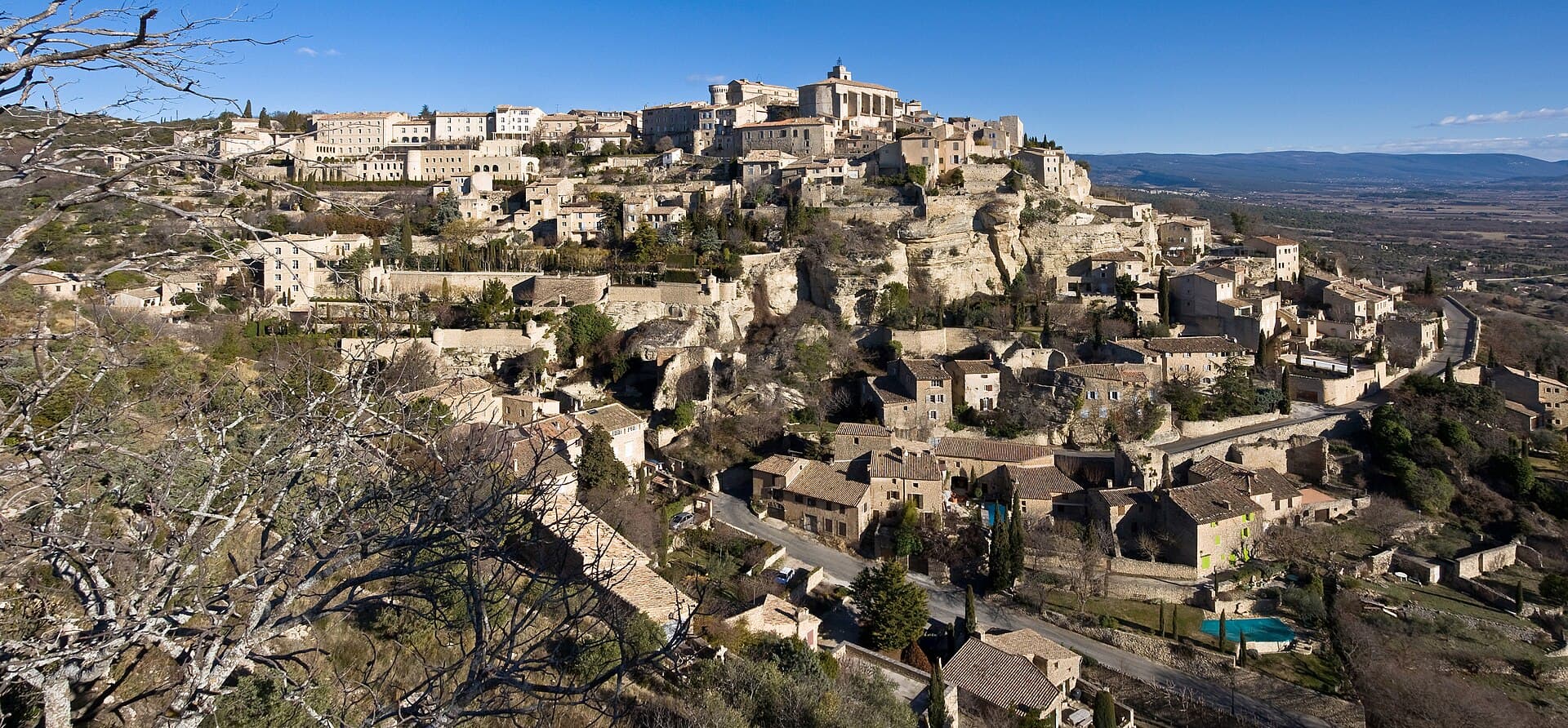
The postcard village, stacked up a rock above the Luberon valley and crowned by its Renaissance château, with the abbey of Sénanque four kilometres north in its own valley and the Village des Bories, dry-stone huts in the garrigue, just below. It has the most luxurious hotels in the Luberon and the steepest parking prices: 8 euros for up to four hours in 2026, first half hour free. The market is on Tuesday mornings.
Best for: Luxury hotels · Sénanque in the morning · Winter sunsets · Couples
Crowded from late morning in summer, and car-heavy. From 9 April to early September the Monts de Vaucluse ridge five kilometres north-west takes the sunset 5 to 19 minutes early, the worst of it, about 19 minutes, around 21 June. From October to early March the sun sets over the far Rhône plain instead, as much as four minutes after the almanac.
 François de Dijon · CC BY-SA 3.0 via Wikimedia Commons
Roussillon and the ochre country
A village painted in the colours of the hill it stands on, red, orange and yellow, above the old ochre quarries that are now the Sentier des Ocres, a short trail through pinnacles and cliffs. Further east, beyond Apt, the Colorado Provençal at Rustrel is the same landscape on a larger, wilder scale. The market is on Thursday mornings.
Best for: Families · Photographers · Short walks · Colour
Busy at midday in summer. The ochre stains shoes and clothes. From 17 April to 25 August the Gordes plateau, about ten kilometres west, takes the sunset 5 to 11 minutes early; from 19 September to mid-November and from late January to March the village sees it set a few minutes after the almanac.
 decar66 · CC BY 2.0 via Wikimedia Commons
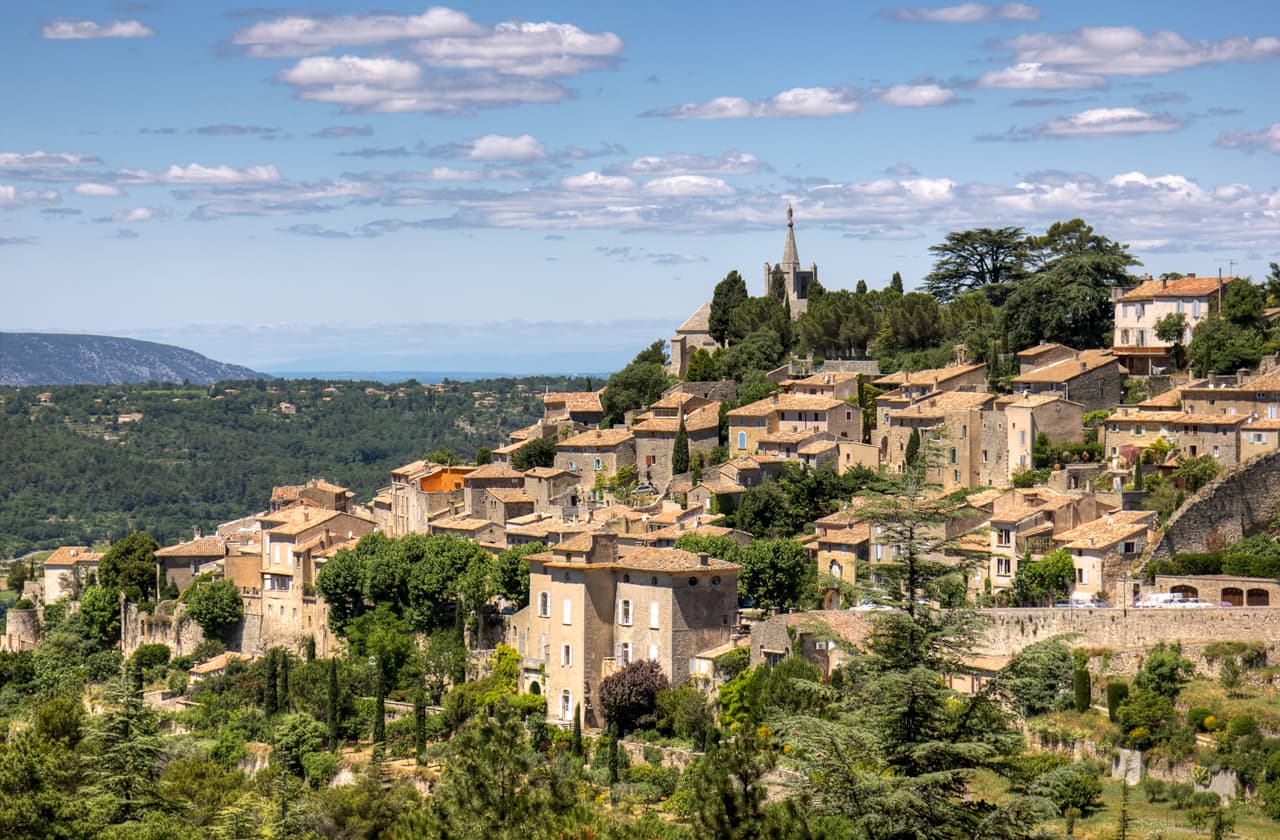
Bonnieux, Ménerbes, Lacoste and Lourmarin
The villages of the Petit Luberon, south of the valley. Ménerbes and Bonnieux face each other across the vines; Lacoste has the ruined castle of the Marquis de Sade; Lourmarin, on the southern side of the range, has a Renaissance château, cafés under plane trees and one of the busiest Friday markets in the region. The Forêt des Cèdres above Bonnieux is one of the few forest sites the State keeps open all day in fire season, except on red extreme days.
Best for: Village hotels and villas · Markets · Cycling · Wine estates
You need a car for everything. Ménerbes and Goult have their markets only from April to September or October.
 Marianne Casamance · CC BY-SA 3.0 via Wikimedia Commons
L’Isle-sur-la-Sorgue and Carpentras
The two towns of the Comtat plain, west of the Luberon. L’Isle-sur-la-Sorgue is built on the channels of the river Sorgue, with water wheels, antique dealers and a Sunday market and flea market that take over the town, plus a Thursday market; it was one of the four carrière towns, and its Jewish cemetery is a protected monument. Carpentras has the synagogue of 1367, its Friday truffle market in winter, and the berlingot sweets.
Best for: Sunday markets and antiques · Jewish heritage · Winter truffles · A flat base with trains
Less beautiful than the hill villages, and L’Isle on a Sunday is as crowded as anywhere in Provence. The Carpentras synagogue opens only on weekday afternoons, for an hour.
 Geert Willemarck · Pexels
Saint-Rémy and Les Baux, the Alpilles
The small limestone range south of Avignon. Saint-Rémy is an elegant market town, Wednesday is market day, with the asylum where Van Gogh painted and the Roman site of Glanum on its southern edge. Les Baux is a fortress village on a spur of rock, with the Carrières des Lumières projections in an old quarry below and the Vallée des Baux olive oil in the mills around Maussane.
Best for: Van Gogh · Roman sites · Olive oil · Gastronomy
Les Baux is very crowded from mid-morning. The Château des Baux closes at 18:00 on weekdays and 17:30 at weekends, so in summer the sunset is watched from the village, not the castle. Fire rules in the Bouches-du-Rhône close the Alpilles to walkers on red days from 1 June to 30 September.
 Jean-Pol GRANDMONT · CC BY 4.0 via Wikimedia Commons
Arles and the Camargue
Arles is Roman, Romanesque and Van Gogh in one walkable town on the Rhône: the arena, the theatre, the cloister of Saint-Trophime, the Fondation Vincent van Gogh and the LUMA tower by Frank Gehry. South of it the Camargue is the delta, rice fields, salt pans, flamingos, black bulls and white horses, down to Saintes-Maries-de-la-Mer on the sea. Arles has a big market on Saturday mornings.
Best for: Roman history · Contemporary art and photography · Birds and the delta · A town base with trains
Mosquitoes in the Camargue on still summer evenings. Arles is loud and full during the férias and the opening week of the Rencontres in early July.
 AXP Photography · Pexels
Aix-en-Provence
The elegant university city, with the Cours Mirabeau and its fountains, the Musée Granet, the Hôtel de Caumont and Cézanne’s last studio, the Atelier des Lauves, reopened in 2026 after restoration for the 120th anniversary of his death. It is 30 minutes by shuttle from Marseille airport and has a TGV station of its own.
Best for: Cézanne · A city break at the start or end · Shopping and cafés · Kosher food
Far from the Luberon villages, about an hour to Lourmarin and more to Gordes. Aix has a low-emission zone for the oldest vehicles, so rental cars need their Crit’Air sticker.
Where to sleep
La Bastide de Marie
romantic · Ménerbes, Luberon
Best for: Couples · A vineyard stay · Groups taking a whole villa
- A country house in the middle of its own 30-hectare vineyard, the Domaine de Marie, below Ménerbes
- Antique and flea-market interiors in the style of the Sibuet family’s other houses
- Three private villas with concierge service on the same estate
- The official site does not print a total room count; ask, if you want to know how small it is
- Rural: a car for everything, and no village on foot
- No season dates on the pages we read; the Luberon estates usually close in winter, so ask
Coquillade Provence
resort · Gargas, between Apt and Roussillon
Best for: Families who want space · A spa · Wine
- A five-star hotel village of 69 rooms on a hilltop vineyard estate, with a private villa for up to 14
- Its own wines, Aureto and Luberon, with tastings on the estate
- Several restaurants and bars and a spa on one site, which matters when the villages close early
- At 69 rooms it is the largest of the Luberon estates here and feels less intimate
- Isolated on its hill: every village is a drive
- No closing dates on the pages we read
Capelongue, a Beaumier Hotel & Spa
boutique · Bonnieux, Petit Luberon
Best for: Couples · Views across the valley · A newly renovated hotel
- Reopened on 1 May 2024 after a two-year renovation by the Beaumier group, with 57 rooms and suites
- Laid out like a small village of its own, with a square, a fountain and a bookshop
- On the hill below Bonnieux, looking across the valley to the northern villages
- Older guides still describe the pre-2020 Capelongue under its former chef; that hotel is gone
- Its old domain now redirects to the Beaumier group site, so book there
- Short operating history under the new owners
La Bastide de Gordes
luxury · Gordes village
Best for: The grand hotel in the postcard village · Couples · A room with the valley below
- Inside the village, in a sixteenth-century building on the edge of the rock, with terraces and hanging gardens over the Luberon valley
- Thirty-four rooms and six suites, run by the Airelles group
- You can walk to the château, the Tuesday market and the restaurants
- The trading name is La Bastide de Gordes; Airelles is the operator, not part of the name, so search for both
- Gordes is steep and congested; arriving by car in summer takes patience
- The village loses the summer sunset up to 19 minutes early behind the ridge to the north-west
Crillon le Brave
unique · Crillon-le-Brave, at the foot of Mont Ventoux
Best for: Ventoux and the Dentelles · Cyclists · A whole hilltop hamlet as a hotel
- About a dozen seventeenth- and eighteenth-century houses around the village church, turned into 26 rooms and 17 suites by the designer Charles Zana
- Views to Mont Ventoux, with Bédoin and the start of the classic climb a short drive away
- A spa in the old stables and the restaurant La Table du Ventoux
- Rooms are spread across several houses, some a walk from the spa and restaurant
- Steps and narrow lanes: hard with heavy luggage or limited mobility
- North of the Luberon, so the southern villages are 40 minutes or more away
Hôtel Bastide de Lourmarin
boutique · Lourmarin, southern Luberon
Best for: Couples · A four-star without the estate prices · Walking into Lourmarin
- A four-star with 17 rooms and two premium suites on the Cucuron road at the edge of the village
- A spa, and a room adapted for guests with reduced mobility
- Lourmarin’s Friday market and cafés on foot
- Adults only: the hotel states that children are not accepted
- The site gives 17 rooms in one place and 19 in another
- A village hotel, not a resort: small grounds
La Mirande
luxury · Avignon, behind the Palais des Papes
Best for: Avignon in style · Food lovers · Arriving by train
- A cardinal’s palace turned hotel, in the square directly behind the Palais des Papes
- A gastronomic restaurant, a bistro and a cooking school under one roof
- Everything in the old town on foot
- Small, so it books out early, above all in July
- A historic building: room sizes and access vary
- Its French homepage returned a server error when we checked; the English site worked
Hôtel d’Europe
luxury · Place Crillon, Avignon
Best for: History · A courtyard dinner · A central base inside the walls
- A coaching inn opened in 1799 and one of the oldest hotels in France still trading, with 44 rooms and suites
- The restaurant La Vieille Fontaine in its courtyard
- Inside the walls on Place Crillon, a short walk from the palace and the bridge
- Old building, uneven rooms: ask for a specific category
- No season information on the page we read
- Place Crillon is a lively square in festival month
Baumanière Les Baux-de-Provence
luxury · Val d’Enfer, below Les Baux
Best for: A three-star dinner and a bed · Special occasions · The Alpilles
- Founded in 1945, with 53 rooms spread through the valley below the fortress
- L’Oustau de Baumanière, three Michelin stars, with its own vegetable garden
- A group of houses, a spa and a chocolate shop around it
- Among the most expensive stays in the region, priced on the restaurant’s reputation
- La Cabro d’Or, a sister hotel, and the separate Domaine de Manville are close by, so check exactly which one you are booking
- You drive up to Les Baux village; it is not in it
Domaine de Manville
family · Les Baux-de-Provence
Best for: Families · Golfers · A house of your own with hotel service
- Thirty rooms and nine houses on a golf estate at the foot of Les Baux, a member of Small Luxury Hotels of the World
- An 18-hole course, a spa, a kids’ club and the restaurant L’Aupiho
- Space: the houses suit families who want a kitchen and a garden
- More golf resort than Provençal village
- Not walkable to Les Baux village
- The .com domain is unreliable; use domainedemanville.fr
Hôtel Sous les Figuiers
value · Saint-Rémy-de-Provence
Best for: A small hotel in a garden · Walking into Saint-Rémy · Parking included
- Fourteen rooms, all on the ground floor, around a garden of hundred-year-old fig trees, with private terraces
- A small pool and closed parking on site
- About 200 metres from the town centre and the Wednesday market
- Three-star simplicity: breakfast but no restaurant, no spa
- Ground floor only, so no views
- Small and popular: book early for May to September
L’Arlatan
design · Old town, Arles
Best for: Art lovers · A pool in the old town · The Rencontres d’Arles
- Forty-one rooms in a historic house whose interior was entirely designed by the artist Jorge Pardo, with thousands of square metres of handmade tiles
- In the heart of the old town, close to the Place du Forum, the arena and Saint-Trophime
- A pool, which in an Arles summer is worth a great deal
- The colour and pattern are everywhere; if you want a quiet Provençal room this is not it
- Street and festival noise in summer
- Parking in the old town is difficult
Hôtel Le Calendal
value · Opposite the Roman theatre, Arles
Best for: The Roman sites on the doorstep · A rooftop drink · Families (apartments)
- Forty rooms and two apartments in a seventeenth-century building facing the Théâtre Antique
- A rooftop terrace over the old town and a small spa
- Both the theatre and the arena within a few minutes’ walk
- Prices climb well above value in the festival weeks
- Central, so noisy on summer nights
- No parking of its own on the page we read
Mas de Peint
unique · Le Sambuc, Camargue
Best for: The Camargue from the inside · Horse riding · Birders
- A working manade, a bull and horse ranch, run by the Bon family, with about fifteen rooms and suites
- A restaurant cooking the ranch’s own produce
- Deep in the delta, close to La Chassagnette and the Vaccarès lagoon
- The site gives the split as 8 rooms and 7 junior suites in one place and 8 rooms, 6 junior suites and 1 suite in another
- The restaurant is closed on Mondays and runs reduced days in spring and autumn
- About half an hour from Arles, and mosquitoes on still evenings
Villa Gallici
luxury · Aix-en-Provence
Best for: Aix at the start or end of a trip · A heated pool · A garden in the city
- A Relais & Châteaux house of 23 rooms and suites in a garden above the old town
- An outdoor pool heated to 28C all year
- Close to the Atelier des Lauves, Cézanne’s studio
- Its second restaurant runs only from June to September
- Small: few rooms and little flexibility in high season
- A walk uphill from the Cours Mirabeau
Essential experiences
 Jean-Paul Wettstein · Pexels
The Palais des Papes and the Pont d’Avignon
The great Gothic palace built when the popes lived in Avignon in the fourteenth century, and the four surviving arches of the Pont Saint-Bénezet a few minutes’ walk away. On 1 May 2026 the palace opened rooms never shown to the public before, with a new visit. From 1 August 2026 a palace ticket is 16 euros for adults and 10 for ages 10 to 17, under 10 free; palace and bridge together are 19.50 and 12; the Avignon City Pass starts at 24 euros. Open 9:00 to 19:00 from 1 March to 1 November, 10:00 to 17:00 from 2 November to 18 December, 10:00 to 18:00 over Christmas to 3 January, 10:00 to 17:00 in January and 10:00 to 18:00 from 7 February; last entry an hour before closing.
 Hub JACQU · Pexels
The Abbey of Sénanque
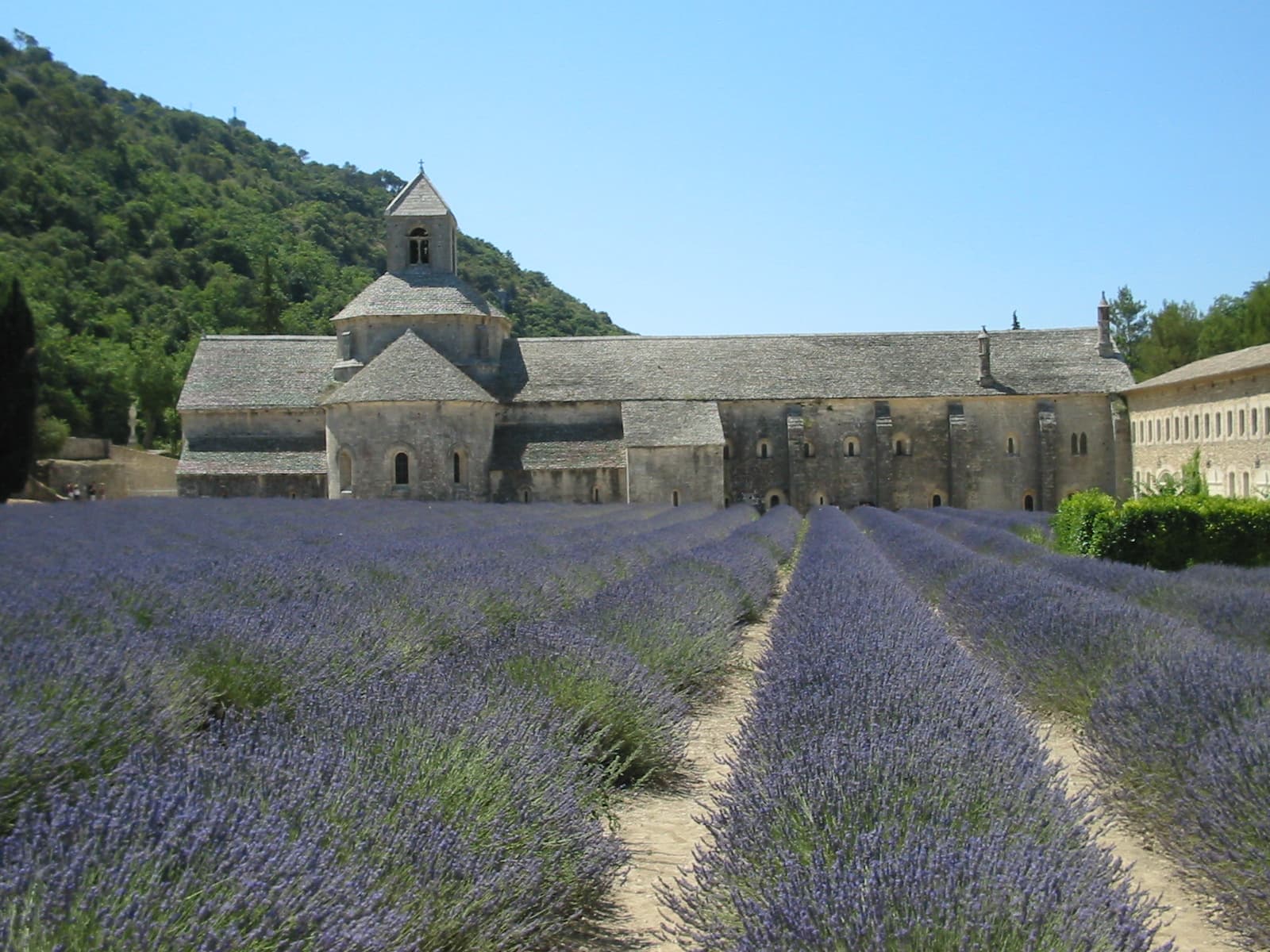
A twelfth-century Cistercian abbey in a narrow valley north of Gordes, still home to a community of monks, with the lavender rows in front of it that appear on half the posters of Provence. The guided tour takes an hour and is in French only, Monday to Saturday at 10:00, 10:30, 13:30, 14:30, 15:30, 16:30 and 17:00, Sunday from 13:30; for everyone else there is a self-guided visit with a HistoPad tablet in 11 languages, Monday to Saturday 9:45 to 11:00 and 13:00 to 17:00 last entry, Sunday 13:00 to 17:00 only. Adults pay 8 euros, students 6, children 6 to 17 pay 4. Modest dress is required; there are many stairs and no wheelchair access. The monks forbid entry to the lavender fields and drone flights over the valley. Flowering at Sénanque is usually from late June to mid-July. The abbey sits so deep in its valley that, by our terrain model, from March to September the sun reaches it about two and a half hours after sunrise and leaves it 40 minutes to an hour before sunset.
 Konradm · CC BY-SA 4.0 via Wikimedia Commons
The synagogue of Carpentras
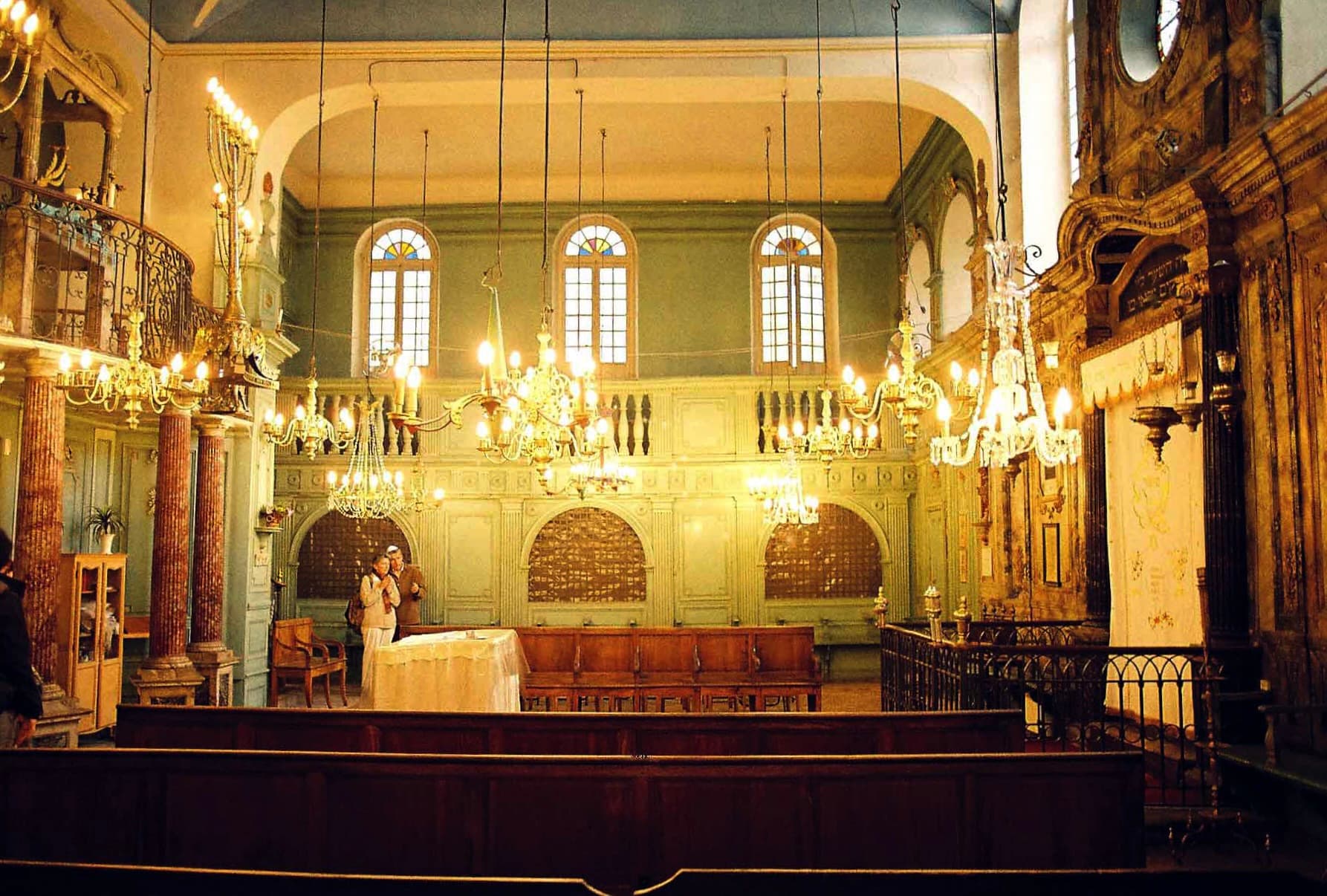
The heart of the Popes’ Jews story. Founded in 1367 and rebuilt in the eighteenth century, with the prayer hall on the upper floor, it is described by the Vaucluse tourism board as the oldest synagogue still in use in France and among the oldest in Europe. The community still prays here. Visits are short, fixed and guided by the Carpentras tourist office: in the autumn 2026 listing, Monday to Friday 14:30 to 15:30, never at weekends and not on public holidays; a morning slot has been added in past summers, so check. Adults 7 euros, 13 to 17 5 euros, under 13 free. Book through the tourist office.
 GFreihalter · CC BY-SA 4.0 via Wikimedia Commons
The synagogue and Jewish museum of Cavaillon
A small eighteenth-century synagogue on the Rue Hébraïque, the old carrière of Cavaillon, with a jewel-box prayer hall above and the Musée juif comtadin below. Guided visits only: from 2 May to 30 September at 10:00, 11:00, 12:00, 14:00, 15:00, 16:00 and 17:00, closed Tuesdays; from October to December at 10:00, 11:00, 14:00, 15:00 and 16:00, closed Tuesdays and Sundays; from January to April ask the museum. 7 euros full, 5 reduced, free under 18 and on the first Sunday of the month.
 Jean-Paul Wettstein · Pexels
Gordes and the Village des Bories
Gordes itself is best seen from the road below it to the east, in the morning, and walked in the late afternoon when the day visitors leave. Below the village, the Village des Bories is a cluster of dry-stone huts and farm buildings, restored as an open-air museum of how people lived in the garrigue. Open all year except 25 December and 1 January: 9:00 to 19:00 in September, 9:00 to 18:30 from 1 to 25 October, 9:00 to 17:30 from 26 October to 15 November and 10:00 to 17:00 from 16 November, last entry half an hour before closing.
 Guillaume Baviere · CC BY 2.0 via Wikimedia Commons
The Sentier des Ocres, Roussillon
A walk through the old ochre quarries below the village, red and orange cliffs and pinnacles in a pine wood, in a short loop of about 30 minutes or a long one of about 50. 3.50 euros, tickets at the gate only, no booking. Open daily from 7 February to 31 December 2026: 9:30 to 18:30 in September, exit by 19:00; last entry 17:30 in October, exit by 18:00; shorter in November and 11:00 to 15:30 from mid-November. It can close after heavy rain; on the State’s fire map it is one of the named sites that stays open all day except on red extreme days.
 Wolf Meusel · Public domain via Wikimedia Commons
The Colorado Provençal, Rustrel
The ochre landscape on a bigger scale and with fewer people: former quarries east of Apt with marked trails through orange and white gullies. In 2026 it is open 9:00 to 18:00 in September and 9:30 to 16:30 in October, closes from 12 November 2026 to 5 February 2027, and runs guided walks on Tuesdays and Thursdays at 14:00. From May to August morning visits must be booked online; from 13:00, and the rest of the year, you pay at the gate without booking.
 Walter Coppola · Pexels
L’Isle-sur-la-Sorgue on a Sunday
The river town at its fullest: the Sunday market of food, olive oil and cloth along the water channels, and the weekly brocante, the antiques and flea market, alongside the town’s permanent antique dealers. The Thursday market is smaller and calmer. L’Isle was one of the four carrière towns of the Popes’ Jews; nothing of its synagogue survives, but its Jewish cemetery is a listed historic monument.
 Pierre Goiffon · CC BY-SA 4.0 via Wikimedia Commons
Les Baux: the Carrières des Lumières and the château
Les Baux is a fortress village on a spur of the Alpilles. In the vast limestone quarry below it, the Carrières des Lumières projects immersive shows onto the walls: in 2026, Picasso and Frida Kahlo on most days and an ocean programme on Wednesdays and Saturdays. 16.50 euros full, 14 reduced, 46 for a family of four; the Pass Baux-de-Provence with the château is 21 euros. Open 9:30 to 19:00 in September and October, 10:00 to 18:00 from November. The ruined château on top is open every day except 25 December and 1 January; its posted hours in September 2026 were 9:00 to 18:00 on weekdays and 10:00 to 17:30 at weekends, which means the castle’s own sunset is possible only in winter: on weekdays from November to early February, and at weekends too from mid-November to mid-January.
Carrières des Lumières: hours and rates ↗Château des Baux ↗View on map ↗
 Greudin · Public domain via Wikimedia Commons
Saint-Rémy: Glanum and Van Gogh’s asylum
On the southern edge of Saint-Rémy, the Roman and Greek town of Glanum lies in a fold of the Alpilles, 9 euros, free for EU residents under 26, run by the Centre des monuments nationaux. Across the road is the monastery of Saint-Paul de Mausole, still a psychiatric clinic, where Van Gogh admitted himself in 1889 and painted around 150 works in a year; his room and the garden can be visited. The olive groves and cypresses around them are the landscapes of The Starry Night period.
 Bingqian Li · Pexels
Arles: the Roman town, LUMA and the Fondation Van Gogh
The amphitheatre of about AD 90 still holds bullfights; the theatre, the cryptoporticos, the baths of Constantine and the cloister of Saint-Trophime are all within a short walk, and the Alyscamps necropolis just outside. The city sells combined passes for its monuments. LUMA Arles, the arts centre around Frank Gehry’s tower, charges for its exhibitions, 15 euros full from July to October and 9 euros from November to June, under 26 free with a reservation, while the tower entrance and park are free. The Fondation Vincent van Gogh is 10 euros, under 26 free, 10:00 to 18:00; a combined LUMA and Fondation ticket is 17 euros in 2026.
LUMA Arles: admissions ↗Fondation Vincent van Gogh Arles ↗View on map ↗
 Bjs · CC BY-SA 4.0 via Wikimedia Commons
Cézanne’s studio, the Atelier des Lauves, Aix
The studio Cézanne built on the Lauves hill and worked in until his death in 1906, with his coats, his easel and the objects of the still lifes. After a major restoration it reopened for the 2026 season, the 120th anniversary of his death, from 4 July to 31 October: 9:00 to 18:00 until 30 September, last visit 17:00, and 10:00 to 17:00 in October. Places are limited and online booking is obligatory; tickets start at 9.50 euros depending on the format. The historic building is not accessible to wheelchairs. Plan the next season before you go: it was shut outside those months in 2026.
 SlimMars 13 · Pexels
Mont Ventoux
The Giant of Provence, 1,910 metres by the tourism office’s figure, its white limestone summit visible from almost everywhere in this guide. Three roads climb it, from Bédoin, the classic Tour de France ascent of 21.8 kilometres at 7.5 percent, from Malaucène and from Sault. The summit road closes in winter: in the last season from 18 November 2025 to 17 April 2026 above Chalet Reynard on the south side and to 15 May 2026 above Mont Serein on the north side, closed to bicycles as well. It is cold and windy at the top even in July. By our model the summit sees the sun set 4 to 9 minutes after the almanac time, over the Massif Central, from the Velay in summer to the Cévennes and the Hérault hills, 125 to 157 kilometres away.
 AXP Photography · Pexels
The Valensole plateau in flower
The wide plateau east of Manosque, where the lavender and lavandin fields run to the horizon in rows between wheat fields and almond trees. Flowering starts in mid-June around Valensole and the fields are usually cut from mid-July; the Fête de la Lavande is held on the third Sunday of July, 19 July in 2026. These are working farms: park where it is allowed and photograph from the edge, never walk into the rows. By our model the sun rises 18 to 22 minutes late here from April to August, behind the Préalpes de Digne, and less in winter, and from 28 May to 14 July it sets behind Mont Ventoux, 73 kilometres to the north-west.
 Véronique PAGNIER · CC BY-SA 3.0 via Wikimedia Commons
The Rocher des Doms
The garden on the rock above the Palais des Papes, 30 metres above the Rhône, with a pond, playgrounds and a terrace looking over the river, the bridge and, on clear days, Mont Ventoux. Free, open from 7:30 all year, and closed at 18:00 from October to March, 20:00 in April, May, August and September and 22:00 in June and July. Set against our sunset times, the sun goes down before closing only from 1 January to 9 February, in June and July, from 7 to 30 September and from 25 October to the end of the year. For most of the season the hills of Villeneuve-lès-Avignon across the river take it 5 to 9 minutes early.
 Chimigi / CC BY-SA 2.0 fr via Wikimedia Commons
 Greudin / Public domain via Wikimedia Commons
Food & drink
Aïoli and le grand aïoli
The garlic and olive-oil emulsion, and the dish built around it: salt cod, boiled vegetables and eggs, traditionally on Fridays. The Bistrot du Paradou still serves it on Fridays.
Daube
Beef braised slowly in red wine, in versions called Avignonnaise, Comtadine or Provençale, the winter dish of the region.
Soupe au pistou
The summer vegetable and pasta soup finished with pistou, garlic, olive oil and basil pounded in a mortar.
 Bingqian Li · Pexels
Tapenade and fougasse
Crushed olives with capers and anchovies, named from the Occitan word for caper, spread on fougasse, the flat, slashed hearth bread topped with olives, onions or herbs depending on the village.
Olive oil from the Vallée des Baux
A protected designation of origin since 2000, from the Salonenque, Béruguette, Grossane and Verdale olives of the Alpilles. The mills around Maussane and Mouriès sell it and let you taste.
Banon
A small raw goat cheese wrapped in chestnut leaves and tied with raffia, a protected designation of origin since 2003.
 Marc Nesen · Pexels
Taureau de Camargue and Camargue rice
The black bull of the delta, a protected designation of origin since 1996, served as gardiane stew, with the red and white rice of the Camargue, protected since 2013.
 Madalina Chicu · CC BY-SA 3.0 via Wikimedia Commons
Black truffles
The winter luxury of the Comtat and the Tricastin, sold at the Friday market in Carpentras and the Saturday market in Richerenches from about mid-November to March.
Calissons and berlingots
The almond and candied-melon calissons of Aix, still waiting for their protected status after two decades of applications, and the striped mint berlingots of Carpentras.
Lunch is the serious meal and it is served on time: from about 12:00 to 13:30 or 14:00, and a kitchen that stops at 13:30 will not be moved by a late arrival. Dinner runs from about 19:30 to 21:30. Many restaurants close one or two days a week, and the days vary: of the tables in this guide, Pollen shuts at weekends, the Bistrot du Paradou and La Chassagnette serve lunch only on most days, and Le Mas at Gordes is closed on Tuesdays and Wednesdays. Book ahead, by phone if the site has no system. Wine by the carafe from the local cooperative is normal and good. Service is included in French prices; leaving small change or rounding up is a courtesy, not an obligation.
Where to eat
L’Oustau de Baumanière
fine-diningThree Michelin stars in 2026, with the chef Glenn Viel cooking Mediterranean food around the Vallée des Baux olive oil and the estate’s own garden. The Michelin listing shows the restaurant closed on Wednesdays and Thursdays; confirm the days and dinner service when you book.
Last researched 2026-09-26
L’Auberge de Saint-Rémy, Fanny Rey & Jonathan Wahid
fine-diningTwo Michelin stars for the chef Fanny Rey and the pastry chef Jonathan Wahid, on the ring road around the old town. Closed Sundays and Mondays per the Michelin listing.
Last researched 2026-09-26
La Chassagnette
fine-diningA farmhouse restaurant in the Camargue with a Michelin star, where the chef Armand Arnal cooks from three hectares of gardens, beehives and a greenhouse. About 20 kilometres from Arles. The Michelin page lists lunch on Mondays and Thursday to Sunday and closes it on Tuesdays and Wednesdays.
Last researched 2026-09-26
Pollen
modernThe chef Mathieu Desmarest’s restaurant, one Michelin star. Lunch menus at 60 euros or a 120-euro carte blanche, dinner at 120 or 150. Open Monday to Friday, closed at weekends.
Last researched 2026-09-26
 Romainbehar · CC0 via Wikimedia Commons
La Mirande
fine-diningThe hotel’s gastronomic restaurant and its more relaxed bistro, with a chef’s table and a cooking school in the old kitchens. Book through the English site; the French homepage was returning an error when we checked.
Last researched 2026-09-26
Le Vivier
fine-diningOne Michelin star in 2026, with a terrace over the river, chef Romain Gandolphe. Per the Michelin listing: lunch Wednesday to Friday and Sunday, dinner Wednesday to Saturday, closed Mondays and Tuesdays.
Last researched 2026-09-26
Le Bistrot du Paradou
institutionOpen since 1984, one fixed menu a day with the dish set by the weekday, aïoli on Fridays, cassoulet on Wednesdays, Bresse chicken from the rotisserie. Lunch Tuesday to Saturday per the Michelin page, open from mid-February to 31 December.
Last researched 2026-09-26
Le Mas, Alexis Osmont
modernThe farmhouse restaurant long known as Le Mas Tourteron, now run by the chef Alexis Osmont under the name Le Mas. Dinner Thursday to Monday, lunch at weekends, closed Tuesdays and Wednesdays per the Michelin listing. The old domain mastourteron.com now belongs to an unrelated company, so ignore it.
Last researched 2026-09-26
La Bastide de Moustiers
fine-diningAlain Ducasse’s country inn, one Michelin star in 2026, with a new head chef in the kitchen. Per the house, lunch 12:00 to 13:30 and dinner 19:00 to 20:30, from May to September closed Tuesdays and Wednesday lunch, in April and October closed Tuesdays and Wednesdays, and shut from 2 November to 1 April; confirm when you book.
Last researched 2026-09-26
Sunrises
 Wikimedia Commons · CC BY-SA 3.0 via Wikimedia Commons
The summit of Mont Ventoux
Sunrise over the Alps. From 1,910 metres the sun comes up over the high peaks 100 to 110 kilometres to the east, over the southern Écrins around Freissinières from mid-May to the end of July and over the Ubaye peaks near Barcelonnette in April and August, within a minute of the almanac time; in winter, when the road is shut, it would rise up to six minutes early over the lower ranges. On 21 June the almanac says 05:55 and the Alpine sunrise comes a minute earlier.
Mid-May to early September, when the summit road is open and the sun rises over the high Alps · Turn round after the sunrise: the shadow of the mountain lies across the Rhône plain to the west.
 Nuno Alves · CC BY-SA 4.0 via Wikimedia Commons
The Valensole plateau
The lavender sunrise, and a late one. The Préalpes de Digne stand 18 to 26 kilometres to the east, the Montdenier and L’Agra above Saint-Jurs in summer, the mountains above Moustiers at the equinoxes, and the sun clears them 18 to 22 minutes after the almanac time from April to August: about 06:12 on 21 June against 05:53. That extra time is useful: the fields are in soft, blue light before the direct sun reaches them.
Mid-June to mid-July, for the flowers · Shoot the rows along their length with the mountains behind; the sun arrives from behind the ridge rather than from a flat horizon.
 Sebleouf · CC BY-SA 4.0 via Wikimedia Commons
Gordes from the east
The classic view of Gordes is from the D15 below the village to the east, looking back at the houses stacked up the rock. Morning is when the sun is on them. In summer the Monts de Vaucluse above Saint-Saturnin-lès-Apt hold the sunrise about 15 minutes late, so the village takes the first light around 06:11 on 21 June; at the equinoxes the delay is only three or four minutes.
All year; best early in the morning before the coaches · A short lens is enough. The château and the church are the top of the composition; the valley haze is part of the picture.
Sunsets
 Wisi eu · CC0 via Wikimedia Commons
The Valensole plateau, with Mont Ventoux behind
The discovery of this guide. From the plateau east of Valensole the sun sets behind Mont Ventoux, 73 kilometres to the north-west, from 28 May to 14 July, two to five minutes before the almanac time: a dark mountain on the horizon, with lavender in front of it, in exactly the weeks the fields are in flower. On 21 June the sun goes behind the Giant at 21:16. Outside that window it sets over the lower ranges of the Luberon and the Montagne de Lure, within three minutes of the almanac.
28 May to 14 July · A longer lens compresses the rows and the distant cone of Ventoux. Haze often hides it; the clearest evenings follow a mistral.
 Hub JACQU · Pexels
The summit of Mont Ventoux
The late sunset. From 1,910 metres the horizon drops far below the horizontal and the sun sets 4 to 9 minutes after the almanac time: over the hills of the Velay near Le Puy in summer, about 140 kilometres away, over the Cévennes and the Causse Méjean at the equinoxes, and over the low hills of the Hérault in winter. In the months the road is open that means about five or six minutes of extra sun.
Mid-April to mid-November, when the road is open · The summit weather station and the white scree make the foreground. On 21 June the sun sets at 21:31.
 Le sixième rêve · Pexels
Gordes in winter
Gordes has two sunsets a year. From October to early March the setting sun lines up with the open Rhône plain, and the village, on its rock at about 370 metres, sees it go down over the far hills of the Costières near Nîmes, 60 kilometres away, up to four minutes after the almanac. From 9 April to early September the Monts de Vaucluse above Fontaine-de-Vaucluse, five kilometres north-west, cut it off 5 to 19 minutes early: about 21:06 on 21 June against an almanac 21:25. From early September to the start of October the ridge costs only two to four minutes.
October to early March · In summer the light goes before the sun sets: plan the golden hour an hour earlier than your phone says.
 François de Dijon · CC BY-SA 3.0 via Wikimedia Commons
Roussillon
The ochre village glows in low light. In spring and summer the Gordes plateau, about ten kilometres west, takes the sunset 5 to 11 minutes early, from 17 April to 25 August. From 19 September to 16 November and from late January to March it sets over the far plain, a few minutes after the almanac time. In late autumn the ridge south-west takes it a few minutes early again.
Late September to mid-November · Face east as well as west: the cliffs turn deep red as the sun drops.
 Federfabbri · CC BY-SA 3.0 via Wikimedia Commons
Les Baux
The fortress stands above the flat Crau and the Camargue, and the horizon is a long way off. From late March to late September the sun sets over the Cévennes, about 100 kilometres away, within a couple of minutes of the almanac time. From November to early February it sets over the Camargue coast near Le Grau-du-Roi, 56 kilometres away, three to four minutes after the almanac. The castle closes at 18:00 on weekdays and 17:30 at weekends, so its own sunset works only in winter, on weekdays from November to early February and at weekends from mid-November to mid-January; the rest of the year watch from the village’s western lookouts.
November to early February for the sea-level horizon · The Val d’Enfer below gives you rock in the foreground and the flat plain behind.
 Txllxt TxllxT · CC BY-SA 4.0 via Wikimedia Commons
The Rocher des Doms, Avignon
The easy city sunset, if the gates are open. The hills of Villeneuve-lès-Avignon, 1.7 to 4 kilometres across the Rhône, take the sun 5 to 9 minutes early from late February to mid-October. The garden closes at 18:00 from October to March, 20:00 in April, May, August and September and 22:00 in June and July, and against our times the sunset falls inside opening hours only from 1 January to 9 February, in June and July, from 7 to 30 September and from 25 October. The rest of the year, walk down to the river or cross to the Île de la Barthelasse.
June, July and September · The Pont Saint-Bénezet and the river are below you to the north-west, and Mont Ventoux to the north-east catches the last pink light.
Day trips
 Carsten Ruthemann · Pexels
The Pont du Gard
The three-tier Roman aqueduct bridge over the Gardon, 45 minutes west of Avignon. The monument itself is free to see; you pay 9 euros per vehicle for the car park, whatever the number of people and however long you stay, and the museum, cinema and children’s space on the left bank are ticketed. Swim in the river below in summer.
About 45 minutes from Avignon · Half day
 Carlo Giovanni Ghiardelli · Pexels
The Camargue and Saintes-Maries-de-la-Mer
South of Arles through rice fields and salt marsh to the sea: flamingos on the lagoons, the black bulls and white horses of the manades, and the fortified church of Saintes-Maries on the shore, where the gypsy pilgrimage takes Saint Sara to the sea on 24 May.
About 45 minutes from Arles · Full day
 Mauro Montoya · Pexels
The Valensole plateau, Moustiers and the Verdon
The lavender day: the plateau in flower from mid-June, Moustiers-Sainte-Marie on its cliff with the gold star hanging between the rocks, and the Lac de Sainte-Croix and the Gorges du Verdon beyond it. Too much for a return day from the Luberon in July heat; sleep a night.
About 1 hour 30 from Gordes to Valensole · Full day or overnight
 This Photo was taken by Wolfgang Moroder. Feel free to use my photos, but please mention me as the author and send me a message. This image is not in the public domain. Please respect the copyright protection. It may only be used according to the rules mentioned here. This specifically excludes use in social media, if applicable terms of the licenses listed here not appropriate. Please do not upload an updated image here without consultation with the Author. The author would like to make corrections only at his own source. This ensures that the changes are preserved.Please if you think that any changes should be required, please inform the author.Otherwise you can upload a new image with a new name. Please use one of the templates derivative or extract. · CC BY-SA 3.0 via Wikimedia Commons
Aix-en-Provence
Cézanne’s city: the Atelier des Lauves, booked ahead and open from 4 July to 31 October in 2026, the Musée Granet, which is showing Paul McCartney’s photographs until 3 January 2027 and closes on Mondays, and the Hôtel de Caumont, with a Toulouse-Lautrec exhibition until 4 October 2026. Lunch on the Cours Mirabeau and back by evening.
About 1 hour from Lourmarin · Full day
 Shoshanah · CC BY 2.0 via Wikimedia Commons
Carpentras, Cavaillon and the Popes’ Jews
A day on the Jewish heritage of the Comtat. The Carpentras synagogue on a weekday afternoon, 14:30 to 15:30, booked through the tourist office, and the Cavaillon synagogue and museum, closed on Tuesdays, by guided tour; L’Isle-sur-la-Sorgue between them for lunch by the river. In winter add the Friday truffle market in Carpentras in the morning.
About 30 minutes between each town · Full day
After dark
 Technocactus · CC BY-SA 4.0 via Wikimedia Commons
A night at the Festival d’Avignon
performanceIn July the whole city is a stage: the official festival in the Cour d’honneur of the palace and a dozen other venues, and the Off festival in hundreds of small theatres and courtyards, with performers handing out flyers on every street.
Opera in the Roman theatre of Orange
performanceThe Chorégies d’Orange stage opera against the great Roman stage wall, one of the best preserved in the world, from late May to mid-July.
A village night market
marketLourmarin runs an evening market on Tuesdays from April to October, Rustrel on Wednesday evenings from May to October, and Les Taillades on Friday evenings, per the Luberon regional park list.
A long dinner under the plane trees
diningThe Provençal evening at its simplest: a village square, a terrace, a carafe of Luberon or Ventoux wine, and dinner starting at eight.
Daily itinerary
Seven days: the Luberon, the Popes’ Jews and the Alpilles
The plan we would book, arriving in Marseille on a Sunday and flying home the next Sunday: four nights in the Luberon, two in the Alpilles, a last night near Marseille, and a car throughout. El Al does not fly on Saturdays, so the return is on the Sunday. It is built around the market days and the fixed hours, which is how Provence works. The Carpentras synagogue opens only on weekday afternoons, Cavaillon’s is shut on Tuesdays, and Sénanque’s French tours and self-guided slots run in the morning and afternoon. In summer, check the forest-fire map at 18:00 every evening before planning the next day’s walk.
- 1
Arrive and drive to the Luberon
relaxedLand at Marseille. Israelis enter the Schengen area here, and first entries are registered in the Entry/Exit System with fingerprints and a photo, fully operational since April 2026, so allow time at the border. Pick up the car.Drive north about an hour and a quarter to the Luberon. On a Sunday stop at the Coustellet farmers’ market, open from April to December, if you land early enough, or at L’Isle-sur-la-Sorgue for the brocante.From your hotel terrace.In your village.The airport shuttle to Aix and the train to Avignon exist, but a car from the airport is the practical choice for a Luberon week.Estimate: Take the train from Paris to Avignon, about three hours, and rent the car there
- 2
Monday: Sénanque, Gordes and the bories
moderateSénanque early: the self-guided HistoPad visit opens at 9:45 and last entry is at 11:00, or take the 10:00 guided tour if you speak French. Stay out of the lavender.In Gordes.The Village des Bories below Gordes, then the village itself when the day visitors thin out.Not in Gordes in summer, where the ridge takes the sun up to 19 minutes early; watch the evening light on the village from the road below it instead.Le Mas, Alexis Osmont, below Gordes, which is open on Monday evenings.Gordes parking is 8 euros for up to four hours in 2026. Sénanque is four kilometres north of the village on a narrow road.Estimate: In winter, stay in Gordes for its open sunset over the Rhône plain
- 3
Tuesday: the Popes’ Jews
moderateGordes has its market on Tuesday mornings; go early, then drive to Carpentras. Lunch in town.The synagogue of Carpentras at 14:30, booked through the tourist office. It opens only on weekday afternoons for one hour. Then L’Isle-sur-la-Sorgue for a walk along the water.Along the Sorgue.Le Vivier in L’Isle-sur-la-Sorgue, closed on Mondays and Tuesdays, so choose a bistro in town tonight and keep Le Vivier for another evening.Cavaillon’s synagogue is closed on Tuesdays, which is why it is on day 4.Estimate: In summer ask the tourist office whether a morning slot is running
- 4
Wednesday: Cavaillon and the southern villages
moderateThe synagogue and Jewish museum of Cavaillon on the Rue Hébraïque, guided tours on the hour.In Ménerbes or Bonnieux.The Petit Luberon villages, Ménerbes, Lacoste and Bonnieux, and the Forêt des Cèdres above Bonnieux if the fire map allows.From Bonnieux, looking north across the valley.In Bonnieux or Lourmarin.Short drives all day. On the fire map the Forêt des Cèdres is one of the sites kept open except on red extreme days.Estimate: Le Vivier for dinner, which is open on Wednesday evenings · Saint-Rémy’s Wednesday market, about an hour from the Luberon, if you would rather start the Alpilles early
- 5
Thursday: Roussillon and the ochres, then the Alpilles
moderateThe Roussillon market and the Sentier des Ocres, 3.50 euros, before the heat.In Roussillon.Drive about an hour to Saint-Rémy and check in.Les Baux village, from its western lookouts: over the Cévennes in summer, within a couple of minutes of the almanac.L’Auberge de Saint-Rémy, two Michelin stars, open Thursday evenings.Roussillon to Saint-Rémy is about 60 kilometres. The Alpilles are in the Bouches-du-Rhône, with their own fire map from 1 June to 30 September.Estimate: The Colorado Provençal at Rustrel instead of the Sentier des Ocres, for fewer people; from May to August book a morning slot online
- 6
Friday: Van Gogh, Glanum and Les Baux
fullGlanum, 9 euros, and Saint-Paul de Mausole across the road, where Van Gogh painted for a year.Aïoli day at the Bistrot du Paradou.The Carrières des Lumières at Les Baux, 16.50 euros, and the château with the 21-euro Pass Baux-de-Provence; the château closes at 18:00 on weekdays.Back at the Les Baux lookouts, or the Alpilles countryside.In Saint-Rémy.All within 15 minutes of Saint-Rémy.Estimate: Arles instead: the arena, the Fondation Van Gogh and LUMA
- 7
Saturday: Arles market and home
moderateThe Saturday market in Arles, then the arena and the theatre.In Arles.Drive about an hour towards Marseille and sleep near the airport or in Aix, 30 minutes away, for the Sunday flight home.El Al does not fly on Saturdays. Leave margin on the Sunday for the Entry/Exit System at departure and for traffic around Marseille.Estimate: A last evening on the Cours Mirabeau in Aix
Four days in the lavender weeks
For late June to mid-July: two nights in the Luberon and two on or near the Valensole plateau, with the fields at their best, the sunsets behind Mont Ventoux and the Verdon next door. Start early every day; the afternoons are hot.
- 1
Sénanque and Gordes
moderateSénanque at 9:45 for the self-guided visit, Monday to Saturday (on Sunday from 13:00), the lavender in front of the abbey seen from the road.Gordes and the Village des Bories.Roussillon, knowing that in summer the Gordes plateau takes it 5 to 11 minutes early.In the Luberon.Estimate: The Sault plateau, where the flowering runs later, into late July
- 2
Markets and villages
relaxedWhatever market falls today: Tuesday Gordes, Thursday Roussillon, Friday Lourmarin or Bonnieux, Saturday Apt, Sunday L’Isle-sur-la-Sorgue.The Petit Luberon villages.Bonnieux.In Lourmarin.Estimate: The Carpentras synagogue on a weekday afternoon
- 3
To the Valensole plateau
fullDrive east about an hour and a half. The fields east of Valensole along the D6 and D8.In Valensole or Riez.Moustiers-Sainte-Marie and the Lac de Sainte-Croix.Back on the plateau: from 28 May to 14 July the sun sets behind Mont Ventoux, 73 kilometres away, two to five minutes early.La Bastide de Moustiers, closed Tuesdays and Wednesday lunch in summer.Estimate: On the third Sunday of July, the Fête de la Lavande in Valensole
- 4
Sunrise on the plateau, then out
relaxedSunrise in the fields, about 18 minutes late behind the Préalpes de Digne, then breakfast.Drive to Marseille airport, about 1 hour 15 minutes.Estimate: The Gorges du Verdon rim road before leaving
Getting around
- El Al flies direct from Tel Aviv to Marseille. The Israel Airports Authority flight board for 25 to 29 September 2026 showed El Al LY321 to Marseille and LY322 back, three rotations in those five days, sold also under Air France and TAP codes, and El Al LY223 and LY224 to Nice on a similar pattern. Paris Charles de Gaulle had 114 rows in the same window, El Al, Air France and Arkia among them. There were none for Avignon, Montpellier or Toulon. The board shows only a few days ahead, so treat it as a late-September snapshot, not a season schedule.
- From Paris, the TGV from the Gare de Lyon reaches Avignon TGV station in a little over three hours, and the TER shuttle links Avignon TGV with Avignon Centre inside the walls. Aix-en-Provence and Marseille have TGV stations of their own. Take the train to the region and rent a car there; driving from Paris takes most of a day.
- From Marseille Provence airport, the A2 shuttle bus runs to Aix-en-Provence bus station via Aix TGV in about 30 minutes, from 05:35 every day, and a shuttle bus links the terminal with Vitrolles airport station for TER trains. For the Luberon and the Alpilles, rent a car at the airport: Gordes is about an hour and a quarter away, Saint-Rémy about an hour.
- Israeli passport holders can stay 90 days in any 180 in the Schengen area without a visa. Since 10 April 2026 the EU Entry/Exit System has been fully operational, so first entries are registered with fingerprints and a facial image; ETIAS is not yet in operation, and the European Commission has set its fee at 20 euros for when it starts.
- A car is the way to see this region. Village roads are narrow, parking is paid in the popular villages, Gordes charges 8 euros for up to four hours and 10 for up to eleven in 2026, and the car parks fill by late morning in summer. Carry an international driving permit with an Israeli licence: rental desks often ask for one.
- Fuel is expensive: on 26 September 2026 the government price feed averaged 2.16 euros a litre for E10 petrol and 2.42 for diesel across 105 stations in the Vaucluse. Motorway tolls apply on the A7 and A9.
- The Zou! regional buses do reach the main villages, line 707 from Avignon to Saint-Rémy, 704 from Arles to Cavaillon via Saint-Rémy, 702 from Arles through Fontvieille, Paradou and Maussane, and others from Apt and Cavaillon towards Gordes and Roussillon, but services are few and a sunset or a dinner in a village is not realistic by bus.
- Aix-en-Provence started a low-emission zone for the oldest vehicles in 2026 and Marseille has had one since 2022. Rental cars are recent enough to enter, but must display the Crit’Air sticker for their category; check it is in the windscreen before driving into either city.
- Taxis are scarce in the villages. Book a transfer ahead for a late train or an early flight.
Things worth knowing
- · Walking into the lavender for a photograph. The fields are crops; at Sénanque the monks forbid it outright.
- · Coming for the lavender in August. By then most fields in the Luberon and on the Valensole plateau have been cut; even the high plateaux around Sault flower only into late July.
- · Planning a hike without checking the fire map. From June to September the State publishes access by massif at 18:00 for the next day, and some days everything is closed.
- · Arriving at the Carpentras synagogue at the weekend or in the morning. It opens on weekday afternoons for an hour; summer morning slots vary, so check.
- · Planning the sunset from the Rocher des Doms in spring, August or most of October. The garden closes at 20:00 or 18:00 and the sun sets after closing.
- · Expecting to watch the sunset from the Château des Baux in summer. It closes at 18:00 on weekdays and 17:30 at weekends.
- · Staying in Aix and trying to see the Luberon villages on day trips. It is an hour or more each way.
- · Arriving at a restaurant at 14:00 for lunch. The kitchen closed at 13:30.
- · Driving up Mont Ventoux in winter. The summit road is closed from mid-November to mid-April on the south side and into May on the north side.
Budget
| Low | Expected | Comfortable | |
|---|---|---|---|
| Accommodation style / per night | €90≈ $101 | €220≈ $246 | €650≈ $728 |
| Food style / per day | €35≈ $39 | €75≈ $84 | €170≈ $190 |
| Local transport / per day | €15≈ $17 | €50≈ $56 | €90≈ $101 |
| Estimate / per day | €4≈ $4 | €15≈ $17 | €35≈ $39 |
Estimate · EUR · 2026-09-26. Quoted in euros per person per day, except accommodation, which is per room per night on a double-occupancy basis; these are our estimates, since few hotels here publish rates. The low accommodation band is a three-star in Saint-Rémy or Arles, the comfortable band a Luberon estate or a palace room in Gordes, which in July runs far higher. The Bank of Israel representative rate on 25 September 2026 was 3.4546 shekels to the euro, so the expected daily spend of about 140 euros a head before the room is roughly 480 shekels. Local transport assumes a shared rental car, fuel at about 2.16 euros a litre and village parking; attractions are cheap, 3.50 euros for the ochre trail, 7 for a synagogue, 8 for Sénanque, 16 to 21 for the palace or Les Baux. The food band runs from market picnics to a starred lunch; a three-star dinner at Baumanière is a separate decision. Add the taxe de séjour to every night, charged per person: in the Pays des Sorgues in 2026, for example, from 0.88 euros at a one-star or guesthouse to 1.87 at a three-star, 2.86 at a four-star, 3.96 at a five-star and 5.39 at a palace. The day-trip figure covers the Pont du Gard car park at 9 euros a car up to a long day with lunch. · 1 USD = €1 (14 Oct 2026)
Things worth knowing
Frequently asked questions
Can I fly directly from Tel Aviv to Provence?
Yes, to Marseille. The Israel Airports Authority board showed El Al LY321 and LY322 between Tel Aviv and Marseille, three rotations in the five days from 25 to 29 September 2026, and El Al also flies to Nice. From Marseille airport it is about an hour and a quarter by car to the Luberon and an hour to Saint-Rémy. The alternative is Paris and the TGV to Avignon, a little over three hours.
When is the lavender in flower?
From about mid-June in the lower fields, the Luberon and the Valensole plateau, to late July on the high plateaux around Sault, according to the Routes de la Lavande association; harvest starts from mid-July. The last week of June and the first half of July are the safest bet for Valensole and Sénanque. Dates shift each year with the heat, so check local bulletins the week before. Never walk into the fields.
Where is the best sunset in Provence?
For something no postcard mentions, the Valensole plateau from 28 May to 14 July, when the sun sets behind Mont Ventoux 73 kilometres away, just as the lavender flowers. For the longest sunset, the summit of Mont Ventoux, where the sun sets 4 to 9 minutes after the almanac, whenever the road is open. In the villages, Gordes and Roussillon have their best open sunsets from October to early March; in summer the ridges take the sun early, up to 19 minutes at Gordes. In Avignon, the Rocher des Doms works in June, July and most of September, but closes before sunset in spring, August and most of October.
Can I visit the synagogue of Carpentras?
Yes, on guided visits run by the Carpentras tourist office on weekday afternoons from 14:30 to 15:30; never at weekends and not on public holidays, and summer morning slots vary. Adults pay 7 euros. Book through the tourist office. The Vaucluse tourism board calls it the oldest synagogue still in use in France, founded in 1367. Combine it with the synagogue of Cavaillon, open by guided tour every day except Tuesday from May to September.
Is there kosher food in Provence?
In the cities, yes. Chabad Avignon is at the synagogue on Place de Jérusalem, Aix-en-Provence has a Chabad house and kosher restaurants, and Marseille has a large community. We found nothing kosher in the Luberon villages or the Alpilles, so plan to self-cater from the cities and contact Chabad ahead about Shabbat.
Can I visit Sénanque?
Yes. The guided tour is an hour, in French only, several times a day; the self-guided visit with a HistoPad tablet in 11 languages runs from 9:45 to 11:00 and 13:00 to 17:00 last entry from Monday to Saturday, and on Sunday afternoons. Adults pay 8 euros. Dress modestly, expect stairs, and do not enter the lavender or fly a drone: the monks forbid both.
Where should I stay in Provence?
In the Luberon for villages and markets, around Gordes, Bonnieux, Ménerbes or Lourmarin; in Saint-Rémy or Arles for Van Gogh, the Roman sites and Les Baux; in Avignon if you arrive by train and want to walk. Most first visits work best as two bases, Luberon then Alpilles, with a car. Aix is lovely but too far from the villages to be the only base.
Do I need a car in Provence?
For the villages, yes. Avignon, Arles and Aix work on foot and by train, but the Luberon, the Alpilles and the lavender need a car: the Zou! buses run a few times a day and not in the evening. Carry an international driving permit with an Israeli licence, and check the Crit’Air sticker if you drive into Aix or Marseille.
Can I hike in the Luberon in summer?
Often, but not always. From June to September the State decides each evening at 18:00 which massifs are open the next day in Vaucluse, and the Bouches-du-Rhône publishes its own map from 1 June to 30 September. On the worst days access is forbidden all day. A few sites, like the Sentier des Ocres and the Colorado Provençal, stay open except at red extreme. Walk in the early morning.
How many days do I need in Provence?
Six to ten. Seven is the plan in this guide: four nights in the Luberon, two in the Alpilles and a last one near Marseille, with a day for the Popes’ Jews of Carpentras and Cavaillon. In the lavender weeks, add a night on the Valensole plateau. Four days is enough for one area and a taste of the other.
Sources (38)
- From 1 August 2026 the Palais des Papes costs EUR 16 adult and EUR 10 for ages 10 to 17, palace and Pont d’Avignon EUR 19.50 and EUR 12, Avignon City Pass from EUR 24; the monument opened new rooms and visit narratives on 1 May 2026 · official · 2026-09-26
- The Abbey of Sénanque publishes its guided tour times in French, the HistoPad self-guided visit in 11 languages, prices of EUR 8 adult, EUR 6 student and EUR 4 child, a dress code, and a ban on entering the lavender fields and on drones; the page was updated on 30 August 2026 · official · 2026-09-26
- The Vaucluse tourism board lists the Carpentras synagogue, founded in 1367, as the oldest synagogue in activity in France, with guided visits Monday to Friday 14:30 to 15:30 in autumn 2026 and prices of EUR 7 and EUR 5 · tourism-board · 2026-09-26
- The Luberon tourism office lists guided visits to the Cavaillon synagogue, Rue Hébraïque, closed Tuesday, EUR 7 full and EUR 5 reduced · tourism-board · 2026-09-26
- The Vaucluse tourism board describes the Avignon synagogue at 2 Place de Jérusalem, rebuilt after an 1846 fire, classified as a historic monument in 1990, with visits Monday to Friday 10:00 to 12:00 except on Jewish holidays · tourism-board · 2026-09-26
- Chabad Avignon, Rabbi Chanan Lewin, is at 2 Place de Jérusalem, Avignon · reputable-local · 2026-09-26
- The town of L’Isle-sur-la-Sorgue documents its Jewish heritage: one of the four carrières of the Comtat Venaissin, alongside Avignon, Carpentras and Cavaillon · municipal · 2026-09-26
- The Ministry of Culture lists the Jewish cemetery of L’Isle-sur-la-Sorgue among protected Jewish heritage in Vaucluse · government · 2026-09-26
- The Israeli National Security Council rates France level 2, occasional threat, recommending heightened precautions; the Foreign Ministry record reads "stay alert, follow the media"; record date fields are empty · government · 2026-09-26
- The French Interior Ministry recorded 1,320 antisemitic acts in 2025, down 16 percent on 2024 but at a historically high level · government · 2026-09-26
- A man was arrested on 26 August 2026 after death threats and antisemitic abuse against a Jewish Australian couple in a supermarket in the Avignon area · reputable-local · 2026-09-26
- The Israeli National Security Council page for France, linked from the travel-warning dataset · government · 2026-09-26
- The Israel Airports Authority flight board for 25 to 29 September 2026 shows El Al LY321 and LY322 between Tel Aviv and Marseille, with Air France and TAP code shares · airport · 2026-09-26
- The Entry/Exit System became fully operational on 10 April 2026 after a progressive start from 12 October 2025 · government · 2026-09-26
- ETIAS is not yet in operation and no applications are collected; the fee has been set at EUR 20 · government · 2026-09-26
- Bank of Israel representative rates of 25 September 2026: EUR 3.4546 and USD 3.033 shekels · government · 2026-09-26
- The Parc naturel régional du Luberon lists market days across the Luberon, including Gordes on Tuesday morning, Roussillon and Ménerbes on Thursday, Bonnieux and Lourmarin on Friday, Apt on Saturday and the Coustellet farmers’ market on Sunday from April to December, the first such market created in 1982 · government · 2026-09-26
- The State services in Vaucluse publish the daily forest-fire access level by massif, updated at 18:00, with named sites open all day except at red extreme · government · 2026-09-26
- MyProvence Balade publishes the Bouches-du-Rhône forest massif access map for the following day during the fire season · tourism-board · 2026-09-26
- The Roussillon town site lists the Sentier des Ocres at EUR 3.50 with seasonal hours through 31 December 2026 · municipal · 2026-09-26
- The Carrières des Lumières lists 2026 prices of EUR 16.50 full and EUR 21 for the Pass Baux-de-Provence with the château, and seasonal hours · official · 2026-09-26
- The Château des Baux-de-Provence opens every day of the year except 25 December and 1 January, Monday to Friday 9:00 to 18:00 and weekends and holidays 10:00 to 17:30 · official · 2026-09-26
- The Atelier des Lauves reopens after restoration from 4 July to 31 October 2026, the 120th anniversary of Cézanne’s death, booking obligatory · official · 2026-09-26
- The Pont du Gard charges EUR 9 per vehicle for parking regardless of the number of people, with free access to the monument · official · 2026-09-26
- The Ventoux Provence tourism office gives Mont Ventoux at 1,910 m and describes the three summit roads and the winter closure to all vehicles including bicycles · tourism-board · 2026-09-26
- Regional press reported the winter closure of the Ventoux summit road from 18 November 2025; the tourism office states the Vaucluse department extended the north-side closure to 15 May 2026, the south side reopening in mid-April · reputable-local · 2026-09-26
- The Routes de la Lavande association gives flowering from mid-June in the low areas to late July on the high plateaux, with harvest from mid-July · reputable-local · 2026-09-26
- INAO: Huile essentielle de lavande de Haute-Provence is a protected designation of origin covering communes in Alpes-de-Haute-Provence, Hautes-Alpes, Drôme and Vaucluse · government · 2026-09-26
- The Fête de la Lavande in Sault is held on 15 August 2026, its 39th edition · event-organizer · 2026-09-26
- The city of Avignon gives the Parc du Rocher des Doms opening and closing hours by season · municipal · 2026-09-26
- The L’Isle-sur-la-Sorgue tourist office publishes 2026 taxe de séjour rates per person per night: palace EUR 5.39, five-star EUR 3.96, four-star EUR 2.86, three-star EUR 1.87, one-star and guesthouses EUR 0.88 · tourism-board · 2026-09-26
- INAO: Huile d’olive de la Vallée des Baux-de-Provence, protected designation of origin since 2000 · government · 2026-09-26
- INAO: Banon, protected designation of origin since 2003 · government · 2026-09-26
- INAO: Taureau de Camargue, protected designation of origin registered in 1996 · government · 2026-09-26
- INAO: Riz de Camargue, protected geographical indication registered in 2013 · government · 2026-09-26
- The French government fuel price feed gave Vaucluse average prices on 26 September 2026 of EUR 2.163 for E10 and EUR 2.416 for diesel across 105 stations · government · 2026-09-26
- AWS Terrain Tiles, a public elevation dataset derived from SRTM and other sources, supports the horizon profiles computed for each viewpoint in this guide · independent-travel · 2026-09-26
- Solar positions and almanac sunrise and sunset times follow the NOAA solar calculator equations · government · 2026-09-26