Portugal · Lisbon
Lisbon
Stay in Chiado or Principe Real for a central, walkable base, spend a morning in Alfama and the castle and a separate day in Belem, pick the right miradouro for the evening, and give a full day to Sintra with a timed Pena Palace ticket.
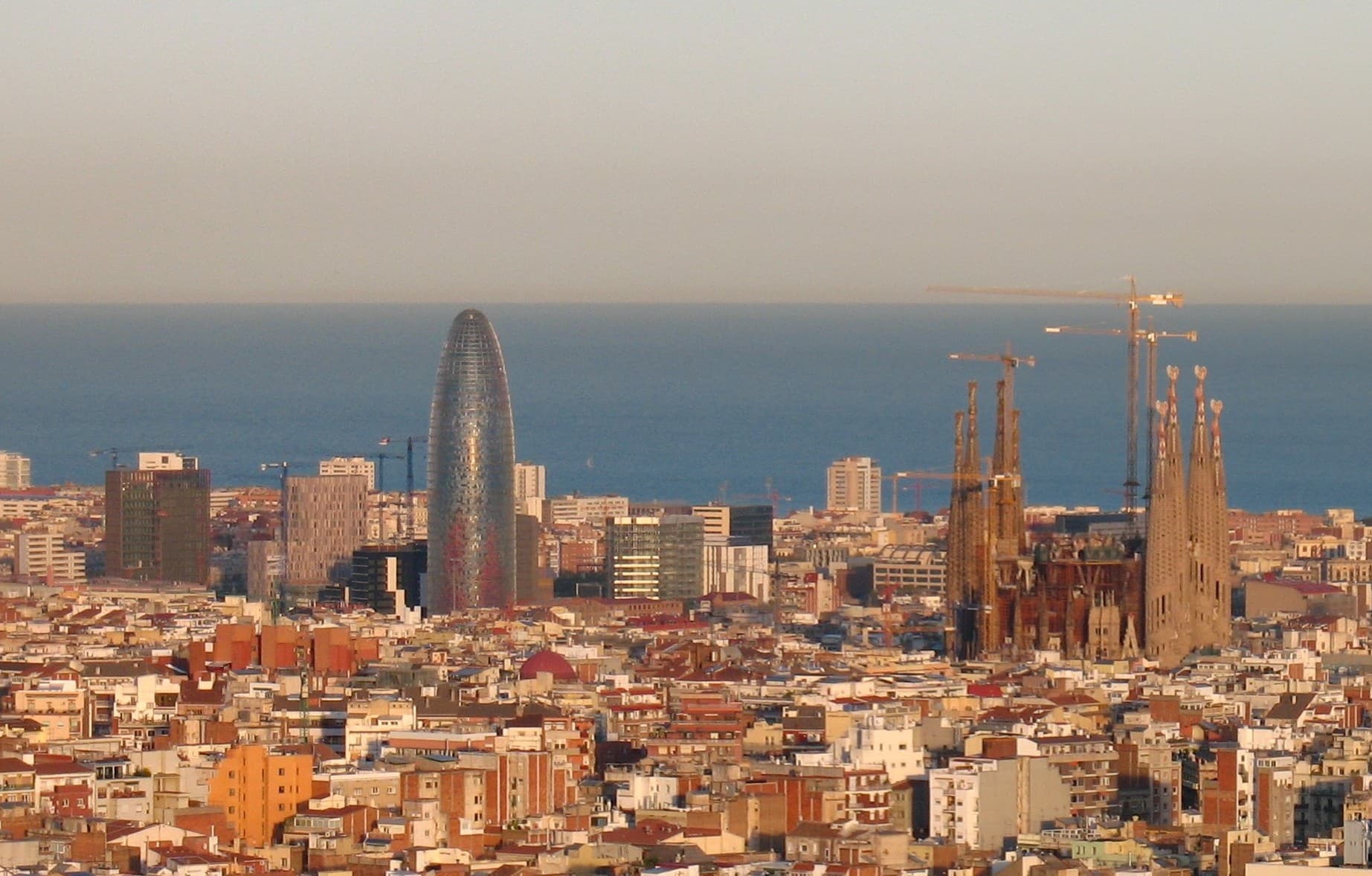
 Jorge Franganillo from Barcelona, Spain / CC BY 2.0 via Wikimedia Commons
Overview
Lisbon is built on hills above the wide mouth of the Tagus, and almost every neighborhood gives you a view of the river as the reward for the climb. It pairs a UNESCO-listed monument district in Belem with a lived-in old town in Alfama, a design-led center in Chiado and Principe Real, and good-value food and wine. For Israelis it is also one of the easiest European capitals to reach: El Al flies direct from Tel Aviv, and the city has a synagogue from 1904 and a memorial to the Jews killed in the 1506 massacre in the Largo de Sao Domingos, beside Rossio.
Do not try to see Belem and the old town on the same day. Belem’s monuments deserve unhurried time, sit 20 to 30 minutes from the center, and the Jeronimos Monastery is closed on Mondays; pair Belem with the riverside instead and save your climbing for Alfama. Then choose the evening viewpoint with the sun in mind, because the famous ones do not all face it. We computed every sunset of 2026 against the terrain: Santa Luzia loses the spring and summer sun up to 16 minutes early behind the castle hill, Sao Pedro de Alcantara faces east and the sun drops behind Bairro Alto 45 minutes to an hour and a half early, while Senhora do Monte, the highest of them, keeps it to within a few minutes all year and, from late October to mid-February, watches it set into the Atlantic beyond the mouth of the Tagus. The castle ramparts do much the same; the gates close at 21:00 from March to October, though the wall-walks can close earlier.
Best for
First-time Europe visitors · Food and wine lovers · Couples · Digital nomads · Budget-conscious travelers
Daily itinerary
4 to 6 days, plus a day for Sintra
Lisbon rewards walking uphill: tiled facades, yellow trams on steep gradients, and a miradouro (viewpoint) at the top of nearly every hill. Plan for one change the older guides miss. Since the Gloria funicular derailed on 3 September 2025, killing 16 people, the city’s historic lifts have been stopped: the Gloria, Bica and Lavra funiculars and the Santa Justa elevator were all still closed in September 2026, and only the modern Graca funicular has reopened. The hills are now climbed on foot, by tram or by bus.
Best time to visit
March to May and September to October are the sweet spots. IPMA’s long-term averages for central Lisbon put the daily high at 19.8C in April, 22.1C in May, 26.6C in September and 22.5C in October, against 27.9C in July and 28.3C in August, when inland heatwaves push well past that. Rain is almost absent in July and August and returns in October; November and December are the wettest months, with about 127 mm each.
- March to May: Spring light, jacaranda trees blooming from late spring, comfortable walking weather. IndieLisboa, the film festival, ran from 30 April to 10 May in 2026.
- June: The Festas de Lisboa run all month; the night of 12 to 13 June, Santo Antonio, fills Alfama with street parties and the marchas parade on the Avenida da Liberdade. Book well ahead. Around 21 June the castle gates close at 21:00, just as the sun sets.
- July to August: Peak heat and crowds; the coast at Cascais and Costa da Caparica gets very busy on weekends.
- September to October: Warm days and a warm sea, softer crowds, arguably the best pair of months. Clocks go back on 25 October 2026 and sunset drops from about 18:45 to 17:45.
- November to February: Mild but wetter, fewer tourists, lower hotel prices. From late October to mid-February the sun sets into the Atlantic beyond the Tagus mouth, as seen from Senhora do Monte.
Things worth knowing
- Festas de Lisboa (June): the year’s biggest street festival, with Santo Antonio on the night of 12 to 13 June centered on Alfama, Graca and the Avenida da Liberdade.
- IndieLisboa (spring): the independent film festival, 30 April to 10 May in 2026, plus fado and jazz series through the year.
Where to stay
 Miguel Vieira [2] · CC BY 2.0 via Wikimedia Commons
Alfama
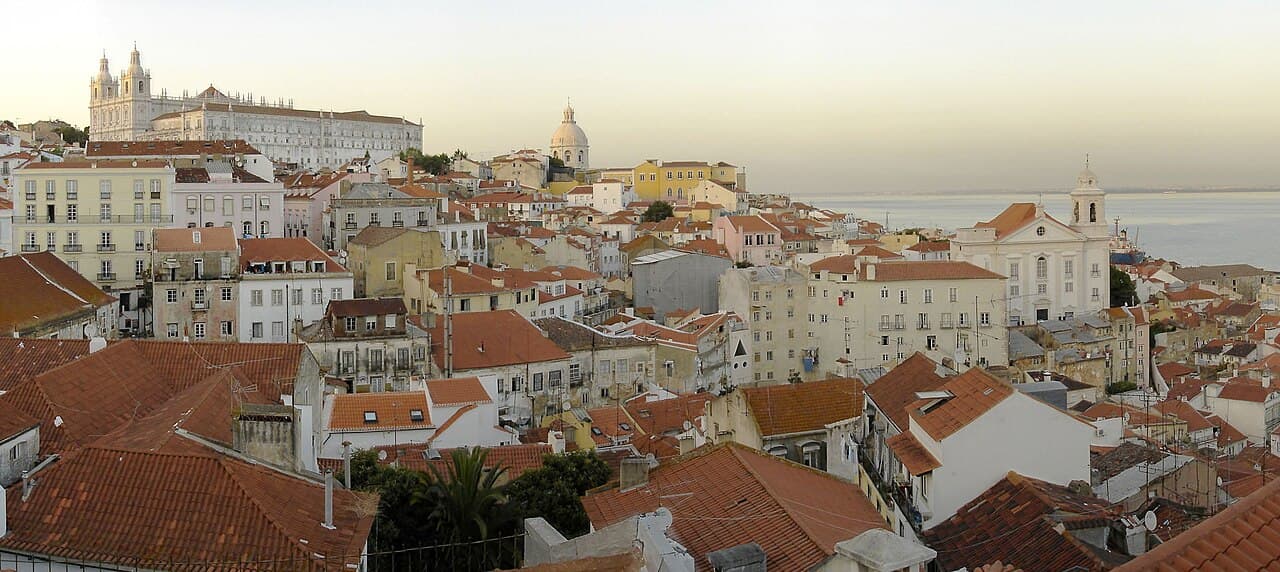
Lisbon’s oldest quarter: a maze of steep, narrow lanes below the castle, tiled facades, fado houses, and the viewpoints of Santa Luzia and Portas do Sol, which face east and south over the river and are at their best in the morning. Atmospheric but a genuine workout on foot.
Best for: First-time visitors · Fado · Views · Photography
Very steep and cobbled; hard on knees and wheeled luggage. Tram 28 gets packed with tourists. From late March to mid-September the castle hill takes the sunset up to 16 minutes early at Santa Luzia.
 RickMorais · CC BY-SA 4.0 via Wikimedia Commons
Chiado and Baixa
The flat, central core: grand 18th-century squares rebuilt after the 1755 earthquake, elegant shopping streets, cafes and theaters. The easiest base for a first visit. The Santa Justa elevator, which used to lift visitors from the Baixa to the Carmo, has been closed since September 2025.
Best for: First-time visitors · Shopping · Central location · No car
Touristy and can feel generic on the main squares; side streets are better for food. The climb up to Chiado and the Carmo is now on foot or by bus while the Santa Justa lift is shut.
 Sharon Hahn Darlin · CC BY 2.0 via Wikimedia Commons
Principe Real and Bairro Alto
Principe Real is upscale and design-led with a leafy square and boutique shops; Bairro Alto below it is quiet by day and Lisbon’s nightlife district after dark, with bars spilling into the streets. The Gloria funicular that climbed here from the Restauradores is gone: a new one is planned for 2029, the Carris minibus route 51E has replaced it since September 2025, and a memorial to the 16 victims will stand in the Largo da Oliveirinha.
Best for: Nightlife · Design shopping · Food
Bairro Alto is loud until the early hours on weekends; light sleepers should stay a few streets away. The Bica funicular down to the river is also closed; Carris gives no reopening date, and planning documents reported in September 2026 point to 2030 at the earliest.
 Pixabay · Pexels
Belem
The riverside monument district: the Jeronimos Monastery and Belem Tower, both UNESCO-listed, the Discoveries Monument, the MAC/CCB contemporary art museum and the original Pasteis de Belem bakery. The tower reopened to visitors on 27 May 2026 after a year of restoration. Better as a day out than a base.
Best for: History · Architecture · Museums
20 to 30 minutes from the center by tram 15E or bus; queues for the monastery and the tower build fast after 10:00, and both are closed on Mondays.
 Sophie Otto · Pexels
Graca and the eastern hills
Quieter and more residential than Alfama, with the city’s highest viewpoint, Senhora do Monte, and a strong local feel. The Graca funicular, opened in 2024, reopened on 30 April 2026, the only one of the city’s lifts running.
Best for: Sunset views · Local atmosphere · Value
Fewer restaurants and services than the center; steep walk up from Alfama.
Where to sleep
Four Seasons Hotel Ritz Lisbon
luxury · Marques de Pombal / Eduardo VII Park
Best for: Couples · Classic luxury · Art lovers
- Ten storeys above Eduardo VII Park with sweeping city views
- Private collection of mid-20th-century Portuguese art
- CURA, one Michelin star in 2026, among five restaurants and bars
- About 15 minutes by taxi, or a 45-minute walk, from Alfama and the old town
- Formal, business-hotel feel rather than boutique character
- Among the most expensive rooms in the city
Bairro Alto Hotel
luxury · Bairro Alto / Chiado
Best for: Couples · Rooftop views · Central nightlife access
- Rooftop terrace with a panoramic river and old-town view
- On the Praca Luis de Camoes, the hinge between Chiado and Bairro Alto
- A member of The Leading Hotels of the World
- Street and nightlife noise on lower floors in Bairro Alto
- The official site gives no room count, and it books out early
- Expensive relative to room size
AlmaLusa Baixa/Chiado
boutique · Baixa / Chiado
Best for: Couples · Central walkable base · Design
- On the Praca do Municipio, minutes from the river and Alfama
- 28 rooms, suites and an apartment, so service stays personal
- Its own restaurant, Delfina, cooking contemporary Portuguese food
- No pool or spa
- Some rooms are compact
- No on-site parking in a car-hostile neighborhood
Memmo Alfama
boutique · Alfama
Best for: Couples · Views over the Tagus · Staying inside Alfama
- A wine bar and terrace looking over the Alfama rooftops to the river
- Genuinely inside the old quarter, on the Travessa das Merceeiras
- Quiet despite the busy neighborhood around it
- Steep, cobbled approach makes luggage difficult
- No restaurant beyond breakfast and the wine bar
- The pool widely mentioned in reviews is not described on the official site, so ask before booking for it
Santiago de Alfama
boutique · Alfama
Best for: Couples · Historic character · A short walk to the castle
- A restored historic mansion with only 19 rooms
- An elevator to every floor, rare in Alfama, and a shared third-floor terrace
- A short walk to Sao Jorge Castle and the Santa Luzia viewpoint
- No balconies on the rooms
- Breakfast room is small for busier mornings
- Same steep-lane access issues as the rest of Alfama
Essential experiences
 Igor Passchier · Pexels
Jeronimos Monastery (UNESCO)
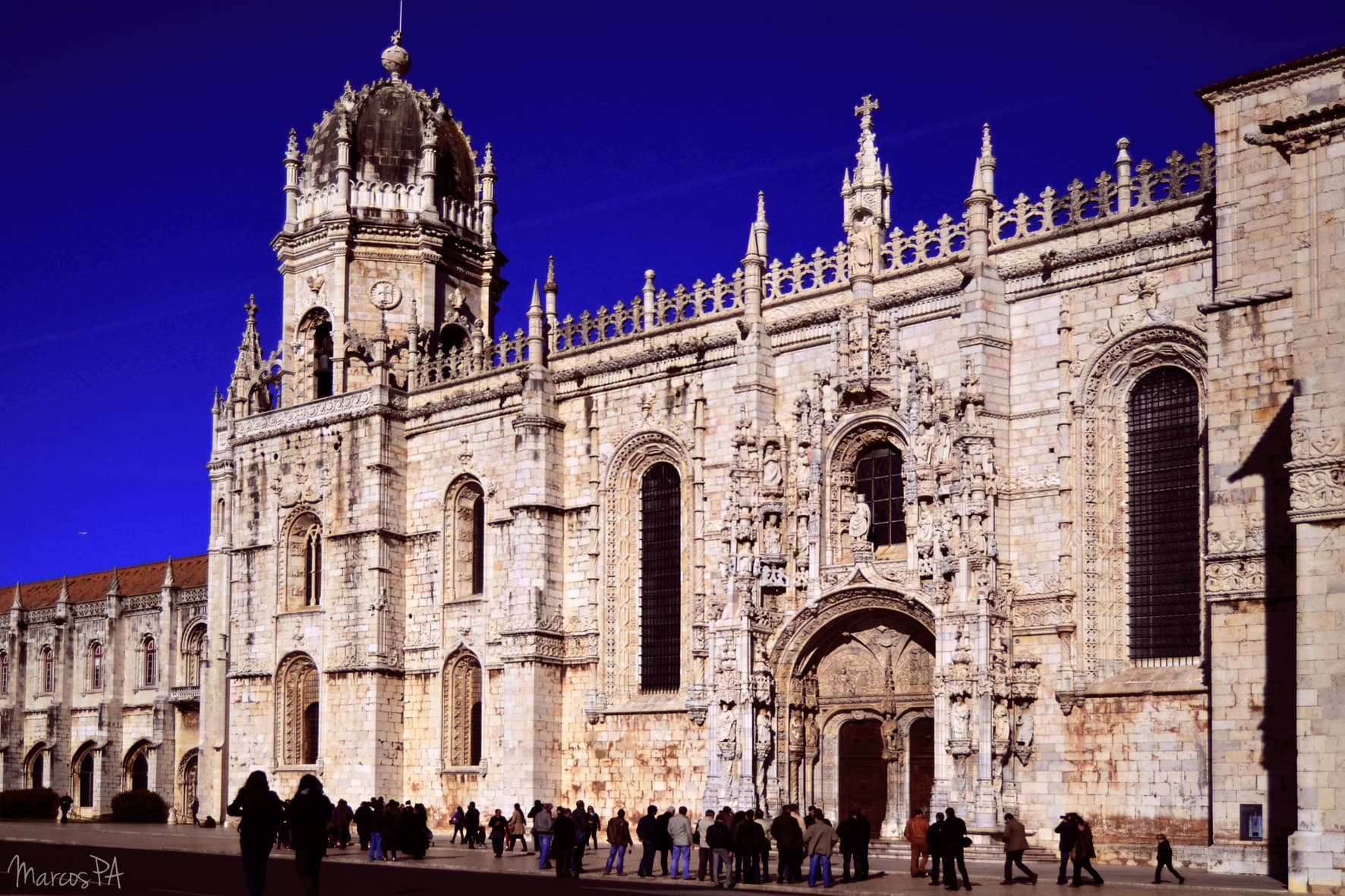
The Manueline monastery begun in 1502 to honor Vasco da Gama’s voyages, inscribed with Belem Tower on the UNESCO World Heritage List in 1983. The cloister ticket is 18 euros; it opens Tuesday to Sunday and is closed on Mondays, 1 January, Easter Sunday, 1 May, 13 June and 25 December. Arrive at opening.
 Vanessa Riecke · Pexels
Belem Tower (UNESCO)
The fortified Manueline tower built around 1514 to guard the Tagus, on the same 1983 UNESCO listing as the monastery. It reopened to visitors on 27 May 2026 after a year of restoration. 15 euros, Tuesday to Sunday 9:30 to 17:30.
 Zak Mir · Pexels
Sao Jorge Castle
The hilltop castle above Alfama, with the best all-round view of the city from its ramparts. 17 euros, 8.50 for ages 13 to 25, 14 over 65. The gates open every day 9:00 to 21:00 from March to October and 9:00 to 18:00 from November to February, last entry half an hour before closing, and close on 1 January, 1 May and 24, 25 and 31 December; the wall-walks and towers can close from 18:00 in summer depending on daylight and at 17:30 in winter, so check at the entrance. By our terrain model the ramparts see the sun set within about seven minutes of the almanac all year, into the Atlantic beyond the Tagus mouth from mid-October to early December and from January to late February, the winter ones mostly after the wall-walks close.
 Christine Zenino from Chicago, US · CC BY 2.0 via Wikimedia Commons
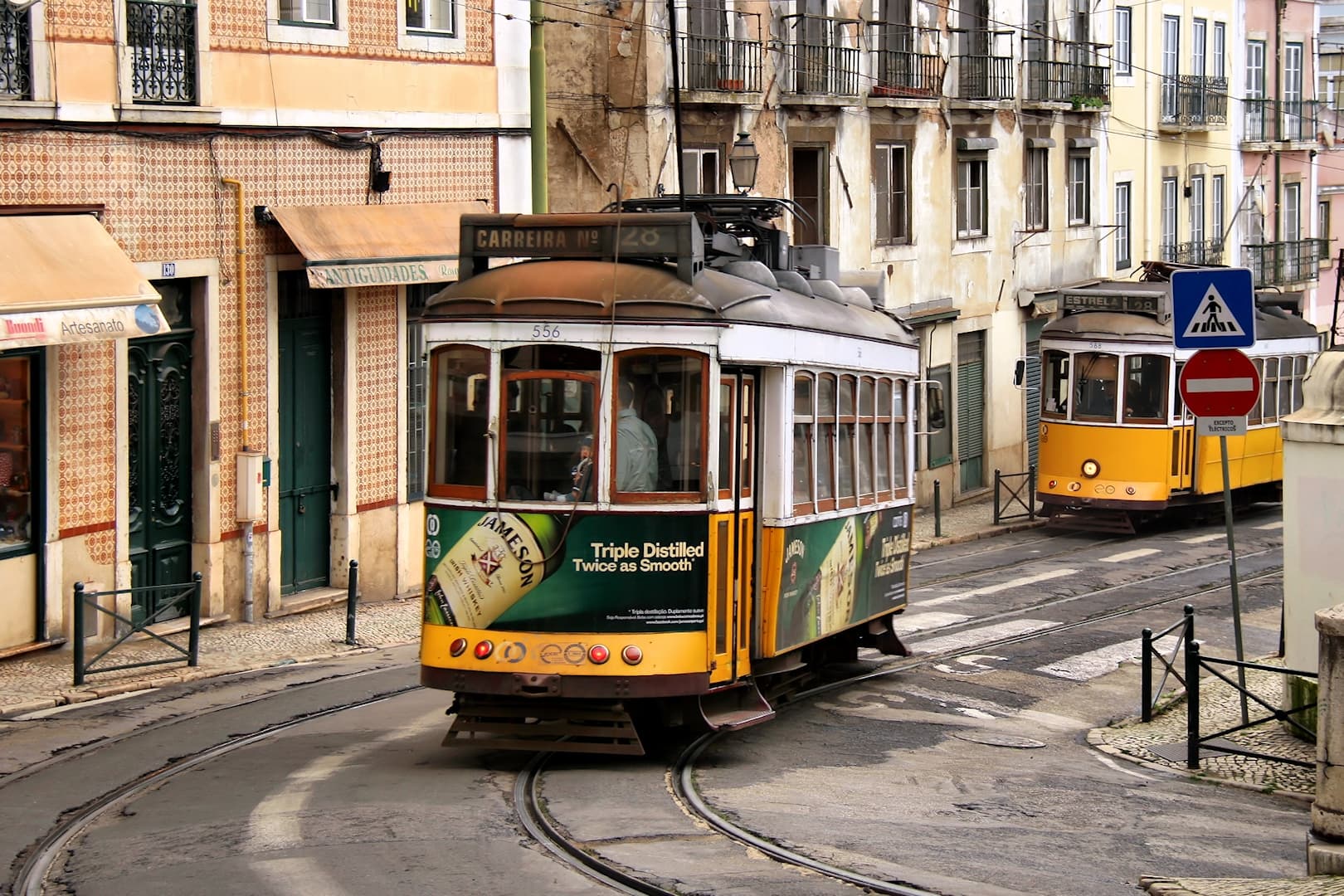
Tram 28
The vintage yellow tram climbing from Martim Moniz through Graca, Alfama, the Se Cathedral, Baixa and Chiado to Estrela and Campo de Ourique; with the historic lifts closed it is the classic way up the hills. 3.30 euros on board in 2026, or use a 24-hour Carris and Metro pass at 7.25 euros.
 Diego Delso · CC BY-SA 3.0 via Wikimedia Commons
Praca do Comercio
The grand riverside square rebuilt after the 1755 earthquake, framed by yellow arcades and opening straight onto the Tagus.
 Pedro Ribeiro Simões from Lisboa, Portugal · CC BY 2.0 via Wikimedia Commons
The 1506 massacre memorial, Largo de Sao Domingos
A stone memorial in the square beside the church of Sao Domingos, inscribed in memory of the thousands of Jews killed in the massacre that began on this square on 19 April 1506, when a mob turned on the New Christians, Jews forced to convert nine years earlier, for three days. It is free, always accessible, and a few steps from Rossio and the ginjinha bars.
 Boaz Gabriel Canhoto · CC BY-SA 3.0 via Wikimedia Commons
Shaare Tikva Synagogue
The Lisbon synagogue, inaugurated on 18 May 1904 on the Rua Alexandre Herculano, the first purpose-built synagogue in Portugal since the forced conversions of 1497, designed by Miguel Ventura Terra and set back in a courtyard because non-Catholic temples were not allowed a street facade at the time. Tourist visits are arranged through the Jewish community, Monday to Thursday 10:00 to 17:00 and Friday 10:00 to 13:00, and need an ID number at booking.
Comunidade Israelita de Lisboa: the synagogue ↗Lisboa.pt: visiting the synagogue ↗View on map ↗
 Vitor Oliveira from Torres Vedras, PORTUGAL · CC BY-SA 2.0 via Wikimedia Commons
MAC/CCB contemporary art museum
The contemporary art museum at the Centro Cultural de Belem, which took over the space of the former Berardo collection. A 15-euro ticket covers all its contemporary art and architecture exhibitions, including the Garagem Sul architecture space.
 RickMorais · CC BY-SA 4.0 via Wikimedia Commons
National Azulejo Museum
A former convent tracing the history of Portugal’s tin-glazed tiles, with a rooftop cafe view over the eastern Tagus waterfront. It is closed to the public for renovation works, with no reopening date on the operator’s page when we checked; do not plan a day around it.
 ricardo from London · CC BY 2.0 via Wikimedia Commons
LX Factory
A former industrial complex under the 25 de Abril Bridge, now workshops, bookshops, restaurants and murals; a popular weekend brunch spot.
 Marcos Proença / CC BY 3.0 via Wikimedia Commons
 Travelholic Path / CC BY 2.0 via Wikimedia Commons
Food & drink
 Simão Moreira · Pexels
Pastel de nata
The custard tart Lisbon is famous for; the original recipe comes from the Jeronimos monks, and Pasteis de Belem has made it since 1837.
 Jana Ohajdova · Pexels
Bacalhau a Bras
Shredded salt cod scrambled with eggs, onions and thin fried potatoes; one of hundreds of Portuguese salt-cod preparations.
 Alberto González · CC BY-SA 3.0 via Wikimedia Commons
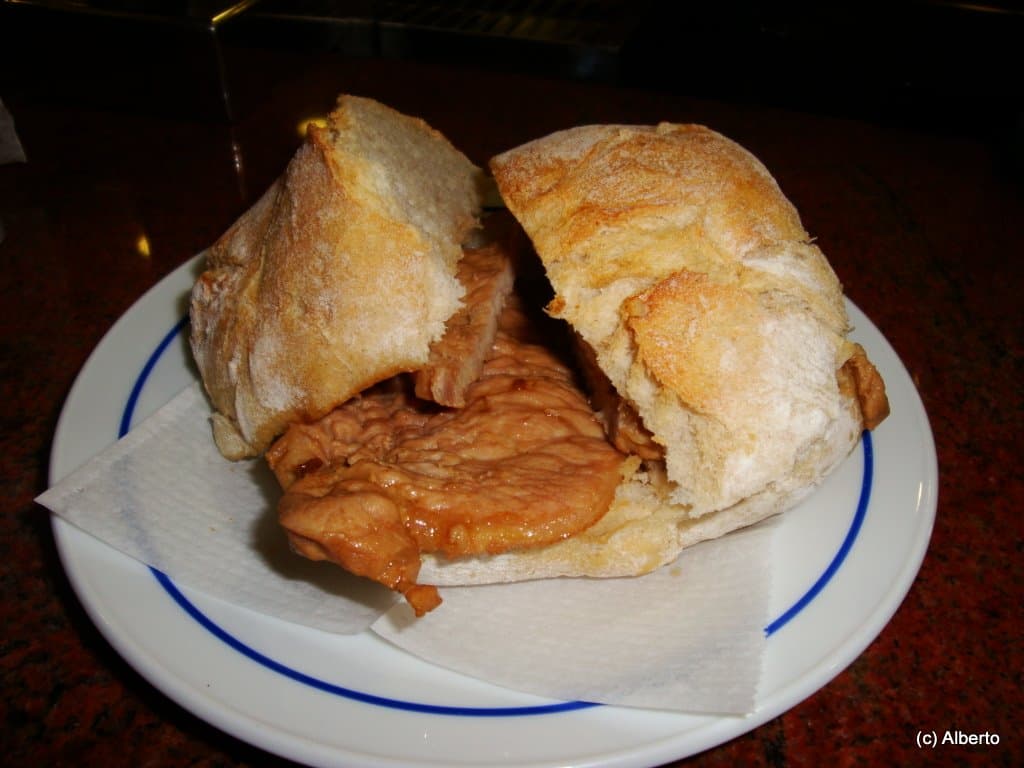
Bifana
A thin, garlicky pork cutlet sandwich in a soft roll; the classic quick lunch or late-night snack.
 Shadowgate · CC BY 2.0 via Wikimedia Commons
Ginjinha
Sour-cherry liqueur served from hole-in-the-wall bars around Rossio, often in a chocolate cup.
 E4024 · CC BY-SA 4.0 via Wikimedia Commons
Grilled fresh seafood
Prawns, clams and whole fish grilled simply; Cervejaria Ramiro is the best-known seafood institution in the city.
Lunch runs 12:30 to 15:00 and dinner from 19:30; many traditional tascas close on Sundays or Mondays, and Cervejaria Ramiro closes on Mondays. Bread, olives and cheese put on the table before you order are charged if you eat them; send them back if you do not want them. Tipping is not obligatory.
Where to eat
Pasteis de Belem
bakeryBaking to the same secret recipe since 1837 and open every day; expect a queue at the takeaway counter, which moves fast, or take a table inside.
Last researched 2026-09-26
Time Out Market Lisboa
marketA curated food hall of Lisbon chefs and stalls inside the historic Mercado da Ribeira on the Avenida 24 de Julho, open daily from 10:00 until late; busy at peak meal times.
Last researched 2026-09-26
Cervejaria Ramiro
institutionA no-frills but famous shellfish hall on the Avenida Almirante Reis, open since 7 April 1956. Tuesday to Saturday 12:00 to midnight, Sunday to 23:00, closed Mondays. Its site now takes table bookings; expect a queue if you walk in.
Last researched 2026-09-26
Belcanto
fine-diningJose Avillez’s flagship on the Rua Serpa Pinto, two Michelin stars in 2026, a few steps from the Sao Carlos opera house. Book well ahead.
Last researched 2026-09-26
Clube de Fado
institutionA fado house in a vaulted building below the cathedral: the kitchen opens at 19:30, fado starts at 20:30 and runs to about 01:00, every day. Booking is recommended and free, since the stone room is small; the set menu is 78 euros a person with the fado included, drinks extra.
Last researched 2026-09-26
Sunrises
 F Mira from Lisbon, Portugal · CC BY-SA 2.0 via Wikimedia Commons
Miradouro das Portas do Sol
Facing east over Alfama’s rooftops and the Tagus, this terrace catches the sunrise with far fewer people than at sunset. By our terrain model the sun comes up over the low land across the estuary, 18 to 60 kilometres away, within a minute or two of the almanac time all year: about 06:10 in late June and 07:50 in December.
Year-round
 Wikimedia Commons · Public domain via Wikimedia Commons
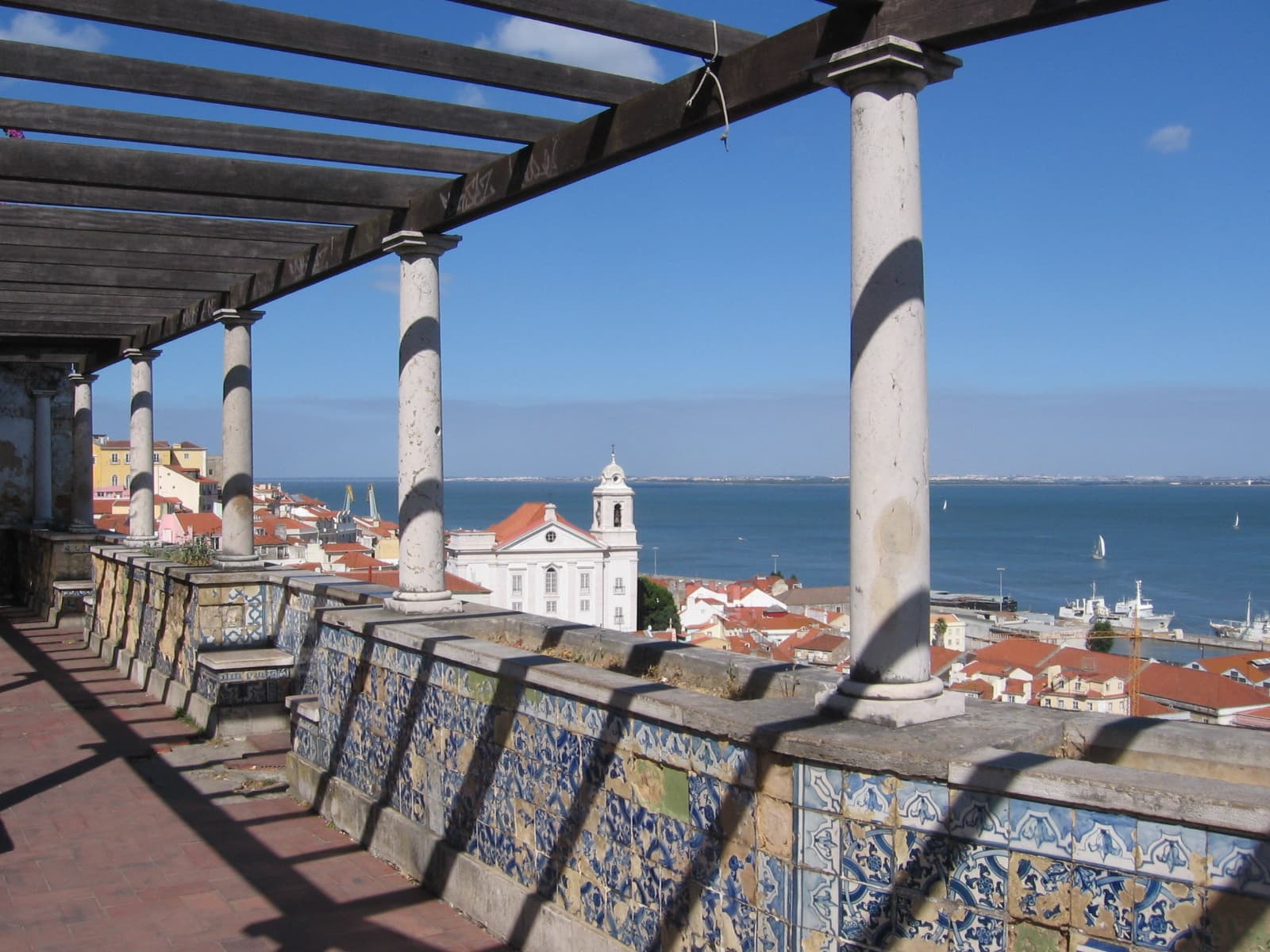
Miradouro de Santa Luzia at dawn
The tiled terrace next door to Portas do Sol looks south and east over the river, and this is the time to have it: the sunrise over the estuary comes a minute or so before the almanac all year, and the bougainvillea and azulejo panels are in soft light before the tour groups arrive.
Year-round
Sunsets
 JP Bennett from Yamato, Japan · CC BY 2.0 via Wikimedia Commons
Miradouro da Senhora do Monte
The best sunset of the city viewpoints and the highest of them, above Graca. From late March to mid-September the hills of Monsanto and, around midsummer, the Sintra hills take the sun three to seven minutes early; from 26 October to mid-February it sets into the Atlantic beyond the Tagus mouth, about 40 kilometres away, about two minutes after the almanac time. The view runs from the castle to the 25 de Abril Bridge.
Year-round; late October to mid-February for the sea horizon · A genuine uphill walk from Alfama, the Graca funicular, which reopened in April 2026, or tram 28 to Graca.
 Diego Delso · CC BY-SA 3.0 via Wikimedia Commons
Miradouro de Santa Luzia
The postcard terrace, draped in bougainvillea over Alfama’s rooftops, faces the river to the south and east, and the castle hill stands just behind it to the north-west. From late March to mid-September that hill takes the sun 5 to 16 minutes early: about 20:48 on 21 June against an almanac 21:04. In late October and November and from mid-January to mid-February the sun sets far to the south-west over the river mouth instead, but side buildings may block that angle from parts of the terrace. It is lovely in the evening light; for the sun itself, go to Senhora do Monte.
Late October to February; spring and summer for the evening light rather than the sun · The azulejo panels and pergola frame the shot; the light on the river is best in the hour before sunset.
 Mauricio Frias · CC BY 2.0 via Wikimedia Commons
Miradouro de Santa Catarina
The terrace of the Adamastor statue looks west over the river to the 25 de Abril Bridge, and is a local evening meeting place. The streets of Lapa and Madragoa, one to two kilometres west, take the sun 5 to 15 minutes early from late February to mid-October; in November, early December and January it sets into the Atlantic horizon beyond the river mouth, about a minute after the almanac.
November to January for the sun on the sea; any evening for the bridge in the last light · A short walk down from Chiado or up from Cais do Sodre.
 Bernt Rostad from Oslo, Norway · CC BY 2.0 via Wikimedia Commons
Miradouro de Sao Pedro de Alcantara
A garden terrace at the top of Bairro Alto that faces east, straight at the castle across the valley. It is not a sunset spot: by our model the sun drops behind Bairro Alto itself 45 minutes to an hour and a half before the almanac time. Come for the late light on the castle and Graca across the valley, then walk on to Santa Catarina or up to Senhora do Monte.
Year-round, for the view of the castle · The Gloria funicular that used to climb here has been closed since September 2025; walk up the Calcada da Gloria or take the replacement minibus route 51E.
 Pedro Simões from Lisboa, Portugal · CC BY 2.0 via Wikimedia Commons
Cristo Rei viewpoint, across the river
The monument across the Tagus in Almada gives the reverse view: the Lisbon skyline and the bridge in the setting sun. From its cliff-top esplanade the sun sets into the Atlantic beyond the river mouth around the equinoxes, from 4 to 25 March and 17 September to 9 October, about two minutes after the almanac; in midsummer the Sintra hills take it four to six minutes early.
March and late September to early October for the sea horizon · Reached by ferry from Cais do Sodre to Cacilhas plus a short bus or taxi ride; check the monument’s own closing time before you cross.
Day trips
 Wendy Wei · Pexels
Sintra (UNESCO Cultural Landscape)
A cluster of Romantic-era palaces in forested hills: the colorful Pena Palace, the Moorish Castle, and the Gothic-mystic Quinta da Regaleira. Pena Palace entry is by timed ticket only: 20 euros for the park and palace, 12 for the park alone; the Moorish Castle is 12 euros; Quinta da Regaleira, run by a separate foundation, is 20 euros in 2026. Buses 434 and 435 link the station, the historic center and the palaces, with a 24-hour ticket at 13.50 euros.
About 40 minutes by train from Rossio station · Full day
Parques de Sintra: Pena ↗Quinta da Regaleira: 2026 prices ↗Cultural Landscape of Sintra (UNESCO) ↗View on map ↗
 Tim Bonnarens · Pexels
Cascais and Cabo da Roca
A relaxed seaside resort town with a marina and sandy beaches, plus continental Europe’s westernmost point at Cabo da Roca on the way there or back.
About 40 minutes by train from Cais do Sodre · Half to full day
 Stephan Saloth · Pexels
Belem monuments (half-day from the center)
Not a full day trip but far enough to plan as its own outing: Jeronimos Monastery, Belem Tower, the Discoveries Monument, the MAC/CCB and the original pastel de nata bakery. Avoid Mondays, when the monastery and the tower are closed.
About 20 to 30 minutes by tram 15E or bus from the center · Half day
After dark
 Stefan Didam - Schmallenberg · CC BY-SA 3.0 via Wikimedia Commons
Fado in Alfama
cultureA small fado house in Alfama or Mouraria for Lisbon’s melancholic traditional song, usually with a set dinner menu; Clube de Fado, below the cathedral, starts its fado at 20:30, with a 78-euro set menu that includes the show.
 Bernt Rostad from Oslo, Norway · CC BY 2.0 via Wikimedia Commons
Miradouro sunset then Bairro Alto
nightlifeTime the sunset at Senhora do Monte or the castle, or at Santa Catarina in November and January, then head down into Bairro Alto for bar-hopping into the night.
Daily itinerary
Five days in Lisbon: hills, river and a day in Sintra
A central base in Chiado or Principe Real, no car needed, one full day reserved for Sintra. Start on a Tuesday so Belem (closed Mondays) falls on an open day and the synagogue, open to visitors Monday to Thursday and on Friday mornings, fits on day 1; with the historic lifts closed, the climbs are on foot, by tram 28 or by bus.
- 1
Baixa and Chiado
relaxedIf you arrived the evening before or on an early flight: walk Praca do Comercio and the Baixa grid, and pass the 1506 memorial at Largo de Sao Domingos.A tasca in Chiado.Walk up to the Carmo Convent ruins, open Monday to Saturday, and the Chiado shopping streets. The Santa Justa elevator has been closed since September 2025, so climb from the Baixa on foot.Miradouro de Santa Catarina for the bridge in the last light; from late February to mid-October the sun itself goes behind Lapa 5 to 15 minutes early.Dinner in Bairro Alto.A first taste of Bairro Alto’s bar streets.Entirely walkable; no car needed.Estimate: The Shaare Tikva synagogue on the Rua Alexandre Herculano, open to visitors Monday to Thursday 10:00 to 17:00, booked ahead through the Jewish community · Miradouro de Sao Pedro de Alcantara for the late light on the castle, before the sun drops behind Bairro Alto · On the afternoon El Al flight you land in the evening: check in and go straight to dinner in Bairro Alto
- 2
Alfama and the castle
moderateSao Jorge Castle for the ramparts view, 17 euros, from 9:00.Lunch near the Se Cathedral.Wander down through Alfama’s lanes to the Fado Museum, via Santa Luzia and Portas do Sol.Miradouro da Senhora do Monte, the highest viewpoint, within about seven minutes of the almanac all year.A fado house dinner in Alfama, booked ahead.Fado performance.Walkable but steep; take tram 28 or the Graca funicular partway if tired.Estimate: Ride tram 28 end to end instead of walking if the heat is intense
- 3
Belem
moderateJeronimos Monastery, arriving at opening to beat the queue; closed on Mondays.Pasteis de Belem for a late-morning tart, then a riverside lunch.Belem Tower, 15 euros, and the Discoveries Monument.Walk back along the riverside promenade toward Alcantara.Dinner in LX Factory or back in the center.Quiet night before Sintra.Tram 15E out to Belem, 3.30 euros on board or covered by a 24-hour pass; taxi or bus back if tired.Estimate: The MAC/CCB contemporary art museum, 15 euros, if the monastery queue is long
- 4
Sintra
fullEarly train to Sintra; head straight for Pena Palace at your booked time, before the tour buses arrive.Lunch in Sintra village.Quinta da Regaleira or the Moorish Castle, depending on energy.Back in Lisbon in time for the castle ramparts or Senhora do Monte.Dinner in Graca or Alfama.Rest after a full day of hills.Train from Rossio; buses 434 and 435 link Sintra’s sights on a 13.50-euro day ticket.Estimate: Pena Palace entry is only by timed ticket; book it online before you go
- 5
Principe Real and departure
relaxedA slow morning around Principe Real’s garden and design shops.A final tasca lunch near your hotel.Last-minute shopping, or LX Factory under the bridge. It is Saturday, so the synagogue is closed to visitors, and the National Azulejo Museum is closed for works.Departure.Leave buffer time for the airport transfer; the airport is inside the city on the red metro line.Estimate: A Cascais half-day if flying out late
Getting around
- El Al flies direct from Tel Aviv to Lisbon. The Israel Airports Authority flight board for 27 to 29 September 2026 showed El Al LY375 to Lisbon and LY376 back, sold also under TAP codes, and LY373 and LY374 to Porto. The board shows only a few days ahead, so treat it as a snapshot of late September.
- Humberto Delgado Airport (LIS) is inside the city, about 20 minutes by taxi or by the red metro line from the center.
- Long-distance trains and buses arrive at Oriente and Santa Apolonia stations; ferries cross the Tagus from Cais do Sodre and Terreiro do Paco.
- Israeli passport holders can stay 90 days in any 180 in the Schengen area without a visa. The EU Entry/Exit System has been fully operational since 10 April 2026, so first entries are registered with fingerprints and a photo; ETIAS is not yet in operation.
- The metro (four lines) covers the newer parts of the city well; the old hilltop neighborhoods are served by trams and buses. In 2026 a Carris and Metro single is 1.90 euros on a card, a tram ticket bought on board 3.30, and a 24-hour Carris and Metro pass 7.25 euros, or 10.35 with the Tagus ferries.
- The historic lifts are stopped. After the Gloria funicular derailed on 3 September 2025, killing 16 people, the Gloria, Bica and Lavra funiculars and the Santa Justa elevator were closed; a year later all four were still shut, a new Gloria funicular is planned for 2029, and only the Graca funicular has reopened, on 30 April 2026. The minibus route 51E, introduced in September 2025, replaces the Gloria.
- A Navegante or Viva Viagem card covers metro, bus, tram and ferry travel and is cheaper than buying on board.
- Tuk-tuks are common for short hops up steep hills but are pricier than public transport.
Things worth knowing
- · Trying to combine Belem and Alfama in one day; they are on opposite ends of the city.
- · Planning the Santa Justa elevator or the Gloria funicular. Both have been closed since September 2025.
- · Going to Belem on a Monday, when the monastery and the tower are closed.
- · Expecting a sunset at Sao Pedro de Alcantara. It faces east, and the sun drops behind Bairro Alto long before it sets.
- · Not booking a timed Pena Palace ticket ahead; palace entry is by reserved time only.
- · Planning a morning at the National Azulejo Museum. It is closed for renovation.
- · Underestimating how physically demanding the hills are with luggage or in summer heat.
Budget
| Low | Expected | Comfortable | |
|---|---|---|---|
| Accommodation style / per night | €60≈ $67 | €130≈ $146 | €280≈ $313 |
| Food style / per day | €20≈ $22 | €40≈ $45 | €80≈ $90 |
| Local transport / per day | €6≈ $7 | €10≈ $11 | €30≈ $34 |
| Estimate / per day | €5≈ $6 | €17≈ $19 | €35≈ $39 |
Estimate · EUR · 2026-09-26. Accommodation is per room per night, two sharing, at shoulder-season levels; July, August and Santo Antonio week run higher. Add Lisbon’s tourist tax of 4 euros per person per night, for guests over the age of 13, up to 7 nights. The Bank of Israel representative rate on 25 September 2026 was 3.4546 shekels to the euro, so the expected daily spend of about 67 euros a head before the room is roughly 230 shekels. Transport assumes a 24-hour pass at 7.25 euros; attractions run from the free miradouros to 15 to 18 euros for the castle, Jeronimos or the tower. The day-trip figure covers the Sintra train, the bus day ticket at 13.50 euros and one or two palace tickets at 12 to 20 euros. · 1 USD = €1 (14 Oct 2026)
Things worth knowing
Frequently asked questions
How many days do you need in Lisbon?
Four to six days covers the city well, plus a full extra day for Sintra. Four is enough for the highlights; six lets you add Cascais or a slower pace.
Can I fly direct from Tel Aviv to Lisbon?
Yes. El Al flies direct: the Israel Airports Authority board for late September 2026 showed LY375 to Lisbon and LY376 back, and El Al also flies to Porto. The airport is inside the city, about 20 minutes from the center by taxi or metro.
Are the Lisbon funiculars and the Santa Justa lift running?
No, apart from the modern Graca funicular. After the Gloria derailment of 3 September 2025, which killed 16 people, the Gloria, Bica and Lavra funiculars and the Santa Justa elevator were stopped, and in September 2026 all four were still closed. A new Gloria funicular is planned for 2029. Use tram 28, the buses, or your legs.
What is the best area to stay in Lisbon for the first time?
Chiado or Baixa for a flat, central, walkable base close to both Alfama and the riverside. Principe Real is a quieter, design-led alternative nearby.
Where is the best sunset in Lisbon?
Senhora do Monte above Graca, the highest viewpoint: the sun sets within about seven minutes of the almanac all year, and into the Atlantic beyond the Tagus mouth from late October to mid-February. The castle ramparts work much the same way; the gates close at 21:00 from March to October, though the wall-walks can close earlier. Santa Luzia loses the spring and summer sun up to 16 minutes early behind the castle hill, and Sao Pedro de Alcantara faces east, so the sun drops behind Bairro Alto long before it sets.
When is the best time to visit Lisbon?
April, May, September and October: highs of about 20C to 27C, good light and lighter crowds than the June-to-August peak.
Do you need a car in Lisbon?
No. The center is walkable and hilly streets make driving and parking impractical; trains handle Sintra and Cascais easily.
Is Sintra doable as a half day?
Not comfortably. Sintra’s palaces are spread across forested hills with queues and transfer time between them, and Pena runs on timed entry; a full day lets you see two or three properly.
Sources (28)
- Monastery of the Hieronymites and Tower of Belem inscribed on the UNESCO World Heritage List in 1983 · unesco · 2026-07-15
- Cultural Landscape of Sintra inscribed on the UNESCO World Heritage List · unesco · 2026-07-15
- Lisbon overview, neighborhoods and attractions · tourism-board · 2026-07-15
- Pasteis de Belem baking since 1837 to the original recipe · official · 2026-07-15
- Carris 2026 fares for Carris/Metro singles, on-board tram tickets and 24-hour passes · transport-operator · 2026-09-26
- Carris statement on the GPIAAF preliminary report into the 3 September 2025 Gloria funicular accident: the report notes cable nonconformities and draws no conclusions on the cause pending the final report · transport-operator · 2026-09-26
- The 3 September 2025 Gloria derailment killed 16 people; a year later Santa Justa, Lavra, Bica and the Gloria remained closed, a new Gloria is expected in 2029 and a memorial is planned in the Largo da Oliveirinha · reputable-local · 2026-09-26
- Only the Graca funicular has resumed operation, reopening on 30 April; Bica, Lavra and Santa Justa remain closed · reputable-local · 2026-09-26
- Museus e Monumentos de Portugal announced the official reinauguration of Belem Tower on 26 May 2026, with visitors admitted again from 27 May · government · 2026-09-26
- Carris planning documents reported in September 2026 point to 2030 at the earliest for the Bica and Lavra lifts · reputable-local · 2026-09-26
- Carris introduced the 51E minibus route in September 2025 as an alternative to the Gloria funicular · reputable-local · 2026-09-26
- Museus e Monumentos de Portugal: Jeronimos Monastery EUR 18, closed Mondays · government · 2026-09-26
- Museus e Monumentos de Portugal: Belem Tower EUR 15, Tuesday to Sunday 9:30 to 17:30 · government · 2026-09-26
- Museus e Monumentos de Portugal: the National Azulejo Museum is closed to the public for requalification works · government · 2026-09-26
- Castelo de Sao Jorge: EUR 17 adult; gates open 9:00 to 21:00 March to October and 9:00 to 18:00 November to February, with the wall-walks and towers closing between 18:00 and 21:00 in summer depending on daylight and at 17:30 in winter · official · 2026-09-26
- Parques de Sintra: Pena Park and Palace EUR 20 adult with palace entry only at a reserved date and time, park only EUR 12, Moorish Castle EUR 12 · official · 2026-09-26
- Quinta da Regaleira 2026 prices from January 2026: EUR 20 adult, EUR 15 youth and senior, EUR 60 family · official · 2026-09-26
- Sintra buses 434 and 435 serve the station, historic center, Moorish Castle, Pena, Regaleira, Seteais and Monserrate, with a 24-hour ticket at EUR 13.50 · transport-operator · 2026-09-26
- Lisbon’s tourist tax on overnight stays is EUR 4 per night per guest aged over 13, up to 7 nights, since 1 September 2024 · municipal · 2026-09-26
- IPMA climate normals 1981 to 2010, Lisboa Instituto Geofisico: mean daily maximum 19.8C in April, 22.1C in May, 27.9C in July, 28.3C in August, 26.6C in September, 22.5C in October; precipitation 127.5 mm in November and 126.2 mm in December · government · 2026-09-26
- The Israeli National Security Council rates Portugal level 2, occasional threat, recommending heightened precautions; the Foreign Ministry record gives no recommendations · government · 2026-09-26
- The Israel Airports Authority flight board shows El Al LY375 and LY376 between Tel Aviv and Lisbon in late September 2026 · airport · 2026-09-26
- The Entry/Exit System became fully operational on 10 April 2026 · government · 2026-09-26
- Bank of Israel representative rate of 25 September 2026: EUR 3.4546 shekels · government · 2026-09-26
- The Comunidade Israelita de Lisboa describes the Shaare Tikva synagogue, inaugurated on 18 May 1904 at Rua Alexandre Herculano 59 · reputable-local · 2026-09-26
- Lisbon’s Jewish Cultural Center on Rua da Judiaria has faced weekly anti-Israel vandalism since the start of the Middle East war, per its founder · reputable-local · 2026-09-26
- Chabad Lubavitch of Portugal is based in Cascais, greater Lisbon · reputable-local · 2026-09-26
- AWS Terrain Tiles, an SRTM-derived elevation dataset, supports the horizon profiles computed for the Lisbon viewpoints · independent-travel · 2026-09-26