Spain · Madrid
Madrid
Stay in Sol, the Barrio de las Letras, Malasana or Salamanca for a central, walkable base, give a full day to the Prado, the Reina Sofia and the Thyssen, on a Wednesday to Saturday if you can, watch the sunset from the Templo de Debod or the Circulo de Bellas Artes rooftop, and add Toledo or Segovia as a day trip.
 Superchilum / CC BY-SA 3.0 via Wikimedia Commons
Overview
Madrid is the highest capital in the European Union, about 650 metres up on a wide plateau with famously clear light and blue skies. It holds one of the world’s great art clusters in the Prado, the Reina Sofia and the Thyssen, three museums a few minutes’ walk apart on the Paseo del Prado, which UNESCO inscribed with the Retiro in 2021. It has a nightlife culture that really starts after midnight, and a food scene that runs from Botin, open since 1725 and listed by Guinness World Records as the world’s oldest restaurant, to standing-room vermouth bars and two-star dining rooms. For Israeli travellers it is also one of the easiest European capitals to reach, with El Al and Air Europa flying direct from Tel Aviv every day.
Eat on Madrid time, not your home country’s: lunch after 14:00 and dinner after 21:00 is when the best tapas bars and restaurants come alive. And use the free hours cleverly: the Prado is free for its last two hours every day, the Reina Sofia from 19:00 to 21:00 on most weekdays and on Sunday late morning, and the Thyssen all day Monday, from 12:00 to 16:00. For the sunset, we computed the sun against the terrain for every day of 2026: from the Templo de Debod the sun never sets on a flat horizon, going down 2 to 3 minutes early behind the low hills west of Casa de Campo from October to early March, and behind the Sierra de Guadarrama and the ranges beyond it, 40 to 100 kilometres away, from April to early September, up to 9 minutes before the almanac in June. The Circulo de Bellas Artes rooftop, higher up, sees it set almost on the almanac time in winter.
Best for
First-time Europe visitors · Art and museum lovers · Nightlife · Food and tapas · Couples
Daily itinerary
4 to 5 days, plus a day for Toledo or Segovia
Unlike coastal Barcelona, Madrid is a landlocked, planned capital: wide boulevards, a walkable historic centre, and a rhythm built around long lunches and later dinners than almost anywhere else in Europe. The museums reward planning in a way few cities do: each of the big three has free hours, the Reina Sofia closes on Tuesdays, the Thyssen opens only four hours on Mondays, and the Royal Palace’s free hours are for EU and Ibero-American citizens only.
Best time to visit
April to June and September to October are the sweet spots. AEMET’s Madrid Retiro normals give a daily high of 22.2C in May and 26.4C in September, against 32.1C in July and 31.3C in August, when heat waves regularly push past 35C on the plateau. Winter is cold and bright: highs near 10C in December and January and nights close to freezing. October is the wettest month, with about 60 mm.
- April to May: Mild, blooming parks, and San Isidro, the city’s patron saint, on 15 May. From April the sun from the Templo de Debod sets over the Sierra de Guadarrama.
- June: Warming up, highs near 28C, and the longest evenings: sunset at 21:48 on 21 June, though the sierra takes it from the Templo de Debod about 9 minutes early. Pride runs from late June into early July; MADO 2027 was pencilled in for 30 June to 4 July, dates to be confirmed.
- July to August: Very hot and dry, about 32C by day; some locals leave the city and some restaurants close for part of August. Go out early, museum in the afternoon.
- September to October: Cooling but still warm, arguably the best month-pair for a first visit. The National Day parade on 12 October, with free entry that day at the Reina Sofia. October is the wettest month.
- November to February: Cold and bright, highs near 10C; fewer crowds and lower prices. From October to early March the sun sets from the Templo de Debod behind the low hills west of Casa de Campo, only 2 to 3 minutes early, and almost on time from the Circulo de Bellas Artes rooftop.
Things worth knowing
- San Isidro (15 May): Madrid’s patron-saint celebrations, with traditional dress, verbenas and the pilgrimage to the saint’s meadow. The Reina Sofia closes that day.
- Madrid Pride, MADO (late June to early July): one of Europe’s largest Pride celebrations, centred on Chueca. The 2027 dates were announced as 30 June to 4 July, still to be confirmed.
- Fiesta Nacional (12 October): the Armed Forces parade along the Paseo del Prado and Recoletos, and free entry at the Reina Sofia.
- Three Kings parade (5 January): the great evening procession through the centre, from about 18:30 to 21:00.
Where to stay
 Alex Hoces · Pexels
Sol and Centro
The literal centre of Spain: Puerta del Sol, Plaza Mayor and the surrounding lanes, with Botin, the Mercado de San Miguel and San Gines all within a few minutes. Busy, central and touristy, but the obvious first-timer base within walking distance of everything.
Best for: First-time visitors · Central location · No car
Very touristy and can feel generic; watch your bag in the crowds around Sol and Gran Via.
 Nicolas Vigier from Paris, France · CC0 via Wikimedia Commons
Malasana and Chueca
Malasana is bohemian and dense with vintage shops; Chueca next door is the LGBTQ-friendly nightlife heart of the city with a lively bar and restaurant scene, and home to Chabad’s centre on Calle de la Reina.
Best for: Nightlife · Vintage shopping · LGBTQ-friendly travel
Loud at night, especially at weekends; not the neighbourhood for an early night.
 Javier Pérez Montes · CC BY-SA 4.0 via Wikimedia Commons
La Latina and Lavapies
La Latina’s old lanes hold Madrid’s best tapas bar-hopping, on the Cava Baja and around Sunday’s El Rastro flea market; Lavapies next door is Madrid’s most multicultural, gritty and creative district, a few minutes from the Reina Sofia.
Best for: Tapas crawling · Sunday flea market · A less polished Madrid
Lavapies is edgier after dark in parts; La Latina gets extremely crowded on Sunday mornings.
 David Adam Kess · CC BY-SA 4.0 via Wikimedia Commons
Barrio de Salamanca
A grid-planned nineteenth-century district of grand avenues, designer shopping and Madrid’s quietest upscale hotels. Elegant, but a 15 to 20 minute walk or a short metro ride from the historic core.
Best for: Luxury shopping · Quiet upscale stays · A polished base
Feels removed from the old-town energy, with fewer casual tapas bars than La Latina or Malasana.
 Mauricio Krupka Buendia · Pexels
Retiro and the Art Triangle (Paseo del Prado)
The UNESCO-listed Paseo del Prado: the Prado, the Reina Sofia and the Thyssen-Bornemisza, alongside the Retiro, more than 125 hectares of former royal garden. The Barrio de las Letras, the old literary quarter between the Paseo and Sol, is the best place to sleep for a museum-heavy trip.
Best for: Museums · Parks · Art lovers
Quiet at night along the Paseo itself; the Letras lanes behind it have the bars.
Where to sleep
Mandarin Oriental Ritz, Madrid
luxury · Plaza de la Lealtad, Paseo del Prado
Best for: Classic luxury · Museum-district base · Special occasions
- Between the Prado and the Retiro, in the heart of the Art Triangle
- Home to Deessa by Quique Dacosta, with two Michelin stars in the 2026 guide
- The Palm Court and El Jardin del Ritz for a lighter meal
- A 15 to 20 minute walk from the Malasana and Chueca nightlife
- Formal, grand-hotel atmosphere rather than an intimate boutique
- Among the most expensive rooms in the city
Four Seasons Hotel Madrid
luxury · Centro Canalejas, near Puerta del Sol
Best for: Central luxury · Shopping access · Rooftop dining
- Unites seven historic buildings in the Centro Canalejas complex, just off Puerta del Sol
- A rooftop restaurant and bar by the chef Dani Garcia
- An indoor pool in a spa of more than 1,450 square metres
- Very busy tourist streets right outside
- One of the priciest hotels in the city
- The pool is indoors: there is no rooftop pool, whatever some listings say
Rosewood Villa Magna
luxury · Paseo de la Castellana, Salamanca
Best for: Luxury shopping base · Quiet upscale stays · Couples
- Reopened after a full renovation, on the Castellana at the edge of Salamanca
- Amos by Jesus Sanchez and Las Brasas de Castellana for dinner in
- The Sense spa and spacious rooms by Madrid standards
- A taxi or metro ride from the historic centre and nightlife
- Formal atmosphere, less suited to a casual city break
- Salamanca itself is quiet after dark
Hotel Urban
design · Carrera de San Jeronimo, Barrio de las Letras
Best for: A base between Sol and the Prado · Design lovers · Dinner in
- A five-star grand-luxury design hotel five minutes from both Sol and the Paseo del Prado
- Its restaurant, Cebo, holds a Michelin star
- A collection of tribal art in the public spaces and a seasonal terrace with a bar
- A busy street outside
- The design is dark and modern, not for lovers of classic hotels
- The terrace is seasonal
7 Islas Hotel
boutique · Calle de Valverde, between Gran Via and Malasana
Best for: A family-run small hotel · Nightlife access · Couples
- One of the few family-run hotels left in central Madrid, opened in 2002 by a family from Lanzarote
- Top-floor penthouse rooms with private terraces
- Walking distance to Malasana, Chueca and Gran Via
- Street noise in a busy nightlife-adjacent area
- No spa or pool
- A small hotel that books up at weekends; use 7islashotel.com, not look-alike domains
Eric Vokel Madrid Suites
apartment · Calle de San Bernardo, Malasana
Best for: Self-catering · Groups and families · Longer stays
- A whole-building apartment hotel in Malasana, with apartments for up to six people
- Private kitchens and living rooms, good value for groups
- A self check-in kiosk for late arrivals
- Reception is staffed only from 09:00 to 17:00
- No hotel services such as a restaurant or daily breakfast room
- Not ideal for a single traveller who wants hotel service
The Hat Madrid
value · Calle Imperial, by Plaza Mayor
Best for: A budget bed in the centre · Solo travellers · A rooftop terrace
- A boutique hostel with dorms and private rooms a minute from Plaza Mayor
- A rooftop terrace bar
- La Latina’s tapas lanes on the doorstep
- Hostel noise and shared spaces
- Small private rooms
- Busy tourist streets around it
Essential experiences
 Brian Snelson from United Kingdom · CC BY 2.0 via Wikimedia Commons
Museo del Prado
One of the world’s great art museums: Velazquez’s Las Meninas, Goya’s Black Paintings, Bosch’s Garden of Earthly Delights. Open Monday to Saturday 10:00 to 20:00 and Sundays and holidays 10:00 to 19:00; 15 euros, 7.50 reduced, and free for the last two hours before closing every day, when the queue is long. Closed 1 January, 1 May and 25 December.
 Adam Jones, Ph.D. · CC BY-SA 3.0 via Wikimedia Commons
Museo Reina Sofia
Spain’s national museum of modern art, home to Picasso’s Guernica and major Dali and Miro holdings. Open 10:00 to 21:00, Sundays to 14:30, and closed on Tuesdays; 12 euros, and free from 19:00 to 21:00 on Monday and Wednesday to Saturday and from 12:30 to 14:30 on Sunday, though you still need a ticket, which can be booked online. In February 2026 museum staff ejected three elderly Israeli women who had displayed an Israeli flag and a Star of David, and other visitors shouted insults at them: keep national symbols low-key here.
 MANZANITAVERDE · CC BY 2.0 via Wikimedia Commons
Museo Thyssen-Bornemisza
The third point of the Art Triangle, a private collection across eight centuries of European painting, from the Italian primitives to Pop Art. 14 euros, 10 for over-65s and students, free for under-18s. From September to June it opens Tuesday to Friday and Sunday 10:00 to 19:00 and Saturday to 23:00, and on Mondays only from 12:00 to 16:00, when the collection is free. The Paseo del Arte ticket covers one visit each to the Prado, the Reina Sofia and the Thyssen for 32.80 euros, valid for a year.
 Enric · CC BY-SA 4.0 via Wikimedia Commons
Retiro Park (UNESCO)
More than 125 hectares of former royal garden with a rose garden, the boating lake of the Estanque Grande and some 15,000 trees, inscribed on the UNESCO World Heritage List in 2021 with the Paseo del Prado. Open 06:00 to midnight from April to September and 06:00 to 22:00 from October to March, and closed on red weather alerts. The Crystal Palace is closed for works in 2026 and wrapped by Andrea Canepa’s installation Bundle until 1 January 2027, so you see it from outside; the Palacio de Velazquez nearby is open and free.
 Margo Evardson · Pexels
Palacio Real (Royal Palace)
One of Europe’s largest royal palaces, more than 135,000 square metres and over 3,000 rooms, still the King’s official residence though used only for state ceremonies, with the Throne Room and the Gasparini Room on the visit. 18 euros, or 24 with the Gallery of the Royal Collections next door. Open 10:00 to 19:00 from April to September and to 18:00 from October to March, Sundays to 16:00, and closed for official events, as on 27 to 29 September 2026. Its free weekday late-afternoon hours are only for EU citizens and residents and Ibero-American citizens, so Israeli visitors pay. Leave large bags at the hotel during the current works.
 Gonzalo Mendiola · Pexels
Templo de Debod
A genuine Egyptian temple of the second century BC, given to Spain for its help in saving the Nubian monuments and rebuilt on a rise in the Parque del Oeste. The outside is free at any hour; the interior is free too, Tuesday to Sunday from 10:00 to 20:00 (to 19:00 from mid-June to mid-September), closed on Mondays, with limited capacity and time slots released on the 15th of the previous month at madrid.es/debodreservas.
 Luis Quintero · Pexels
Plaza Mayor
The great seventeenth-century arcaded square at the heart of old Madrid, historically used for markets, bullfights and public ceremonies. Free, and best early in the morning before the cafes set out their tables.
 Carlos Arribas · Pexels
Gran Via
Madrid’s early twentieth-century boulevard, built between 1910 and 1929, of theatres, cinemas and department stores, anchored by the winged dome of the Edificio Metropolis at its eastern end. The Circulo de Bellas Artes rooftop, a few steps away on Alcala, is the place to see it from above.
 Carlos Delgado / CC BY-SA 3.0 via Wikimedia Commons
 Jeremy A.A. Knight / CC BY-SA 4.0 via Wikimedia Commons
Food & drink
 Tnarik · CC BY-SA 2.0 via Wikimedia Commons
Cocido madrileno
A slow-cooked stew of chickpeas, meats and vegetables served in courses, the soup first; a winter classic.
 Xemenendura · CC BY-SA 4.0 via Wikimedia Commons
Bocadillo de calamares
A fried squid-ring sandwich, the street-food classic of the lanes around Plaza Mayor.
 carthesian · CC BY 2.0 via Wikimedia Commons
Cochinillo asado
Roast suckling pig, the Castilian speciality: Botin lists it at 32.50 euros, and Segovia makes a day trip of it.
 Xemenendura · CC BY-SA 4.0 via Wikimedia Commons
Torrezno
Crisp-fried pork belly strips, a tapas-bar staple.
 Çiğdem Bilgin · Pexels
Churros con chocolate
Fried dough with thick hot chocolate for dipping, eaten late at night or for breakfast, above all at San Gines, open around the clock.
Lunch runs late, 14:00 to 16:00, and dinner later still, from 21:00; many restaurants do not open for dinner before 20:30. Vermouth at midday, standing at the bar, is a Madrid ritual, and tapas are often ordered as raciones to share. Tipping is modest: rounding up or a few euros for good service.
Where to eat
 Esetena · Public domain via Wikimedia Commons
Sobrino de Botin
institutionOpened in 1725 and listed by Guinness World Records as the world’s oldest restaurant, still roasting in its centuries-old wood-fired oven: suckling pig 32.50 euros, roast lamb 33. Open every day from 13:00 to 23:30; book ahead.
Last researched 2026-09-27
 Luis García (Zaqarbal) · CC BY-SA 3.0 via Wikimedia Commons
Mercado de San Miguel
marketA restored iron-framed market hall of more than a century, now a gourmet tapas market with more than seven million visitors a year, so touristy and priced accordingly. Open 10:00 to midnight, to 01:00 on Fridays, Saturdays and holiday eves.
Last researched 2026-09-27
 David Adam Kess · CC BY-SA 4.0 via Wikimedia Commons
Chocolateria San Gines
institutionChocolate and churros since 1894, open 24 hours every day of the year. No reservations: order and pay at the till first, then hand the ticket to the waiter.
Last researched 2026-09-27
Deessa
fine-diningQuique Dacosta’s restaurant in the Ritz, with two Michelin stars in the 2026 guide. Book well ahead.
Last researched 2026-09-27
Las Tortillas de Gabino
casualA Bib Gourmand in the 2026 Michelin guide, built around the tortilla de patatas in many versions. Book for dinner.
Last researched 2026-09-27
Bodegas Ricla
barA tiny standing-room bodega founded in 1867, a few doors from Botin, for vermouth or a glass of wine with a tapa. Its listed hours are lunchtime every day but Tuesday and evenings from Thursday to Saturday, but the listing may be old, and its own domain did not load when we checked.
Last researched 2026-09-27
La Venencia
barA sherry-only bar where no photographs are allowed and no reservations taken, open from 12:30 to 15:30 and from 19:30 in the evening by its map listing. We do not link its website, which now carries injected casino spam.
Last researched 2026-09-27
Sunrises
 Wikimedia Commons · CC BY-SA 3.0 via Wikimedia Commons
Retiro Park, Estanque Grande
The boating lake of the Retiro is calm and nearly empty at dawn, before the joggers and the tour groups. The sun rises at 06:44 on 21 June and 08:07 on 27 September, and reaches the water once it clears the trees on the eastern side of the park.
Year-round
Sunsets
 MGR from Madrid, Spain · CC BY 2.0 via Wikimedia Commons
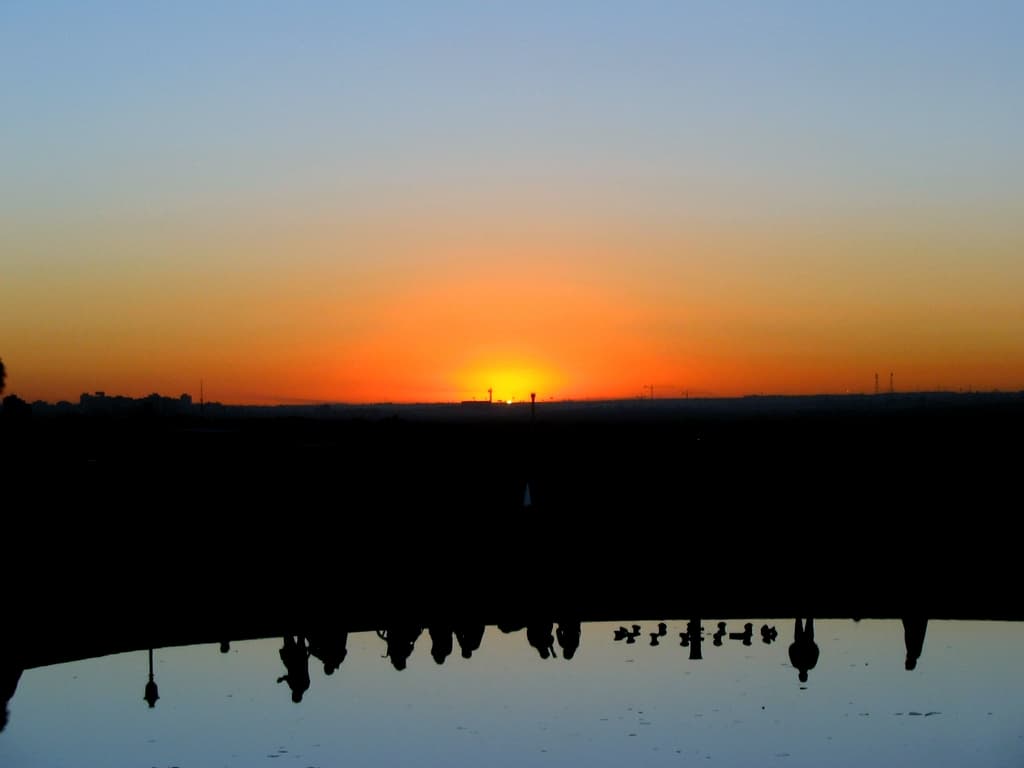
Templo de Debod
The Egyptian temple on its rise in the Parque del Oeste, with the pools that reflect it, is Madrid’s classic sunset, and here is what the sun really does, computed from terrain data for every day of 2026. It never sets on a flat horizon. From October to early March it goes down behind the low hills west of Casa de Campo, 5 to 10 kilometres away, 2 to 3 minutes before the almanac time. From April to early September it sets over the Sierra de Guadarrama and the ranges west of it, 40 to 100 kilometres away, which takes it earlier: about 9 minutes in June, at 21:39 against the almanac 21:48 on 21 June. On 27 September it goes at about 20:01.
Year-round; the sierra horizon from April to early September · The park and the outside of the temple are free at any hour; the interior closes at 20:00, or 19:00 in summer, and on Mondays. · Stand on the eastern side of the pools to catch the temple and its gates against the western sky, with the reflection below.
 RaquelCBA · CC BY-SA 4.0 via Wikimedia Commons
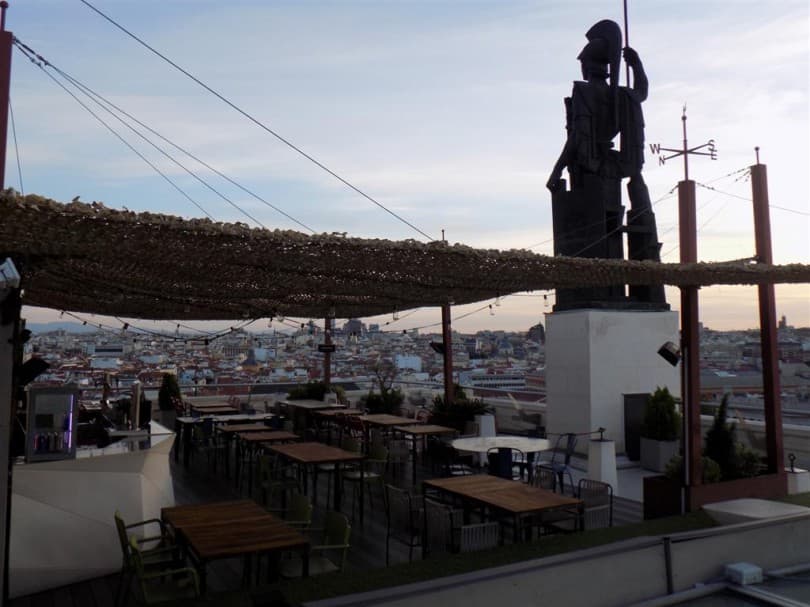
Circulo de Bellas Artes rooftop (Azotea)
The roof terrace of the Circulo de Bellas Artes on Alcala, about 50 metres above the street, with views over Gran Via, the Metropolis dome and the mountains beyond. From that height the horizon is almost flat in winter: from November to February the sun sets within half a minute of the almanac time. From March to early October it goes down over the far sierras, up to 8 minutes early in June.
November to February for the flattest horizon; any clear evening for the view · 6 euros, 5 reduced; open daily from 10:00 to 01:30, to 02:00 on Fridays and Saturdays. Arrive before sunset: tables fill up.
 Luis García (Zaqarbal) · CC BY-SA 3.0 via Wikimedia Commons
Las Vistillas gardens
A terraced garden south of the Royal Palace looking west over the Manzanares valley towards Casa de Campo, with the Almudena Cathedral dome close by. From October to early April the sun sets about 3 minutes before the almanac, and from mid-April to early September over the Sierra de Guadarrama, up to 9 minutes early in June.
Year-round
 Barcex · CC BY-SA 2.0 via Wikimedia Commons
Cerro del Tio Pio
The grassy hills of the Parque del Cerro del Tio Pio in Puente de Vallecas, nicknamed the Siete Tetas, where locals come for the whole city skyline to the west with the sierra behind it. By our terrain model the sun sets there only half a minute to a minute and a half before the almanac from October to early March, and over the far sierras from late March to mid-September, up to 8 minutes early in June. Free, and away from the tourist crowds.
Autumn and winter for the flattest horizon
Day trips
 Diliff · CC BY 2.5 via Wikimedia Commons
Toledo
The medieval city of three cultures on a gorge above the Tagus, a UNESCO World Heritage city, with its Gothic cathedral, the Alcazar and the Jewish quarter. The Sinagoga del Transito, home of the Sephardic Museum, costs 3 euros, half with your Renfe ticket, and is free on Saturday afternoons and Sundays; it opens Tuesday to Saturday 09:30 to 20:00 and Sundays 10:00 to 15:00, and is closed on Mondays. Santa Maria la Blanca, the former synagogue with its white horseshoe arches, costs 4 euros and opens daily.
About 33 minutes by Renfe Avant high-speed train from Atocha · Full day
Renfe: Madrid to Toledo ↗Museo Sefardi: hours ↗View on map ↗
 Óscar Ibáñez Fernández · CC BY-SA 3.0 via Wikimedia Commons
Segovia
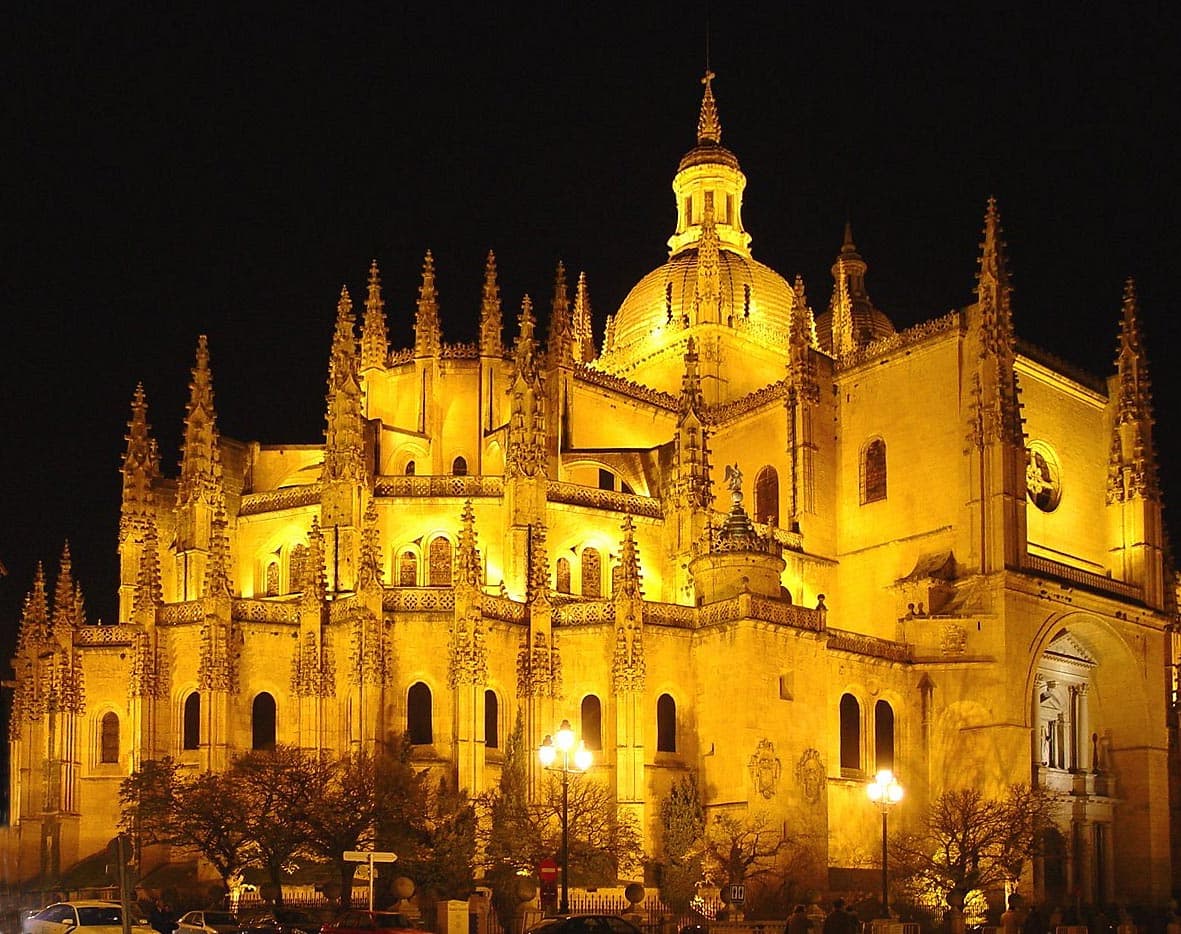
A Castilian city famous for its Roman aqueduct, its fairy-tale Alcazar and its roast suckling pig. The fast trains from Chamartin, Renfe and Ouigo, take about half an hour to Segovia-Guiomar station, which is about 7 kilometres outside town, so add a local bus or taxi to the aqueduct.
About half an hour by fast train from Chamartin, plus the bus into town · Full day
 Codrin Rusu · Pexels
Combined Toledo and Segovia tour
A long but efficient way to see both UNESCO cities in one day if time is tight, usually by guided coach tour of around twelve hours. We would rather give each its own day by train.
Full-day guided tour, around 12 hours in all · Full day
After dark
 Javier Pérez Montes · CC BY-SA 4.0 via Wikimedia Commons
Tapas crawl in La Latina
foodBar-hop the Cava Baja and the lanes around it for small plates and vermouth, starting with a vermouth at Bodegas Ricla on Cuchilleros, Madrid’s classic tapas-crawl neighbourhood.
 Dtom · CC BY-SA 3.0 via Wikimedia Commons
Flamenco tablao
cultureAn intimate flamenco show in a small tablao, often paired with a set dinner or drinks menu. Book ahead at weekends.
 Discasto · CC BY-SA 4.0 via Wikimedia Commons
Free evening at the Prado
cultureThe Prado is free for its last two hours every day, 18:00 to 20:00 Monday to Saturday and 17:00 to 19:00 on Sundays. Queue a little early, go straight to Velazquez and Goya, and come out to dinner in the Barrio de las Letras.
Daily itinerary
Five days in Madrid: art, tapas and a day in Toledo
A central base in Sol, the Letras or Malasana, no car, and one full day for Toledo or Segovia. Two calendar rules shape it: the Reina Sofia is closed on Tuesdays and the Thyssen opens only 12:00 to 16:00 on Mondays, so the Art Triangle day should fall between Wednesday and Saturday; and El Rastro runs on Sunday mornings, so put the La Latina day on a Sunday if you can. Toledo’s synagogue museum is closed on Mondays.
- 1
Centro and the Royal Palace
relaxedArrive and walk Puerta del Sol and Plaza Mayor.A bocadillo de calamares near Plaza Mayor.The Palacio Real, 18 euros, open to 19:00 in summer and 18:00 in winter, 16:00 on Sundays; check the official-events closures first.Las Vistillas gardens, next door.Suckling pig at Botin, booked.A first walk through the bars of Malasana.Entirely walkable; no car needed. From the airport: the Airport Express bus, 5 euros, to Cibeles and Atocha, or a flat 33-euro taxi to anywhere inside the M-30.Estimate: The Almudena Cathedral next to the palace, if the palace is closed for an event
- 2
The Art Triangle
fullThe Prado at 10:00 opening.Near the Paseo del Prado or in the Barrio de las Letras.The Reina Sofia for Guernica, or the Thyssen if art fatigue sets in.A walk through the Retiro to the Estanque Grande and past the wrapped Crystal Palace, or into the free Palacio de Velazquez.The Barrio de las Letras, then sherry at La Venencia.A quiet night after a museum-heavy day.Walkable; the metro if tired. The Paseo del Arte ticket, 32.80 euros, covers all three museums.Estimate: Use the free hours instead: the Reina Sofia from 19:00 to 21:00 and the Prado for its last two hours
- 3
La Latina and Lavapies
moderateEl Rastro if it is Sunday, otherwise La Latina’s old lanes.Vermouth at Bodegas Ricla and a tapas crawl along the Cava Baja.Lavapies and its galleries.The Templo de Debod, over the Sierra de Guadarrama from April to early September.Back in La Latina.A flamenco tablao.Walkable; a short metro hop to Plaza de Espana for the Templo de Debod.Estimate: Book a slot inside the Templo de Debod, free, Tuesday to Sunday
- 4
Toledo
fullAn early Avant train from Atocha, about 33 minutes.Lunch in the Jewish quarter.The Sinagoga del Transito and the Sephardic Museum, Santa Maria la Blanca, then the cathedral.Back in Madrid for the Circulo de Bellas Artes rooftop, 6 euros.Salamanca or Centro.Rest after a full day of walking.Renfe Avant from Atocha; book ahead at weekends and on holidays. The Transito is closed on Mondays.Estimate: Segovia instead, from Chamartin, if the aqueduct and suckling pig matter more than the synagogues
- 5
Salamanca and departure
relaxedA slow morning in Barrio de Salamanca, or a second look at the Prado.A last tapas lunch near your hotel.The Retiro if time allows.Departure.Metro line 8 runs from the airport to Nuevos Ministerios, where you change; a single ticket needs the 3-euro airport supplement, which the tourist pass covers.Estimate: Swap the shopping morning for the Thyssen on a Monday, free from 12:00 to 16:00
Getting around
- El Al flies Tel Aviv to Madrid twice a day and Air Europa once a day: the Israel Airports Authority flight board for 27 to 30 September 2026 showed El Al LY395 to LY398 on two daily rotations, with Iberia, Aeromexico and Aerolineas Argentinas selling seats on them as codeshares, and Air Europa UX1301 and UX1302 daily.
- Since 10 April 2026 the EU Entry/Exit System has been fully operational: Israelis are registered with fingerprints and a facial image at their first Schengen entry. ETIAS is still not in operation, and no applications are being taken. Israelis can stay 90 days in any 180 without a visa.
- From Madrid-Barajas: the Airport Express bus runs to Cibeles and Atocha around the clock for 5 euros; metro line 8 runs to Nuevos Ministerios, a single plus the 3-euro airport supplement; and taxis charge a flat 33 euros to anywhere inside the M-30 ring, with no supplements.
- High-speed trains arrive at Atocha, for Toledo and the south, and at Chamartin, for Segovia and the north.
- The metro is extensive, fast and cheap: a single in Zone A costs 1.50 euros for up to five stations, 10 cents more for each station from six to nine, and 2 euros for ten or more, and a 10-trip ticket 7.30 euros, loaded on the Tarjeta Multi card. EMT city buses cost 1.50 euros.
- The Tourist Travel Pass gives unlimited metro and bus travel in Zone A for 10.30 euros for one day up to 43.20 euros for seven, half price for under-11s, and includes the airport without the supplement. The days are calendar days, not 24-hour periods.
- Taxis and ride-hailing apps are plentiful and reasonably priced by European standards.
Things worth knowing
- · Showing up for dinner at 19:00 and finding kitchens not yet open.
- · Planning the Reina Sofia on a Tuesday, when it is closed.
- · Expecting to go inside the Crystal Palace in the Retiro, which is closed for works through 2026.
- · Queueing for free hours at the Royal Palace with an Israeli passport: they are for EU and Ibero-American citizens only.
- · Taking the AVE to Segovia and assuming you are in town: Segovia-Guiomar station is about 7 kilometres out.
- · Not booking trains to Toledo or Segovia ahead at weekends and on holidays.
- · Underestimating how hot and dry July and August get on the plateau.
Budget
| Low | Expected | Comfortable | |
|---|---|---|---|
| Accommodation style / per night | €65≈ $73 | €150≈ $168 | €350≈ $392 |
| Food style / per day | €25≈ $28 | €45≈ $50 | €95≈ $106 |
| Local transport / per day | €3≈ $3 | €10≈ $11 | €30≈ $34 |
| Estimate / per day | €0≈ $0 | €18≈ $20 | €40≈ $45 |
Estimate · EUR · 2026-09-27. Quoted in euros per person per day, except accommodation, which is per room per night for two sharing; these are our estimates for the shoulder season. Madrid has no tourist tax: the city rejected one in July 2026, unlike Barcelona. The museums are the main attraction cost, the Prado 15 euros, the Reina Sofia 12, the Thyssen 14 and the Palacio Real 18, and the free hours can bring that to nothing. A one-day transport pass is 10.30 euros. The Bank of Israel representative rate on 25 September 2026 was 3.4546 shekels to the euro, so the Prado is about 52 shekels, the airport taxi about 114 and Botin’s suckling pig about 112. · 1 USD = €1 (14 Oct 2026)
Things worth knowing
Frequently asked questions
How many days do you need in Madrid?
Four to five days cover the city well, plus a full extra day for Toledo or Segovia. Four is enough for the highlights; five allows a slower museum pace.
What is the best area to stay in Madrid for the first time?
Sol or Centro for a central, walkable base near Plaza Mayor, or the Barrio de las Letras between Sol and the Prado. Malasana is a good alternative with more nightlife nearby.
When is the best time to visit Madrid?
April to June and September to October: highs of about 22C in May and 26C in September, without the 32C July and August heat on the plateau.
Do you need a car in Madrid?
No. The metro and walking cover the city, and Toledo and Segovia are reached faster by train than by car.
Where is the best sunset in Madrid?
The Templo de Debod is the classic. We computed it for every day of 2026: the sun sets 2 to 3 minutes early behind the low hills west of Casa de Campo from October to early March, and over the Sierra de Guadarrama from April to early September, up to 9 minutes early in June. The Circulo de Bellas Artes rooftop, 6 euros, has the flattest horizon in winter, and the Cerro del Tio Pio in Vallecas has the whole skyline with the locals.
Are there direct flights from Tel Aviv to Madrid?
Yes. In late September 2026 the Israel Airports Authority board showed El Al twice a day and Air Europa once a day. Iberia flight numbers on the route are codeshares on El Al.
When are the Madrid museums free?
The Prado for the last two hours before closing every day; the Reina Sofia from 19:00 to 21:00 on Monday and Wednesday to Saturday and 12:30 to 14:30 on Sunday, with a ticket; the Thyssen collection on Mondays from 12:00 to 16:00. The Royal Palace’s free hours are for EU and Ibero-American citizens only.
Is there kosher food in Madrid?
Yes. The Jewish Community of Madrid lists several kosher restaurants, dairy and meat, and two kosher shops, and Chabad of Central Madrid in Chueca serves Shabbat meals by booking. Check the list before you go, because it is undated.
Sources (20)
- Paseo del Prado and Buen Retiro, a landscape of Arts and Sciences, inscribed on the UNESCO World Heritage List in 2021 · unesco · 2026-09-27
- Guinness World Records lists Restaurante Botin, opened in Madrid in 1725 by Jean Botin, as the oldest restaurant · independent-travel · 2026-09-27
- The Museo del Prado charges EUR 15 general and EUR 7.50 reduced and is free for the last two hours before closing · museum · 2026-09-27
- The Museo Reina Sofia is closed on Tuesdays, charges EUR 12, is free weekday evenings 19:00-21:00 and Sunday 12:30-14:30, and states that the Palacio de Cristal is temporarily closed for architectural improvements · museum · 2026-09-27
- Patrimonio Nacional restricts free admission to the Palacio Real to citizens of the European Union, residents and work-permit holders there, and Ibero-American citizens · official · 2026-09-27
- The Israeli National Security Council rates Spain level 2, occasional threat, recommending heightened precautions; the Foreign Ministry row reads "stay alert, follow the media"; the resource was last modified on 14 September 2026 · government · 2026-09-27
- In February 2026 a Museo Reina Sofia staffer ejected three elderly Israeli women who displayed the Israeli flag and the Star of David, while other visitors shouted insults · reputable-local · 2026-09-27
- Chabad of Central Madrid runs a Bet Chabad at Calle de la Reina 33 with Friday night and Shabbat lunch meals, and asks visitors to the Balmes 3 synagogue to register their passport with seguridad@cjmadrid.org · reputable-local · 2026-09-27
- The Comunidad Judia de Madrid lists kosher restaurants Barganzo, Pizzeria Rimmon and Cares Coffee Club (dairy), Fuego Steakhouse and Herzl Coffee & Market (meat), and the shops Kosher Sefarad and Gourmet Kosher · reputable-local · 2026-09-27
- The Museo Sefardi (Sinagoga del Transito), Toledo, opens Tuesday to Saturday 9:30-20:00 and Sundays and holidays 10:00-15:00, closed Mondays; general EUR 3, reduced EUR 1.50 with a Renfe ticket; free Saturday from 14:00 and Sundays · museum · 2026-09-27
- Santa Maria la Blanca, Toledo, costs EUR 4 general and opens daily, 10:00-18:45 from 1 March to 15 October and 10:00-17:45 in winter · official · 2026-09-27
- The Entry/Exit System became fully operational on 10 April 2026 and replaces the stamping of passports · government · 2026-09-27
- ETIAS is currently not in operation and no applications for travel authorisations are collected · government · 2026-09-27
- AEMET normals for Madrid Retiro (667 m): mean maximum 22.2C in May, 32.1C in July, 31.3C in August and 26.4C in September; rainfall 60 mm in October · government · 2026-09-27
- Madrid will not have a tourist tax, the city decided in July 2026 · reputable-local · 2026-09-27
- Bank of Israel representative rates of 25 September 2026: EUR 3.4546 and USD 3.033 shekels · government · 2026-09-27
- esMadrid gives the Retiro park hours as 06:00 to midnight from April to September and 06:00 to 22:00 from October to March, covering more than 125 hectares and 15,000 trees · tourism-board · 2026-09-27
- The Madrid City Card includes the CRTM Tourist Travel Pass and discounts at museums and attractions, priced from EUR 10.30 · tourism-board · 2026-09-27
- AWS Terrain Tiles (terrarium format, zoom 12, SRTM-derived elevation) support the horizon profiles cast every 0.25 degrees from each Madrid viewpoint in this guide out to 100 km · independent-travel · 2026-09-27
- Solar positions and almanac sunrise and sunset times follow the NOAA solar calculator equations, giving sunset 21:48 in Madrid on 21 June 2026 (CEST) · government · 2026-09-27