Spain · Andalusia, southern Spain
Andalusia Road Trip
Land in Malaga, drive two hours to Granada and give the Alhambra a morning you booked weeks ago. Two hours west to Cordoba for the Mezquita at its free hour and the synagogue on Calle Judios. On to Seville for three nights: the Alcazar, the cathedral, the Alfalfa bars and, this autumn, the Bienal de Flamenco. South through Jerez for a sherry bodega, Cadiz for the Atlantic and a fish lunch, then inland to Ronda for the bridge and the white villages, and back to Malaga through the Caminito del Rey. Book the Alhambra first, then the hotels, then the flights.
 Dionisioortiz / CC BY 4.0 via Wikimedia Commons
Overview
Andalusia is the south of Spain: eight provinces between the Sierra Morena and the sea, with the three cities that hold most of what people mean by Spain, Seville, Cordoba and Granada, sitting in a triangle about two hours apart, and the mountain town of Ronda, the white villages, the sherry country of Jerez and the Atlantic at Cadiz filling the space between them and Malaga airport. It is a road trip by nature: the cities are worth two or three nights each, the roads between them are good and mostly free, and the countryside, olive groves to the horizon, cork oaks, limestone gorges, is the reason to drive rather than take the train. What changed for 2026 is what happens when you arrive. Granada switched on a low-emission zone covering nearly the whole city on 1 October 2025, enforced around the clock, with the Alhambra grounds and their access road carved out of it; Malaga tightens its own zone in the third year of its scheme, which secondary sources date to 30 November 2026, when cars with the yellow B label lose access unless they are registered in the city; Cordoba has policed its old town by camera since 2023; and Seville keeps the old town closed to anyone without a permit. A rental car with Spanish plates and a C or ECO label is fine in all of them, but the car now stops at the edge of every city, and the trip has to be planned that way. Two of the great buildings are also mid-repair: the Giralda has scaffolding on its Renaissance crown for about 22 months from spring 2026, and the Mezquita of Cordoba is still finishing restoration work after its 2025 fire. Both stay open.
Two things decide this trip and both are administrative. The first is the Alhambra. The general ticket is 22.27 euros on the Patronato’s own site, it is nominative, you show the passport it was bought with at the gate, the Nasrid Palaces admit 300 people per half-hour slot and you lose your slot if you are late, and the ticket offices sell only same-day tickets and only until two hours before the palace slot. Book it before you book the flights, then build the days around it. The second is the car. Since 1 October 2025 Granada fines any car without a Spanish environmental label that enters the city, 24 hours a day, and only the Alhambra’s own grounds and its access road are outside the zone; Malaga does the same to B-label cars from the third year of its scheme, dated by secondary sources to 30 November 2026; Cordoba and Seville police their old towns by camera. A recent rental car registered in Spain is usually classified C or ECO and passes, which is the answer to the question every reader asks us, though B-label cars remain in fleets and the label on the agreement is worth a look, but the old towns themselves are closed to it whatever the sticker says. Leave the car at a garage on the ring and walk, every city. The third thing is the calendar. We published in the middle of the Bienal de Flamenco, which runs in Seville until 3 October 2026; Semana Santa 2027 is 21 to 28 March, the Feria de Abril follows on 13 to 18 April, and Jerez moved its Feria del Caballo forward to 24 April to 1 May to escape the pile-up. Those three weeks are wonderful and booked out a year ahead. October and November, and March before Holy Week, are the weeks we would take.
Best for
Couples · Road trips · History and architecture · Food and wine travelers · Spring and autumn travel · Jewish heritage
Daily itinerary
10 to 12 days
Nowhere else in Europe puts a mosque with 850 columns, a Moorish palace city and a Renaissance cathedral built inside a mosque within a morning’s drive of each other, and nowhere else lets you eat and drink your way through it for so little. The rhythm is the other difference. Lunch is at three, dinner at ten, the sun sets after half past nine in June because Seville is nearly two and a half hours west of its own clock, and the afternoon is for a siesta or a pool, not for sightseeing. The classic mistake is to treat Andalusia like northern Europe and turn up at the Alhambra in the afternoon in August without a ticket bought weeks ago and a passport in your pocket. The second is to try to drive into the old towns. The third is to skip Cadiz, which is the oldest city in western Europe and the one Andalusians themselves go to for the sea.
Best time to visit
March to early June and mid-September to November. AEMET’s normals put Seville’s average daily maximum at 36.0 degrees in July and 35.5 in August, and the city regularly passes 40; Cordoba is hotter still. In April and May the maximum is 23 to 27, in October 26, in November 20, and the orange trees are in blossom in March and fruit in December. Winter is short, mild and often wet in the west: Seville averages 91 mm of rain in November and 99 in December, while Granada sits at 700 metres and touches zero on January nights with snow on the Sierra Nevada above it. Summer 2026 was the worst fire season in years in Andalusia, with a second heatwave over 40 degrees and fires in Huelva, Almeria and Granada provinces in August.
- March to April: Orange blossom in Seville, wildflowers in the Grazalema hills, and the Alhambra on summer hours from 1 April. Semana Santa falls on 21 to 28 March in 2027 and the Feria de Abril on 13 to 18 April; outside those two weeks this is the best month of the year to be here.
- May to June: The Cordoba Patios open to the public in the first half of May, the Feria del Caballo fills Jerez from 24 April to 1 May in 2027, and Granada’s Corpus Christi fair follows in late May or June. Sunsets after 21:30 in Seville by June, and the heat arrives in the second half of the month.
- July to August: Average maxima of 36 in Seville, nearly 37 in Cordoba and nearly 35 in Granada, with days over 40 every summer. The sea at Cadiz is the refuge. Malaga’s feria is in mid-August, and Ronda’s Goyesca bullfight and fair open September. Do the monuments at opening, sleep through the afternoon, and book rooms with a pool.
- September to October: Sherry harvest in Jerez, the Bienal de Flamenco in Seville from 9 September to 3 October 2026, and the year’s best weather from mid-September. The Alhambra drops to winter hours on 15 October and the clocks go back on 25 October, after which the sun sets before 18:40.
- November to February: Olive harvest, rain in the west, snow on the Sierra Nevada, and the short winter hours everywhere. Public holidays on 2 November, 7 and 8 December in 2026, and 28 February for Andalusia Day. Cadiz Carnival in February is loud, brilliant and booked solid.
Things worth knowing
- Bienal de Flamenco, Seville (9 September to 3 October 2026): the biggest flamenco festival in the world, in theatres and courtyards across the city every second autumn. We published while it was on.
- Semana Santa, Seville and everywhere (21 to 28 March 2027): processions through the night from Palm Sunday to Easter Sunday. Sublime, and the old town is closed to cars and very nearly to pedestrians.
- Feria de Abril, Seville (13 to 18 April 2027, lit at midnight on Monday 12 April): a week of casetas, horses and sherry on the fairground across the river. Most casetas are private; a few are public.
- Feria del Caballo, Jerez (24 April to 1 May 2027): the horse fair, moved forward for 2027 to clear Holy Week and the Seville feria, and unlike Seville its casetas are open to everyone.
- Fiesta de los Patios, Cordoba (first half of May): private courtyards open to the public for a fortnight, UNESCO-listed. Dates are confirmed by the city early in the year.
- Corpus Christi, Granada (late May or June): the city’s own feria, a week around the Thursday of Corpus.
- Feria de Malaga (mid-August) and the Feria de Pedro Romero with its Goyesca bullfight, Ronda (early September; it ran 1 to 6 September in 2026 and 2027 dates were not published when we went to press).
Where to stay
 Julián Rejas De Castro · CC BY-SA 2.0 via Wikimedia Commons
Granada: the Albaicin and the Realejo
The Albaicin is the Moorish hill town across the valley from the Alhambra, a maze of whitewashed lanes, walled carmen gardens and the Mirador de San Nicolas at its top, where the whole city stands at dusk to watch the palace turn red. The Realejo, below the Alhambra hill on the other side, was the Jewish quarter and is now the neighbourhood of bars, street art and the city’s best cheap tapas, which in Granada still come free with a drink. Both are inside the low-emission zone; the Alhambra’s own car park and the road up to it are not.
Best for: The Alhambra at the top of the hill · Free tapas · Sunset from the Mirador de San Nicolas · Two nights
The Albaicin is steep, cobbled and closed to cars without a permit; luggage goes up by hand or in a taxi to the nearest square. Granada’s ZBE covers 23.55 square kilometres, 24 hours a day, since 1 October 2025. Nights are cold from November to March.
 Daka · Pexels
Cordoba: the Juderia and the river
The old Jewish quarter wraps around the Mezquita in lanes barely wide enough for two people, with the 1315 synagogue on Calle Judios, the Maimonides statue, the flower-hung Calleja de las Flores and the courtyards that open for the Patios festival in May. The Roman bridge crosses the Guadalquivir below the mosque to the Calahorra tower, and the evening walk is along the river with the whole ensemble lit. One night is the usual allowance; two lets you add Medina Azahara.
Best for: The Mezquita at 08:30 · Jewish heritage · Patios in May · A night between Granada and Seville
The whole historic centre is a camera-controlled restricted zone, in force since February 2023 with fines of 200 euros, 100 if paid within 20 days; only cars with a booked garage inside may enter. Cordoba is the hottest city in Spain in July and August.
 Jose Rodriguez Ortega · Pexels
Seville: Santa Cruz, the Alfalfa and Triana
Santa Cruz is the postcard, the old Jewish quarter of orange trees and tiled patios between the cathedral and the Alcazar, and the most expensive place to sleep. The Alfalfa and the streets north to the Setas are where Sevillanos actually drink, with the Rinconcillo, the city’s oldest bar, at the top end. Triana, across the bridge, is the ceramics and flamenco quarter with a market on the river and the sunset light on the Torre del Oro across the water. Three nights is the minimum, and the car should be in a garage by the ring road for all of them.
Best for: First-time visitors · Tapas crawls · Flamenco · Three nights without the car
The old town is closed to non-permit traffic and camera-enforced; hotels inside it can register your plate for the drop-off, otherwise use a public garage. Holy Week and the Feria triple the rates. The Giralda has scaffolding on its crown from spring 2026 for about 22 months.
 Explorando la provincia de Cádiz · Pexels
Jerez and Cadiz
Jerez is the sherry town, a working city of bodegas, tabancos and horses an hour and ten minutes south of Seville; Cadiz, half an hour further, is a 3,000-year-old port on a spit of land in the Atlantic, with a golden-domed cathedral, a fish market and La Caleta beach facing west-southwest between two castles. Sleep in one and day-trip the other, or take one night in each. The sherry harvest is in September; Cadiz Carnival in February.
Best for: Sherry · The Atlantic · Fish · Sunset over the sea
Cadiz old town is tight for cars and has a low-emission ordinance published in June 2026 whose rules for visitors were not yet clear when we checked; park in a garage on the way in. Sunday is a thin day in Jerez, with Bar Juanito closed, and Monday is the day the Tio Pepe bodega shuts, since its tours run Tuesday to Sunday.
 Anatolii Maks · Pexels
Ronda and the white villages
Ronda sits on a table of rock split by a 100-metre gorge, with the 18th-century Puente Nuevo bridging it, the oldest bullring in Spain on the new-town side and the Moorish old town on the other. Around it, the Sierra de Grazalema’s white villages, Zahara on its rock over a turquoise reservoir, Grazalema under the peaks, Setenil with its houses built under an overhanging cliff, are a day’s loop on mountain roads. Two nights is right; the parador stands on the bridge.
Best for: The bridge · Mountain driving · Walkers · A base for the white villages
Day-trippers fill the bridge from eleven to five; stay the night and see it at either end of the day. The Grazalema park’s best walks, the Garganta Verde and the Pinsapar, need a permit from the Junta’s online quota system, and the Pinsapar is guided-only from June to October for fire risk.
 Té y kriptonita · CC BY-SA 3.0 via Wikimedia Commons
Malaga
The airport city, and better than its reputation: a Moorish alcazaba, a Roman theatre, the Picasso Museum in the Palacio de Buenavista a few streets from the house where he was born, a Pompidou outpost by the port and a bar culture built on sweet Malaga wine and fried fish. Worth the first or last night, or a full day if the flight times allow it. The low-emission zone covers 404 hectares of the centre and tightens on 30 November 2026.
Best for: First or last night · Picasso · Fried fish · A beach before the flight
From the third year of the scheme, which secondary sources date to 30 November 2026, cars with the yellow B environmental label may only enter the ZBE if registered in Malaga; C, ECO and zero-emission cars are unaffected. Most Spanish rental cars are C or ECO, but check the label before you drive in.
Where to sleep
Corral del Rey
boutique · Alfalfa, Seville
Best for: Seville old town on foot · Couples · A rooftop between the cathedral and the bars
- A 17th-century casa palacio in the Alfalfa quarter, five minutes from the cathedral, restored around an atrium patio with Roman marble columns
- 17 rooms, individually done, with marble bathrooms and a roof-top bar
- Privately owned and small enough that the staff know which bar to send you to
- Inside the old-town restricted zone: the car cannot come to the door, so plan the garage first
- Rates are among the highest in the quarter and it books out for Holy Week and the Feria a year ahead
- No pool and no view of the Giralda; this is about the house, not the skyline
Hotel Casa 1800 Sevilla
value · Santa Cruz, Seville
Best for: A rooftop pool with the Giralda in it · Santa Cruz without a palace price · Afternoon tea included
- A restored 19th-century house on a lane behind the cathedral, with a rooftop plunge pool that looks straight at the Giralda
- Rooms from a small premium double to suites with jacuzzis and terraces, and an afternoon tea served to guests
- The location means the car stays in a garage from arrival to departure
- Santa Cruz lanes are noisy on feria and Holy Week nights and busy with tour groups by day
- The pool is small and shared with every other guest who read the same reviews
- The Giralda view will carry scaffolding on the tower’s crown until about 2028
Hotel Alfonso XIII, a Luxury Collection Hotel
luxury · Beside the Alcazar gardens, Seville
Best for: The grand Seville address · A pool in the city · Feria week, if you booked a year ago
- Built for the 1929 Ibero-American Exposition in Mudejar-revival style around a courtyard, and still the hotel the city puts its guests in
- A garden pool, a bar on the patio and the Alcazar, the cathedral and the university across the road
- Marriott points and Marriott booking if that is how you travel
- Marriott’s site blocks automated visitors, so we could not verify room counts or current rates ourselves; secondary sources put it at 122 rooms and 12 suites
- Grand-hotel prices and grand-hotel formality; the bars of the Alfalfa are a fifteen-minute walk
- Its car park is the one place in the old town the car can reach, at a price
Hospes Palacio del Bailio
luxury · North of the Mezquita, Cordoba
Best for: The one-night splurge in Cordoba · A spa after the drive from Granada · Roman mosaics under your feet
- A 16th-century palace with a glass floor over the remains of a Roman villa in its central patio, frescoed suites and a garden pool
- A Bodyna spa and a serious restaurant, which matters on a night when the Juderia is heaving
- Ten minutes on foot to the Mezquita and just outside the tightest part of the old town, so the garage is easier
- Luxury prices for what is, for most people, a single night
- Rooms in the old wings are quirky in shape and light
- Booked out for the Patios festival months ahead
Balcon de Cordoba
boutique · Juderia, beside the Mezquita
Best for: Sleeping a minute from the Mezquita’s free hour · Couples · A terrace over the old town
- Ten rooms on two floors around three patios of a centuries-old house, with a roof terrace that looks onto the Mezquita’s walls
- Close enough to be in the free 08:30 queue at the Patio de los Naranjos before breakfast
- Quiet once the day-trippers leave, which is the whole point of sleeping in Cordoba
- Ten rooms means it sells out early; book with the Alhambra tickets
- Inside the camera-controlled zone: the hotel arranges access for the drop, otherwise park outside and walk five minutes with the bags
- No pool, and Cordoba in July is the hottest city in Spain
Parador de Granada
unique · Inside the Alhambra
Best for: Sleeping inside the Alhambra walls · The one night that justifies the price · Being first into the palaces
- The only hotel inside the monument: the convent of San Francisco, built by the Catholic Monarchs on a Nasrid palace and their first burial place, with the remains of the palace baths found in 1949
- The Patronato lets hotel guests drive to the door, which puts the car outside the city’s low-emission zone entirely
- Breakfast on a terrace over the Generalife gardens before the gates open to everyone else
- The most booked parador in Spain; the good dates go many months ahead and the rate reflects it
- Rooms are comfortable rather than spectacular; the building and the address are what you pay for
- The city, its bars and the Albaicin are a 25-minute walk downhill and a taxi back up
Hospes Palacio de los Patos
luxury · City centre, Granada
Best for: A spa night in Granada · Couples · Flat streets and a garage after the Albaicin hills
- A 19th-century palace on a garden in the flat centre, with a modern wing, a Bodyna spa and a pool
- Walking distance to the cathedral, the Capilla Real and the tapas streets around Navas
- The easiest luxury address in Granada for a car, since it sits on the grid rather than on a hill
- You are not on the Alhambra hill and not in the Albaicin; the postcard views are a walk or a taxi away
- Rates in the same band as the parador without the parador’s address
- A hotel that hosts weddings and events, which can change the mood of a weekend
Hotel Casa Morisca
boutique · Lower Albaicin, Granada
Best for: The Alhambra from the pillow · Couples on a normal budget · Sleeping in a Moorish house
- A late-15th-century Morisco house at the foot of the Albaicin, restored by the Granada architect Carlos Sanchez and given the Europa Nostra award in 2001, the year it opened
- 14 rooms around a patio with a pool of water, some looking straight across the Darro at the Alhambra
- Ten minutes on foot to Plaza Nueva and the tapas bars
- On the Carrera del Darro side of the hill, which is cobbled, narrow and closed to cars; luggage comes in on foot
- Old house, small rooms, thin ceilings; ask for a view room and expect stairs
- No parking of its own and inside the ZBE
Parador de Ronda
unique · On the Puente Nuevo, Ronda
Best for: The bridge from the bedroom · The gorge at dawn and dusk · A pool on the edge of the cliff
- The old town hall and market, on the lip of the Tajo beside the Puente Nuevo, rebuilt as a parador in 1994 behind the original facade and clock
- A pool and terrace on the edge of the gorge, and the bridge lit below the windows at night
- Its own car park at the door, which in Ronda is a real advantage
- Modern behind the facade; the rooms are parador-standard rather than romantic
- The bridge side of the hotel is the side the whole town photographs from, so the terrace is not private
- Paradores price the view, and this is one of the views
Hotel La Fuente de la Higuera
romantic · Olive groves outside Ronda
Best for: Two quiet nights with Ronda ten minutes away · Couples · Driving the white villages from a farmhouse
- A four-star finca in the countryside north of Ronda with suites, a duplex, a private villa and a pool among the olives
- Dinner on the terrace and a blog on Ronda’s bodegas that reads like a local wrote it
- The car parks at the door and the low-emission question does not arise
- You need the car for everything, including dinner in town
- A small hotel that groups can book out entirely
- Rural roads back after a wine evening; take the taxi
Hotel Bodega Tio Pepe
unique · Inside the Gonzalez Byass bodega, Jerez
Best for: Sleeping in a sherry bodega · Jerez as a base for Cadiz · Wine travelers
- The first hotel inside a working sherry house, in the Gonzalez Byass estate beside the cathedral, with the bodega tours starting at the door
- A pool and a restaurant in the grounds, and the cathedral and the tabancos a few minutes’ walk
- Rates well below what the same hotel would cost in Seville
- Tours and tastings run Tuesday to Sunday only, so a Monday night here is quieter than you planned
- The site is a tourism machine; it can feel like sleeping in a visitor centre
- Jerez itself is a working town that empties on Sundays
Parador de Cadiz
design · Seafront, old town of Cadiz
Best for: The Atlantic from every room · A pool and spa night by the sea · Families
- A modern parador on the western seafront of the old town, with bay views from the terraces, the rooms, the pool and the spa
- A five-minute walk to La Caleta for the sunset and to the fish market
- Its own parking, in a city where that is the problem
- Contemporary glass and concrete, not the historic parador people imagine
- Cadiz Carnival in February and summer weekends book it out
- Rooms on the city side lose the point of the building
Essential experiences
 Sebastiaan Been · Pexels
The Alhambra and Generalife
The Nasrid palace city on its hill above Granada, the last Moorish court in Europe and the reason most people come south. The general day ticket is 22.27 euros on the Patronato’s own site and covers the Alcazaba, the Nasrid Palaces, the Partal and the Generalife; it is nominative, you show the passport it was bought with, and the palaces admit 300 people per half-hour slot, so be at their door before your time or lose it. Hours are 08:30 to 20:00 from 1 April to 14 October and 08:30 to 18:00 from 15 October to 31 March; night visits to the palaces are 12.73 euros. The ticket office sells same-day tickets only, and only until two hours before the palace slot. Closed 25 December and 1 January.
Patronato de la Alhambra: hours and tickets ↗Official ticket shop ↗View on map ↗
 Zekai Zhu · Pexels
Mezquita-Catedral of Cordoba
The great mosque of the caliphate, begun in 785, a forest of some 850 columns under red-and-white arches with a Renaissance cathedral planted in the middle of it in the 16th century. 15 euros, and free from 08:30 to 09:30 Monday to Saturday, with no groups allowed in that hour, which is the single best hour of the trip. The bell tower, the old minaret, is 4 euros more on a timed climb, and the night show El Alma de Cordoba is 25. A fire in 2025 damaged part of the building; the Chapel of the Holy Spirit reopened in 2026 after full restoration and the monument never closed. Daily hours shift with services, so check the day on the official site.
 José Luis Filpo Cabana · CC BY 3.0 via Wikimedia Commons
The Cordoba Synagogue and the Juderia
One of three medieval synagogues left in Spain, built in 1315 on Calle Judios in the Mudejar style, a single small room with Hebrew inscriptions on the plasterwork and a women’s gallery above. Free, open Tuesday to Sunday 09:00 to 15:00 and closed on Mondays except public holidays, when it opens the same hours. The Junta runs it; groups over six book on its ARES portal. A few doors along are the Casa de Sefarad museum and the statue of Maimonides, born in Cordoba in 1138, and the lanes of the Juderia run from here down to the Mezquita.
 José Antonio Otegui Auzmendi · Pexels
Medina Azahara
The caliphal palace city built by Abd al-Rahman III from 936 on the slopes eight kilometres west of Cordoba, sacked within a century and excavated for the last hundred years, UNESCO-listed since 2018. Entry is free for EU citizens and 1.50 euros for everyone else, and the site is closed on Mondays. A shuttle bus runs from the visitor centre to the ruins, and a tourist bus from Cordoba, about twenty minutes, sells tickets online. The Junta’s own page would not load its hours for us; the timetable is seasonal and the reliable rule is a morning visit, Tuesday to Sunday.
Conjunto Arqueologico Madinat al-Zahra ↗Daily bus from Cordoba ↗View on map ↗
 Jl FilpoC · CC BY-SA 4.0 via Wikimedia Commons
Real Alcazar of Seville
A royal palace still in use, built by Christian kings in the Moorish style on the site of the Almohad fort, with the Patio de las Doncellas, the Salon de Embajadores and gardens that go on for hours. 15.50 euros, 5.50 more for the royal apartments upstairs, and timed entry. Open 09:30 to 19:00 from 1 April to 30 September and 09:30 to 17:00 from 1 October to 31 March, closed 1 and 6 January, Good Friday and 25 December. The Patronato runs free public visits on days its board fixes; the ticketing sites offer them on Monday afternoons, booked about a month ahead, and they sell out.
 Diliff · CC BY-SA 3.0 via Wikimedia Commons
Seville Cathedral and the Giralda
The largest Gothic cathedral in the world, built on the site of the Almohad mosque whose minaret became the Giralda, climbed by ramps rather than stairs so a horseman could ride to the top. 13 euros online or 14 at the desk, including the Iglesia del Salvador; Monday to Saturday 11:00 to 18:00 with the tower closing at 17:00, Sundays 14:30 to 19:00, and a free visit on Sundays from 16:30 to 18:00 by online reservation. Phase six of the Giralda restoration began after Holy Week 2026 and wraps the Renaissance crown in scaffolding for about 22 months; visits and the climb continue. Columbus is in a tomb by the south door.
 AXP Photography · Pexels
Casa de Pilatos and the Setas
Two Sevilles. The Casa de Pilatos is the 16th-century palace of the dukes of Medinaceli, Mudejar tiles, Renaissance courtyards and a garden, open every day 09:00 to 18:00 for 12 euros, or 6 for the upper floor only, and rarely crowded. The Setas de Sevilla, the timber canopy over the Plaza de la Encarnacion, has a roof walk open from 09:30 to 01:00 with last entry at 00:15, and a light show called Aurora from 21:30 to 01:00 between April and October; the Giralda sits almost due south of it, so the roof is the sunset platform in the city centre.
 El Pantera · CC BY-SA 3.0 via Wikimedia Commons
The sherry bodegas of Jerez
Sherry is made in a triangle of three towns and Jerez is the apex. Gonzalez Byass, the Tio Pepe house beside the cathedral, runs tours Tuesday to Sunday by reservation: 25.50 euros with two wines, 28.50 with four, 30.50 with tapas, and a 50-euro tour of the VORS wines from the cask. Lustau’s tastings run from 26 euros for an hour to 60 for its sacristy; Bodegas Tradicion, the small house with an art collection, charges 60 for a 90-minute visit for ten people at most. The tabancos, old sherry bars with the wine from the barrel and flamenco some nights, are the cheap version and the better one after dark.
Tio Pepe tours ↗Lustau visits ↗Bodegas Tradicion ↗View on map ↗
 Explorando la provincia de Cádiz · Pexels
Cadiz: Torre Tavira, the cathedral and La Caleta
The oldest continuously inhabited city in western Europe, founded by the Phoenicians, on a spit of rock in the Atlantic. Climb the Torre Tavira, the 18th-century merchant’s watchtower with a camera obscura, 8 euros, open 10:00 to 18:00 from October to April and to 20:00 from May to September, for the whole city laid out below. The cathedral’s golden dome is 12 euros with its bell tower 7 more. Then walk out to La Caleta, the town beach between the castles of Santa Catalina and San Sebastian, which faces west-southwest and is the sunset of the whole trip.
 Pedro Luis Domínguez Ruiz · Pexels
Ronda: the Puente Nuevo and the bullring
The 18th-century bridge across the 100-metre Tajo gorge is the image of Andalusia after the Alhambra, and it is free: walk it, then take the path from the Plaza de Maria Auxiliadora down to the viewpoints below for the full drop. The Real Maestranza bullring, from 1785 and the cradle of modern bullfighting, opens every day: 10:00 to 18:00 from November to February, to 19:00 in March and October, to 20:00 from April to September, 10 euros or 12 with the audioguide, and it came out of a two-year stabilisation in time for the 2026 Goyesca. The Moorish old town across the bridge has the Arab baths, the Mondragon palace and the Casa del Rey Moro’s water mine cut down to the river.
 Agustin Piñero · Pexels
The white villages: Setenil, Zahara and Grazalema
Three of the pueblos blancos within an hour of Ronda, best as one loop. Setenil de las Bodegas, half an hour north, has streets of houses built under a rock overhang, with the bars of Cuevas del Sol in the shade of the cliff; park at the top and walk. Zahara de la Sierra sits under a Moorish castle above a turquoise reservoir, and Grazalema, the wettest village in Spain, under the peaks of the Sierra de Grazalema park, whose best walks, the Garganta Verde and the Pinsapar fir forest, need a free permit from the Junta’s online quota system, with the Pinsapar restricted to guided groups from June to October. Olvera and Arcos de la Frontera extend the loop west.
 Diego Delso · CC BY-SA 4.0 via Wikimedia Commons
Caminito del Rey
The walkway pinned to the wall of the Gaitanes gorge near Ardales, an hour from Malaga, rebuilt in 2015 and now a three-hour linear walk of about eight kilometres with the old 1905 path visible below the new one. 10 euros for general entry or 18 with an official guide, plus 2.50 for the shuttle bus back to the start and 2 for parking; tickets are online only, there is none at the visitor centre, and they go weeks ahead for weekends. Closed on Mondays and on 24, 25 and 31 December and 1 January; open from 09:00 until 14:50 or 17:20 depending on season. Children under eight are not admitted and everyone over eight shows ID.
 Mustafa El-Taie · Pexels
Malaga: the Alcazaba, Gibralfaro and the Picasso Museum
The Moorish fort above the Roman theatre and the castle above that share a 10-euro combined ticket, 7 for the Alcazaba alone, open 09:00 to 20:00 from April to October and to 18:00 in winter with last entry an hour before, and free every Sunday from 14:00. The Picasso Museum in the Palacio de Buenavista is 13 euros, free in the last two hours of every Sunday, and the Pompidou by the port closes on Tuesdays. Together they make a real first or last day rather than an airport wait.
Alcazaba and Gibralfaro ↗Museo Picasso Malaga ↗View on map ↗
 Moñizv / CC BY-SA 4.0 via Wikimedia Commons
 NaturalEarth / CC BY-SA 3.0 via Wikimedia Commons
Food & drink
 Cillas · CC BY-SA 4.0 via Wikimedia Commons
Salmorejo
Cordoba’s thick cold soup of bread, tomato, oil and garlic, served with chopped egg and jamon on top, richer than gazpacho and eaten with a spoon. The thing to order at Bodegas Campos and at every bar in the Juderia on a day over thirty degrees.
 Pravdaverita · CC BY 3.0 via Wikimedia Commons
Jamon iberico de bellota
The acorn-fed black-pig ham from the Sierra de Aracena north of Seville, with Jabugo the name on the label. Sold by weight at the bar, cut by hand, and worth the 20 euros a plate once. The cheaper serrano is a different animal.
 Cayetano - · CC BY-SA 2.0 via Wikimedia Commons
Pescaito frito and tortillitas de camarones
Fried fish is the coast’s religion: boquerones, puntillitas, cazon en adobo, whatever the market had, in a paper cone or on a plate at Los Diamantes in Granada or a freiduria in Cadiz. The tortillita de camarones is Cadiz’s own, a lace-thin fritter of tiny shrimp in chickpea batter.
 Draceane · CC BY-SA 4.0 via Wikimedia Commons
Rabo de toro and flamenquin
Cordoba’s two meat dishes: oxtail braised in wine until it falls off the bone, and the flamenquin, a roll of pork loin around ham, breaded and fried. Order one between two with a salmorejo first.
 Tubamirum at French Wikipedia · Public domain via Wikimedia Commons
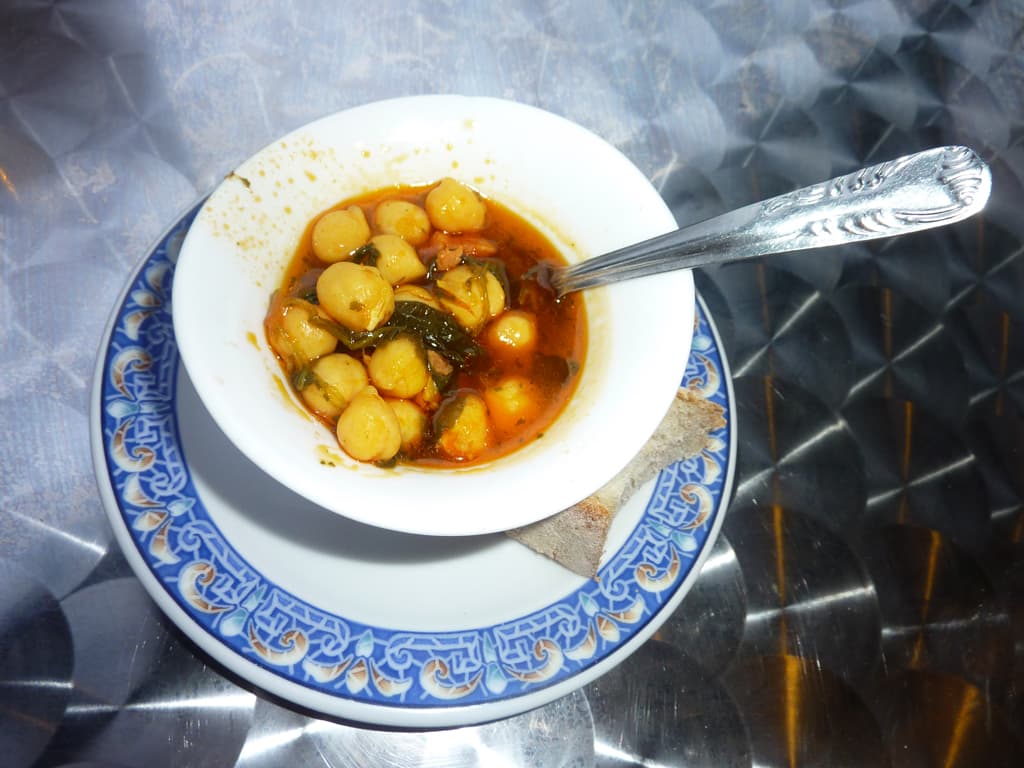
Espinacas con garbanzos
Seville’s Moorish tapa of spinach stewed with chickpeas, cumin and paprika, at its best in the old bars of the Alfalfa. The vegetarian dish the city does without thinking about it.
 Michal Osmenda from Brussels, Belgium · CC BY 2.0 via Wikimedia Commons
Sherry: fino, manzanilla, amontillado, oloroso
A chilled fino from Jerez or a manzanilla from Sanlucar is the aperitif of the whole region, drunk with olives or ham; amontillado and oloroso come later and darker. In the tabancos of Jerez it costs a euro or two a glass from the barrel.
 Lagambadeoro · CC BY-SA 3.0 via Wikimedia Commons
Berenjenas con miel
Fried aubergine strips with cane honey, the miel de cana of the Malaga coast: sweet, salty and Andalusian to the core. Granada bars do it best.
 Lee Kyung-joon · CC BY-SA 2.0 via Wikimedia Commons
Free tapas, Granada style
In Granada and in Jaen and Almeria a drink still comes with a tapa the bar chooses for you. Two rounds is dinner. The custom is nearly gone in Seville and Cordoba, where tapas are ordered and paid for.
Lunch is from 14:00 and often 15:00, and is the main meal; dinner starts at 21:00 and kitchens are busy until midnight. A bar that looks closed at 19:30 is not closed, it is between shifts. Tapas are eaten standing, and the bill is added up on the counter, sometimes in chalk. Tipping is a euro or two or rounding up; nobody expects ten percent. Cards work almost everywhere, including in the tabancos, but small bars in the villages prefer cash. Since 2 December 2024 hotels and car-rental firms must record your passport details and payment method for the police under the traveller-registration decree, so check-in takes a minute longer. Book the starred restaurants weeks ahead; book the parador restaurants and the Sacromonte caves days ahead; walk into everything else.
Where to eat
El Rinconcillo
institutionOpen since 1670, with the bill chalked on the bar, hams on hooks and waiters who have been there for decades. Order the espinacas, the bacalao and a fino, stand at the counter, and do not expect a table. Traditional Andalusian cooking in the dining rooms upstairs if you want to sit.
Last researched 2026-09-13
Cañabota
fine-diningA fish restaurant with one Michelin star in the 2026 guide, at Orfila 1, built around whatever the Cadiz boats landed, cooked over coals at a counter. Its sister, La Barra de Cañabota at number 5, does the same fish in tapas form without the tasting-menu commitment. Gift vouchers and menus on its site; book well ahead for either.
Last researched 2026-09-13
Bodegas Campos
institutionThe Cordoba institution at Lineros 32, a warren of patios and barrel-lined rooms east of the Mezquita, serving the local canon, salmorejo, flamenquin, oxtail, since the early 20th century, with a taberna at the front for tapas and the restaurant behind. Its site now leads with weddings and its other venues, which confused us for a moment; the Cordoba restaurant is very much open.
Last researched 2026-09-13
Noor
fine-diningPaco Morales’s restaurant in the suburb where he grew up, at Pablo Ruiz Picasso 6, holds three Michelin stars in the 2026 guide and cooks each season around a century of Andalusi history, with no ingredients the Moors did not have. Menus change by season and it closes between them; book weeks ahead and take a taxi, it is outside the old town.
Last researched 2026-09-13
Los Diamantes
casualGranada’s fried-fish bar since 1942, now several branches, of which the original on Calle Navas and the one on Plaza Nueva are the ones to use. A caña comes with a tapa; the plates of boquerones, puntillitas and berenjenas con miel are shared at the bar. No bookings, elbows out, and a queue at two o’clock on Saturdays.
Last researched 2026-09-13
Carmen Mirador de Aixa
modernA restaurant in a carmen, one of the walled Albaicin garden houses, with a terrace that looks straight across the valley at the Alhambra and the Sierra Nevada behind it. Granada cooking with some ambition; the view is what you book for, so book a terrace table for the hour before sunset and expect to pay for it.
Last researched 2026-09-13
Bardal
fine-diningBenito Gomez’s restaurant in the new town holds two Michelin stars in the 2026 guide, and cooks the Serrania: goat, game, mountain herbs and the Ronda wines that the bodegas around the town have made respectable. Tasting menus only; it closes for holidays and on some weekdays, so check the calendar on its site and book weeks out.
Last researched 2026-09-13
Bar Juanito
institutionOn Calle Pescaderia Vieja since 1943, the tapas bar of Jerez, famous for its artichokes and for a sherry list that runs from fino to the old olorosos. Tuesday to Saturday 13:00 to 16:30 and 20:00 to 23:30, Monday evenings only from 20:00, and closed on Sundays, which is the day to be in Cadiz instead.
Last researched 2026-09-13
El Faro de Cadiz
institutionThe Cordoba family’s restaurant on Calle San Felix in the fishermen’s quarter of La Viña, a few streets from La Caleta: a tiled bar for tapas at the front and a serious fish restaurant behind. Open every day, 13:30 to 16:30 and 20:30 to 23:00. Order the tortillitas, whatever the market fish is, and a manzanilla.
Last researched 2026-09-13
El Pimpi
barThe bodega in an 18th-century house on Calle Granada, opened in 1971, whose barrels are signed by everyone from Picasso’s family to Antonio Banderas, who part-owns it. Sunday to Thursday 12:00 to midnight with the kitchen running all day, Friday and Saturday to 00:30, and a terrace on Calle Alcazabilla facing the Roman theatre. Touristy, and still the right place for a glass of Malaga dulce.
Last researched 2026-09-13
Sunrises
 Jebulon · Public domain via Wikimedia Commons
Mirador de San Nicolas at dawn
The same terrace the whole city uses for sunset is empty at dawn, and the geometry is better. From the mirador the Alhambra bears about 147 degrees, south-southeast, and the Sierra Nevada with Mulhacen bears about 120, so in December the sun comes up at 120 degrees, straight over the highest mountain in mainland Spain, behind the snow, with the palace in silhouette below it. In June it rises at 60 degrees, behind the Sacromonte hill to your left, and the show is the first light hitting the towers. Sunrise in Granada is about 07:53 in mid-September, 08:29 on 24 October, 07:30 the day after the clocks change and 08:24 at the solstice.
November to February for the sun over the Sierra Nevada; year-round for the light on the palace · Bring a long lens for the snow and a wide one for the wall of the terrace. The sun rises directly behind Mulhacen only around the winter solstice, and never behind the Alhambra itself, which lies further round to the south; by the equinoxes it rises at 90, well to the left of both.
 Explorando la provincia de Cádiz · Pexels
Castillo de Santa Catalina, Cadiz, looking back at the city
From the star fort at the north end of La Caleta the cathedral’s golden dome bears about 110 degrees, east-southeast across the beach and the roofs of La Viña. The sun rises at 110 degrees in early November and again in early February, which puts it almost exactly behind the dome on those mornings, and within ten degrees of it from mid-October to late February, so through the winter the dome is backlit at dawn. In summer it rises at 60, up the coast to the left, over the bay bridge.
October to February · Sunrise in Cadiz is about 08:04 in mid-September, 08:39 on 24 October and 07:40 after the clock change, 08:33 in December. The fishing boats on La Caleta are the foreground.
Sunsets
 Alejandro Mantecón-Guillén · CC BY-SA 3.0 via Wikimedia Commons
Mirador de San Nicolas, Granada
The terrace at the top of the Albaicin faces the Alhambra across the Darro valley with the Sierra Nevada behind it, and because the palace lies to the south-southeast and the sun sets between west-southwest and northwest, to your right and behind you, the walls take the last light almost full on and turn from gold to red while the snow on the peaks goes pink. It is the most famous sunset in Spain, it is free, and it is crowded; arrive an hour early for a place on the wall, or pay for a terrace at one of the carmen restaurants below.
Year-round; winter for the snow, June for sunsets after 21:30 · Sunset in Granada is about 21:37 at midsummer, 20:27 in mid-September, 19:27 on 24 October and 18:26 the day after the clocks change, 18:00 at the winter solstice. The sun sets at about 300 degrees in June, behind your right shoulder, and 240 in December, almost square on your right; it is never in the frame; the colour on the walls lasts ten minutes after it goes.
 Emilio J. Rodríguez Posada · CC BY-SA 2.0 via Wikimedia Commons
La Caleta, Cadiz
The town beach sits in a bay that opens west-southwest between two castles, so the sun goes into the Atlantic here all year round, always between the two castles. From the middle of the beach the Castillo de San Sebastian on its causeway bears about 260 degrees, which is where the sun sets in late October and mid-February; in June it sets at 300, well to the right of the causeway over open water and short of the Castillo de Santa Catalina at the north end of the beach, and in December at 240, to the left of San Sebastian over open water. The bathing club on stilts in the middle is the frame in every photograph.
Year-round · Sunset in Cadiz is about 21:46 at midsummer, 20:37 in mid-September, 19:38 on 24 October, 18:37 the day after the change and 18:12 at the solstice. The causeway is the best foreground when the sun sets over the castle.
 David Vives · Pexels
Ronda: the Alameda del Tajo and the Puente Nuevo
The cliff-edge park beside the bullring looks due west over the valley below Ronda towards the Sierra de Grazalema, and the gorge itself opens west below the bridge, so the sun sets into the plain in front of you and lights the west face of the Puente Nuevo from the side. The balconies in the Alameda are free; the parador terrace next door charges for the drink. The best view of the bridge itself at that hour is from below, on the Camino de los Molinos path, where the whole span is lit orange.
Year-round; autumn for the clearest air · Sunset in Ronda is 21:42 at midsummer and 18:07 at the solstice. Sunset bearing runs from 300 in June to 240 in December, and the valley is open across that whole arc.
 Wilomanso · CC BY-SA 3.0 es via Wikimedia Commons
The Setas roof, Seville
The roof walk of the timber canopy over the Plaza de la Encarnacion is the only high, open platform in the middle of Seville, and the Giralda stands almost due south of it, at about 186 degrees, so the tower is lit from the side as the sun goes down over Triana to the west. The walk is open until 01:00 with the last entry at 00:15, and from April to October the Aurora light show runs on the structure from 21:30.
Year-round; April to October for the lights afterwards · Sunset in Seville is 21:48 at midsummer, 20:36 in mid-September, 19:36 on 24 October, 18:35 the day after the change and 18:09 at the solstice, with the earliest of the year at about 18:06 in early December.
Day trips
 Alex Quezada · Pexels
Medina Azahara from Cordoba
The caliphal city west of Cordoba for a morning: the visitor centre and museum first, the shuttle to the ruins, the reception halls and the view back over the plain. Closed Mondays. Back for a late lunch in the Juderia or straight on to Seville.
20 minutes by car or tourist bus · Half day
 Pedro M. Martínez Corada · https://martinezcorada.es · CC BY-SA 4.0 via Wikimedia Commons
Jerez and Cadiz from Seville
For a Seville-based trip: an hour and ten minutes south on the free AP-4 to Jerez for a mid-morning bodega tour, lunch at Bar Juanito, then thirty minutes on to Cadiz for the Torre Tavira, La Viña and sunset at La Caleta before the drive back, about an hour and a half. Not on a Sunday, when Juanito is shut, and not on a Monday, when Tio Pepe is.
1 hour 10 to Jerez, 30 minutes on to Cadiz · Full day
The white villages loop from Ronda
Ronda to Grazalema over the pass, about 35 minutes, then down to Zahara de la Sierra along the reservoir, 25 minutes more, and back to Ronda by Setenil, whose cave streets are the lunch stop. Roughly 120 kilometres of mountain road in a day; add Olvera or Arcos if you have the hours. Walkers with a permit swap Zahara for the Garganta Verde.
35 minutes to Grazalema, 25 on to Zahara, 45 back via Setenil · Full day
 Malopez 21 · CC BY-SA 4.0 via Wikimedia Commons
Caminito del Rey on the way to Malaga
Between Ronda and the airport: the gorge walkway is an hour from Ronda and an hour from Malaga, about three hours on the walkway plus the shuttle back to the car, tickets bought online weeks ahead, closed Mondays. Do it in the morning on your last full day and sleep in Malaga, or on the first day if the flight lands early.
1 hour from Ronda, 1 hour from Malaga · Half day
 Antonio Morales García from Granada, España · CC BY-SA 2.0 via Wikimedia Commons
Sierra Nevada from Granada
In winter the ski resort is 45 minutes above the city, the highest in Spain; in summer the road goes on up to the Hoya de la Mora for walks towards the Veleta. Snow on the peaks is what makes the Albaicin views, and the drive up is the fastest way from a Moorish palace to a glacier valley. Check the road and the weather in winter; chains are sometimes required.
45 minutes to Pradollano · Half day
 Diego Delso · CC BY-SA 4.0 via Wikimedia Commons
Vejer de la Frontera and the Trafalgar coast
From Cadiz, 45 minutes south to Vejer, a white hill town of Moorish lanes over the Atlantic plain, then down to the beaches of El Palmar and the lighthouse at Cape Trafalgar for a swim and a fish lunch, and back, or on to Ronda by the inland road, about two and a half hours. Vejer’s best hotels sit in the Grupo Califa cluster around the Plaza de España; their websites refused every connection we tried, so book them through a third party or by phone.
45 minutes from Cadiz · Half day, or a night
After dark
 Marian Florinel Condruz · Pexels
Tapas in the Alfalfa and around the Setas, Seville
foodStart at El Rinconcillo at nine, move down through the Alfalfa bars and finish under the Setas with a glass at midnight. Nobody sits, the bills are chalked, and three bars is dinner. On Bienal nights, until 3 October 2026, the flamenco is in the theatres and the courtyards; the rest of the year, a tablao in Santa Cruz or Triana.
 Alberto-g-rovi · CC BY 3.0 via Wikimedia Commons
A zambra in the Sacromonte caves, Granada
performanceFlamenco as the Gitano families of the Sacromonte have performed it in their whitewashed caves since the 19th century: the zambra, with cante, guitar and dance a metre from your chair. Maria la Canastera’s cave, run by her descendants, charges 26 euros for the hour-long show and a drink; Cuevas Los Tarantos is the other name. Book, and take the minibus or a taxi up.
 Rino Adamo · Pexels
The Mezquita after dark
eveningEl Alma de Cordoba, the night visit with sound and light in the empty mosque, 25 euros, runs on selected evenings; check the calendar on the official site. Whether or not you go in, the walk along the Guadalquivir to the Roman bridge and back with the mosque lit is the Cordoba evening.
 El Pantera · CC BY-SA 4.0 via Wikimedia Commons
A tabanco in Jerez
barThe old sherry taverns of Jerez pour fino and oloroso from the barrel for a couple of euros a glass, with a plate of chicharrones or cheese, and on some nights a singer and a guitar. El Pasaje on Calle Santa Maria, going since 1925, is the one people name; there are a dozen others within ten minutes. A cheaper and better night than any bodega tour.
 Jesús Esteban San José · Pexels
The Alhambra at night
eveningThe Nasrid Palaces open for night visits, 12.73 euros, on Friday and Saturday from 20:00 to 21:30 in winter and Tuesday to Saturday from 22:00 to 23:30 from April to mid-October. Far fewer people than by day, the courts lit from below, and the Court of the Lions with its fountain running in the dark. Book it like the day ticket, with the passport.
Daily itinerary
Eleven days, the full loop from Malaga
The plan we would book: Malaga to Granada for two nights, Cordoba for one, Seville for three, one night at Jerez or Cadiz, two in Ronda, and a last night in Malaga after the Caminito del Rey. About 1,000 kilometres in all, no drive over two and a half hours, and almost all of it toll-free. Three rules set the order: the Alhambra ticket comes first and the trip is built around its date; the Cordoba morning, day four, must be a Tuesday to Saturday, because the Mezquita’s free hour does not run on Sundays and the synagogue and Medina Azahara shut on Mondays; and the Caminito is closed on Mondays too. The car stops at a garage on the edge of every city and you walk in.
- 1
Malaga to Granada
moderateCollect the car at Malaga airport. An Israeli licence needs an International Driving Permit alongside it in Spain; the rental desk or the police may ask for it. Since 10 April 2026 the first entry to the Schengen area is fingerprints and a photograph under the Entry/Exit System rather than a stamp, so allow the extra minutes at the border. Check the car’s environmental label on the rental agreement before you leave: C or ECO is what you want.Fried fish at El Pimpi in Malaga if the flight was early, otherwise on the road.The A-45 and then the A-92M and A-92 north-east through the mountains to Granada, about an hour and three-quarters, 130 kilometres, no tolls. Park at the hotel’s garage or, if the hotel is inside the Albaicin, at one of the public garages by the ring and walk up. Granada’s low-emission zone is 24 hours; the rental’s label gets you in, the old-town restrictions keep you out of the lanes.The Mirador de San Nicolas, an hour early for a place on the wall.Free tapas on Calle Navas: two rounds is dinner.If the flight lands late, sleep in Malaga and drive up in the morning; the Alhambra slot should be on day two in any case.Estimate: Land in Seville instead and run the loop the other way, ending at Malaga; the drive times are the same
- 2
The Alhambra
fullAt the Alhambra for the slot you booked weeks ago, passport in hand, the Nasrid Palaces first if your time is early: 300 people per half hour, and no entry after your slot. The Alcazaba for the view over the Albaicin, the Partal gardens, then the Generalife.On the hill, or back down at Los Diamantes on Plaza Nueva.Siesta, then the Capilla Real for the tombs of the Catholic Monarchs and the cathedral beside it, and a walk up the Carrera del Darro with the Alhambra above.From a carmen terrace in the Albaicin this time, Carmen Mirador de Aixa if booked.In the Albaicin.A zambra in the Sacromonte, booked, or the Alhambra night visit if your day slot was full.No car today. The Alhambra is a 25-minute walk up from Plaza Nueva or a minibus; the parador guests drive in.Estimate: If the only Alhambra slot you could get is on day three, move the whole loop by a day
- 3
Granada to Cordoba
moderateWest on the A-92 and then north on the N-432 through the olive country of Cordoba province, about two hours and ten minutes, toll-free; the all-motorway alternative by Antequera and the A-45 is longer and no faster. Stop at Priego de Cordoba or Baena for oil if you are that way inclined.Salmorejo and rabo de toro at Bodegas Campos.The Mezquita in the afternoon light, 15 euros, or wait for tomorrow’s free hour and do the Juderia now: the lanes, the Calleja de las Flores, the Alcazar de los Reyes Cristianos and its gardens, then the Roman bridge. The synagogue on Calle Judios shuts at 15:00, so it belongs to tomorrow morning, after the free hour.From the far end of the Roman bridge, looking back at the mosque.Noor, booked weeks ago, three stars and a taxi away; or the tabernas of the Juderia.The historic centre is camera-controlled; a hotel inside it registers the plate for the drop or you park in a garage on the Paseo de la Victoria side and walk ten minutes.Estimate: If today is a Monday, everything still works except the synagogue and Medina Azahara: do both tomorrow morning after the free hour and leave for Seville after lunch
- 4
Cordoba’s free hour, then Seville
moderateIn the queue at the Patio de los Naranjos by 08:15 for the free hour, Monday to Saturday 08:30 to 09:30: the mosque nearly empty, no groups allowed. Then the synagogue after 09:30 if you missed it, and Medina Azahara by car or bus if you have the morning, closed Mondays.In Cordoba, or on arrival in Seville.The A-4 southwest to Seville, an hour and forty minutes, 141 kilometres, no tolls. Into a garage by the ring; the old town is closed to you. Walk the Alfalfa to the cathedral and get your bearings.The Setas roof, with the Giralda to the south.El Rinconcillo, standing.Three nights in Seville means the car does not move until day seven. Choose the garage for the price, not the distance.Estimate: Skip Medina Azahara and be in Seville for lunch
- 5
The Alcazar and the cathedral
fullThe Real Alcazar at opening, 09:30, timed ticket bought ahead, 15.50 euros: the Mudejar palace of Pedro I, then the gardens until the heat.Casa Morales or a bar on the Calle Garcia de Vinuesa.Siesta. Then the cathedral from 14:30 on a Sunday or any time from 11:00 to 18:00 on other days, the Columbus tomb, and the Giralda ramps before the tower closes at 17:00, scaffolding and all.The Triana bank of the river, looking back at the Torre del Oro.Cañabota if you booked, La Barra next door if you did not.Flamenco, at the Bienal until 3 October 2026 or at a tablao.On foot all day.Estimate: On a Sunday, the cathedral’s free visit at 16:30 by reservation
- 6
Seville’s other side
relaxedThe Casa de Pilatos at 09:00, 12 euros, then the Plaza de España and the Parque de Maria Luisa while it is cool.Triana market on the river.Triana’s ceramics quarter, the Hospital de la Caridad, or nothing at all by the hotel pool; this is the day to leave loose.The rooftop of the hotel.A tapas crawl through the Alfalfa and Santa Catalina.Still no car.Estimate: Italica, the Roman city ten kilometres north with its amphitheatre, by taxi or bus · Carmona, half an hour east, for a Roman necropolis and a parador lunch
- 7
Sherry country and the sea
fullCollect the car and take the AP-4 south, toll-free since 2020, to Jerez, an hour and ten minutes. A bodega tour at eleven or twelve: Tio Pepe, booked, Tuesday to Sunday, 25.50 euros with two wines; or Lustau or Bodegas Tradicion for something smaller.Bar Juanito, artichokes and a fino, Tuesday to Saturday, Monday evenings only, closed Sundays.Thirty minutes on to Cadiz. The Torre Tavira for the camera obscura and the view, then the cathedral dome, then the streets of La Viña.La Caleta, between the two castles, the sun into the Atlantic.El Faro, the tortillitas and the market fish.Sleep in Cadiz at the parador or in Jerez at the bodega hotel; the two are half an hour apart. Cadiz old town is tight for cars and has a new low-emission ordinance whose visitor rules were unclear when we checked; use a garage on the way in.Estimate: If day seven is a Sunday, reverse it: Cadiz in the morning and Jerez in the afternoon, when the bodegas are open and Juanito is not, and eat in a tabanco · If it is a Monday, Tio Pepe is shut: check whether Lustau or Tradicion has a Monday booking, otherwise do the tabancos
- 8
The Atlantic coast to Ronda
fullFrom Cadiz, or after the half-hour drive from Jerez, 45 minutes south to Vejer de la Frontera, the white town on its hill, and down to El Palmar or the Trafalgar lighthouse for a swim if the season allows.Fish on the beach at El Palmar, or in Vejer.Inland to Ronda by the A-381 and the mountain roads through the Alcornocales cork forest, about two and a half hours, the best drive of the trip. Check in and walk to the bridge.The Alameda del Tajo, then the parador terrace.Bardal if booked; otherwise the tapas bars of the Calle Nueva.About 240 kilometres today, all toll-free. Fill up in Cadiz or Vejer; fuel is thin in the sierra.Estimate: Go straight from Jerez to Ronda in two hours and give Vejer a miss if the sea is cold · Stop at Arcos de la Frontera on the way, an hour from Jerez, for the cliff-top old town and its parador
- 9
Ronda and the white villages
moderateThe bullring at opening, 10:00, then the walk down from the old town to the Camino de los Molinos for the bridge from below while the light is on it. Back up for the Arab baths and the Mondragon palace.Under the rock at Setenil, half an hour north.The loop: Setenil, then across to Zahara de la Sierra on its reservoir, up over the pass to Grazalema, and back to Ronda by the A-372, about two hours of driving with the stops.Back in Ronda, from the Alameda or from below the bridge.Ronda.About 120 kilometres of mountain road. The Grazalema park walks need a permit booked ahead on the Junta’s site; without one, the villages and the viewpoints are enough.Estimate: A rest day at the finca with the pool and a bodega tasting in the Serrania
- 10
The Caminito del Rey and Malaga
moderateAn hour east to Ardales for the Caminito del Rey slot you booked weeks ago, closed Mondays: three hours on the gorge walkway, the shuttle back to the car.In Ardales or El Chorro after the walk.An hour on to Malaga. Drop the bags, then the Alcazaba and the Roman theatre, or the Picasso Museum.From the Mirador de Gibralfaro on the road below the castle, which is outside the walls and open when the castle has closed.El Pimpi, and a glass of Malaga dulce.Malaga’s low-emission zone covers the centre; a C or ECO rental enters freely, a B-label one only until 30 November 2026. Return the car tonight at the airport if the hotel is central, or keep it for the morning.Estimate: If day ten is a Monday, do the Caminito on day nine and the villages today · Skip the walk and spend the day on the Malaga beaches
- 11
Out through Malaga
relaxedThe Atarazanas market for a last breakfast, the Pompidou if it is not a Tuesday, and the airport, fifteen minutes from the centre.Fly.Home.Return the car with a full tank; the airport stations are on the approach road. Malaga to Tel Aviv is about five hours in the air.Estimate: Add a night in Malaga for the Picasso Museum and the beach at El Palo
Seven days, the triangle and the bridge
For a week: the three cities and Ronda, nothing else. Fly into Malaga, two nights in Granada, one in Cordoba, two in Seville, one in Ronda, and out through Malaga. The same rules apply: book the Alhambra first, make the Cordoba morning a Tuesday to Saturday, and leave the car at the edge of each city.
- 1
Malaga to Granada
moderateCollect the car, IDP in the wallet, and drive two hours to Granada.Park by the ring, walk the Albaicin.Mirador de San Nicolas.Free tapas on Navas.Estimate: Sleep in Malaga if the flight is late
- 2
The Alhambra
fullThe booked slot, passport in hand, palaces first.Los Diamantes.The Capilla Real and the Darro.A carmen terrace.The Albaicin.A zambra in the Sacromonte.Estimate: The Alhambra at night, 12.73 euros, if the day slot was gone
- 3
To Cordoba
moderateTwo hours and ten minutes northwest through the olives.Bodegas Campos.The Juderia lanes, the Alcazar de los Reyes Cristianos and the Roman bridge; the synagogue shuts at 15:00 and belongs to tomorrow morning.The far end of the bridge.Noor, if booked; the Juderia if not.Estimate: If day three is a Monday, the synagogue and Medina Azahara are closed today but open tomorrow. If day three is a Saturday, day four is a Sunday and the free hour does not run, so shift the loop by a day
- 4
The free hour, then Seville
moderateThe Mezquita at 08:30, free, Monday to Saturday, then the synagogue after 09:30.An hour and forty minutes to Seville; garage; the Alfalfa.The Setas roof.El Rinconcillo.Estimate: Medina Azahara before the drive, closed Mondays
- 5
Seville
fullThe Alcazar at 09:30, booked.The Arenal bars.The cathedral and the Giralda before 17:00.Triana bank.Cañabota or its bar.Flamenco.Estimate: The Casa de Pilatos and the Plaza de España instead of the cathedral if you have seen enough Gothic
- 6
Seville to Ronda
moderateAn hour and fifty minutes south-east on the A-376 through the sierra, a two-lane road, toll-free.Setenil, under the rock, half an hour past Ronda.Back to Ronda: the bullring, the bridge, the old town.The Alameda del Tajo.Bardal if booked.Estimate: Zahara and Grazalema instead of Setenil if you leave Seville early
- 7
Ronda to Malaga
relaxedThe Caminito del Rey, an hour east, if booked and not a Monday; otherwise the bridge from below at dawn and the drive to Malaga.Malaga: the Alcazaba, or the airport.Fly.Estimate: Add a Malaga night and do the Picasso Museum on Sunday afternoon for free
Getting around
- Malaga is the gateway for a loop, Seville for the triangle. From Tel Aviv, Israir was selling seats on a Malaga charter in September and early October 2026, out at 16:25 and in at 20:55, about five and a half hours, and Arkia announced a weekly Tel Aviv to Malaga flight for July to September 2026 in its summer programme; neither airline’s own site could be read by our tools, so confirm days and dates with them. The year-round alternative is Madrid or Barcelona and a connection or a high-speed train south: Madrid to Seville is about two and a half hours by AVE or the cheaper Avlo, and Madrid to Malaga a little more. Iberia and Air Europa suspended and re-suspended their Tel Aviv services through 2025 and 2026; check what is flying when you book.
- Since 10 April 2026 the EU Entry/Exit System has been fully operational at every external Schengen border, Spain included. Non-EU travellers, Israelis among them, have their facial image recorded on first entry, with fingerprints from the age of twelve, and passport stamping has ended. ETIAS, the online pre-authorisation, was still not in operation when we published. Israeli passport holders remain visa-free for 90 days in any 180.
- The Israeli driving licence is not on Spain’s list of licences exchangeable by convention, and the DGT advises all non-EU visitors to obtain an International Driving Permit at home before they come. Carry it with the licence; the rental desk or the Guardia Civil may ask for it.
- Spain’s traveller-registration decree, Real Decreto 933/2021, has been mandatory since 2 December 2024: hotels and car-rental firms record your passport details, dates and payment method for the interior ministry’s platform, and may ask how travellers sharing a room are related. It is bureaucracy, not suspicion; have the passports out at every check-in.
- The car is the trip. Book an automatic early if you need one, take full cover, and ask for the vehicle’s environmental classification: most Spanish-registered rental cars are C or ECO, which passes every low-emission zone on this route, while a B-label car will be barred from Malaga’s zone from 30 November 2026 unless registered there. Do not drive into any old town; every city on the route restricts it by camera.
- Tolls: almost none. The AP-4 Seville to Cadiz has been free since 1 January 2020, and the A-4, A-45 and A-92 between the cities are toll-free autovias; the roads to Ronda are ordinary two-lane. The exceptions are on the coast: the AP-7 Autopista del Sol from Malaga past Marbella charges 5.70 euros at Calahonda and 2.20 at San Pedro for a car in the 2026 normal season, more in summer, and the AP-46 north of Malaga through the Las Pedrizas tunnels is still tolled; the parallel free roads add a few minutes.
- Fuel on 13 September 2026, from the Spanish government’s station-price feed for Seville province: a median of 1.87 euros a litre for 95 petrol and 1.85 for diesel. Stations are everywhere on the autovias and thin in the Grazalema sierra and the Alcornocales; fill up in towns.
- Low-emission zones by city, from each council’s own page. Granada: 23.55 square kilometres, 24 hours a day, fines from 1 October 2025, any car with a Spanish B, C, ECO or zero label admitted regardless of where it is registered, the Alhambra grounds and the Avenida Santa Maria de la Alhambra excluded. Malaga: 404 hectares of the centre, C, ECO and zero labels admitted, B labels only if registered in Malaga from the third year of the scheme, which secondary sources date to 30 November 2026. Seville: the climate-law zone covers only the Isla de la Cartuja, Monday to Friday 07:00 to 19:00, but the old town is a separate permit-only zone with cameras. Cordoba: the zone coincides with the historic centre’s restricted-access area, in force since February 2023, with a 200-euro fine reduced to 100 for prompt payment. Cadiz published an ordinance in June 2026 with rules for visitors still unclear when we checked; Jerez we could not establish.
- Speed limits are 120 on motorways and autovias, 90 on other roads and 30 on urban streets with one lane per direction; speed cameras are everywhere and fines follow the rental company home. The drink-drive limit is 0.5 grams per litre of blood, 0.25 in breath, and lower for new drivers; two glasses of fino is over it.
- Trains work well between the cities if you would rather not drive the whole loop: Seville to Cordoba is under an hour by AVE, Cordoba to Malaga about an hour, and Granada joined the high-speed network in 2019 via Antequera. Iryo and Ouigo compete with Renfe on the Madrid lines. ALSA buses connect Seville with Malaga and Ronda. None of them reach the white villages.
- Parking in the historic centres is a garage on the ring, typically 15 to 22 euros a day in Cordoba, Granada, Ronda and Cadiz; the Alhambra has its own car park by the ticket office, charged by the hour, outside the city’s low-emission zone. Blue-zone street parking needs renewing every couple of hours. The FCDO’s advice on Spanish roads is the one to heed: highway pirates target foreign-registered and hire cars, flag you down claiming something is wrong with the car, and rob it while you look; leave nothing visible, stop only at busy service areas, and be wary of anyone offering help.
Things worth knowing
- · Arriving in Granada without an Alhambra ticket, or with a ticket in someone else’s name. The ticket offices sell same-day only and only until two hours before the palace slot, and the palaces are usually full.
- · Driving into an old town. Every city on the route polices its centre by camera; the fine arrives through the rental company months later with an administration fee on top.
- · Assuming a rental car has the right sticker. Check the environmental label on the agreement; a B-label car loses Malaga from 30 November 2026.
- · Planning the Cordoba morning for a Sunday, when the Mezquita’s free hour does not run, or a Monday, when the synagogue and Medina Azahara are shut; or Jerez for a Sunday, when Bar Juanito is closed; or the Caminito or the Tio Pepe tour for a Monday.
- · Booking Seville for Holy Week or the Feria by accident. In 2027 that is 21 to 28 March and 13 to 18 April; rates triple and the centre is closed to cars.
- · Turning up for lunch at one or dinner at seven. The kitchens open at two and nine.
- · Trying to see the Alhambra in the afternoon in July. Do everything at opening, sleep from three to six, go out at nine.
Budget
| Low | Expected | Comfortable | |
|---|---|---|---|
| Accommodation style / per night | €80≈ $92 | €170≈ $196 | €420≈ $483 |
| Food style / per day | €30≈ $35 | €60≈ $69 | €140≈ $161 |
| Local transport / per day | €25≈ $29 | €40≈ $46 | €75≈ $86 |
| Estimate / per day | €8≈ $9 | €22≈ $25 | €45≈ $52 |
Estimate · EUR · 2026-09-13. Quoted in euros per person per day, except accommodation, which is per room per night on a double-occupancy basis and averaged across a loop that mixes a parador with a 14-room casa. The Bank of Israel put the euro at 3.514 shekels and the dollar at 3.023 on 10 September 2026, so the expected daily figure of about 120 euros a head before the room is roughly 420 shekels. Local transport assumes a shared compact rental, fuel at 1.87 a litre over about 1,000 kilometres, garages at 15 to 22 euros a night in the cities and almost no tolls; the comfortable band assumes an automatic and a one-way fee. Attractions reflect the Alhambra at 22.27, the Mezquita at 15 and the Alcazar at 15.50 as the three big tickets, with the free hours listed above pulling the average down. Holy Week and the Feria de Abril double or triple the Seville room figure. There is no tourist tax anywhere on this route as of September 2026. · 1 USD = €1 (17 Sep 2026)
Things worth knowing
Frequently asked questions
Do I need a car for Andalusia?
For the triangle alone, no: Seville, Cordoba and Granada are linked by fast trains and are all walking cities. For Ronda, the white villages, the Caminito del Rey and the coast, yes. The loop in this guide is about 1,000 kilometres over eleven days with the car parked and untouched for the two full days in Seville. Carry an International Driving Permit with an Israeli licence, check the car’s environmental label, and never drive into an old town.
How far ahead do I need the Alhambra ticket?
Weeks, and in spring, autumn and any Spanish holiday, months. The Patronato’s shop is the only official channel, at 22.27 euros for the general day ticket; it is nominative, with passport at the gate; the Nasrid Palaces admit 300 people per half-hour slot; and the ticket office sells same-day only and only until two hours before the palace slot. Book the Alhambra date first and arrange the rest of the loop around it. The night visit, 12.73 euros, is the fallback when the day is full.
Can my rental car enter the low-emission zones?
A car registered in Spain carries a DGT environmental classification, usually C or ECO for a recent rental, and that passes Granada’s 24-hour zone, Malaga’s zone and the Cartuja zone in Seville. A B-label rental loses Malaga from 30 November 2026 unless registered there. None of this gets you into the old towns of Seville and Cordoba, which are permit-only whatever the label; hotels inside them can register your plate for the drop-off, otherwise use a garage outside and walk.
When is the best time to go?
March to early June and mid-September to November, outside Holy Week and the ferias. Seville averages 36 degrees in July and 35 in August by AEMET’s normals and passes 40 most summers; October is 26, and April 23. Semana Santa 2027 is 21 to 28 March and the Feria de Abril 13 to 18 April: magnificent, and booked out. October and November, and March before Holy Week, are our pick, with the Alhambra on winter hours from 15 October.
Which order should I do the cities in?
From Malaga: Granada, Cordoba, Seville, then Jerez and Cadiz, then Ronda and back to Malaga, which keeps every drive under two and a half hours and ends near the airport. From Seville: Cordoba, Granada, Ronda, Cadiz and back. Whichever way, make the Cordoba morning a Tuesday to Saturday, since the free hour skips Sundays and the synagogue and Medina Azahara shut on Mondays, and keep the Caminito and the Tio Pepe tour off Mondays too.
Are there flights from Tel Aviv to Malaga or Seville?
To Malaga, seasonally. Israir was selling seats on a Malaga charter in September and early October 2026, and Arkia announced a weekly Tel Aviv to Malaga service for July to September 2026; neither airline’s site could be read by our tools, so confirm the days with them. There is no Seville nonstop that we could find. Madrid and Barcelona have more options, with the AVE two and a half hours from Madrid to Seville, but Iberia and Air Europa suspended and re-suspended their Tel Aviv services through 2025 and 2026, so check what is actually flying.
What do the big sights cost in 2026?
The Alhambra 22.27 euros, the Mezquita 15 and free from 08:30 to 09:30 Monday to Saturday, the Real Alcazar 15.50, Seville cathedral 13 online with the Salvador church included, the Cordoba synagogue free, Medina Azahara 1.50 for non-EU visitors, Ronda’s bullring 10, the Caminito del Rey 10 plus 2.50 for the bus, Torre Tavira 8, Cadiz cathedral 12, the Malaga Alcazaba and Gibralfaro 10 together, the Picasso Museum 13. A couple doing the Alhambra, the Mezquita, the Alcazar and the cathedral spends about 130 euros on admission.
Is Andalusia safe for Israeli travellers in 2026?
Spain sits at level 2 on the Israeli National Security Council’s scale, which means awareness rather than avoidance, and that is how we would treat it. Spain’s government has been sharply critical of Israel and there are demonstrations in the big cities; we found no verified 2026 incident targeting Israeli tourists in Andalusia. The practical risks are the ones the FCDO lists for everyone: pickpockets, drink spiking and the motorway car thieves who target hire cars.
How many days do I need?
Eleven for the loop in this guide: two nights in Granada, one in Cordoba, three in Seville, one at Jerez or Cadiz, two in Ronda, one in Malaga and a morning to leave. Seven does the triangle and Ronda. Five is Seville and Cordoba by train, or Granada and Malaga by car. Two weeks lets you add a night in Vejer, a day at Medina Azahara and a Sierra Nevada morning without hurrying anything.
What about the Giralda scaffolding and the Mezquita fire?
Both monuments are open. The Giralda’s crown is in scaffolding for about 22 months from spring 2026 while its Renaissance top is restored; the climb and the cathedral visit continue. The Mezquita of Cordoba stayed open after its 2025 fire and reopened the restored Chapel of the Holy Spirit in 2026. Neither is a reason to wait.
Sources (36)
- Alhambra tariffs: general day visit EUR 22.27, Generalife gardens day visit EUR 12.73, night visit to the Nasrid Palaces EUR 12.73, night gardens EUR 8.48, Dobla de Oro EUR 30.48 general and EUR 23.06 night, Andalusi monuments EUR 8.48 and free on Sundays; day hours 08:30 to 18:00 from 15 October to 31 March and 08:30 to 20:00 from 1 April to 14 October; night palaces Friday and Saturday 20:00 to 21:30 in winter and Tuesday to Saturday 22:00 to 23:30 in summer; closed 25 December and 1 January · official · 2026-09-13
- Alhambra FAQ: the ticket is nominative, personal and non-transferable and the original DNI or passport must be presented; the Nasrid Palaces have a capacity control of 300 people every half hour and the right to visit is lost after the slot; ticket offices sell only same-day tickets and only up to two hours before the Nasrid Palaces slot · official · 2026-09-13
- Real Alcazar of Seville: general EUR 15.50, Cuarto Real Alto EUR 5.50, reduced EUR 8; 1 October to 31 March 09:30 to 17:00 and 1 April to 30 September 09:30 to 19:00; closed 1 and 6 January, Good Friday and 25 December; free public visits on days and hours fixed by the Comision Ejecutiva · official · 2026-09-13
- Seville Cathedral: general EUR 13 online and EUR 14 at the desk from 1 January 2026, reduced EUR 7 and 8, including the Iglesia del Salvador; Monday to Saturday 11:00 to 18:00 with accesses and the Giralda closing at 17:00, Sundays 14:30 to 19:00; free public visit Sundays 16:30 to 18:00 by online reservation · official · 2026-09-13
- Phase VI of the Giralda intervention on the Renaissance crown began after Holy Week 2026 with an estimated duration of approximately 22 months; cultural visits to the monument continue and the scaffolding will not interfere with the following Holy Week · official · 2026-09-13
- Mezquita-Catedral de Cordoba: general EUR 15, reduced EUR 12 and EUR 8; night visit El Alma de Cordoba EUR 25 and EUR 18; bell tower EUR 4; free visit Monday to Saturday 08:30 to 09:30 except on extraordinary celebration days, no groups in that hour; ticket sales stop thirty minutes before closing · official · 2026-09-13
- The Cabildo of the Mezquita-Catedral reopened the Capilla del Espiritu Santo after completing its full restoration following the previous year’s fire, received a letter of thanks from UNESCO for its rapid and effective response, and was recognised by the Andalusian architects’ council for the recovery · official · 2026-09-13
- Sinagoga de Cordoba, Calle Judios 20: Tuesday to Sunday 09:00 to 15:00, Mondays closed except holidays and their eves; free admission; groups over six book via the ARES portal; opening holidays include 12 October, 2 November and 7 December 2026 · government · 2026-09-13
- Caminito del Rey: general EUR 10, guided EUR 18, shuttle EUR 2.50, parking EUR 2; closed Mondays; minimum age 8 with ID; hours 09:00 to 14:50 or 17:20 depending on season; online sales only · official · 2026-09-13
- Plaza de Toros de Ronda: open every day, November to February 10:00 to 18:00, March and October 10:00 to 19:00, April to September 10:00 to 20:00; EUR 12 with audioguide, EUR 10 individual, EUR 8 groups · official · 2026-09-13
- Torre Tavira: EUR 8 general, EUR 6 reduced; October to April 10:00 to 18:00, May to September 10:00 to 20:00; Cadiz Cathedral general EUR 12 with the Torre del Reloj bell-tower add-on EUR 7 · official · 2026-09-13
- Casa de Pilatos: open every day 09:00 to 18:00, main floor EUR 12, upper floor EUR 6 · official · 2026-09-13
- Setas de Sevilla: open 09:30 to 01:00 with last access at 00:15, Aurora lights 21:30 to 01:00 from April to October · official · 2026-09-13
- Alcazaba of Malaga: general EUR 7, combined with Gibralfaro EUR 10, reduced EUR 3; winter 1 November to 31 March 09:00 to 18:00, summer 1 April to 31 October 09:00 to 20:00, last entry one hour before closing; free every Sunday from 14:00 · municipal · 2026-09-13
- Museo Picasso Malaga: single ticket EUR 13, reduced EUR 11, free for under-17s and others; free for everyone during the last two hours of every Sunday, on 28 February, 18 May, 27 September and 27 October · museum · 2026-09-13
- Tio Pepe bodega tours run Tuesday to Sunday by reservation: EUR 25.50 with two wines, EUR 28.50 with four, EUR 30.50 and EUR 33.50 with tapas, EUR 50 for the Premium VORS tour; Lustau tastings from EUR 26 for 60 minutes; Bodegas Tradicion EUR 60 for 90 minutes with a maximum of ten people · official · 2026-09-13
- Maria la Canastera zambra in the Sacromonte: show plus drink EUR 26 for adults and EUR 20 for children 5 to 11, one hour · official · 2026-09-13
- Autopista del Sol 2026 normal-season light-vehicle tariffs: Calahonda EUR 5.70 mainline, EUR 3.55 lateral, EUR 3.85 entry-exit; San Pedro EUR 2.20, EUR 2.45 and EUR 1.20 · transport-operator · 2026-09-13
- Granada ZBE: 23.55 km2, 24 hours every day, fully effective for sanctions from 1 October 2025, Alhambra Patronato grounds and Avenida Santa Maria de la Alhambra excluded, vehicles with B, C, ECO or zero label admitted regardless of fiscal domicile, unlabelled vehicles admitted only if domiciled in Granada · municipal · 2026-09-13
- Malaga ZBE: 404.03 hectares; second year CERO, ECO, C and B labels plus unlabelled Malaga-domiciled vehicles; from the third year CERO, ECO and C plus B-label and unlabelled vehicles domiciled in Malaga; the council links a DGT page of information for foreign tourists · municipal · 2026-09-13
- Seville ZBE: Isla de la Cartuja, automatic camera control since 8 January 2024, Monday to Friday 07:00 to 19:00 excluding holidays, information phase to June 2024 and sanctions from July 2024, targeting petrol vehicles registered before 2001 and diesel before 2006 · municipal · 2026-09-13
- Cordoba’s low-emission zone coincides with the restricted-circulation areas of the historic centre, in operation since February 2023, with unauthorised access fined EUR 200 or EUR 100 if paid within 20 days · reputable-local · 2026-09-13
- Spanish government station-price feed, Seville province, 13 September 2026: median EUR 1.869 per litre Gasolina 95 E5, EUR 1.849 Gasoleo A · government · 2026-09-13
- DGT: visitors from outside the EU and EEA are advised to obtain the international driving permit in their own country before coming; it is valid for one year; permits from non-convention countries are valid only for the first six months of residence · government · 2026-09-13
- AEMET climate normals, Seville airport: mean daily maximum 16.0 in January, 21.9 in March, 23.4 in April, 27.2 in May, 32.2 in June, 36.0 in July, 35.5 in August, 31.7 in September, 26.0 in October, 20.2 in November and 16.6 in December; mean rainfall 91 mm in November, 99 in December and 2 in July; Granada airport January mean minimum 0.0 and July mean maximum 34.8; Cordoba airport July mean maximum 36.9 and August 36.5 · government · 2026-09-13
- The Entry/Exit System became fully operational on 10 April 2026 after a progressive rollout from 12 October 2025, replacing passport stamping with digitally recorded entries and exits and registering facial image and fingerprints of non-EU short-stay travellers · government · 2026-09-13
- FCDO travel advice for Spain, safety and security: highway pirates target foreign-registered and hire cars, flagging drivers down claiming something is wrong with the car; be wary of anyone offering help; people posing as plain-clothes police; drink spiking; distraction theft in cities · government · 2026-09-13
- Bank of Israel representative rates on 10 September 2026: EUR 3.514 and USD 3.023 shekels · government · 2026-09-13
- Israeli press summaries in 2026 place Spain at level 2, potential threat, on the National Security Council’s travel-warning scale; the council’s own pages returned HTTP 403 to automated access · reputable-local · 2026-09-13
- Arkia’s summer 2026 programme announced a weekly Tel Aviv to Malaga flight between July and September 2026 among about 40 destinations · reputable-local · 2026-09-13
- An Israeli agency listed an Israir charter Tel Aviv to Malaga on 15 September 2026 departing 16:25 and arriving 20:55, returning 6 October 21:55 to 03:50 · independent-travel · 2026-09-13
- The XXIV Bienal de Flamenco runs in Seville from 9 September to 3 October 2026 · event-organizer · 2026-09-13
- Feria de Sevilla 2027 runs Tuesday 13 to Sunday 18 April with the alumbrado at midnight on Monday 12 April and Wednesday 14 April a local holiday; Semana Santa 2027 runs 21 to 28 March · reputable-local · 2026-09-13
- Michelin Guide Spain 2026: Noor and Aponiente hold three stars in Andalusia, Bardal and Lu Cocina y Alma two, Cañabota, Abantal and Kaleja one · reputable-local · 2026-09-13
- Bar Juanito, Jerez, since 1943: Tuesday to Saturday 13:00 to 16:30 and 20:00 to 23:30, Monday 20:00 to 23:30, closed Sunday · restaurant-official · 2026-09-13
- Hotel Casa Morisca, Granada: 14 rooms in a Morisco house in the Albaicin, restored by Carlos Sanchez, Europa Nostra award 2001 · official · 2026-09-13


