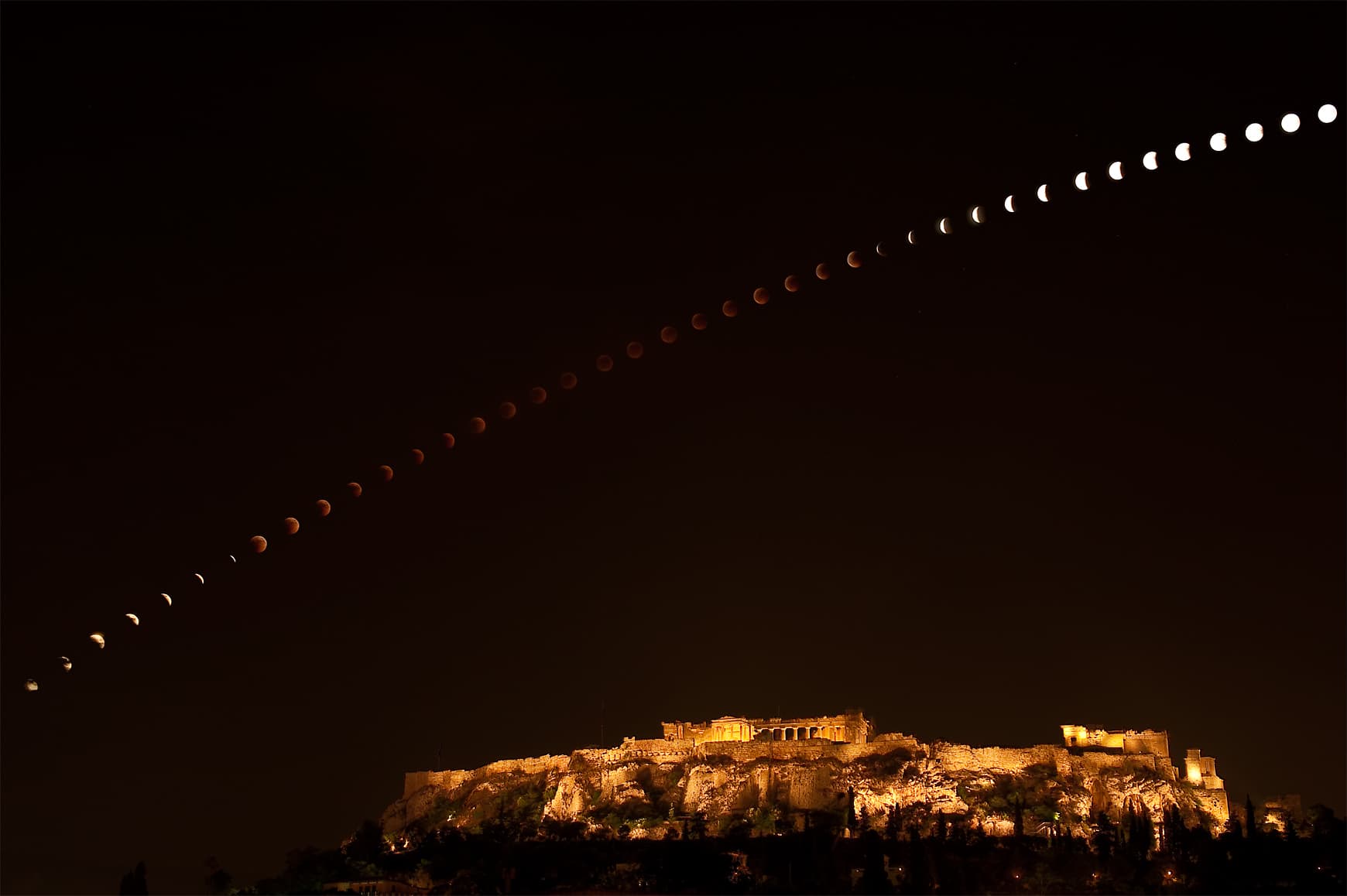
Croatia · Dubrovnik-Neretva County, Dalmatia
Dubrovnik
Sleep within walking distance if you can take stairs and outside the zone if you cannot. Walk the walls first thing or in the last two hours, never in the middle of a two-ship day, and check the port’s own schedule before you pick which morning. Give the cable car an evening: from the top at 400 metres the sun goes down into open water almost every day of the year, which the seaward walls cannot do between mid-April and late August. Buy Lokrum for a half day and watch the 19:00 last boat. Book one of the nine Michelin-listed tables and eat one meal at the Bib Gourmand, which is Bosnian and costs a third as much. Then take a boat somewhere: the Elafiti islands for a swim, or Cavtat for a lunch on a waterfront that is not full.
 Akira Takiguchi / CC BY 2.0 via Wikimedia Commons
Overview
Dubrovnik is a walled city of about 800 buildings on a limestone shelf, with a 400-metre hill at its back and a 1,940-metre circuit of wall around it, and it is the rare famous place whose fame is not exaggerated. The Old Town is a single planned composition: one straight paved street, the Stradun, with a fountain at each end and a grid of stepped lanes running up from it, all of it inside walls that were never taken by siege. What separates it from other Mediterranean set pieces is that it was an independent state for five centuries, the Republic of Ragusa, a small maritime republic that bought its safety with diplomacy and tribute rather than armies, and the city reads like the capital of a country because it was one. Then there is the newer layer, which the stone tells if you look up: 594 of the Old City’s 824 buildings were damaged by shelling in 1991 and 1992, and the roofs you photograph from the walls are mostly new tile, laid in a restoration that took the city off UNESCO’s danger list in 1998.
The two useful things we learned about Dubrovnik came out of arithmetic, not opinion. First, the crowd is a published schedule. The port’s own announcement sheet for 3 September to 31 December 2026 lists 149 cruise calls with a combined berth capacity of 217,458 and an average stay of 16.2 hours, and when you sort it by day the pattern is blunt: Tuesday is the heaviest day of the week in September and October, averaging just under 5,000 passenger capacity alongside, and Saturday is the lightest at about 1,600. Sixteen of the 69 largest calls arrive at 06:00 and forty at 07:00; forty-six of them leave at 18:00 or 19:00. The mean capacity alongside peaks between noon and 16:00 and collapses after 19:00. So the walls at opening and the Old Town after dinner are a different city from the Old Town at two in the afternoon, and you can see which days are worst before you book a flight. The port also says the quiet thing out loud on its own page: only 18 of 243 cruise days a year exceed 8,000 passengers, and ships average about 85 percent of capacity, so read every capacity figure as roughly a sixth lighter in practice. Second, and this genuinely surprised us: the cruise peak is not midsummer. In the port’s own published statistics, 2025 ran September 101,246 passengers, October 100,132, July 96,072 and August 87,385. Across the fifteen years in that table the busiest month was August five times, September four, October four and July once. September and October are the crush, and they are also the months everyone recommends. Third, the light. Cast a ray from the Stradun along the rising arc through SRTM elevation data and the ridge behind the city stands 13 to 17 degrees up at 45 to 52 degrees of bearing, which means that on 1 June the sun clears it at 06:37 against an almanac sunrise of 05:13, an hour and twenty-four minutes late, and Banje beach, under a 280-metre ridge a kilometre away, gets nothing until 07:14. At the other end of the day the famous cliff bars are honest only out of season: from Buža, cut into the south wall, the sun drops into open water from 25 August to 18 April, and in between the Lapad headland takes it 10 to 20 minutes early. From Lovrijenac’s terrace the water sunset runs 30 August to 13 April. From the top of the cable car, 406 metres up, it is open sea almost every day of the year. That is the whole trip in one sentence: mornings on the walls, evenings on the hill, and the middle of the day anywhere the ships are not.
Best for
Couples · A long weekend · Walkers · History and architecture · Island day trips · Food, at the top end and the cheap end
Daily itinerary
3 to 4 nights, 5 if you want the islands
Dubrovnik is small, and everybody arrives at once, which means the thing that decides your visit is not what you see but when you go out. Two calendars govern it and both are public. The first is the Dubrovnik Port Authority’s cruise-call sheet, which lists every ship, its passenger capacity and its berth hours months ahead, so anyone can know, before booking, whether a given Tuesday has two large ships alongside or none. The second is the sun against the ridge, because the city sits on the southwest flank of Srđ and the hills carry on east behind Ploče: the Old Town does not get first light when the almanac says sunrise, and in high summer the sun leaves the seaward walls twenty minutes before the published sunset. We have never seen a Dubrovnik guide that computes either one, and between them they are worth more than any list of sights.
Best time to visit
Dubrovnik has a wet, mild winter and a dry, hot summer, and the shoulder months are genuinely better in every way except swimming. DHMZ’s station normals give mean monthly temperatures of 25.3C in July and 25.4C in August against 21.9C in September and 18.0C in October, with 30 and 29 days above 25C in July and August but only four or five days of rain, while November and December are the wettest months of the year at 142.8 mm and 138.8 mm. The sea is the argument for late season: on 13 September 2026 DHMZ measured the Dubrovnik station at 26.1C to 26.6C, warmer than the air on most autumn days. The catch is that the city’s own visitor peak sits in that same window. The port’s statistics make September and October the biggest cruise months in most recent years, so the pleasant weather and the crowd arrive together, and the only way to separate them is by the day and the hour.
- January to February: Wettest and quietest, mean temperatures 9.2C and 9.6C, 12 and 11 rain days, the cable car shut. First light on the Stradun is only five to seven minutes later than the almanac sunrise in midwinter, because the sun rises far enough south to miss the ridge, so winter is the one season the Old Town wakes on time. Saint Blaise on 3 February fills the city with a procession in folk costume and a throat-blessing that has nothing to do with tourism.
- March to April: The season restarts. Clocks go forward on 29 March 2026, the cable car reopens in April on 09:00 to 21:00, Trsteno arboretum goes to 07:00 to 19:00 from 1 May, and the Mali Ston oyster days run 19 to 22 March 2026 up the coast. The walls are at their best now: cool stone, long light, and the sun still drops into open water from the seaward side until 18 April.
- May to June: The most comfortable weeks of the year, five days above 25C in May rising to 19 in June, sea warming through the low twenties. From mid-April the Old Town’s own sunset is gone: the sun goes behind the Lapad headland 10 to 20 minutes early at Buža and 8 to 12 minutes early at Lovrijenac, so the evening view moves up the hill. First light on the Stradun is now 74 to 89 minutes after the almanac sunrise, which is a gift if you want the walls to yourselves at opening.
- July to August: Peak heat, peak price, peak festival. Thirty days above 25C in July, 32 mm of rain all month, and the Summer Festival on the Lovrijenac stage. Book restaurant tables and the Elafiti ferry ahead: the domestic island line, unlike the cruise traffic, really does peak now, carrying 37,618 and 38,760 passengers in July and August 2025. Walk the walls before 09:00 and carry water, because the operator itself tells you to.
- September to October: The best weather and the biggest ships at the same time. Sea still 26C in mid-September, air in the low twenties by October, and the port’s sheet shows 56 September calls and 60 October calls. The seaward sunset comes back on 25 August at Buža and 5 September at Uvala Lapad. Clocks go back on 25 October 2026, which drops sunset from 18:06 to 16:50 in a single week, and the Good Food Festival takes 5 to 18 October.
- November to December: The wettest months, 142.8 mm and 138.8 mm, and the emptiest: twelve November days and twenty-four December days with no cruise ship at all. The cable car runs 09:00 to 17:00 in November and then closes, and from the top the sun is gone by 16:24 on 15 November, so the last useful ride up is around 16:00. Advent lights the Stradun from late November, though the city had not published the 2026 dates when we wrote this.
Things worth knowing
- Feast of Saint Blaise, 3 February: the city’s patron and its own holiday, inscribed on UNESCO’s Representative List of the Intangible Cultural Heritage of Humanity in 2009. UNESCO’s own description has the church bells ringing and white doves released the evening before, a throat-blessing against illness, and a procession on the day attended by bishops, ambassadors and civic leaders with parish banner-bearers in folk costume.
- Dubrovnik Summer Festival, traditionally 10 July to 25 August: theatre, opera and concerts on stages that include Fort Lovrijenac, where the festival has staged Hamlet for decades. Note carefully: as of 21 September 2026 the festival had published no 2027 dates, and its site blocks automated reading, so confirm before booking around it.
- Good Food Festival, 5 to 18 October 2026: two weeks of chef dinners, set restaurant menus, tastings and gastronomic excursions, on the tourist board’s own events listing. The only cleanly dated 2026 or 2027 event we could confirm on a primary source.
- Mali Ston oyster days, 19 to 22 March 2026, up the coast at Mali Ston and Brijesta: the tourist board of Ston publishes the dates. Ostrea edulis from that bay carries EU protected designation of origin since 2020.
- Midsummer Scene, usually late June into early July at Fort Lovrijenac: an English-language Shakespeare festival. Dates for 2026 and 2027 were not confirmable on any page we could reach.
- Advent in Dubrovnik, from late November: the 2025 to 2026 edition ran 29 November to 3 January with a Stradun opening concert. The 2026 to 2027 dates were not published when we wrote this.
Where to stay
 Diego F. Parra · Pexels
The Old Town (Grad)
Inside the walls, and the only address where the city is the building you sleep in. About 800 buildings on a grid that runs uphill from one straight street, which means stairs in every direction except along the Stradun itself. The City of Dubrovnik’s own traffic decision puts Grad at the centre of a permit zone that operates from 1 March to 30 November, so arrival by car is not a matter of finding a space: the two Old Town hotels we recommend both state plainly that they have no parking, and one of them sends a porter to meet you at the edge of the pedestrian zone. In exchange you get the walls at opening, the Stradun at midnight and the short hour after the ships leave, which is the best hour Dubrovnik has.
Best for: First-timers · Couples · Walkers who do not mind stairs · Early mornings on the walls · Late dinners
Stairs, stone and no cars, which is charming until you are carrying luggage or knees. It is also the loudest address in the city in July and August, and the most crowded between noon and 16:00 on a two-ship day. Anyone with mobility limits should sleep outside the walls and come in along the flat Stradun through Pile.
 Diego F. Parra · Pexels
Ploče
The cliff shelf east of the walls, five to eight minutes on foot from the Ploče gate, and where the grand hotels have always been: the Excelsior, the reopened Villa Argentina and Villa Orsula, all of them looking back at the Old Town across the harbour. The cable car’s lower station is here, which matters more than the address usually gets credit for, because in this city the hill is the evening. Banje beach sits just outside the gate, and the one thing to know about it is computed rather than reported: it is under a 280-metre ridge one kilometre to the east, so it gets no direct sun until 07:14 in midsummer and 07:41 on 1 October, two hours and fifty-six minutes after the almanac sunrise in the first case.
Best for: Old Town views from your room · Couples · The cable car on foot · A beach club without a bus
Inside the permit zone, and the hotels here sit on cliffs, so sea view usually means a walk down to the water and a longer walk back up. Banje is a paid beach club as much as a beach in high season.
 Dejana Popovici · Pexels
Pile and Kono
The west gate and the ground immediately behind it, which is the hinge of the whole city: every Libertas city line terminates at or runs through Pile, the cruise shuttles and taxis from Gruž discharge here under their own permit code, and Lovrijenac stands on its rock just south. It is the least restful address in Dubrovnik and the most useful, two minutes from the Pile gate and the main walls entrance. The parking that exists here is the most expensive in the country: Sanitat’s zone 0 at Pile is 20 euros an hour and 250 euros a day from May to October.
Best for: Bus connections · Walking in through the main gate · Short stays
Inside the permit zone. Traffic, coaches and pedestrian volume all day, and the noise of it. Not where we would put a honeymoon.
 Vitalii Dobrianskyi · Pexels
Boninovo and Montovjerna
The hillside between the Old Town and Lapad, which is where the mid-priced hotels live and where the arithmetic of a Dubrovnik stay usually works out best. Hotel Lero puts it exactly: the Old Town is 1.7 kilometres away and the 15-minute stroll goes through Boninovo. Hotel Bellevue, on a 30-metre cliff above Miramare bay, calls it a 10-minute walk down to the centre, and the word to notice is down. Everything here is a climb on the way home, and the beaches are small coves at the bottom of long staircases.
Best for: Value with a walk · Drivers who still want to be near the walls · Quiet evenings
Hilly. Maps understate the gradient, and a 15-minute walk in is 20 uphill minutes back. Beach access is by staircase almost everywhere, with the Bellevue’s own cove the exception.
 Lazar Krstić · Pexels
Lapad and Uvala Lapad
Outside the permit zone, flat along its seafront, and the easiest place in Dubrovnik to spend a week without stairs: a bay beach with shallow water, a pedestrian promenade of cafes behind it, and bus lines 4 and 6 running to Pile in about ten to fifteen minutes. This is where families and anyone who wants to park a car should sleep. The sunset is better here than in the Old Town for half the year and worse for the other half, and the dividing lines are computable: from the bay the sun sets into open water from 10 February to 6 April and again from 5 September to 1 November, while in high summer Petka hill on the peninsula’s west side takes it 15 to 28 minutes early.
Best for: Families · Step-free walking · A car you actually want to park · Longer stays
Every Old Town visit is a bus or a taxi, roughly 4 km each way, and the last stretch of any evening back involves waiting for a bus at Pile. The bay gets busy and shallow in August.
 Diego F. Parra · Pexels
Babin Kuk
The resort headland beyond Lapad, outside the permit zone, with the big pool-and-pine hotels, the Copacabana and Cava coves and a self-contained feel. Lines 2A, 5, 6 and 7 serve it and Hotel Dubrovnik Palace is literally the name of a bus terminus, line 4, which tells you everything about how you will reach the Old Town from here: reliably, and not on foot. Fifteen to twenty minutes to Pile depending on traffic.
Best for: Resort holidays · Families with small children · Pools and pine shade
The furthest mainland base from the walls. Works only if you accept a bus or taxi every time, and if you are happy for the hotel to be the holiday for part of it.
 Diego F. Parra · Pexels
Gruž
The working harbour: cruise berths, the ferry quay, the intercity bus station at Obala pape Ivana Pavla II, the city’s real market and the Red History Museum. It is not a resort address and it is the most honest one, and it is where you understand the scale of what arrives, because the port’s berths 9 to 14 are where those 149 autumn calls tie up. Buses 1A, 1B and 3 run to Pile in 10 to 20 minutes. The one hotel a guide would normally recommend here, Petka, is closed for reconstruction with a 2027 reopening reported, so this is a district to use rather than to sleep in.
Best for: Onward ferries and buses · The market · Early flights
Port and road noise, no beach, and no hotel we can currently recommend. Also the district that fills first when several ships dock together.
 Alan Wang · Pexels
Sveti Jakov
The cliff road southeast of Ploče, quiet, residential, and the address of the city’s most secluded luxury hotel. Its beach is the local secret and its price is about 160 steps down from the road, which you pay again on the way up. Inside the permit zone, and the only practical way in and out without a car is bus 5 or 8 to the last stop plus that staircase, or a taxi.
Best for: Couples who want distance from the crowd · A quiet beach · Swimming before breakfast
The staircase is the defining fact, and there is no lift. Nothing walkable for dinner outside your hotel, so plan on taxis. Named inside the permit zone, so the car question applies here too.
 Yona Photography · Pexels
Cavtat, as a base
A separate town 19 km south, five to seven kilometres from the airport, with its own compact old core, a waterfront of restaurants and a boat line into the Old Town harbour. Adriana’s own timetable runs from Cavtat at 09:00, 10:00, 11:15, 12:30, 14:30 and 16:15, and back from Dubrovnik at 10:15, 11:00, 13:30, 15:00, 16:15 and 17:30 from 1 April to 1 November, from 10 euros, calling at Plat, Mlini and Srebreno, around 45 minutes. It is the answer for a last night before an early flight, and for anyone who wants a Dalmatian town rather than a monument.
Best for: A last night before a morning flight · Quiet waterfront dinners · Families who want a town, not a monument
Every Old Town visit costs a boat, bus or taxi leg each way, and the boat stops for the winter on 1 November. The 09:00 sailing is marked seasonal on the operator’s own page, so check it rather than assuming.
Where to sleep
The Pucić Palace
boutique · Old Town, Od Puča 1
Best for: Sleeping inside the walls · Couples · A short stay with no car
- A baroque palace on the Gundulić square market side of the Old Town, open as a hotel since 2002, with the Stradun and both walls entrances inside three minutes on foot
- Two restaurants of its own, Lucijan and Magdalena, which matters on the nights you do not want to walk out into an August evening
- The only category of address in Dubrovnik that puts you inside the monument after the gates empty
- No parking at all, and the hotel says so in its own words: the Old Town is an exclusive pedestrians-only zone, so it has no lot and you pay for the nearest garage
- Arrival is on foot with a hotel porter from the edge of the zone, which is charming once and tiring with three bags
- A market square address means market noise from early, and Old Town nightlife noise late
Hotel Stari Grad
boutique · Old Town, Od Sigurate 4
Best for: A small house inside the walls · Couples · Rooftop evenings
- Eleven rooms and three suites, which is small enough that the building behaves like a house rather than a hotel
- Above 5, the rooftop restaurant, is the only rooftop in the middle of the Old Town, and it is where you watch the city go quiet
- Thirty seconds from the Stradun and about four minutes from the Pile walls entrance
- Fourteen keys in the most sought-after square kilometre in Croatia means booking months out, especially for June to September
- No parking of its own: the hotel asks you to contact the team for directions and parking information, which is a polite way of saying the city will charge you for it
- Its rooftop restaurant advertises Michelin recognition since 2018, but Above 5 does not appear in the Michelin Guide’s current Dubrovnik selection, so treat the claim as marketing
- The footer of its own site still reads 2025, a small sign of a site that is not being watched closely
Hotel Excelsior Dubrovnik
luxury · Ploče, Frana Supila
Best for: The classic Old Town view from bed · Couples · A hotel that carries the city’s history
- The landmark five-star on the Ploče cliff, refurbished, with the walls and the harbour framed from the tower rooms and a walk of five to eight minutes into the Ploče gate
- On the cable car side of the city, which in our reading of the light is the side that owns the evening
- A beach shelf below the hotel and a spa above it, so a day can happen without leaving
- No on-site parking is stated anywhere on its own pages, and the property sits inside the city’s permit zone: the hotel registers guest vehicles in the city system, and its own notice says that has to be done within three days of check-in
- Cliff geometry means the sea is below you, down steps, and back up again
- Scale: this is a large hotel, reported at 158 rooms, so it is not an intimate stay
Villa Dubrovnik
romantic · Sveti Jakov, Vlaha Bukovca 6
Best for: Couples · Quiet · A hotel restaurant worth staying in for
- About thirty rooms on the Sveti Jakov cliff, which is the most private luxury address in the city, and it carries one Michelin Key on the guide’s own hotel listing
- Pjerin, its restaurant, is in the Michelin Guide’s 2026 Dubrovnik selection and serves in three windows a day, 07:00 to 11:00, 13:00 to 16:00 and 18:30 to 23:30, so a late lunch here is a plan in itself
- Its own waterfront and boat shuttle geometry mean the Old Town arrives by sea rather than by road
- No parking information is published anywhere on its own site, and the property sits inside the permit zone
- Nothing is walkable: the public beach at Sveti Jakov is 400 metres away down about 160 steps, and dinner elsewhere means a taxi
- At this price, a rainy week has nowhere to go
Villa Argentina and Villa Orsula
luxury · Ploče, above the Banje shore
Best for: A new room in an old building · Couples · Gardens above the sea
- Dubrovnik’s original five-star landmark, 96 rooms, reworked and reopened with the 13-room Villa Orsula beside it, the two reconnected by garden and reported as 109 rooms and suites together
- The Ploče cliff position, minutes from the Ploče gate and the cable car, with the Old Town in the frame
- Villa Orsula is the small half of the pair, which is the one we would book of the two
- As of 21 September 2026 the operator’s own pages still said Villa Argentina will reopen in 2026 and Villa Orsula was still marked Coming soon, seven weeks after the reported 1 August reopening, so verify the booking status by phone rather than believing either page
- No parking is stated for either, and both sit inside the permit zone
- Villa Orsula has no OpenStreetMap node, so map apps may send a driver to the Argentina entrance instead
 Tony Hisgett from Birmingham, UK · CC BY 2.0 via Wikimedia Commons
Hotel Bellevue Dubrovnik
design · Montovjerna, Pera Čingrije 7
Best for: A cove of your own · Couples · Sunsets from the room
- Built into a 30-metre cliff above Miramare bay with its own pebble cove at the bottom, and beach service for hotel guests from the 2026 summer season
- West-facing, which in this city is rarer than it sounds: from this side of the peninsula the evening light stays late, and its restaurant Vapor is in the Michelin Guide’s 2026 Dubrovnik selection
- The hotel calls it a ten-minute walk down to the Old Town, which is accurate in that direction
- Down is the operative word: the walk back from the Old Town is uphill, and the cove is a lift and stair descent from reception
- No on-site parking is stated, and Montovjerna sits in the buffer zone around the restricted centre
- Its own booking widget still defaults to an arrival date in 2019, and no opening hours for Vapor are published on the group site, so reserve by phone or email
 S J Pinkney · CC BY 2.0 via Wikimedia Commons
Hotel More
luxury · Lapad, Kardinala Stepinca 33
Best for: Adults only · Couples · A quiet week outside the permit zone
- An adults-only, 14 and over, family-owned five-star on the Lapad waterfront, open since 2007, which is a rare combination in a city of group hotels
- Cave Bar More is exactly what the name says, a bar inside a natural cave below the hotel, open March through November
- Outside the restricted zone, so a hire car is simply parked rather than negotiated
- Adults only is a hard exclusion: no children, at all, under 14
- Four kilometres from the Old Town, so every visit is a bus or taxi
- No parking detail is published on its own pages, which for a Lapad hotel is an odd omission worth an email
 snailo86 from Ireland · CC BY 2.0 via Wikimedia Commons
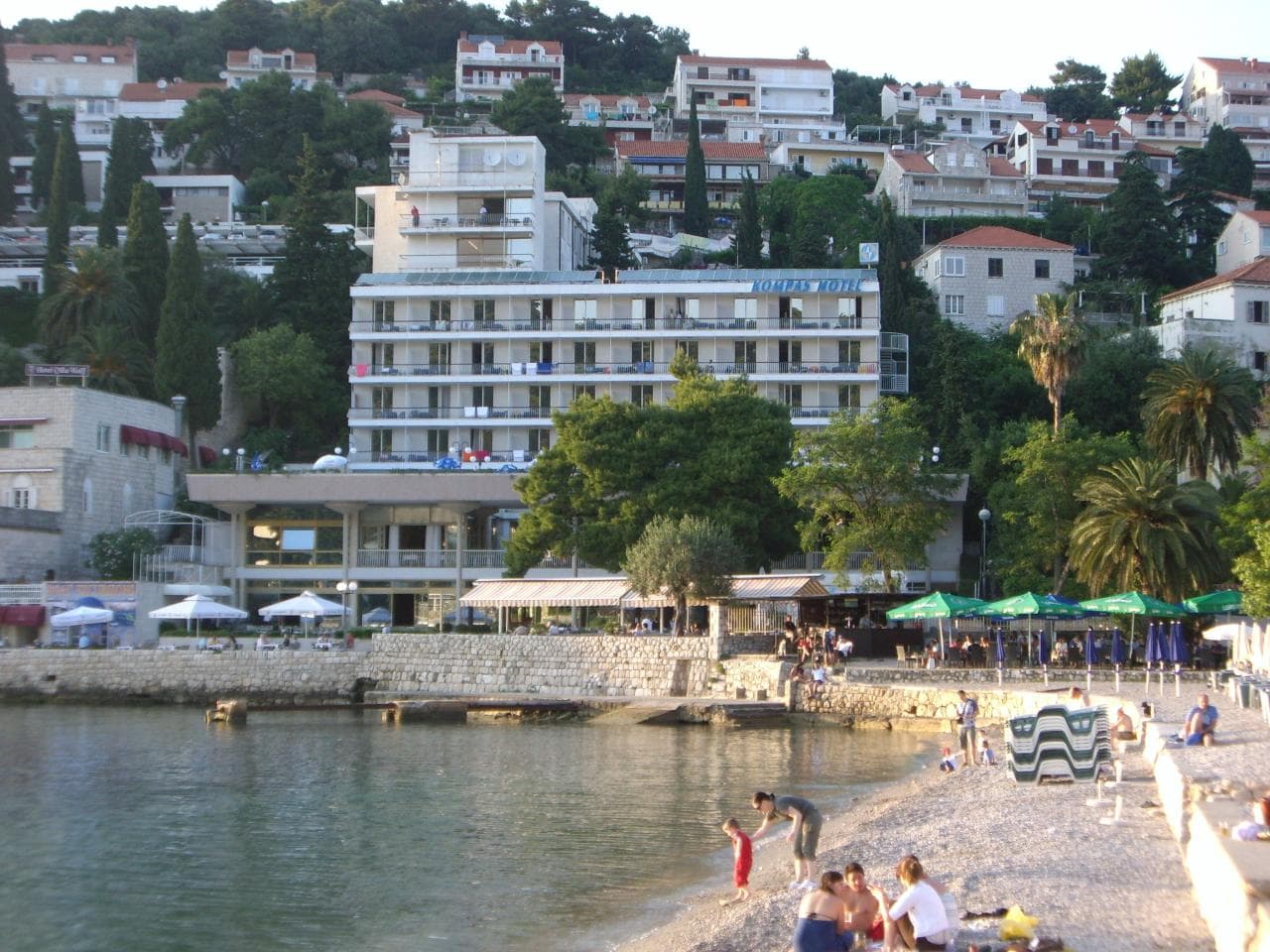
Hotel Kompas Dubrovnik
family · Lapad bay, Šetalište Nika i Meda Pucića
Best for: Families · Value in a good position · Step-free days
- Seafront on Lapad bay, which is the flattest, most walkable beach ground in the city, with the promenade of cafes immediately behind
- A rooftop bar and a spa at a four-plus star price rather than a five-star one, and the group’s own page puts it less than 4 km from the Old Town centre
- Outside the permit zone, on bus lines that run to Pile in ten to fifteen minutes
- Less than 4 km still means a bus or taxi every time, and the promenade is busy in August
- A large hotel with group business, so public areas can feel like a conference at the wrong moment
- No parking detail published, though being outside the zone makes it a practical rather than a legal question
 Дмитрий Мозжухин · CC BY 3.0 via Wikimedia Commons
Hotel Dubrovnik Palace
resort · Lapad peninsula, Masarykov put 20
Best for: Sea views from every room · Families · Pools and pine
- A large seafront resort on the pine end of the Lapad peninsula with Adriatic views from every room, which the group claims and the geometry supports
- It is the terminus of Libertas line 4, named Hotel Palace to Pile on the operator’s own timetable, which is the cleanest public-transport answer of any hotel in the city
- West-facing, so the evening light lands on the hotel rather than behind it
- A few minutes drive north west of the Old Town is the group’s phrasing, and it undersells the distance for anyone on foot
- Resort scale, with the crowding at pools and restaurants that implies in August
- The Elafiti and Old Town boats leave from elsewhere, so a day out starts with the bus
 Panek · CC BY-SA 4.0 via Wikimedia Commons
Hotel Lero
value · Montovjerna, Iva Vojnovića 14
Best for: Drivers · A walk to the walls at a fair price · Longer stays
- The rare Dubrovnik hotel that publishes a straight answer on cars: outdoor parking subject to availability, and a parking garage at extra charge
- Its own page gives the distance honestly, 1.7 km and a 15-minute stroll through Boninovo to the Old City
- Open since 1972 in a building that was designed as a student dormitory and never used as one, which is the kind of detail that tells you the place is not a brand
- No room count is published anywhere on its own site, so scale is a surprise on arrival
- The 15-minute walk in is an uphill 20 back, and the nearest beaches are staircase coves
- A four-star in the middle of the range: comfortable, not memorable
Van Bloemen Apartments
apartment · Old Town, Bandureva 1
Best for: A family or two couples inside the walls · Self-catering · Travellers who want a host, not a front desk
- Four apartments in a stone family house inside the walls, run by the family who live in it, which is the cheapest legitimate way to sleep inside the Old Town
- A kitchen inside the walls is worth real money here, because the market at Gundulić square is two minutes away and Old Town restaurant prices are not
- The Old Town at night without a hotel corridor between you and it
- The name is a trap: the property was long known as Karmen Apartments, and karmendu.com now redirects to the Van Bloemen site, so old reviews and new bookings use different names
- No parking, stairs, and no reception to solve a problem at midnight
- Four units means availability is thin, and there is no OpenStreetMap node, so navigate by the street rather than by pin
 Aleksandar Topuzović · CC BY 3.0 via Wikimedia Commons
Hotel Croatia Cavtat
resort · Cavtat, Trumbićev put
Best for: A last night before an early flight · Families · A quieter base with a boat into town
- A five-star resort on a forested peninsula above Cavtat bay, and the group’s own page puts it 5 km from Dubrovnik airport, which on a 06:00 departure is worth more than a view
- Outside Dubrovnik’s permit zone entirely, with parking that is not a negotiation, and the Adriana boat line into the Old Town harbour from the town below
- Cavtat’s waterfront restaurants are a short walk, including the Hotel Supetar restaurant, new in the Michelin Guide’s 2026 selection
- Nineteen kilometres from the Old Town: this is a base, not a walk
- The boat into town runs only 1 April to 1 November, so a winter stay is bus or taxi
- Large resort, and the beach is a rocky shelf rather than sand
Essential experiences
 László Szalai (Beyond silence) · Public domain via Wikimedia Commons
The City Walls
The reason everyone comes, and the one ticket worth buying whatever else you skip: 1,940 metres of wall around the Old Town, up to 25 metres high and four to six metres thick, carrying sixteen towers, three fortresses, six bastions, three moats and two drawbridges. Three entrances open onto the same circuit, at Pile beside the main gate, at Sv. Dominika on the Ploče side and at St John’s near the aquarium, and the walk is one direction only, anticlockwise from Pile, with staff turning back anyone going the wrong way. Two rules from the operator decide how you plan it. The ticket is valid for one tour and re-entry is not possible, so there is no popping out for a coffee, and the end of working hours means the last entry, not the last exit, so a 18:00 closing time is a 18:00 last entry. The operator also tells you, in its own words, to bring water, a hat or cap and sunscreen, which is the most honest sentence on the site: there is no shade and nothing to buy up there. Sites are open every day of the year except 25 December.
 Neoneo13 · Public domain via Wikimedia Commons
Fort Lovrijenac
The fortress on its own rock west of the Pile gate, facing the walls across a small bay, and the one piece of the defences that stands outside them. The ticket logic is worth knowing before you queue: a City Walls ticket admits you to Lovrijenac, but a Lovrijenac ticket does not admit you to the walls, so buy the walls ticket and use it here. In summer the fort is a stage, and has been for decades: the Dubrovnik Summer Festival plays Hamlet on it. From its terrace, about 37 metres above the sea, we computed the setting sun against an SRTM horizon profile: it drops into open water from 30 August to 13 April, and from mid-April to the end of August the Lapad headland takes it 8 to 12 minutes before the published sunset.
 Bracodbk · CC BY-SA 3.0 via Wikimedia Commons
The Srđ cable car
Four minutes from the Ploče side of the Old Town to 400 metres above it, and the single best-value decision in Dubrovnik after the walls. Adult return is 30 euros, one way 17, children 4 to 12 pay 8 return and 5 one way, under-fours free, and the last departure from the lower station is thirty minutes before closing time. The closing time is what to plan around, because it moves every fortnight: 09:00 to 21:00 in April, to 22:00 from 1 May, to 23:30 from 15 May, to midnight from June to 14 September, 23:00 from 15 September, 21:00 from 1 October, 20:00 from 21 October, 17:00 in November, and closed from December to March. Strong wind or lightning stops it, which on a jugo day is not a rare event. In November the arithmetic gets tight: we computed last sun at the top at 16:24 on 15 November against a 16:30 last ride up, so be on the cabin by about 16:00 or take the sunset somewhere else.
 Nikola Kojević · Pexels
Fort Imperial and the Homeland War Museum, Srđ
The Napoleonic-era fort at the top of the cable car, holding the museum of the 1991 to 1995 war, and the reason to go up before dark rather than exactly at dusk. Admission is 5 euros for adults, 3 for schoolchildren and students, free under seven, and it opens 08:30 to 22:00 from 1 April to 30 September, 09:00 to 20:00 in October and 09:00 to 17:00 from 1 November to 31 March, which is longer than the cable car runs for much of the year. Parking in front is free if you drive up. The museum itself is plain and unglamorous, the fort awaits a comprehensive renovation in its own words, and the terrace gives the view every photograph of this city is taken from, the Old Town due south at 179 degrees and the Elafiti islands out to the northwest.
 Travelling Tourist · Pexels
Lokrum
The wooded island 600 metres off the Old Town, a nature reserve with a Benedictine monastery, a small salt lake called the Dead Sea, botanical gardens, a colony of feral peacocks and no hotels, because sleeping there is prohibited. One price covers everything: 30 euros a person includes the reserve and the return trip on the official boat, children 7 to 18 pay 5 and students 10, and the same 30 euros is charged to anyone who arrives on their own boat. Tickets are sold at Luža in the old harbour from 08:00 to 18:00 and are usable up to three days after the date on them. The boat leaves the city harbour at 09:00 and then every half hour from 10:00 to 18:00, returning every half hour to 18:15, and the last boat off the island is 19:00. That last figure is the one that ruins evenings: from mid-September the 19:00 sailing is at or after sunset, so Lokrum is a morning or a long afternoon and never a sunset.
 Maria Orlova · Pexels
The Rector’s Palace and the ten-museum ticket
The Rector’s Palace is the building the Republic of Ragusa governed itself from, and the Cultural History Museum inside it is the best single answer to the question of what this city actually was. The ticketing is unusually generous: a ten-museum combined ticket is 20 euros for adults and 10 for schoolchildren and students, family 45, and it is valid for seven days from the first visit, which covers the Maritime Museum in St John’s fortress, the Ethnographic Museum in the old granary, the Revelin archaeological display and the Homeland War museum on Srđ. The Rector’s Palace alone is 15 euros, so two museums pay for the pass. Summer hours are 09:00 to 18:00 every day from 1 April to 31 October, winter 09:00 to 16:00 and closed Mondays, and tickets at all offices are card only, no cash.
 Alan Wang · Pexels
War Photo Limited
Two floors of war photography in an Old Town lane off the Stradun, with a permanent Yugoslav-wars room and changing exhibitions, and it is the most serious thing in the city that has nothing to do with the Republic. Adults 10 euros, students 6, groups of ten or more 7 each. Open every day 10:00 to 17:00 in April and October with last admission at 16:00, and 10:00 to 22:00 from May through September with last admission at 21:00, which makes it the rare Old Town interior that is open after dinner. Closed from November through March. Put it in the middle of a hot afternoon, which is exactly when the streets outside are at their worst.
 Zekai Zhu · Pexels
Red History Museum
A museum of everyday life in socialist Yugoslavia, in a former factory building in Gruž rather than in the Old Town, which is both its charm and the thing people get wrong when they plan an hour for it. Adults 10 euros, students and over-65s 8 with a valid university ID, ages 10 to 18 4 euros, under-tens free with an adult. Open 10:00 to 20:00 every day from 1 April to 31 October with last entry 19:15, and 11:00 to 17:00 Monday to Saturday in winter, closed Sundays. Pair it with the Gruž market and the ferry quay for a morning that is about the city people actually live in.
 Dawid Tkocz · Pexels
The synagogue on Žudioska
A synagogue on the second floor of a house in the old ghetto lane, one of the oldest in Europe still standing, with a small museum of Torah scrolls and ritual silver above the city’s stepped streets. The dates need care, because the internet has two incompatible stories. The Dubrovnik tourist board’s own account is that a decision of the Republic’s government in 1546 allowed Jews to settle inside the walls, formally establishing the ghetto in Žudioska street, and that one of the houses was converted into a synagogue in 1652, preserved to this day in a baroque interior. A great many secondary sites instead claim a founding in 1352 with legal status in 1408 and call it the second oldest in Europe. We print the tourist board’s version because it is the one on an official page, and we would not repeat the 1352 date without a primary source. Hours and the admission price are not published anywhere official we could reach.
 Zekai Zhu · Pexels
The Stradun, and what the roofline is telling you
The Stradun is 300 metres of polished limestone between two fountains, rebuilt after the 1667 earthquake to a single plan, and it is the only flat walking line in the Old Town, which matters for anyone who cannot take stairs. Walk it once at 08:00 and once at midnight and you have seen two different cities. Then look up from the walls at the roofs, because the colour difference is the most recent chapter of the city’s history: of 824 buildings in the Old City, 594 with a combined surface of 192,338 square metres were damaged in the 1991 to 1992 shelling, including 382 residential buildings, 19 religious buildings and 10 public buildings, and around 2,000 projectiles of various calibres hit the Old City. The city’s own record counts 76 direct hits on the City Walls, 45 on the Stradun, 37 on the Franciscan monastery and 23 on the Dominican. The worst single day was 6 December 1991, when more than 600 projectiles fell inside the walls.
City of Dubrovnik: destruction of the Old City ↗View on map ↗
 Bob Jenkin · Pexels
The Buža bars, through a hole in the wall
Buža means hole, and that is literally the entrance: a gap in the south wall above the rocks, with drinks in plastic cups, no kitchen, no menu worth the name and one of the best seats in the Mediterranean. There are two, the larger lower Buža II with table service closer to the water and the rougher upper Buža I, both reached from Crijevićeva, and neither has a working website: the domain that used to carry one now serves unrelated content. Here is the thing nobody writes: this is a sunset spot for three quarters of the year and a late-afternoon spot for the rest. We cast the setting arc from the south wall against SRTM terrain and the sun drops into open water from 25 August to 18 April; between 18 April and 25 August the Lapad headland to the west takes it 10 to 20 minutes before the published sunset, and on 15 June the sun is gone from the rocks at 20:06 while the almanac says 20:27.
 Modzzak · Public domain via Wikimedia Commons
Trsteno Arboretum
A Renaissance garden on the coast 18 kilometres northwest of the city, laid out by a Dubrovnik patrician family in the late fifteenth century, with an aqueduct, a Neptune grotto, citrus terraces and a view down to a small harbour. It is run under the Croatian Academy of Sciences and Arts, which is why it feels like a botanical collection rather than an attraction, and it is the best half day within reach of the city for anyone who has had enough stone. Open 07:00 to 19:00 from May to October and 08:00 to 16:00 from November to April. Adults pay 10 euros individually, children and students 7, agency groups 8 and 6, and residents of the city, county school groups and veterans’ and pensioners’ groups go free. Bus 12 from Pile, or the Lokrum operator’s combined Trsteno and Lokrum boat trip at 42 euros with the arboretum ticket 8 euros on top.
Trsteno visitor information ↗HAZU arboretum unit ↗View on map ↗
 Nikolett Emmert · Pexels
Banje and the city’s cove beaches
Dubrovnik swims off rock and shingle, not sand, and almost every central beach is at the bottom of a staircase cut into the cliff: Šulić under Lovrijenac, Danče on its headland, the cove below the Bellevue, and Sveti Jakov about 160 steps down behind its church. Banje, just outside the Ploče gate, is the exception for access and the rule for crowding, five minutes from the walls with the Old Town in the frame and a beach club across most of it in season. The computed detail worth carrying: Banje sits under a 280-metre ridge one kilometre east, so it has no direct sun until 07:14 in late June and 07:41 on 1 October, roughly two hours after the almanac sunrise in midsummer. If you want a sunrise swim in warm light, it is the wrong beach; if you want shade at eight in the morning in August, it is the right one. Flat, sandier, family swimming is on Lapad bay and the Babin Kuk coves instead.
 Jocelyn Erskine-Kellie / CC BY 2.0 via Wikimedia Commons
 Alexey Komarov / CC BY-SA 4.0 via Wikimedia Commons
Food & drink
 Rosali Iraheta · Pexels
Šporki makaruli
Dirty macaroni: pasta in a long-cooked beef and tomato sauce, the city’s own dish and the one tied to its patron saint. Restaurants across Dubrovnik serve their versions around the Feast of Saint Blaise at the start of February, promoted by the tourist board as its own short season. The story that it began as the servants’ meal made from the masters’ leftovers is tradition rather than documented fact, and we would tell it that way.
 Nadin Nandin · Pexels
Zelena menestra
Green stew, the Konavle winter dish: cured ham, bacon and dried mutton cooked down with potatoes and mixed cabbages, kale and savoy. It is mentioned in local writing as far back as 1480 and is traditionally eaten the day after Christmas, so it is a cold-season order and not an August one.
 Matheus Bertelli · Pexels
Rožata
The city’s dessert and the reason not to order panna cotta: a caramel custard flavoured with rozalin, a rose-petal liqueur, which is what separates it from crème caramel. Medieval in origin by every account we read, though we could not verify a first date on an official page.
 Larbigno • · Pexels
Mali Ston oysters
Ostrea edulis from Mali Ston bay, about 40 km up the coast, farmed there since the Republic and recorded in a 1573 archive note on gathering from natural nurseries. In 2020 the EU granted them protected designation of origin, reportedly the first time a farmed flat oyster received that mark, and the bay accounts for the great majority of Croatian oyster production. In town they are an hours-old starter, not a delicacy flown in.
 Adriano Bragi · Pexels
Black risotto
Crni rižot, cuttlefish or squid with its own ink, on every seafood menu on this coast. It is Dalmatian rather than specifically Dubrovnik, and the test of a kitchen is whether the rice is still loose and the ink tastes of the sea rather than of salt.
 Elina Volkova · Pexels
Malvasija Dubrovačka
The Republic’s own white grape, almost extinct by the end of the twentieth century and brought back from two surviving vines: the Karaman winery’s own account dates the revival initiative to 2001, the first replanted vineyard to 2003 and the first harvest to 2006, and puts Konavle today at more than 92,000 vines with 24 winemakers working with the variety. Order it instead of a Pošip if you want to taste something the city can claim.
 Corinna Widmer · Pexels
Plavac Mali from Dingač and Postup
The heavy Pelješac reds from steep south-facing terraces an hour and a half up the coast, Croatia’s first controlled-origin wine region in 1961 and the second in 1967. They are big, warm and high in alcohol, which is why locals drink them in winter and dilute the lesser ones with water in summer without embarrassment.
Dinner is late by northern European standards and early by Spanish ones: kitchens in the Old Town fill from 20:00, and the fine-dining rooms take their last tables around 22:00, with Nautika running to midnight. Lunch is a real meal and often the better value one, and several of the best rooms serve it, Pjerin from 13:00 and Stara Loza from 08:00 for brunch. Tipping is custom rather than rule: around ten percent at a sit-down table, less at a konoba or pizzeria, and cash to the server is preferred even on a card bill. Reserve the Michelin-listed tables days ahead in season, and understand that the rooftop seats in particular are counted in single figures: Stara Loza’s rooftop has fourteen seats, dinner only, two seatings a night, minimum two and maximum six guests, at 110 euros a head in March to May and October and 125 in June to September.
Where to eat
Restaurant 360
fine-diningThe city’s only Michelin star in the 2026 guide, and the highest Gault&Millau score we found on this coast at 18 out of 20. It sits on the walls themselves, looking down into the old harbour, and it opens Tuesday to Sunday 18:00 to midnight, closed Monday, with an elegant dress code. Dinner only, so it never competes with a day plan.
Last researched 2026-09-21
Taj Mahal
institutionDespite the name it is a Bosnian kitchen, and it is the city’s only Bib Gourmand in the 2026 Michelin selection, which in Michelin’s own language means good quality and good value cooking and in practice means the best-value serious meal inside the walls. Ćevapi, pastries, slow-cooked lamb, its own butchery. Two locations, and the Old Town one is the listed one. It publishes no opening hours, so book through its own site.
Last researched 2026-09-21
Stara Loza
fine-diningIn the Michelin selection every year since 2017 and again in 2026, with the only fine-dining rooftop on Prijeko. Two things to know before you plan it: the rooftop is fourteen seats, dinner only, two seatings a night, minimum two and maximum six guests, priced per person by season at 110 euros from March to May and in October and 125 from June to September; and the street-level terrace does brunch from 08:00, with dinner service 18:00 to 22:00. Its own pages disagree on whether brunch ends at 13:00 or 15:00, so confirm when you book.
Last researched 2026-09-21
Pjerin
fine-diningVilla Dubrovnik’s restaurant, in the Michelin Guide’s 2026 Dubrovnik selection, named after an unfinished play by the sixteenth-century Dubrovnik playwright Marin Držić, with Robert Račić as executive chef. It serves in three windows, 07:00 to 11:00, 13:00 to 16:00 and 18:30 to 23:30, which makes the 13:00 seating the best-value way into the hotel. A taxi each way unless you are staying there.
Last researched 2026-09-21
Nautika
institutionThe city’s formal address for fifty years, on the terrace between the Pile gate and Lovrijenac, in the Michelin selection for 2026 and scored 16.5 by Gault&Millau. Open every day 18:00 to midnight. One warning: its own page still carries a leftover line saying it is closed for the 2025 season next to the current hours, so trust the hours and not the notice. The same group runs the more casual Dubravka 1836 next door and Gradska Kavana Arsenal on Luža square.
Last researched 2026-09-21
 Ben Snooks from Melbourne, Australia · CC BY-SA 2.0 via Wikimedia Commons
Restaurant Dubrovnik
institutionA five or nine course chef’s choice menu in a hidden Old Town courtyard, in the Michelin selection for 2026 and scored 15 by Gault&Millau. It closes for the winter, from November until April on its own statement, with the exact dates varying year to year, so it is a season-dependent booking. Beware the domain: restaurantdubrovnik.com is a parked lander, and the real site is restorandubrovnik.com.
Last researched 2026-09-21
 Sasa Sobot · CC BY-SA 4.0 via Wikimedia Commons
Proto Fish
institutionFounded in 1886 and the oldest restaurant inside the walls, in the Michelin selection for 2026, with a street terrace on Široka, an interior room and an upper terrace. Order whatever is whole and grilled and priced by the kilo, and ask to see it before it is cooked, which here is normal practice rather than an insult. Its own website renders almost nothing, so book by phone.
Last researched 2026-09-21
Vapor
fine-diningThe Bellevue’s restaurant, in the Michelin Guide’s 2026 Dubrovnik selection and scored 14 by Gault&Millau, on the west-facing cliff above Miramare bay, which is the right side of the city for evening light. No hours are published anywhere on the group’s site and the booking widget on its page still defaults to 2019, so reserve by phone or email and confirm the time.
Last researched 2026-09-21
Pantarul
modernThe modern Dalmatian bistro in Lapad that Dubrovnik’s own residents name first, built on produce from farmers around the city, scored 14.5 by Gault&Millau and deliberately not a white-tablecloth room. One live contradiction to check: its contact page says open Monday to Sunday while its own FAQ asks why it is closed on Mondays, so ring before you walk there on a Monday.
Last researched 2026-09-21
Kopun
casualOn a small square above the Jesuit stairs, cooking revived Croatian recipes including the capon the restaurant is named after, with two dinner seatings at 19:00 to 21:00 and 21:00 to 23:00. It is not in the Michelin selection despite plenty of search results claiming otherwise, which we checked against the guide’s own index, and it does not need to be: this is a good dinner at a fair price in the quietest corner of the walled city.
Last researched 2026-09-21
Gverović-Orsan
casualA family seafood restaurant since 1966, in a centuries-old boathouse on Zaton bay with its own organic garden, which celebrated its sixtieth year in 2026. It is seven kilometres west of the Old Town, which is exactly far enough that the ships do not reach it, and the drive is the price of a lunch where the water is at the table leg rather than in the photograph.
Last researched 2026-09-21
Bota Šare oyster and sushi bar
casualThe Old Town branch of the Mali Ston oyster family, serving oysters pulled from a bay 40 kilometres away earlier the same day, plus a fusion sushi menu that is better than it sounds on paper. There is also a six-seat, no-menu room built around a dry-aged whole Adriatic bluefin, which is the most interesting reservation in the city for anyone who eats raw fish. No hours are published, and the only Bota Šare pin on OpenStreetMap is the Mali Ston original, so navigate to the Buža gate rather than to a map marker.
Last researched 2026-09-21
Dubravka 1836
casualThe big terrace immediately outside the Pile gate, open 08:00 to midnight, run by the same group as Nautika next door, which is why the kitchen is better than its position suggests. It is the practical answer to the walls-at-opening plan: coffee here at 07:30, through the gate and up the steps when the ticket office opens.
Last researched 2026-09-21
Life According to Kawa
cafeA third-wave coffee bar and concept store in a converted garage a few minutes outside the walls, pouring Croatian roasters, and the nearest thing in Dubrovnik to a room where people are working rather than sightseeing. Useful for the same reason the Buža bars are: it is a few metres off the tour route and therefore a different city.
Last researched 2026-09-21
 Ardfern · CC BY-SA 3.0 via Wikimedia Commons
The Gruž market
marketThe city’s real market, on the harbour front in Gruž, fish on one side and produce on the other, and a completely different experience from the small souvenir-and-fruit stalls on Gundulić square inside the walls. Go early. We could not confirm the opening hours on any official page and the two independent versions we found contradict each other, so treat early morning to early afternoon as the safe window and do not plan a late visit.
Last researched 2026-09-21
Sunrises
 Argo Allvee · Pexels
The Old Town’s late first light
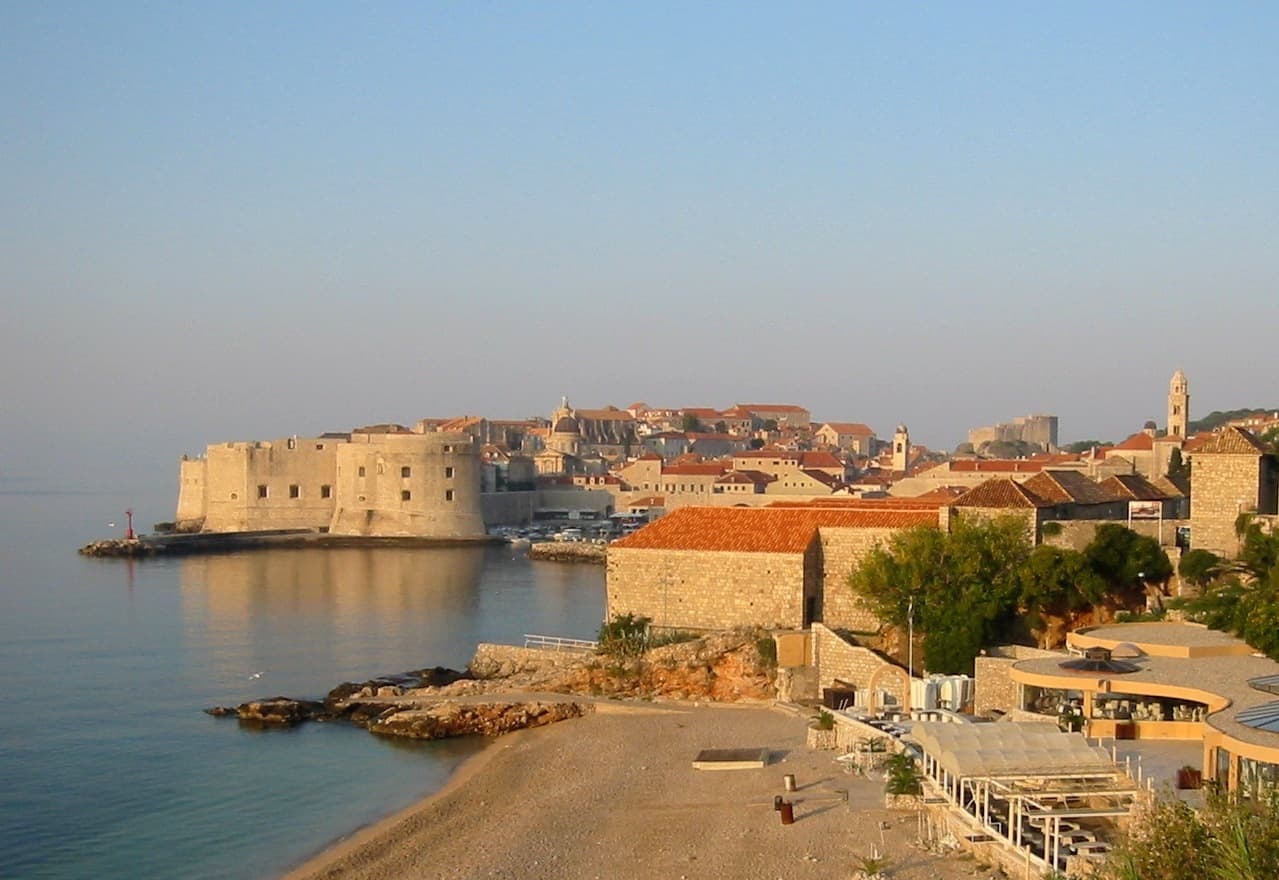
Dubrovnik is the rare southern city where the almanac sunrise is close to meaningless, because the Old Town lies on the southwest flank of Srđ with the ridge carrying on east behind Ploče. Cast a ray from the Stradun through SRTM elevation data along the rising arc and the terrain stands 13 to 17 degrees above the horizontal between 45 and 52 degrees of bearing, about 300 metres of hill one kilometre away. The result, computed rather than repeated: on 1 June the sun reaches the street at 06:37 against an almanac sunrise of 05:13, an hour and twenty-four minutes late, and on 15 June at 06:38 against 05:09. In mid-September it is 07:14 against 06:27. Only in midwinter does the city wake on time, five to seven minutes behind the almanac in December and January, because the sun then rises far enough south to miss the ridge entirely. What that buys you is the best hour of the day: the walls open while the eastern half of the circuit is still in shade, the stone is cool, and the first big ships are only just tying up at Gruž.
April to September, when the delay is largest and the cool shaded hour is worth most · Flat along the Stradun, steps everywhere else. The walls themselves are stairs from the first metre. · The city is in flat shade until the sun clears the ridge, then goes to hard contrast within minutes. The soft window is the twenty minutes before first light, not after it.
 Art Anderson · CC BY-SA 3.0 via Wikimedia Commons
Banje, and why the sunrise swim does not work there
Banje is the beach everybody walks to from the Ploče gate, and the one many guides suggest for a sunrise swim. The terrain says otherwise. The ridge a kilometre east of it stands 20 to 24 degrees above the horizontal across the whole eastern bearing band, so the beach gets no direct sun until 07:14 on 15 June and 07:41 on 1 October, which is two hours and five minutes and fifty-six minutes behind the respective almanac sunrises. Swim there at 06:30 in July and you are swimming in grey shade with the Old Town lit up behind you, which is its own picture but not the one you planned. For sun on the water early, take the west-facing side of the city instead: Lapad bay and the Babin Kuk coves get the light on the water long before the eastern shore does.
Any season, as a warning rather than a recommendation · Steps, shingle, and a beach club across much of it from June to September. · The lit subject at dawn here is the Old Town and the walls from the east, not the sea.
Sunsets
 Tony Hisgett from Birmingham, UK · CC BY 2.0 via Wikimedia Commons
The top of the cable car, Srđ
The one place in Dubrovnik where the sunset is reliable, and the reason to spend an evening 400 metres above your hotel. From the upper station the whole western horizon is open water: the highest terrain anywhere in the setting arc is the far Pelješac ridge at 15 to 20 kilometres, and it stands only about one degree up, so the sun goes down into the sea and not into a hill. We ran the full year against the profile and the sun sets over open water on essentially every date, with one marginal exception: between 14 May and 29 July it clips the distant Pelješac ridge, which costs a minute or two, not a sunset. The Old Town lies due south from up here at 179 degrees and the Elafiti islands sit out to the northwest, so the composition is the city in silhouette on one side and the light on the water on the other.
All year while the cable car runs, which is April to November · Step-free from the Ploče lower station, four minutes up. Walking is possible on the serpentine path, about 2 km with no shade and no water, and we would not do it in July at four in the afternoon. · Bring something for both directions: the sun sets to the northwest over the islands while the Old Town lights up to the south. The Fort Imperial terrace is the wider frame.
Tony Hisgett from Birmingham, UK · CC BY 2.0 via Wikimedia CommonsThe Buža bars on the south wall
The famous one, and it is honest only out of high summer. From the rocks below the south wall the sun sets into open water from 25 August to 18 April. Between those dates the Lapad headland to the west, a low ridge that reads as nothing from a table, takes the sun 10 to 20 minutes before the published sunset: on 15 June the sun leaves the rocks at 20:06 while the almanac says 20:27, and on 1 July at 20:09 against 20:29. That does not make a July evening here a waste, because the afterglow over the sea and the swimmers on the rocks are the point as much as the disc is, but if you have come for the moment the sun touches the water you want the end of August through mid-April, or you want the cable car.
Late August to mid-April for the sun on the water, any evening for the place itself · A hole in a wall, then rock terraces and steps. Not step-free, not for small children after a drink. · Drinks come in plastic cups and the light is behind everything: expose for the sky and let the rocks go dark.
 Diego F. Parra · Pexels
The Lovrijenac terrace
Standing on its own rock outside the walls, about 37 metres above the sea and facing west across the small bay at Pile, Lovrijenac gives the framed version: the walls and the Old Town to your east, open sea in front. The same headland arithmetic applies as at Buža but slightly later, because height helps: from the terrace the sun goes into open water from 30 August to 13 April, and from mid-April to the end of August it disappears behind the Lapad side 8 to 12 minutes early. The catch is access. The fort keeps daytime hours, so most of the year the sunset is not available from inside it at all, and the exception is a Summer Festival performance, when the stage is on the terrace and the evening is the point.
Late August to mid-April for the geometry, July and August for a festival night · A long flight of stone steps up from the Pile side. There is no step-free route. · The strongest frame is not the sun at all: it is the walls and Minčeta in the last warm light with the sea behind you.
 Muhammed Fatih Beki · Pexels
Uvala Lapad, the flat-footed sunset
The bay beach in Lapad is the sunset for anyone who does not want stairs, a wall or a cable car: a pedestrian promenade, cafes at the back of the sand and the sun going down the length of the bay. It works in the shoulder seasons and not in high summer, which is the opposite of what a beach promenade implies. From the bay the sun sets into open water from 10 February to 6 April and again from 5 September to 1 November; in between, Petka hill on the peninsula’s western side takes it 15 to 28 minutes early, and in deep winter the same hill costs up to fifty minutes. Late September here, with a 19:00 sunset into the water and the restaurants filling behind you, is the most relaxed evening in the city.
Mid-February to early April and early September to the end of October · Flat and step-free the whole length of the promenade, the only sunset spot in this guide that is. · Long lens down the bay to compress the headlands, or wait for the ten minutes after the sun goes, when the water holds the colour better than the sky.
Day trips
 Nikola Kojević · Pexels
The Elafiti islands: Koločep, Lopud and Šipan
Three small islands an hour or less northwest of Gruž on the Jadrolinija local line, and the closest thing to an escape valve the city has. Koločep is the nearest and smallest, Lopud is car-free with the sandy Šunj beach on its far side, and Šipan is the largest and quietest with a local bus between its two villages. Unlike the cruise traffic, this line really does peak in midsummer: the port’s own 2025 statistics put 37,618 passengers on the Elafiti line in July and 38,760 in August against 24,646 in September, which is a queue on the quay in August rather than a scheduling problem. Buy tickets at Gruž, pick the last return sailing first and plan the day backwards from it. Jadrolinija publishes the 2026 timetable and fares as PDFs behind a script-driven page that we could not read, so take the times from the operator at the quay and not from a blog, ours included.
Roughly 25 minutes to Koločep, 45 to Lopud and an hour to Suđurađ on Šipan from Gruž · A full day for one island, or a long day for two
 Conor Rees conorrees · CC0 via Wikimedia Commons
Cavtat by boat
The best half day in this guide for the money. Adriana’s regular line runs from the Old Town harbour to Cavtat and back from 1 April to 1 November, from 10 euros one way, calling at Plat, Mlini and Srebreno, taking between twenty minutes and an hour depending on the stops, around forty-five minutes on average. Departures from Dubrovnik are 10:15, 11:00, 13:30, 15:00, 16:15 and 17:30, and from Cavtat 09:00, 10:00, 11:15, 12:30, 14:30 and 16:15, with the 09:00 marked seasonal. Cavtat gives you a waterfront promenade of restaurants, two small beaches, the Račić family mausoleum by Ivan Meštrović above the town, open 1 May to 31 October Monday to Saturday 09:00 to 16:00 at 4 euros, and the Hotel Supetar restaurant, new in the Michelin Guide’s 2026 selection.
About 45 minutes each way by boat, 20 minutes by taxi · Half a day, or a long lunch
Cavtat boat line ↗Konavle museums hours and tickets ↗View on map ↗
 JERRYE AND ROY KLOTZ MD · CC BY-SA 3.0 via Wikimedia Commons
Ston, Mali Ston and the oyster bay
An hour up the coast at the neck of the Pelješac peninsula: a 5 km defensive wall climbing the hill above Ston, salt pans still worked by hand, and in Mali Ston on the other side of the isthmus the oyster beds that carry EU protected designation of origin since 2020. The drive is the same road the Split to Dubrovnik route uses, over the Pelješac bridge, and it pairs a serious piece of Republic-era engineering with the best hour of eating within reach of the city. Ston’s own oyster days fall on 19 to 22 March 2026, which is early season, quiet and cold, and exactly when a bivalve is at its best.
About 55 km and an hour each way by car or taxi · A full day, or a half day if you skip the walls
 August Dominus · CC BY-SA 3.0 via Wikimedia Commons
Konavle and Sokol Grad
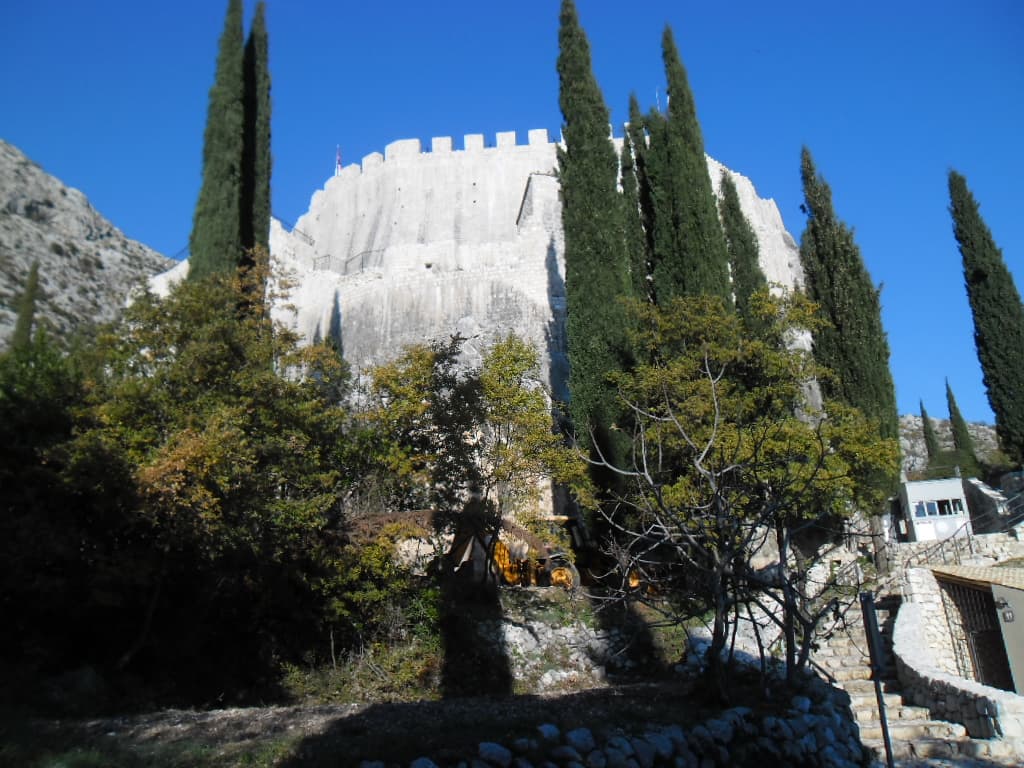
The green valley south of the airport, where the city’s wine and its embroidery come from, and a fortress built into a rock at Dunave that the walls operator also runs, so it keeps the same every-day-except-Christmas rule. This is the antidote to a walled city: farms, a few konobas that cook for locals, the revived Malvasija Dubrovačka vineyards, and almost no cruise traffic by definition, because there is nothing here that fits in a four-hour shore excursion. Hours and the current ticket price for Sokol Grad were not published on any page we could reach, so ring ahead or ask at the walls ticket office in town.
About 40 km and 45 minutes to Dunave by car · A full day with lunch
 Lena Netkach · Pexels
Mostar or the Bay of Kotor, with one caution
Both are sold on every corner of the Old Town as a day trip, and both are genuinely worth a day. Read the border and the advisory before you book, and read them differently depending on your passport. For Israeli travellers the relevant line is Israel’s own: the National Security Council dataset rates Croatia as no warnings, while Bosnia and Herzegovina carries a level 2, occasional threat, with wording about an increase in hostility toward Israelis and Jews since the war and a recommendation to take heightened precautions. Montenegro and Bosnia are both outside Schengen, so each crossing is a full border check in each direction, and since 10 April 2026 the return into Croatia is an Entry and Exit System registration. A day trip that looks like four hours of driving is often six.
Mostar about 140 km and three hours each way; Kotor about 90 km and two to three hours each way with border queues · A very full day
After dark
 Alan Wang · Pexels
The Stradun after the ships leave
walkThe best free thing in Dubrovnik, and it is on a timetable. In the port’s own 2026 announcement sheet, of the 69 calls carrying 1,500 passengers or more, 46 depart at 18:00 or 19:00, and the mean capacity alongside falls from about 2,600 at 19:00 to about 860 by 20:00. Walk the length of the Stradun at 20:30 and the city you were pushing through at two in the afternoon has emptied by roughly two thirds.
 Diego F. Parra · Pexels
A night at the Summer Festival
performanceFrom 10 July to 25 August in a normal year the city becomes the stage set it was built to be, with performances in the Rector’s Palace courtyard and on the Lovrijenac terrace, where the festival has staged Hamlet for decades. It is the one way to be inside the fortress after dark. The 2027 dates had not been published when we wrote this and the festival’s own site blocks automated reading, so check it directly.
 Jose D´Alessandro · Pexels
The cable car at dusk, then dinner down the hill
viewpointRide up ninety minutes before sunset, walk the fort terrace while the light moves, watch the sun go into the sea, then come down into a late table. The last cabin down runs to closing time, which is midnight from June to mid-September, so this does not need to be rushed in high summer. In November the sun beats the cable car and the whole plan moves an hour earlier.
 Irina Grigore · Pexels
A drink through the hole in the wall
barBuža after dinner rather than at sunset, which is what locals do and which sidesteps the geometry problem entirely: plastic cup, warm rock, the sea black and loud below, Lokrum a shape in the dark. No kitchen, no card machine you should rely on, no reservations.
Daily itinerary
Three nights, planned around the ships and the light
The trip most people actually take, done in the right order. Before you book, open the Dubrovnik Port Authority’s announcement sheet and look at your dates: in September and October 2026 Tuesday averages just under 5,000 passengers of berth capacity and Saturday about 1,600, so if the dates are flexible put your walls morning on the lightest day you have. Everything here is on foot except the cable car and one bus.
- 1
Arrive, and let the city empty around you
relaxedLand at DBV and take the Platanus shuttle, 10 euros one way and 15 return, which leaves about thirty minutes after every flight arrival and stops at the Ploče gate and then Gruž bus station. A taxi is roughly 30 to 60 euros depending on who you ask, and no official fixed fare is published. If this is a first Schengen entry since 10 April 2026, allow a few extra minutes at the kiosk for the Entry and Exit System: passport scan, face, four fingerprints, valid for three years.Late, outside the walls. Dubravka 1836 at the Pile gate is open 08:00 to midnight and is better than its position suggests.Do not start with the walls. Walk in through Pile, along the Stradun, and get the shape of the place: Onofrio’s fountain at one end, Luža and the bell tower at the other, the Rector’s Palace, the stepped lanes. Buy your walls ticket for tomorrow morning if the office will sell one ahead.From late August to mid-April, Buža on the south wall, where the sun still lands in the water. From mid-April to late August, skip it and go up the cable car instead: the seaward walls lose the sun 10 to 20 minutes early in those months.Kopun on its quiet square above the Jesuit stairs, two seatings, 19:00 to 21:00 or 21:00 to 23:00.Walk the Stradun again at 22:00. Of the big calls in the published schedule, 46 of 69 leave at 18:00 or 19:00, and the difference is the whole reason to sleep near the walls.Airport to Ploče gate about 30 minutes on the shuttle, 35 to Gruž. Everything else today is walking.Estimate: If you land late, eat at the hotel and keep the Stradun for the morning · A Dubrovnik Pass bought now covers the walls, the city museums and the buses, and the city states it includes public transport
- 2
The walls at opening, the museums at noon, the hill at dusk
fullBe at a ticket office when it opens. Walk anticlockwise from Pile, which is the enforced direction, and remember the two operator rules: one tour only, no re-entry, and last entry equals closing time. Carry water and a hat, because the operator itself says to, and there is no shade on 1,940 metres of wall. In summer the eastern half is still in the ridge’s shade, because the sun does not reach the Old Town until 06:37 to 07:14 depending on the month. Use the walls ticket for Lovrijenac too: it works that way round, not the other.Bota Šare by the Buža gate for Mali Ston oysters, or Proto Fish on Široka for a whole grilled fish.The indoor hours, deliberately placed when the streets are worst. The ten-museum ticket is 20 euros and valid seven days, which pays for itself at the Rector’s Palace alone, and War Photo Limited on Antuninska is open to 22:00 from May to September with last admission at 21:00.Cable car. Ride up ninety minutes before sunset, walk the Fort Imperial terrace, 5 euros and open to 22:00 from April to September, and watch the sun go into open water, which from 400 metres up it does on almost every day of the year.Come down to 360 on the walls above the old harbour if you booked it, Tuesday to Sunday 18:00 to midnight, or to Taj Mahal for a third of the price and Michelin’s Bib Gourmand.A drink at Buža on the way back, when the geometry no longer matters.All on foot except the cable car from the Ploče lower station. Last departure up is thirty minutes before closing, and closing changes every fortnight.Estimate: If the cable car is shut for wind, take the same evening at the Bellevue’s Vapor or on the Lapad promenade, which faces west · If it is raining, the ten-museum ticket buys a whole day indoors
- 3
Water: Lokrum or Cavtat
moderateBuy Lokrum at Luža in the old harbour, 30 euros including the return boat, and take the 09:00 or a 10:00 sailing. Walk the monastery, the botanical garden and the small salt lake, swim off the rocks, watch for peacocks. The ticket is valid up to three days after its date, which is useful if the sea turns.On the island, simply, or back in town.Either stay on Lokrum until mid-afternoon, or swap the whole day for the Cavtat boat from the harbour: 10 euros one way, calling at Plat, Mlini and Srebreno, about 45 minutes, with the Meštrović mausoleum above the town open Monday to Saturday 09:00 to 16:00 from May to October at 4 euros.Watch the clock on Lokrum: the last boat back is 19:00, and from mid-September that is at or after sunset, so the island is never the sunset.Pantarul in Lapad, where the city eats, reached on bus 4 or 6 from Pile in ten to fifteen minutes.The Lapad promenade, which is flat, or back to the Stradun for the last empty hour.Boat both ways. Buses to Lapad are 1,73 euros if bought before boarding and 2,50 on board.Estimate: Swap Lokrum for the Elafiti islands if you want a real swim rather than a rock ledge · On a jugo day both boats can be cancelled, so keep the museums in reserve
Five nights, with the islands and one day out of the city
The same spine, with the breathing room that makes Dubrovnik pleasant rather than efficient: a full island day, a day up the coast, and two evenings that are not in the Old Town. This is the version we would book, ideally in the second half of October when the sea is still swimmable, the Good Food Festival is on from the 5th to the 18th, and the cruise sheet has begun to thin.
- 1
Arrive and walk in
relaxedShuttle or taxi from DBV, check in, and stay out of the Old Town until the late afternoon.Near the hotel.The Stradun, the fountains, the Rector’s Palace from the outside, and the ticket office for tomorrow.Buža if the date is between late August and mid-April, otherwise the Lapad promenade or the cable car.Dubravka 1836 or Gradska Kavana Arsenal on Luža.The empty Stradun after 20:00.Airport shuttle 10 euros, about 30 minutes to the Ploče gate.Estimate: A first night in Cavtat if you land after 22:00
- 2
Walls, Lovrijenac, museums, cable car
fullThe walls at opening, anticlockwise from Pile, then Lovrijenac on the same ticket.Oysters at Bota Šare or fish at Proto.The ten-museum ticket: Rector’s Palace, the Maritime Museum in St John’s fortress, and War Photo Limited.The cable car and the Fort Imperial terrace.360, Stara Loza’s rooftop or Taj Mahal, in descending order of price.Down the hill on the last cabins, which run to closing.On foot plus the cable car.Estimate: Swap the museums for the Red History Museum in Gruž and the market beside it
- 3
The Elafiti islands
moderateGruž quay for the local line: Koločep at about 25 minutes, Lopud at 45, Suđurađ on Šipan at about an hour. Take the timetable from the operator at the quay, because the PDF is not readable online.On Lopud, near the promenade.Walk across Lopud to Šunj, one of the few real sand beaches in this region, and swim. Lopud has no cars.Back in the city. Uvala Lapad has the flat-footed sunset into the water in September and October.Pantarul in Lapad, the modern Dalmatian bistro the city itself names first.The Lapad promenade.Bus 1A, 1B or 3 to Gruž, then the ferry. In July and August the island line is at its busiest, so be early at the ticket window.Estimate: Lokrum instead if the sea is rough: it is a fifteen-minute crossing rather than an hour
- 4
Out of the city: Ston and the oysters, or Konavle and the wine
fullNorth to Ston by car or taxi, about an hour, for the 5 km wall above the town and the salt pans. Or south into Konavle for the Malvasija Dubrovačka vineyards and Sokol Grad on its rock.Mali Ston for oysters and mussels metres from where they grew, or a Konavle konoba.Wine on the Pelješac side coming back, or the Cavtat waterfront and the Račić mausoleum if you went south.From wherever you are: both directions face water.Gverović-Orsan in Zaton on the way back into town, in a boathouse on the bay since 1966.Early. Today was a driving day.Ston is about 55 km each way; Dunave in Konavle about 40 km. A taxi for the day costs less than a car plus Pile parking at 20 euros an hour.Estimate: Trsteno arboretum and a swim at Zaton instead, half the distance and a third of the effort
- 5
A slow last day
relaxedSwim: Banje for convenience, but note it sits in the ridge’s shade until 07:14 in June, or Lapad and Babin Kuk for flat, easy water.The 13:00 seating at Pjerin above Sveti Jakov, which is the cheapest way into the best hotel in the city.The Gruž market, the Red History Museum, or an hour on the walls you skipped. Buy oil, figs and Malvasija to take home.The cable car again, because it is the one that always works.Wherever you liked best. This city rewards the second visit to the same table.The Stradun at midnight.Buses and feet. Keep 1,73 euro tickets in your pocket rather than paying 2,50 on board.Estimate: Move to Cavtat for the last night if you fly early: the airport is five to seven kilometres away
Getting around
- Dubrovnik airport, DBV, is at Čilipi about 22 km southeast of the Old Town, 30 to 35 minutes on a normal day and up to an hour in summer traffic. The Platanus shuttle is the default: 10 euros one way, 15 return with the return valid 15 days, children under 6 free, departing about thirty minutes after every flight arrival from the first flight to the last, stopping at the Old Town’s Ploče gate at about 30 minutes and finishing at the Gruž bus station about five minutes later, 500 metres from the ferry port. Taxis have no single published fare: figures from 30 to 60 euros circulate depending on the source and the drop point, and neither the airport nor the city publishes a fixed board we could read, so agree the price before you get in. Uber and Bolt both operate in the city and at the airport.
- From Tel Aviv, the direct service is real but seasonal and thin at the edges. Reading the Israel Airports Authority flight board on 21 September 2026, over its whole published window of 20 to 24 September, Croatia appears three times and Dubrovnik exactly once: El Al flight LY5388 from Dubrovnik, scheduled to land at Ben Gurion at 13:00 on 20 September and landed at 12:59. There is no Dubrovnik departure in that window at all, while Zagreb still shows a pair. In other words the 2026 Dubrovnik season was closing as we published. The service was announced as a seasonal summer route flown by El Al’s leisure arm, roughly twice a week from late May to late October, but the trade press disagrees on the operating days and the exact end date, and the airline sites block automated reading, so check elal.com or a travel agent for your own dates rather than trusting any published schedule, ours included. Out of season the usual routing is a connection through a European hub, or a flight to Split or Zagreb and the road south.
- Israeli passport holders travel visa-free in the Schengen area for 90 days in any 180, which Croatia’s own foreign ministry confirms for Israel. Since 10 April 2026 the EU Entry and Exit System has been fully operational, and Dubrovnik airport has been running self-service kiosks since April: on a first crossing expect a passport scan, a facial image and four fingerprints, which takes a few minutes and then lasts three years. ETIAS, the pre-travel authorisation, was still not in operation when we published.
- By sea and road: the Gruž terminal takes the ferries and the catamarans, including the seasonal TP Line service up the coast to Korčula, Hvar and Split, and the bus station beside it takes FlixBus, Arriva and the international coaches to Kotor, Mostar and Sarajevo. Jadrolinija’s Italian routes including Dubrovnik to Bari were suspended until 21 October 2026 after a technical problem with the vessel, so do not plan on an Adriatic crossing without checking it first.
- Libertas runs the city buses and almost every line ends at Pile: 1A and 1B from Mokošica, 2A from Babin Kuk, 3 from Nuncijata, 4 from Hotel Palace on the Lapad peninsula, 6 from Babin Kuk, 9 from Gorica by way of the general hospital and 17 from Bosanka on the hill, with 5, 7 and 8 covering Babin Kuk, Kantafig and Gruž. Fares on the operator’s own 2026 price list: 2,50 euros bought on the bus, 1,73 for a one-hour ticket bought before boarding, 3,19 for two journeys, 5,31 for a day ticket and 11,95 for three days. The page does not label the pre-boarding channel clearly, so ask at a kiosk or the Pile window. The Dubrovnik Pass includes public transport alongside the walls and the city museums, which is the cleanest way to stop counting.
- Walking is the real transport. Pile to Ploče through the Old Town is about ten minutes on the flat Stradun, and everything inside the walls is stairs off it. From Boninovo it is fifteen minutes in and twenty back uphill. From Lapad it is a bus.
- Boats do what roads cannot: the Lokrum ferry from the old harbour every thirty minutes in season, Adriana’s Cavtat line from the same harbour, and the Jadrolinija Elafiti line from Gruž. All of them stop when the weather turns, and the operators say so in their own terms: Lokrum states plainly that in bad weather the boat does not operate.
- Taxis and the two ride apps cover the airport, the hotels outside the walls and the day trips. For a day out to Ston or Konavle, a taxi for the day is usually cheaper than a hire car once Pile parking is priced in.
Things worth knowing
- · Walking the walls between 11:00 and 16:00 on a two-ship day, which is the hottest, most crowded and least rewarding hour of the trip, when the whole thing is published in advance and avoidable.
- · Arriving with a hire car and an Old Town hotel. The permit zone covers Grad, Pile and Kono, Ploče and Sveti Jakov from 1 March to 30 November, the fine for an individual is 260 euros, and Pile parking in season is 20 euros an hour or 250 for the day.
- · Booking a summer sunset at Buža or Lovrijenac. From mid-April to late August the headland takes the sun 8 to 20 minutes early: the summer sunset belongs to the cable car.
- · Planning a sunset on Lokrum. The last boat is 19:00 and staying after it is prohibited.
- · Assuming the famous cruise crush is a July and August problem. In the port’s own statistics the busiest months are usually September and October.
- · Paying 2,50 euros on the bus every time when a one-hour ticket bought beforehand is 1,73 and a day ticket is 5,31.
Budget
| Low | Expected | Comfortable | |
|---|---|---|---|
| Accommodation style / per night | €80≈ $90 | €210≈ $235 | €650≈ $728 |
| Food style / per day | €30≈ $34 | €65≈ $73 | €150≈ $168 |
| Local transport / per day | €5≈ $6 | €12≈ $13 | €45≈ $50 |
| Estimate / per day | €10≈ $11 | €35≈ $39 | €60≈ $67 |
Estimate · EUR · 2026-09-21. Quoted in euros per person per day, except accommodation, which is per room per night at double occupancy. Croatia has used the euro since 2023 and VAT is 25 percent standard with 13 percent on accommodation and catering, already in the prices you see. Dubrovnik is expensive by Croatian standards and the walls are the reason the attractions band starts high: the adult walls ticket is widely reported at 40 euros in season, and while the operator publishes no price list of its own, every reseller agrees on that figure, so budget it. Add Lokrum at 30 euros including its boat, the cable car at 30 return, the ten-museum ticket at 20, the Rector’s Palace alone at 15 and the Homeland War museum at 5. Transport is cheap if you walk and use one-hour bus tickets at 1,73 euros, and expensive the moment you put a car inside the permit zone, where Pile parking is 20 euros an hour and 250 a day from May to October. Tourist tax is charged per person per night on top of the room: 2,65 euros from 1 April to 30 September and 1,85 euros the rest of the year. The Bank of Israel put the euro at 3.476 shekels on 18 September 2026, so the expected daily figure of about 112 euros a head before the room is roughly 390 shekels. Decline every offer to be charged in your home currency at a card terminal or a yellow standalone ATM: that is dynamic currency conversion and it costs real money against a bank rate. · 1 USD = €1 (14 Oct 2026)
Things worth knowing
Frequently asked questions
When is Dubrovnik least crowded?
Not when you think. The port’s own passenger statistics make September and October the biggest cruise months in most recent years: 2025 ran September 101,246, October 100,132, July 96,072 and August 87,385, and across fifteen published years the peak month was August five times, September four, October four and July once. Within any month the day of the week matters more than the month: in the published September and October 2026 sheet, Tuesdays average just under 5,000 passengers of berth capacity alongside and Saturdays about 1,600. And within any day, the hours matter most: big ships arrive at 06:00 or 07:00 and leave at 18:00 or 19:00, so before 09:00 and after 19:30 the Old Town is a different place. November is genuinely quiet, with twelve days carrying no ship at all, and it rains.
How long do I need?
Three nights covers the walls, the museums, the cable car and one island. Five gives you the Elafiti, a day up the coast to Ston or south into Konavle, and the slower evenings that are the actual pleasure of the place. More than five and you should be using Dubrovnik as a base for Mljet, Korčula or the Pelješac wine road rather than looking for more to do inside the walls.
Is the City Walls ticket worth 40 euros?
Yes, and it is the one thing we would not skip, with two conditions: walk it early or late, and use the same ticket for Fort Lovrijenac, which it includes. Note what you are buying: 1,940 metres, one direction, no re-entry, no shade, no water for sale up there, and last entry is the closing time rather than an hour before it. In July at midday it is an endurance event. At 08:00 in May, with the eastern half still in the ridge’s shade, it is the best hour in Croatia.
Where is the best sunset?
The top of the cable car, on almost any day of the year, because from 400 metres the western horizon is open water and the highest terrain in the whole setting arc is the Pelješac ridge at about one degree. The famous alternatives are seasonal in a way nobody prints: we cast horizon profiles from SRTM data and the sun lands in open water at Buža only from 25 August to 18 April, at Lovrijenac from 30 August to 13 April, and at Uvala Lapad from 10 February to 6 April and 5 September to 1 November. Between those windows the Lapad headland takes the sun 8 to 28 minutes early depending on where you stand.
Should I rent a car?
Not for the city. The Old Town, Pile, Ploče and Sveti Jakov sit inside a permit zone from 1 March to 30 November with a 260 euro fine for an individual entering without one, Pile parking is 20 euros an hour in season, and the hotels inside the zone mostly have no parking of their own. Buses are 1,73 euros a ride bought ahead, boats cover the islands, and a taxi for a day trip to Ston or Konavle costs less than a car for three days plus parking. Rent one only if you are driving on up the coast.
Can I fly direct from Tel Aviv?
In summer, yes, but check before you plan. On the Israel Airports Authority flight board on 21 September 2026, across its whole 20 to 24 September window, Dubrovnik appears exactly once: El Al LY5388 landing at Ben Gurion at 12:59 on 20 September, with no departure listed at all. The route ran as a seasonal service roughly twice a week from late May to late October, but the reported operating days conflict between sources and the airline sites cannot be read automatically, so verify your own dates with the airline. Off season, connect through a European hub or fly to Split or Zagreb.
Is Lokrum worth it?
For a half day, yes. Thirty euros covers the reserve and the return boat, the crossing is fifteen minutes, and it buys pine shade, a monastery, a small salt lake to swim in and rocks to jump off. Two rules: the ticket is valid for up to three days after its date, which is a real kindness when the weather turns, and the last boat back is 19:00 with staying overnight prohibited, so from mid-September you cannot watch the sunset there.
Where should I stay if I cannot manage stairs?
Lapad bay. The promenade is flat, the beach shelves gently, the cafes are at ground level and buses 4 and 6 run to Pile in ten to fifteen minutes, where the Stradun is level from gate to gate. Inside the Old Town everything except the Stradun is a staircase, Ploče and Sveti Jakov hotels sit above cliffs, and Montovjerna is a hill. The cable car, step-free from the Ploče station, is the one great view in this city that costs no steps at all.
What should I eat that is actually from here?
Šporki makaruli if you are here in early February, zelena menestra in winter, Mali Ston oysters any month with an r in it and most without, rožata for dessert instead of panna cotta, and Malvasija Dubrovačka, the Republic’s own white grape, brought back from two surviving vines by a Konavle project that started in 2001 and now counts more than 92,000 of them. The 2026 Michelin selection for the city is nine restaurants: 360 has the star, Taj Mahal the Bib Gourmand, and the other seven are Dubrovnik, Marco Polo, Nautika, Pjerin, Proto Fish, Stara Loza and Vapor.
Sources (16)
- The Dubrovnik Port Authority announcement file for the period 3.9.2026 to 31.12.2026 for calls at Gruž lists 149 cruise calls with a total of 8,867,571 gross tonnes, a total passenger capacity of 217,458 and an average stay of 16.2 hours, distributed as 56 calls and 93,402 capacity in September, 60 and 98,312 in October, 26 and 24,502 in November and 7 and 1,242 in December, with the heaviest single day 6 October 2026 at two ships and 5,798 capacity and the most ships in a day five on 24 September at 4,086 capacity · government · 2026-09-21
- The Dubrovnik Port Authority states that new measures in most cases limit the number of cruise passengers to 8,000 per day, that out of the 243 cruise days per year only 18 days exceed the estimated number of 8,000 passengers of which six days in July and August, that only 4 days a year deal with a number slightly higher than 10,000, that ships on average use about 85% of their capacities, that it has refused about forty cruise call requests in a season, and that it and the county port authority book according to the 2+1 principle of two large cruise ships at the port and one in front of the Old City · government · 2026-09-21
- The Dubrovnik Port Authority statistics tool publishes monthly cruise passenger totals by year, giving 2025 as September 101,246, October 100,132, July 96,072 and August 87,385 for a year total of 625,257, 2024 with October the peak at 105,560, and 2019 with October the peak at 121,151; across the fifteen years published the busiest month was August five times, September four, October four and July once · government · 2026-09-21
- Horizon profiles cast from SRTM 30 m elevation data via the opentopodata API, crossed with NOAA solar positions, give first direct sun on the Stradun at 06:37 local on 1 June 2026 against an almanac sunrise of 05:13 and at 07:14 on 15 September against 06:27, first sun at Banje beach at 07:14 on 15 June against 05:09, and last visible sun over open water at Buža from 25 August to 18 April, at a 37 m observer height on Fort Lovrijenac from 30 August to 13 April, at Uvala Lapad from 10 February to 6 April and 5 September to 1 November, and at Fort Imperial on Srđ on all dates except a marginal clip of the Pelješac ridge between 14 May and 29 July · independent-travel · 2026-09-21
- The City of Dubrovnik records that of 824 buildings in the Old City 594 were damaged with a total surface of 192,338 m2, that approximately 2,000 projectiles of various calibers hit the Old City, that 72 percent of city buildings suffered damage, that the most violent assault was on 6 December 1991 with more than 600 projectiles, and that the City Walls took 76 direct hits, Stradun 45, the Franciscan Monastery 37 and the Dominican Monastery 23 · municipal · 2026-09-21
- The City Walls operator states that the 1940 m long walls carry sixteen towers, three fortresses, six bastions, two corner fortifications, three bulwarks, three moats, two flank fortresses, one breakwater and two drawbridges, are up to 25 m high and 4 to 6 m thick, that the ticket is valid for one tour with no re-entry, that the end of working hours means the last entry, that the sites are open every day of the year except 25 December, that a walls ticket admits the holder to Lovrijenac but not the reverse, and recommends bringing water, a hat or cap and sunscreen · official · 2026-09-21
- Lokrum states that the reserve ticket is 30 euros per person including the return trip on the official boat, sold at Luža in the old city harbour 08:00 to 18:00, with child 7 to 18 at 5 euros and student at 10 euros on the 2026 price list, tickets usable up to three days after their date, boats from the city harbour at 09:00 and every 30 minutes from 10:00 to 18:00 with the last boat at 19:00, and that remaining on the island after the last boat is prohibited · national-park · 2026-09-21
- The Dubrovnik cable car publishes an adult return at 30 euros and one way at 17, children 4 to 12 at 8 and 5, last departure from the lower station thirty minutes before closing, and monthly closing times from 21:00 in April through midnight in June to mid-September, 23:00 from 15 September, 21:00 from 1 October, 20:00 from 21 October and 17:00 in November, with January to March and December closed · transport-operator · 2026-09-21
- The Michelin Guide index for Dubrovnik in the 2026 selection lists nine restaurants: 360 with One Star, Taj Mahal with a Bib Gourmand, and Dubrovnik, Marco Polo, Nautika, Pjerin, Proto Fish, Stara Loza and Vapor as selected without distinction · reputable-local · 2026-09-21
- The Israeli National Security Council dataset on data.gov.il, package last modified 14 September 2026, records Croatia with the NSC recommendation of no warnings and the Foreign Ministry recommendation to stay alert and listen to the media, while Bosnia and Herzegovina carries occasional threat level 2 with a recommendation of heightened precautions · government · 2026-09-21
- The Dubrovnik-Neretva county decision on the tourist tax for 2026 sets 2,65 EUR per person per night in commercial accommodation from 1 April to 30 September and 1,85 EUR for the rest of the year · government · 2026-09-14
- The Croatian meteorological service DHMZ publishes Dubrovnik station monthly means of 25.3C in July and 25.4C in August against 21.9C in September and 18.0C in October, monthly rainfall peaking at 142.8 mm in November and 138.8 mm in December, 30 and 29 days above 25C in July and August, and measured sea temperature at the Dubrovnik station of 26.1C to 26.6C on 13 September 2026 · government · 2026-09-14
- UNESCO inscribed the Festivity of Saint Blaise, the patron of Dubrovnik, on the Representative List of the Intangible Cultural Heritage of Humanity in 2009, describing church bells ringing and white doves released the evening before, a ritual healing of the throat, and a procession on 3 February attended by bishops, ambassadors, civic leaders and the people of Dubrovnik · unesco · 2026-09-21
- The Dubrovnik tourist board events page gives the Good Food Festival 2026 dates as 5 to 18 October 2026 · tourism-board · 2026-09-21
- Sanitat Dubrovnik prices parking zone 0, which covers Pile and the cable car lower platform, at 20 EUR per hour and 250 EUR per day from May to October, with 5 EUR per hour and 51 EUR per day out of season · municipal · 2026-09-21
- The Bank of Israel published the euro at 3.476 shekels and the dollar at 3.028 with a last update of 18 September 2026 · government · 2026-09-21