Portugal · Southern Portugal
Algarve
Split the week: the western cliff coast first (Ponta da Piedade, the Seven Hanging Valleys trail, Benagil by licensed boat), then the quiet east (Tavira, the Ria Formosa ferries, octopus in Santa Luzia). Use the toll-free A22 or the newly electrified train to cross, give one day to Sagres and the wild west coast, one to the islands, and in August book boat trips a day or two ahead and arrive early for the island ferries, which are turn-up-and-go.
 Dronepicr / CC BY 3.0 via Wikimedia Commons
Overview
The Algarve is roughly 150 kilometres of Portugal's south coast, and it holds two coastlines that barely speak to each other: a western half of ochre cliffs, sea caves and coves that photograph like nowhere else in Europe, and an eastern half where a 60-kilometre lagoon, the Ria Formosa, separates the towns from barrier-island beaches you reach by ferry. It is also busier than it has ever been. Faro airport passed ten million passengers for the first time in 2025, the region sold 20.8 million overnight stays, and accommodation revenue hit a record 1.8 billion euros. What changed for 2026 is how you move through it: the A22 motorway has been toll-free since January 2025, and on 19 July 2026 the Algarve railway line went fully electric, with the first direct trains ever to run from Lagos to Vila Real de Santo Antonio. Crossing the region has never been this cheap or this easy, which makes the two-coast trip, west for the cliffs, east for the lagoon, the honest way to plan it.
If you take one thing from this guide: the famous cave stopped being a swim years ago, and planning around that makes for a better morning. Since August 2024 the Benagil cave has been run under a maritime authority edict: nobody lands on the beach inside, nobody swims or floats in, kayaks and paddleboards enter only in guided single-file groups, and motorized boats are limited to three small ones at a time on a visit of about two minutes. So book a licensed boat or a guided kayak for early morning, treat it as a short, spectacular flyby, and spend the saved hours walking the Seven Hanging Valleys trail above the same coastline, which is free, quieter before mid-morning, and on balance the better way to see this coast. The second thing: the east is not a consolation prize. Tavira, the Ria Formosa islands and a plate of Santa Luzia octopus are the part of the trip most visitors skip, and the part this guide would not.
Best for
Couples · Families · Beach travelers · Food travelers · Golfers · Walkers and hikers
Daily itinerary
6 to 8 days
Most beach regions are one product repeated along a shore. The Algarve is at least three: the cliff coast between Lagos and Albufeira, where the beaches are coves framed in golden rock and the famous caves are reached by boat; the Ria Formosa east of Faro, where flat island sands sit across a lagoon full of oyster beds and flamingos and the towns, Tavira and Olhao, still feel Portuguese in August; and the Costa Vicentina around Sagres, an Atlantic edge of surf, wind and near-empty cliffs inside a natural park. The water is a divider too: the sheltered east runs warmer, while the exposed southwest stays bracing all summer. Choosing which Algarve you want is most of the planning, and the 2026 transport upgrades make it realistic to have two of them in one week.
Best time to visit
May, June and September are the Algarve at its best: warm sea by southern-Portugal standards, everything open, and beaches you can actually see the sand on. July and especially August are peak, when Portuguese and British school holidays land together, prices double and the cove beaches fill by 11am. Winter is mild, quiet and increasingly popular for long stays: many restaurants and boat operators wind down, but the walking is at its finest and almond blossom arrives in late January. The Atlantic is the constant: even in August the sea runs from bracing on the west coast to genuinely warm only in the sheltered east.
- April to June: The region wakes up. Trails at their greenest, the first reliable beach days from May, and the sea still cool. June brings the Festival MED world-music weekend to Loule's old town and long evenings without August crowds.
- July to August: Peak. The warmest sea of the year, the mid-August Festival do Marisco in Olhao and the Silves medieval fair, and the highest prices and fullest beaches. Book boats, ferries and tables ahead and go early.
- September to October: The exhale. Sea still warm, especially east of Faro, crowds gone with the school terms, and Faro's Festival F opens September in the old town. The stretch of the Algarve year we would book first.
- November to January: Quiet, mild, short days. Long-stay season for northern Europeans, big Atlantic swells for surfers in the west, and almond blossom turning the back country white from late January.
- February to March: Spring before anyone arrives: wildflowers, storks nesting, carnival floats in Loule, and hotel rates at their lowest. The sea is cold; the walking and cycling are the point.
Things worth knowing
- Festival MED, Loule (late June): a world-music festival threaded through the old town's lanes and squares over several nights, one of southern Portugal's best city festivals.
- Festival do Marisco, Olhao (mid-August): the seafood festival of the Algarve, a week of shellfish and live music in the waterfront gardens of the region's biggest fishing port.
- Feira Medieval de Silves (August): the old Moorish capital dresses its castle and riverside streets for roughly a week of markets, jousts and processions.
- Festival F, Faro (early September, 3 to 5 September in 2026): a Portuguese music festival across stages inside Faro's walled old town, the sign that shoulder season has arrived.
- Almond blossom (late January to February): the interior between Loule and the Spanish border turns briefly white, the Algarve's quiet answer to cherry-blossom season.
Where to stay
 Milo Deckert · Pexels
Lagos
The western coast's best all-round base: a walled old town of cobbled lanes, a working marina, and the Ponta da Piedade headland, the coast's signature cluster of golden sea stacks and grottoes, a half-hour walk from the centre. Meia Praia, a four-kilometre sweep of flat sand, runs east of the marina. Lagos also carries weight the postcard does not show: the Mercado de Escravos museum, in a later building on the old market site, documents the 1444 sale of captive Africans here, one of the earliest recorded slave sales of Portugal's Atlantic trade.
Best for: First-time visitors · A base without a car · Couples · Boat and kayak trips
July and August are heaving, and the old town runs loud into the night around the bar streets. The famous cove beaches below the cliffs are small and fill early; the big sand is at Meia Praia, not under the postcards.
 Rodolfo Fernandes · Pexels
Sagres and the Costa Vicentina
The end of the land: a small, wind-scoured surf town on the Algarve's southwestern tip, with the Sagres fortress on one headland, the Cabo de Sao Vicente lighthouse on the next, and the protected cliffs of the Southwest Alentejo and Vicentine Coast Natural Park running north. The beaches are wide, Atlantic and serious; the crowd is surfers, walkers and people who like their coast raw.
Best for: Surfers · Hikers · Escaping the resorts · Dramatic scenery
The wind is real and frequent, the sea is the coldest in the Algarve, and evenings are quiet. As a day trip from Lagos it is perfect; as a week-long base it suits surfers more than beach holidaymakers.
 Micheile Henderson · Pexels
Carvoeiro and Ferragudo
The Lagoa cliff coast, and the prettiest concentrated stretch of it: Carvoeiro's whitewashed amphitheatre above its beach, the boardwalk to the Algar Seco rock formations, and the Seven Hanging Valleys trail running east past Benagil to Praia da Marinha. Ferragudo, across the river from Portimao, is a fishing village that kept its shape. This is the base for seeing the caves early, before the day boats arrive from further afield.
Best for: Couples · Cliff walks · Benagil and Marinha · Quieter stays near the sights
Cove beaches are small and busy in season, and the villages are hilly: steps everywhere. You will want a car here; bus connections are thin and the sights spread along ten kilometres of coast.
 Vitor Oliveira from Torres Vedras, PORTUGAL · CC BY-SA 2.0 via Wikimedia Commons
Albufeira
Two towns wearing one name. The old town is a genuinely handsome Portuguese beach town, whitewashed lanes above a broad sandy bay with the fishermen's beach at its feet. The Strip, two kilometres east in the new town, is the Algarve's mass-market party quarter, all sports bars and stag parties. The beaches on either side, Falesia's red cliffs above six kilometres of sand to the east especially, are excellent.
Best for: Nightlife · Package-style convenience · Falesia beach · Families who want everything on the doorstep
Decide which Albufeira you are booking, because the two are a taxi ride apart in geography and a world apart in tone. In August this is as crowded as the region gets, and it is central to everything but adjacent to nothing: an hour from both Lagos and Tavira.
 Richard Heyes · CC BY 2.0 via Wikimedia Commons
Vilamoura, Quinta do Lago and Vale do Lobo
The golden triangle: a purpose-built marina resort and two gated golf estates between Albufeira and Faro, holding the region's densest cluster of championship courses, five-star hotels and villa compounds, with the western edge of the Ria Formosa as a backdrop. This is the Algarve of winter golf weeks and summer villa season, engineered for comfort rather than character.
Best for: Golfers · Villa holidays · Resort infrastructure · Winter sun
Built for cars and golf buggies, not for wandering: there is no old town and little that is walkable beyond the marina. Prices are the region's highest, and in high summer the triangle books out with repeat villa guests months ahead.
 Joseolgon · CC BY-SA 4.0 via Wikimedia Commons
Faro
The regional capital most visitors only see from the airport shuttle, which is their loss. Inside the ring of walls, entered through the 19th-century Arco da Vila, the old town is a quiet grid of cobbles around the cathedral square, storks nesting on the belfries. The marina is the launch point for Ria Formosa boat trips and the Ilha Deserta ferry, and the town now holds a Michelin star of its own at Alameda.
Best for: Short stays · Ria Formosa access · Food travelers · First or last night near the airport
Faro is a working city with modest beaches of its own: the sand is across the lagoon on the islands. As a full-week base it is limiting; as a one- or two-night city stop bolted to a flight, it is the most underrated town in the region.
 Björn Ehrlich · CC BY 3.0 via Wikimedia Commons
Tavira and the east
The Algarve people claim no longer exists, an hour east of the airport. Tavira folds over both banks of the Gilao river under a castle ruin, its skyline all church towers and hipped terracotta roofs, with the seven-arch bridge, Roman by nickname and largely 17th-century in its present form, in the middle. The beach is Ilha de Tavira, a barrier island of vast sand reached by a short ferry. Cacela Velha, fifteen minutes east, is a hamlet on a bluff over the lagoon that may be, to our reading of it, the finest view in the region.
Best for: Couples · A slower Algarve · Long beach days without cliffs · Repeat visitors
The beach involves a ferry, which is charm in June and a queue in August. Nightlife is a riverside drink, not a scene, and the sea, though the warmest in the Algarve, still runs cooler than the Mediterranean most visitors are comparing it to.
 Marc Ryckaert (MJJR) · CC BY 3.0 via Wikimedia Commons
Olhao
The Algarve's biggest fishing port, and its most honest town: no beach of its own, a waterfront pair of century-old red-brick market halls full of the morning catch, and a cubist old quarter of flat-roofed houses that looks across the lagoon to Culatra and Armona, the inhabited barrier islands its ferries serve. The food, from market stalls to no-menu marisqueiras, is the draw.
Best for: Food travelers · Island ferries · Markets · Staying somewhere that does not depend on tourism
Rougher-edged than Tavira and unapologetic about it; the town itself has working docks rather than promenades. Beach days depend entirely on the ferry timetable, which thins outside the summer season.
Where to sleep
Vila Vita Parc
luxury · Porches (Lagoa coast)
Best for: Special occasions · Food-led stays · A resort with real gardens
- Around 200 rooms, suites and villas spread through subtropical gardens on a low cliff above its own coves, so it feels like grounds rather than a compound
- Home of Ocean, one of the Algarve's two two-Michelin-star restaurants, plus a long list of other kitchens and cellars
- The Lagoa cliff coast location puts Benagil, Marinha and the Seven Hanging Valleys trail within fifteen minutes
- Top of the regional market in price, and the gastronomy that justifies it costs extra on top
- A self-contained world: the nearest real town life is a drive away
- Its scale means it is a resort experience, however polished, not a boutique one
Bela Vista Hotel & Spa
boutique · Praia da Rocha, Portimao
Best for: Couples · Architecture and azulejos · A small hotel on a big beach
- A 1918 clifftop mansion, the Palacete, at the heart of a 38-room Relais & Chateaux property, with original stained glass and azulejo panels
- Directly above Praia da Rocha's enormous sweep of sand, with the beach a staircase away
- Small enough that the service stays personal, with a serious spa and the Michelin-starred Vista restaurant in-house
- Praia da Rocha around it is a high-rise resort strip, so the refinement ends at the property line
- With 38 rooms it books out well ahead in season
- Not a family resort: the tone, and the restaurant, are built for couples
 Josi · CC BY-SA 4.0 via Wikimedia Commons
Vilalara Grand Hotel Algarve
resort · Porches (Lagoa coast)
Best for: Wellness and thalassotherapy · Quiet resort stays · Gardens and pools
- Clifftop gardens above a near-private cove on the Lagoa coast, long known for one of Europe's serious seawater-therapy spas
- Suite-and-apartment room stock suits longer, slower stays
- A calmer, health-led alternative to the region's showier five-stars
- Recently rebranded (it traded for years as Vilalara Thalassa Resort), so older reviews and older prices describe a slightly different product
- Isolated by design: dinner outside the resort means driving
- Wellness focus and hush are the point; travelers wanting buzz should look elsewhere
 Notafly · CC BY-SA 4.0 via Wikimedia Commons
Casa Mae
boutique · Lagos old town
Best for: Design-led stays · Walking to everything · Younger couples
- A small design hotel across three buildings and a garden at the top of Lagos's old town, with its own restaurant, pool and kitchen garden
- One of the few characterful stays inside the walls, so Ponta da Piedade, the beaches and dinner are all on foot
- Rooms across boho, minimalist and vintage registers rather than one bland standard
- Not on a beach: the coves are a walk or a short drive
- Small property in a busy town, so book early for summer
- Lagos's old-town soundtrack carries on summer nights; light sleepers should ask for the quiet side
 José Barreiro · CC BY-SA 3.0 via Wikimedia Commons
Pousada Convento de Tavira
unique · Tavira old town
Best for: Heritage stays · The eastern base · Couples
- 36 rooms in the restored 16th-century Convento de Nossa Senhora da Graca, wrapped around a cloister in the heart of Tavira's old town
- Two outdoor pools, a rarity for a historic-centre property
- The best-placed comfortable hotel for the eastern Algarve: the ferry to Ilha de Tavira, the riverfront and the castle are all on foot
- Convent architecture means some rooms are cosier and darker than resort standards
- Tavira is a slow town by design; nightlife is a riverside glass of wine
- The beach is a ferry ride, not a lift ride, away
Essential experiences
 Evarusso · CC BY-SA 3.0 via Wikimedia Commons
Benagil cave and the Lagoa sea caves
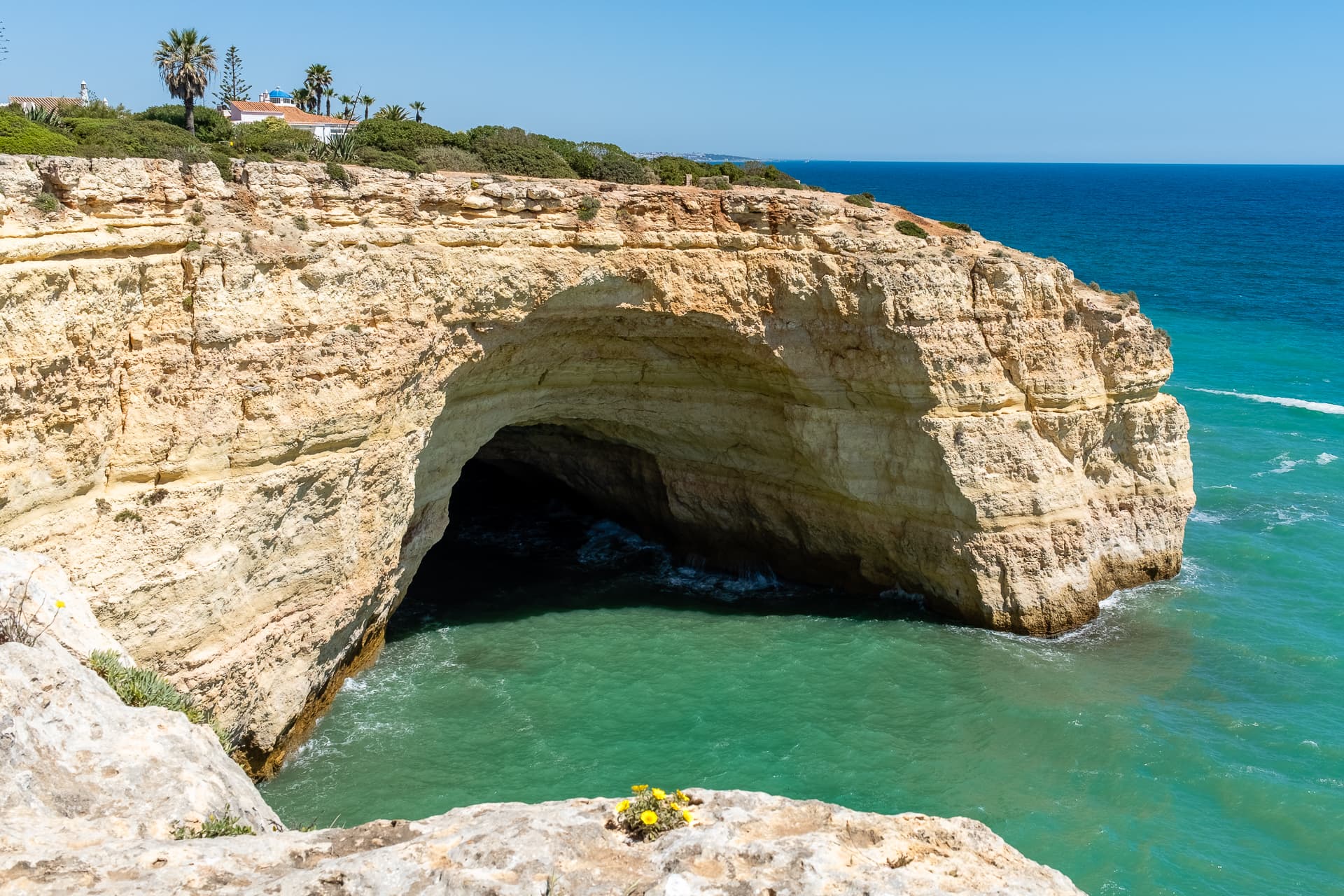
The domed sea cave with the oculus in its roof is one of the most photographed places in Portugal, and since 13 August 2024 it has been governed by a maritime authority edict that every visitor should know before booking. Nobody may land on or use the beach inside the cave, nobody may enter swimming or on a float, kayaks and paddleboards go in single file through the eastern entrance in guided groups only, and motorized boats are capped at three small vessels inside at a time on a visit of roughly two minutes, with kayak groups held to about eight minutes. In practice, and sea conditions permitting (swell closes the caves): book a licensed boat from Benagil, Carvoeiro or Armacao de Pera, or a guided kayak trip, go at 9am before the queue forms offshore, and treat it as a short, spectacular pass through a coastline of dozens of caves rather than a beach stop.
 Klugschnacker · CC BY-SA 3.0 via Wikimedia Commons
Seven Hanging Valleys Trail (Percurso dos Sete Vales Suspensos)
Our pick for the finest walk on the south coast: a clifftop path of roughly six kilometres each way between Praia de Vale Centeanes near Carvoeiro and Praia da Marinha, crossing the hanging valleys the name promises, past sinkholes that open straight down into sea caves, the lighthouse at Alfanzina, and a beach staircase every half hour for a swim. Do it early or late in summer: there is almost no shade, and the morning light is when the ochre rock earns its reputation. Walking one way and taxiing back is the comfortable version.
 Felix König · CC BY-SA 3.0 via Wikimedia Commons
Ponta da Piedade
Lagos's headland of golden sea stacks, arches and grottoes, the western coast's signature view. You can do it three ways: walk the clifftop boardwalks for free, take the long staircase down to water level between the pillars, or see it from the sea on a small boat or kayak out of Lagos marina, which is the version that gets inside the arches. Sunset from the top is the classic; morning light is better for the water itself and the small boats slip in before the wind picks up.
 Matthias Süßen · CC BY-SA 4.0 via Wikimedia Commons
Cabo de Sao Vicente and the Sagres fortress
Continental Europe's southwestern corner: a sheer cliff edge with a working lighthouse, long mythologized as the end of the world, and the place the crowd gathers every evening for sunset. Five minutes east, the Fortaleza de Sagres spreads across its own headland, the site tradition links to Henry the Navigator; entry costs 10 euros (open 9:30 to 17:30, last entry 17:00), a fee that has risen steeply since 2024, and the point of it is the walk around the cliff perimeter rather than the modest buildings. The headland at the cape itself is free.
Museus e Monumentos de Portugal: Fortaleza de Sagres ↗View on map ↗
 Efrem Efre · Pexels
Ria Formosa Natural Park and the barrier islands
A lagoon of tidal flats, salt pans and channels curving some 60 kilometres from west of Faro to Cacela Velha, sheltered from the Atlantic by a chain of barrier islands that hold the east's real beaches: Ilha de Tavira, Armona, Culatra with its lighthouse village of Farol, and the unbuilt Ilha Deserta south of Faro. Ferries run from Olhao to Armona and Culatra and from Faro to Ilha Deserta; flamingos, spoonbills and chameleons live in the reserve, and the seafood on your plate in Olhao mostly grew up in this water. Pick one island and give it a full day rather than collecting them.
 Valérie Schlott · Pexels
Silves castle and old town
The red-sandstone castle above the orange groves of the Arade valley is the largest and best-preserved Moorish-era fortification in the Algarve, the citadel of the city the Arab geographers called Xilb, which in its Islamic golden age outranked Faro as the seat of power in the Algarve. The walls walk in a full circuit, the vaulted cistern below held the city's water, and the Gothic cathedral downhill was built into the town the Reconquista took. Entry is a few euros; August's medieval fair is the liveliest week to be here and the busiest.
 Aurori Rodríguez · Pexels
Cacela Velha
A whitewashed hamlet of one church, one fort wall and a handful of houses on a bluff at the eastern end of the Ria Formosa, looking down on a turquoise tidal channel and the sandbar beach beyond. At low tide locals wade across; in season a small boat shuttles swimmers over from the fishing hamlet below. Come at golden hour with an hour to spare and a table booked at one of the two or three simple restaurants, and you will understand the eastern Algarve's entire argument in one view.
 Tânia Roques · Pexels
Loule market and old town
One of the Algarve's great food markets, in a 1908 neo-Moorish hall of red domes in the middle of Loule's workaday old town: fish, fruit, flor de sal from the Castro Marim pans, carob and almond sweets, and cataplana pans to take home. Mornings only, biggest and best on Saturdays, when a farmers' market spreads outside. Ten minutes inland from the coast, and the honest counterweight to a beach week.
 Nils Rotura · Pexels
Foia and the Serra de Monchique
The Algarve has a mountain range, and almost nobody on the beaches visits it. Foia, at 902 metres the region's highest point, rises behind the hill town of Monchique, above the old spa hamlet of Caldas through eucalyptus and cork oak, with a road to the summit and, on clear days, a view that takes in both the south coast and the Atlantic west. The hill towns do a proper lunch of smoked presunto and piri-piri chicken, and the local firewater is medronho, distilled from arbutus berries. Go for the cool air when the coast swelters.
 Marty B / CC BY-SA 2.0 via Wikimedia Commons
 Tobi 87 / CC BY-SA 3.0 via Wikimedia Commons
Food & drink
 Kolforn (Kolforn)
I'd appreciate if you could mail me (Kolforn@gmail.com) if you want to use this picture out of the Wikimedia project scope.
This file is licensed under the Creative Commons Attribution-Share Alike 4.0 International license.
You are free:
to share – to copy, distribute and transmit the work
to remix – to adapt the work
Under the following conditions:
attribution – You must give appropriate credit, provide a link to the license, and indicate if changes were made. You may do so in any reasonable manner, but not in any way that suggests the licensor endorses you or your use.
share alike – If you remix, transform, or build upon the material, you must distribute your contributions under the same or compatible license as the original.https://creativecommons.org/licenses/by-sa/4.0CC BY-SA 4.0 Creative Commons Attribution-Share Alike 4.0 truetrue · CC BY-SA 4.0 via Wikimedia Commons
Kolforn (Kolforn)
I'd appreciate if you could mail me (Kolforn@gmail.com) if you want to use this picture out of the Wikimedia project scope.
This file is licensed under the Creative Commons Attribution-Share Alike 4.0 International license.
You are free:
to share – to copy, distribute and transmit the work
to remix – to adapt the work
Under the following conditions:
attribution – You must give appropriate credit, provide a link to the license, and indicate if changes were made. You may do so in any reasonable manner, but not in any way that suggests the licensor endorses you or your use.
share alike – If you remix, transform, or build upon the material, you must distribute your contributions under the same or compatible license as the original.https://creativecommons.org/licenses/by-sa/4.0CC BY-SA 4.0 Creative Commons Attribution-Share Alike 4.0 truetrue · CC BY-SA 4.0 via Wikimedia CommonsCataplana de marisco
The Algarve's signature pot: clams, prawns and fish steamed with peppers, onion and white wine in the hinged copper clamshell that gives the dish its name. Made for two, unhurried by design, and best in a fishing town rather than a resort strip.
 Kolforn (Kolforn) I'd appreciate if you could mail me (Kolforn@gmail.com) if you want to use this picture out of the Wikimedia project scope. This file is licensed under the Creative Commons Attribution-Share Alike 4.0 International license. You are free: to share – to copy, distribute and transmit the work to remix – to adapt the work Under the following conditions: attribution – You must give appropriate credit, provide a link to the license, and indicate if changes were made. You may do so in any reasonable manner, but not in any way that suggests the licensor endorses you or your use. share alike – If you remix, transform, or build upon the material, you must distribute your contributions under the same or compatible license as the original.https://creativecommons.org/licenses/by-sa/4.0CC BY-SA 4.0 Creative Commons Attribution-Share Alike 4.0 truetrue · CC BY-SA 4.0 via Wikimedia Commons
Frango piri-piri
Flame-grilled chicken brushed with chilli oil, and a dish with a capital: the village of Guia near Albufeira calls itself the home of frango da Guia, and its roadside grill houses have queues to prove it. Cheap, fast and better than anything on a beachfront menu at three times the price.
 E4024 · CC BY-SA 4.0 via Wikimedia Commons
Sardinhas assadas
Fat summer sardines grilled whole over charcoal, served on bread with roasted peppers. At their plump best from roughly June to September, which is not a coincidence: this is the smell of an Algarve summer evening, especially on the Portimao riverside.
 Exilexi · CC BY 4.0 via Wikimedia Commons
Polvo of Santa Luzia
The village of Santa Luzia outside Tavira is known across Portugal as the octopus capital, its fleet still fishing with the traditional clay pots called alcatruzes. Order it grilled with sweet potato, in rice, or in salad, in the village where it landed that morning.
 Jinoni J · Pexels
Conquilhas a Algarvia
Tiny wedge clams from the Ria Formosa's sands, flashed open with garlic, olive oil, coriander and often a tangle of sliced sausage. The east's answer to clams bulhao pato, and the reason to trust any kitchen that serves them.
 Kunal Lakhotia · Pexels
Amendoa e figo: the almond and fig sweets
The interior's orchards fill the pastry counters: morgado and Dom Rodrigo egg-and-almond sweets wrapped in foil, marzipan fruits, and fig-and-almond cheeses that are not cheese at all. Loule market is the place to assemble a box.
 Kolforn (Kolforn)
I'd appreciate if you could mail me (Kolforn@gmail.com) if you want to use this picture out of the Wikimedia project scope.
This file is licensed under the Creative Commons Attribution-Share Alike 4.0 International license.
You are free:
to share – to copy, distribute and transmit the work
to remix – to adapt the work
Under the following conditions:
attribution – You must give appropriate credit, provide a link to the license, and indicate if changes were made. You may do so in any reasonable manner, but not in any way that suggests the licensor endorses you or your use.
share alike – If you remix, transform, or build upon the material, you must distribute your contributions under the same or compatible license as the original.https://creativecommons.org/licenses/by-sa/4.0CC BY-SA 4.0 Creative Commons Attribution-Share Alike 4.0 truetrue · CC BY-SA 4.0 via Wikimedia Commons
Kolforn (Kolforn)
I'd appreciate if you could mail me (Kolforn@gmail.com) if you want to use this picture out of the Wikimedia project scope.
This file is licensed under the Creative Commons Attribution-Share Alike 4.0 International license.
You are free:
to share – to copy, distribute and transmit the work
to remix – to adapt the work
Under the following conditions:
attribution – You must give appropriate credit, provide a link to the license, and indicate if changes were made. You may do so in any reasonable manner, but not in any way that suggests the licensor endorses you or your use.
share alike – If you remix, transform, or build upon the material, you must distribute your contributions under the same or compatible license as the original.https://creativecommons.org/licenses/by-sa/4.0CC BY-SA 4.0 Creative Commons Attribution-Share Alike 4.0 truetrue · CC BY-SA 4.0 via Wikimedia CommonsMedronho
The Serra de Monchique's clear brandy, distilled in small copper stills from the fruit of the arbutus tree. Locals drink it as a morning coffee chaser or after dinner; treat the first glass with respect and buy a labelled bottle rather than the unmarked one, unless your host vouches for the still.
 Vitor Oliveira from Torres Vedras, PORTUGAL · CC BY-SA 2.0 via Wikimedia Commons
Ostras and the lagoon's shellfish
The Ria Formosa grows oysters that increasingly end up in Paris, plus the clams and cockles behind half the region's menus. Waterfront stalls and simple marisqueiras in Olhao and Fuseta serve them within sight of the beds they came from.
Where to eat
Casa do Polvo Tasquinha
institutionThe octopus specialist of the octopus village: a tiled dining room opposite the moored fleet, serving polvo grilled, in rice, in salad and in versions the menu explains, from animals caught in the clay pots offshore. Book in summer; the village is small and the reputation is not.
Last researched 2026-08-26
Estamine
casualThe only building on the Ria Formosa's only uninhabited barrier island: a solar-powered dining room in the dunes at the end of the Animaris boat from Faro, serving fish and shellfish to people who arrived by sea and have nowhere better to be. It is a production number, and it is also, genuinely, lunch on a desert island. Boat and table are best booked together.
Last researched 2026-08-26
Alameda
fine-diningChef Rui Sequeira's contemporary dining room won Faro its first Michelin star in the 2026 guide, cooking tasting menus built on Algarve fish, shellfish and vegetables. The interesting move is what it represents: the region's fine dining leaving the resorts and moving into the capital's streets. Book well ahead for weekend tables.
Last researched 2026-08-26
Ocean
fine-diningHans Neuner's dining room above the sea at Vila Vita Parc holds two Michelin stars, one of only two Algarve restaurants at that level alongside Vila Joya, and its menus tour Portugal's coasts and former trade routes course by course. This is the region's special-occasion table; plan it, dress for it, and book it before you fly.
Last researched 2026-08-26
Sunrises
 Prof.Lippold · CC BY-SA 4.0 via Wikimedia Commons
Cacela Velha over the Ria Formosa
The east faces the dawn, and the bluff at Cacela Velha is its best seat: first light coming up the lagoon, the tide either sheeting the sand flats with pink or filling the channel below, and nobody around but the shellfish gatherers heading out. The hamlet asks nothing of you at that hour except quiet.
Year-round; winter dawns are latest and often clearest · Park by the church; the view is a two-minute walk.
 Chedi Tanabene · Pexels
Ilha de Tavira from the sand
The ferries start after dawn itself, but take the first crossing of a summer morning and the island's kilometres of Atlantic-facing sand are still empty, the light low and clean, and the day's heat hours away. The walk from the jetty through the pines to the ocean side is part of the ritual.
June to September, when early ferries run · Ferry times shift with the season; check the day before and note the tide.
Sunsets
 Rosino · CC BY-SA 2.0 via Wikimedia Commons
Cabo de Sao Vicente
The lighthouse cliff at continental Europe's southwestern corner has been collecting sunset-watchers since antiquity, when the ancients supposedly believed the sun hissed into the water here at the world's end. The nightly gathering at the wall is now a small institution, complete with an enterprising bratwurst van. It is windy essentially always; bring a layer even in August.
Year-round; the sun sets into the open sea through the winter months
 Sergei Gussev · CC BY 2.0 via Wikimedia Commons
Ponta da Piedade
The Lagos headland turns its own gold at the end of the day, with the sea stacks in silhouette and the cliff path giving a dozen private ledges instead of one crowded platform. Closer to the towns than Sagres, so it is the low-effort great sunset of the western Algarve.
Year-round · The clifftop paths are free and unfenced in places; keep back from the edges, which are eroding rock.
 Erik Mclean · Pexels
Foia at 902 metres
The Algarve's highest point faces the Atlantic west, and on a clear evening the sun goes down over the Costa Vicentina with the whole south coast lit at your feet. In summer the summit is many degrees cooler than the beaches, which is either the warning or the entire point.
Spring and autumn for the clearest air · Paved road to the summit; haze can flatten the view on hot summer days.
Day trips
 Bert Christiaens · Pexels
Sagres and the wild west coast
The day the western Algarve makes its point: the fortress headland at Sagres, the lighthouse and the sunset wall at Cabo de Sao Vicente, and then north up the Costa Vicentina to Carrapateira's board-riding beaches and the clifftop boardwalk over Praia da Bordeira. Pack a windproof layer whatever the month, swim only where flags and lifeguards say so, and stay for sunset: it is the best in the region and the drive back to Lagos is 40 minutes.
About 40 minutes from Lagos to Sagres; add 25 to Carrapateira · Full day into the evening
 Reinaldo Simoes · Pexels
A Ria Formosa island day
Pick your island and commit to it. From Faro, the Animaris boat to Ilha Deserta buys you the emptiest sand in the region and lunch at Estamine; from Olhao, the ferries to Culatra put you in a real lighthouse-and-fishing-village community with beach on the ocean side; from Tavira, the short crossing to Ilha de Tavira is the family-easy version. Take water and shade in high summer, mind the last boat back, and buy the round trip.
Ferries run 15 to 45 minutes depending on the island · Full day
 Wilrooij · CC BY-SA 4.0 via Wikimedia Commons
Silves, Monchique and Foia
The inland day, and the antidote to a week of coast: the red Moorish castle and cathedral at Silves in the morning, then the climbing road through the Serra de Monchique for a mountain-town lunch of presunto and piri-piri chicken, a look at the hillside spa hamlet of Caldas de Monchique, and the summit road up Foia for the view over both coasts. Come down the same way or loop west to Aljezur for the long way home.
Silves is 20 minutes from Portimao; Monchique another 30 · Full day
 Alegna13 · CC BY-SA 3.0 via Wikimedia Commons
Tavira and Cacela Velha from the west
If you refuse the two-base plan, at least borrow its best day: the free A22 or the direct train east to Tavira for the old town and the river, a late lunch of octopus in Santa Luzia, and the golden-hour view from Cacela Velha's bluff before heading back. It is a long day from Lagos (about an hour and a half each way by car) and a fair one from Albufeira, and it is the single best argument for coming back and doing the east properly.
About 90 minutes from Lagos by A22; about 2 hours 10 by direct train · Full day
After dark
 El Pantera · CC BY-SA 4.0 via Wikimedia Commons
Tavira's riverside at dusk
walkThe Gilao river doubles the town at dusk: church towers and terracotta reflected in still water, dinner tables filling on both banks, and the seven-arch bridge lit between them. An evening here is a walk, a slow dinner and a glass of wine on the Praca da Republica, and that is the whole itinerary.
 Vera Inácio · Pexels
Sardines on the Portimao dockside
diningPortimao's riverside restaurants grill sardines more or less continuously through summer, and the smoky, elbow-on-paper-tablecloth version eaten by the old fish-canning quays is the region's definitive cheap dinner. June to September is the season for the fat ones.
 Ana Rey from Sevilla, España · CC BY-SA 2.0 via Wikimedia Commons
The sunset wall at Cabo de Sao Vicente
natureEnding a western day at the lighthouse wall with the rest of the pilgrimage is one of the Algarve's small rituals. Applause when the sun goes is traditional, faintly absurd, and somehow earned. The drive back to Lagos in the dark is easy.
 Bert Kaufmann from Roermond, Netherlands · CC BY 2.0 via Wikimedia Commons
Old-town Faro after the day-trippers
walkFaro's walled quarter empties in the evening into something close to secret: floodlit stone, storks rattling their bills on the cathedral, wine bars in the lanes, and one Michelin-starred kitchen if you have booked it. If your flight schedule gives you a Faro night, spend it here rather than at an airport hotel.
Daily itinerary
Seven days in the Algarve: four nights west, two nights east, one move
The two-coast plan the 2026 transport upgrades finally make painless. Four nights in Lagos for the cliff coast, the caves and the wild west, then one crossing on the free A22 or the direct train, and two nights in Tavira for the lagoon, the islands and the slow east. It front-loads the drama and ends on calm, which is the right order.
- 1
Land, get west, first cliffs
relaxedLand at Faro, pick up the car or take the train west, and settle into Lagos.First cataplana or a grilled-fish lunch near the Lagos market.Walk the old town walls and the marina, then out along the cliff path towards Ponta da Piedade to understand where you are.Ponta da Piedade from the clifftop.Lagos old town, booked if it is high season.Early night; the whole week benefits from early starts.Faro airport to Lagos is about an hour by the A22, toll-free since 2025. By rail, the direct Algarve-line train runs from Faro to Lagos in about an hour and a half.Estimate: Late arrival: skip the cliff walk and just do dinner; the headland is better in tomorrow's morning light anyway.
- 2
Ponta da Piedade properly, and Meia Praia
relaxedA small boat or kayak from Lagos marina into the grottoes under Ponta da Piedade, booked the day before, in the calm of the morning.Back in town, or carry a picnic to the sand.Meia Praia's four kilometres of flat sand for the classic beach afternoon, or the cove-hopping alternative at Praia do Camilo and Dona Ana if you prefer the postcard version with the crowds it draws.From a beach bar on Meia Praia.Casa Mae's garden restaurant or a marisqueira in town.Lagos has the west's best bar scene if you want it.Everything today is on foot or one short taxi; no car needed.Estimate: Big swell or wind: the boats stop running; swap in the slave-market museum and the old town, and push the boat to tomorrow morning.
- 3
Sagres and the end of the world
moderateDrive to Sagres and walk the fortress headland early, before the wind and the coaches.Simple and good in Sagres town; the surf cafes feed people properly.North to Carrapateira for the Bordeira boardwalk and the west coast's scale, then back south.The wall at Cabo de Sao Vicente, with a layer on.Back in Lagos, late and easy.Nothing; you watched the main event already.Lagos to Sagres is about 40 minutes; the loop north to Carrapateira adds under an hour of driving. Doable by bus to Sagres alone, but the west coast beaches need the car.Estimate: No car: bus to Sagres for the fortress and cape, skip Carrapateira, and check the last return bus before committing to sunset; if it leaves too early, a taxi back or a guided sunset tour is the honest cost of the view.
- 4
The Lagoa coast: seven valleys and one cave
fullDrive 40 minutes east to Vale de Centeanes and walk the Seven Hanging Valleys trail east while the light is good, or the shorter Carvoeiro-to-Benagil leg if a full twelve-kilometre round trip is too much.Above Praia da Marinha or back in Carvoeiro.The booked Benagil boat or guided kayak: a short, regulated, spectacular pass through the caves. Then flop on Marinha's sand below the famous cliffs.Algar Seco's rock terraces at Carvoeiro.Ferragudo's square, or the once-a-trip blowout at Ocean if tonight is the occasion.Pack; tomorrow you cross the region.Trailhead parking fills by mid-morning in summer: be at Vale de Centeanes by 8:30. The boat trips run from Benagil and Carvoeiro; book a named time slot a day or two ahead.Estimate: Swell closes the cave: operators reroute along the coast's other grottoes, which is still worth the ticket, or refund; the trail does not care about swell.
- 5
Cross to the east, arrive slow
relaxedThe move: A22 east past Faro to Tavira, about 90 minutes, or the direct train from Lagos, a little over two hours since the July 2026 electrification. Drop the bags at the pousada or your guesthouse.On the Tavira riverside.Tavira on foot: the castle garden, the camera obscura in the old water tower if it is open, the seven-arch bridge, and an unhurried pastry stop.From the riverside as the lights come on.Grilled fish on the east bank.A glass of wine on Praca da Republica.This is the only moving day. By car it is one toll-free motorway; by rail it is one seat, no changes, which was impossible before this summer.Estimate: With a car and energy to spare, detour via Loule market on the way east if it is a market morning.
- 6
Island day on the Ria Formosa
moderateFerry from Tavira's quay to Ilha de Tavira and give the Atlantic sand the whole morning, or drive to Olhao for the Culatra boat and the lighthouse village of Farol.Octopus at Casa do Polvo in Santa Luzia, a late lunch after the beach.The slow version of the east: Santa Luzia's waterfront and an unhurried hour doing very little on it.Cacela Velha's bluff, timed for golden hour.Simple, near the water, wherever you are.Nothing. That is the east.Ferries run all day in season but check the last return crossing before you settle in; Cacela Velha is 15 minutes from Tavira by car.Estimate: Swap the island for Praia do Barril and its anchor cemetery, reached by the little tourist train or a flat walk from Pedras d'el Rei: same sea, different ritual, and a better fit if the ferry queues are long. · No car: stay with Ilha de Tavira and Santa Luzia, both reachable from Tavira without one, and take a taxi to Cacela Velha for sunset.
- 7
Faro, then out
relaxedCheck out and give Faro's old town the two hours almost everyone denies it: the Arco da Vila, the cathedral square with its storks, the lanes inside the walls.In the old town, or early at the airport if the flight is tight.Fly out of Faro, 20 minutes from the city and about 40 from Tavira.Departure.Tavira to Faro airport is about 40 minutes by the A22. Returning a rental: allow 30 extra minutes in August for the queue.Estimate: Late flight: the Animaris boat to Ilha Deserta from Faro's marina fills a half day, luggage permitting, and lunch at Estamine is a better send-off than a departure lounge.
Getting around
- Faro (FAO) is the region's only airport, and it is having a moment: it passed ten million passengers for the first time in 2025. It sits 20 minutes west of Faro city, about an hour from Lagos and about 40 minutes from Tavira by the A22. Nearly half its traffic is British, which explains both the flight map and the August queues.
- From the airport: rental cars are the default and should be booked well ahead for summer; a city bus connects to Faro's centre and station in about 20 minutes; and a seasonal airport bus links the airport to the main coastal towns a few times a day. Pre-booked private transfers are the painless option for the far west.
- Arriving overland: Lisbon is about three hours away by car on the A2 (tolled, unlike the A22) and about three to three and a half by train or express bus to the region's main towns. Seville in Spain is roughly two hours from the eastern Algarve, which makes an Andalusia-Algarve combination genuinely practical.
- For non-EU visitors, including British and Israeli travelers: the EU's biometric Entry/Exit System has been fully operational at Schengen borders since April 2026, replacing passport stamps with fingerprint and photo registration on first entry. Build in a few extra minutes at the border; the ETIAS travel authorization had not yet launched as of August 2026.
- The A22 (Via do Infante) motorway runs the length of the region and has been toll-free since 1 January 2025, when Portugal abolished charges on its former shadow-toll motorways. The old electronic-toll signage and roadside transponder shops linger, which confuses arrivals from Spain: you do not need a toll device for the A22 itself, only for tolled motorways elsewhere in Portugal such as the A2 to Lisbon.
- The alternative east-west road, the N125, is slower, busier and passes through the towns; use it for short hops and beach access, not for crossing the region. In summer, allow generously for parking at cove beaches and trailheads, which fill by mid-morning.
- The Algarve railway line between Lagos and Vila Real de Santo Antonio went fully electric on 19 July 2026, with new trains and, for the first time, direct services along the whole line: no more changing at Faro. Lagos to Faro takes about an hour and a half, Faro to Tavira about half an hour. One caveat inherited from the 19th century: several stations sit inland from the towns they name, most notoriously Albufeira-Ferreiras, a taxi ride from Albufeira itself.
- Vamus is the regional bus network, useful for the main town-to-town corridors and cheap; coverage of beaches, trailheads and villages is thin, and Sunday timetables are thinner. It works as a supplement to a base you can walk from, not as the backbone of a touring trip.
- The east runs on boats: regular ferries to Ilha de Tavira from Tavira, to Armona, Culatra and Farol from Olhao, and to Ilha Deserta from Faro, with water taxis covering the gaps. Services are frequent in summer and skeletal in winter; always confirm the last crossing back before you commit your afternoon to an island.
Things worth knowing
- · Planning to swim into the Benagil cave. Entry by swimming or on floats has been banned since August 2024, along with landing on the beach inside; the cave is visited by licensed boat or guided kayak, briefly. Book that instead of a rented kayak and a fine.
- · Treating the Algarve as one place. Lagos to Tavira is 130 kilometres; day-tripping the whole region from a single central base means living on the motorway. Pick a coast, or better, move once.
- · Expecting Mediterranean water. Even in August the sea runs from high teens on the west coast to low twenties in the sheltered east. The east is the answer if warm swimming is the priority.
- · Booking "Albufeira" without checking which Albufeira: the old town and the Strip are different holidays. Similarly, Albufeira's train station is in Ferreiras, a taxi ride inland.
- · Ignoring beach flags. These are Atlantic beaches with real currents; red means no entry, yellow means no swimming, and the checkered flag means no lifeguard. Portuguese lifeguard season and flag law are enforced, and drownings happen on unwatched beaches every year.
- · Assuming the tourist tax is one system. Seven of the sixteen Algarve municipalities charge a nightly city tax as of 2026 (Faro, Albufeira, Portimao, Lagoa, Loule, Olhao and Vila Real de Santo Antonio, typically 1 to 2 euros per adult night with caps), and your accommodation collects it separately from the room rate.
Budget
| Low | Expected | Comfortable | |
|---|---|---|---|
| Accommodation style / per night | €70≈ $78 | €150≈ $168 | €380≈ $425 |
| Food style / per day | €30≈ $34 | €55≈ $62 | €130≈ $146 |
| Local transport / per day | €5≈ $6 | €30≈ $34 | €65≈ $73 |
| Estimate / per day | €0≈ $0 | €15≈ $17 | €45≈ $50 |
Estimate · EUR · 2026-08-26. Accommodation is per room per night for two sharing, and it is the volatile line: the same room can triple between March and August, and July-August rates drive the whole trip cost. Food splits cleanly in two: a menu do dia lunch in a working town runs 8 to 12 euros and a grilled-fish dinner 15 to 25 per person, while resort-zone and fine-dining tables price like northern Europe. Transport is where the Algarve got cheaper: the A22 is toll-free, regional trains cost single-digit fares for most hops, and the budget line above assumes a mix of rental-car days (car hire itself, at roughly 30 to 60 euros a day in season plus fuel, sits outside these per-day figures). Add the municipal tourist tax, typically 1 to 2 euros per adult per night in seven of the sixteen municipalities, and 3 to 4 euros for a coffee and a pastry almost anywhere. · 1 USD = €1 (14 Oct 2026)
Things worth knowing
Frequently asked questions
West Algarve or east Algarve?
West (Lagos, Carvoeiro, Sagres) for the postcard: golden cliffs, sea caves, cove beaches, boat trips and the livelier towns. East (Tavira, Olhao, the Ria Formosa) for warm, calm water, huge flat island beaches, better-value food and towns that stay Portuguese in August. The honest answer for a week is both, four nights west and two east, because the free A22 and the new direct train have made the crossing trivial. If you must choose one: first trip and photographs, west; second trip, families with small children, or warm-sea swimmers, east.
How many days do you need in the Algarve?
Six to eight. That covers the two-base plan: the cliff coast and a Benagil boat, a Sagres day, the Seven Hanging Valleys trail, one Ria Formosa island day and Tavira, without turning the holiday into a driving tour. Four or five days works if you commit to a single coast. Two weeks is not too long in June or September, when you can add the interior, more islands and genuinely empty beaches on the Costa Vicentina.
Can you swim into the Benagil cave?
No. Since August 2024 the maritime authority's rules ban swimming or floating into the cave and any landing or bathing on the beach inside it. Kayaks and paddleboards enter only in guided single-file groups through the eastern entrance, and motorized boats are limited to three small vessels inside at a time on a roughly two-minute visit. In practice you book a licensed boat trip or a guided kayak tour from Benagil, Carvoeiro, Armacao de Pera or Portimao, ideally the first slots of the morning, and you see the cave briefly and legally. The marked clifftop viewpoint over the cave's oculus is free; stay behind the barriers, because the ground around the opening is eroding rock.
Do you need a car in the Algarve?
For the full version of this guide's plan, yes, and the A22 being toll-free since 2025 removed the old running cost. But the carless version is now genuinely respectable: base in Lagos and Tavira, use the newly electrified direct train between them (about two hours and ten minutes), walk to the western cliffs from Lagos, take ferries to the eastern islands, and buy one or two guided trips for Sagres and Benagil. What a car really buys is the west coast beaches, the interior and trailhead flexibility.
When is the best time to visit the Algarve?
June and September, without much internal debate: beach weather, warm-enough sea, everything open and the crowds either not yet arrived or already gone. May and October are the value picks, with more walking than swimming at the edges. July and August deliver the warmest water and the fullest experience of everything, including the region at maximum occupancy and price. Winter is for golf, hiking, long stays and almond blossom, with island ferries and some coastal restaurants on skeleton service.
Is the sea warm in the Algarve?
Warmer than the rest of Portugal, colder than the Mediterranean of most visitors' imagination. Late summer surface temperatures run around the low twenties Celsius east of Faro, where the barrier islands shelter the coast, and the high teens around Lagos and Sagres, where Atlantic upwelling keeps things brisk. The pattern to remember: the further east, the warmer and calmer; the further west, the wilder and colder. September usually holds the year's warmest water.
Is the Algarve expensive?
It is two price lists. The tourist front line, beach clubs, resort zones, the famous cove towns in August, prices like the rest of coastal western Europe, and record demand (Faro airport passed ten million passengers in 2025) keeps it firm. One street back, Portugal reasserts itself: a menu do dia lunch for around 10 euros, a grilled-fish dinner for 15 to 25, coffee at 1.50, trains at single-digit fares, and the motorway free. The east is systematically cheaper than the west, and June or September systematically cheaper than August. Add the small municipal tourist taxes, 1 to 2 euros a night in seven municipalities.
Sources (12)
- Tolls on the A22 Via do Infante are set at zero since 1 January 2025 under Law 37/2024 abolishing tolls on former SCUT motorways · government · 2026-08-26
- The Algarve railway line started fully electric operation on 19 July 2026 with direct Lagos to Vila Real de Santo Antonio trains and roughly 18 percent more regional capacity · government · 2026-08-26
- The Algarve closed 2025 with 20.82 million overnight stays, 5.34 million guests and about 1.8 billion euros in accommodation revenue, a record, with average stay 3.9 nights · tourism-board · 2026-08-26
- Faro Airport surpassed 10 million passengers for the first time in 2025, reaching about 10.4 million, up 6 percent year on year · airport · 2026-08-26
- Edital 019/2024 of the Capitania do Porto de Portimao, effective 13 August 2024, prohibits landing and bathing on the beach inside the Algar de Benagil, bans entry by swimming or with flotation aids, restricts non-motorized craft to guided groups entering single file by the eastern entrance with at most 7 inside, and limits motorized access to 3 vessels under 12 metres at a time with visits of about 2 minutes · government · 2026-08-26
- The Fortaleza de Sagres charges a standard ticket of 10 euros and opens 9:30 to 17:30 with last entry 17:00 · official · 2026-08-26
- Faro charges a municipal tourist tax of 2 euros per night from 1 March to 31 October and 1 euro from 1 November to end February, for guests 16 and over, capped at 14 euros per stay · municipal · 2026-08-26
- Portimao charges a tourist tax of 2 euros per overnight stay in high season (1 April to 31 October) and 1 euro in low season, from age 13, up to 7 consecutive nights · municipal · 2026-08-26
- In the Michelin Guide Portugal 2026, the Algarve holds two two-star restaurants, Vila Joya in Albufeira and Ocean in Porches, and five one-star restaurants including Alameda in Faro, newly starred under chef Rui Sequeira · reputable-local · 2026-08-26
- Regular boat services connect Faro's Portas do Mar quay with Ilha da Culatra, Farol and Ilha Deserta, the Ilha Deserta route operated by Animaris · municipal · 2026-08-26
- The EU Entry/Exit System launched at Schengen external borders on 12 October 2025 with a phased rollout to full operation within six months · government · 2026-08-26
- After the 2024 drought, the Algarve's main reservoirs recovered to roughly 90 percent of capacity by early 2026, with the environment agency easing borehole licensing restrictions in May 2026 while a general 5 percent consumption restriction remained · reputable-local · 2026-08-26