India · Konkan coast
Goa
Base north or south, not both at once. Give one full day to Old Goa's churches and Panjim's Latin Quarter, one to the Ponda spice country or Dudhsagar in season, and the rest to a short list of beaches you can reach without an hour in a taxi. Eat Goan at least once a day, book a car or scooter early, and read the drinking and bottle rules before your first sunset.
 JosephAssisFernandes / CC BY-SA 4.0 via Wikimedia Commons
Overview
Goa is about 105 kilometres of Arabian Sea coast wrapped around four and a half centuries of Portuguese rule, and it is the one place in India where a beach holiday, a UNESCO-listed Baroque church and a plate of pork vindalho sit within half an hour of each other. It is also coming off the biggest year it has ever had: 10.8 million arrivals in 2025, an all-time high and roughly a third above 2019. What almost nobody outside India notices is the shape of that number. Domestic travellers made up 10.28 million of it; foreign arrivals, at 518,000, are still well short of where they were before the pandemic. Goa has quietly become a domestic destination that foreigners also visit, and the difference shows in what gets built, what gets priced in rupees, and which beaches now feel like a Mumbai weekend.
If you take one thing from this guide: your Goa trip is shaped less by which beach you choose than by how you get to it. As of August 2026 there is no Uber, Ola or Rapido here: the state licenses its own apps, GoaMiles and Goa Taxi, and the government has publicly ruled out admitting outside aggregators. Coverage is decent around Panjim and the north strip and thin in the far south, fares are set rather than surged, and a cross-state hop costs real money and anything from ninety minutes (Assagao to Benaulim) to three hours (Assagao to Palolem in season traffic). So decide your coast before you book a room, and if the answer is genuinely "both", split the trip into two halves and move once. The second thing: the 2026-27 season is the first under Goa's deposit-refund scheme for drinks containers, which is due to begin on 1 September 2026, days after we wrote this, and penalties for public drinking and for carelessly discarding bottles in public places and tourist spots now run from 5,000 to 50,000 rupees. Nobody will tell you this at check-in.
Best for
Couples · Families · Beach and resort travelers · Food travelers · Heritage and architecture · First-time India travelers
Daily itinerary
6 to 8 days
Most Indian beach destinations are a coastline with hotels on it. Goa is a former colony with its own cuisine, its own architecture, its own spirit (cashew feni, GI-registered since 2009 and reclassified from country liquor to a heritage spirit in 2016) and a Catholic-Hindu double calendar that produces Carnaval in February and Shigmo in March. It also has an unusually legible geography: a busy, loud, restaurant-dense north and a slow, wide, resort-and-village south, separated by the capital and, depending on which villages you pick, between ninety minutes and three hours of road. Choosing between them is most of the planning.
Best time to visit
Mid-November to February is the window: dry days, sea calm enough for boats, the shacks back up, and evenings cool enough to sit outside. October and March are the honest value months, either side of the crowd. June to September is the southwest monsoon, when swimming and water sports along the beaches are suspended on safety grounds, the shacks are gone and the state is green, cheap and empty. Beach shacks are legally seasonal: the state's shack policy runs the season from 1 September to 31 May, and structures come down for the monsoon.
- October to November: The season opens. Shacks reassemble, the Anjuna Wednesday flea market restarts, the sea calms and the light goes clean. Dudhsagar's jeep safaris usually resume around the end of October once the monsoon flow drops.
- December to January: Peak. Dry, warm days, cool nights, every boat and market running, and the highest prices of the year over Christmas and New Year. The Sea Food Festival and the Ramponkaranche Fest at Arambol both fall in December.
- February to March: Still dry, gradually hotter, and the best festival stretch: Carnaval across six towns in February, Shigmo's night parades through March. The cashew season starts, which means fresh urrak in the village bars.
- April to May: Hot and humid, with the sea at its warmest and the crowd thinning fast. Mankurad mangoes arrive. Shacks trade until 31 May, then come down; late May is a gamble on the monsoon's arrival.
- June to September: The monsoon. Beaches closed to swimming, water sports suspended, shacks gone, the Anjuna market shut. The Sao Joao festival falls on 24 June, with Siolim its best-known stage, and Chikhal Kalo, the mud festival, follows at Marcel in July.
Things worth knowing
- Carnaval (February 2027): four days of float parades before Lent, staged by Goa Tourism at Porvorim, Panaji, Margao, Vasco, Mapusa and Morjim. The state's signature Catholic street festival.
- Shigmo (March 2027): the Hindu spring festival, run as a circuit of evening parades through Panaji, Margao, Vasco and a long list of smaller towns. Free, loud and much less touristed than Carnaval.
- Sea Food Festival (December 2026) and the Ramponkaranche Fest at Arambol (December 2026): two of the state festivals timed for the top of the season, the second named for the ramponkars, Goa's traditional shore-net fishermen.
- Sao Joao (24 June annually, with Siolim the best-known village) and Chikhal Kalo (July, Marcel): the monsoon pair. Sao Joao is the one where revellers in flower crowns jump into wells and rivers; Chikhal Kalo is played in mud. Neither is a beach event, which is the point.
- Feast of St Francis Xavier (3 December, Old Goa): the biggest religious gathering of the Goan year. The saint's relics themselves are lowered for public veneration only once a decade; the last Exposition ran from November 2024 into January 2025, so the next is due in 2034.
Where to stay
 Elridge · Pexels
Assagao and Siolim
The inland north: laterite lanes between Portuguese villas, banyan trees, and a concentration of good restaurants that has no equal on this coast. Assagao has become Goa's dining room and Siolim its quieter neighbour on the Chapora river, five to fifteen minutes from Anjuna, Vagator and Morjim without living on top of any of them.
Best for: Food travelers · Villa stays · Repeat visitors · A north base without the beach noise
No beach, so every swim is a drive or a scooter ride. The area has gentrified hard and fast, and prices now read Mumbai rather than Goa; the villa-and-cafe economy here is also the sharpest edge of the local debate about who Goa is being built for.
 Jebakumar Samuel · Pexels
Anjuna, Vagator and Chapora
The cliff coast, and the part of Goa with a mythology attached. Red laterite headlands drop into small coves, Chapora fort sits above the river mouth, and the Wednesday flea market has run at Anjuna since the hippie era. Nightlife is concentrated here, and so is everything downstream of nightlife.
Best for: Nightlife · Younger travelers · Markets · Cliff scenery
Beaches here are small, rocky at the edges and get crowded; the party scene means late bass and, at some venues, an aggressive drug-and-touting economy the police warn about openly. Families and light sleepers should look one bay north or go south.
 Mohit Hambiria · Pexels
Morjim, Ashwem and Mandrem
North of the Chapora river the coast opens into long, flat, near-continuous sand backed by casuarinas and a low-rise, seasonal kind of development. Morjim, Ashwem and Mandrem are three names for one very good beach. This is also turtle country: Morjim and Mandrem are among the state's protected Olive Ridley nesting beaches.
Best for: Couples · Long beach walks · Quiet north stays · Yoga and wellness stays
Almost everything here is seasonal, so an April booking and a July booking are different places entirely. Restaurants are spread thin along the road, the river crossing adds time to any trip south, and the nesting-season rules mean lights and vehicles are restricted on parts of the sand.
 Mohit Hambiria · Pexels
Calangute, Baga and Candolim
The original mass-tourism strip and one of the most intensively developed stretches of beach in India: hotels stacked behind a long beach, water sports operators every fifty metres, Saturday night markets at Arpora and Baga, and shopping that runs from Tibetan silver to counterfeit football shirts. Candolim at the southern end is the calmest third.
Best for: First-time visitors · Water sports · Shopping and night markets · Value hotels
This is the Goa people mean when they say Goa is ruined: heavy traffic, hard selling on the sand, and a beach that at Christmas holds more people than most towns. If your image of Goa is an empty coconut grove, you will hate it. If you want everything within walking distance, this is the only part of Goa that offers it.
 Roman Saienko · Pexels
Panjim and Fontainhas
The capital, and the most underrated base in the state. Fontainhas is the Latin Quarter: a grid of narrow streets in ochre, indigo and green, repainted after every monsoon, with bakeries, small bars and a cluster of heritage hotels inside it. Old Goa's churches are twenty minutes east, the Mandovi ferries run from the waterfront, and you can walk to dinner.
Best for: Heritage and architecture · Food travelers · Car-free trips · Rainy-season visits
No beach: Miramar is a ten-minute drive or a long walk away, and it is a promenade rather than a swimming beach. Panjim is a working city with traffic and a casino-boat waterfront, and it goes quiet early compared with the north.
 Vikram · Pexels
Majorda, Betalbatim and Benaulim
South Goa's resort belt: a single wide beach running for kilometres behind a screen of coconut palms and rice paddy, with the big properties set well back and villages between them. The sand is broader and emptier than anything in the north, the sea shelves gently, and the whole coast tilts towards early dinners.
Best for: Families · Resort stays · Honeymooners · Beach walking
Restaurant choice outside the resorts is limited and spread out, so you will use a car most evenings. It is a long way from the north's markets and nightlife, and Colva at the centre of the belt is the one busy, slightly tired stretch.
 urtimud.89 · Pexels
Agonda, Palolem and Patnem
The far south, in Canacona district near the Karnataka border. Three crescent bays under wooded headlands, where accommodation is still mostly seasonal beach huts put up in October and taken down in May. Palolem is the busy one, Agonda the long quiet one and a protected turtle beach, Patnem the small one in between.
Best for: Beach huts and simple stays · Long stays · Swimmers · Travelers on a budget
Roughly two and a half to three hours from Mopa airport and about ninety minutes from Dabolim, with the thinnest taxi-app coverage in the state; a scooter is close to essential. Everything is seasonal, so nothing you book here in December exists in July, and the best sea-facing huts sell out months ahead.
Where to sleep
Taj Exotica Resort & Spa, Goa
luxury · Benaulim beach (South Goa)
Best for: Families · Honeymoons · A resort you do not need to leave
- About 140 rooms and villas spread over 56 acres of gardens with roughly 800 metres of beach frontage, which is why it never feels full
- Full resort infrastructure: pools, spa, tennis, a nine-hole golf course and several restaurants
- Benaulim's beach is wide, gently shelving and quiet, a genuinely different coast from the north
- Priced at the top of the Goan market, and the on-site dining is priced accordingly
- Deliberately isolated: Panjim and the north are ninety minutes away and even Margao is a drive
- The scale that makes it comfortable also makes it impersonal next to Goa's small heritage properties
W Goa
design · Vagator (North Goa)
Best for: Design-led stays · Sunset drinks · Travelers who want the north at arm's length
- About 120 rooms and villas on the Vagator headland, most with a Portuguese-style balcony and a sea or garden view
- The Rock Pool bar looks straight down the coast to Chapora fort, which is one of the north coast's finest views from a bar stool
- You can walk to Vagator beach and drive to Assagao's restaurants in ten minutes, which is a rare combination up here
- The brand's music-and-party positioning is the whole point; if you want quiet, this is the wrong building
- Vagator's beaches are small and rocky compared with the south, and busy in season
- Rates match international resort pricing without an international resort beach
Ahilya by the Sea
boutique · Nerul, Dolphin Bay (North Goa)
Best for: Couples · Small-property travelers · People who want a house, not a hotel
- Nine rooms across three villas above a quiet corner of the Mandovi estuary, run in the same house-party register as its sister property Ahilya Fort in Maheshwar
- Two pools, a spa and an owner-curated art collection in a property small enough to feel private
- Between Panjim and the Candolim strip, so both the churches and the north beaches are short drives
- Estuary frontage, not surf: the swimming beach is a drive away
- Nine rooms means it books out and there is no anonymity if you want it
- Top-of-market rates for a property with resort prices and non-resort facilities
Vivenda dos Palhacos
unique · Majorda (South Goa)
Best for: Heritage architecture · Slow stays · Travelers bored of resorts
- Eight rooms in a carefully restored 120-year-old Portuguese house on a residential cul-de-sac, about a kilometre from the beach
- Character per rupee that no new-build in the state can match, with a bar built into an old bathroom and a long table people actually eat at
- A genuine village setting in the middle of the South Goa resort belt, so the beach and the restaurants are both close
- Not on the sand: every swim is a short drive, walk or cycle
- Old house, eight rooms, shared spaces; it works if you like talking to strangers and not if you do not
- Closed during parts of the monsoon, so check dates before booking outside the season
WelcomHeritage Panjim Inn
boutique · Fontainhas, Panjim
Best for: Heritage stays on a budget · Car-free trips · Old Goa and Panjim days
- A colonial mansion of the 1880s in the heart of Fontainhas, converted into what is described as Goa's first classified heritage hotel and still run by the founding family
- Three linked houses (Panjim Inn, Panjim Pousada and Panjim Peoples) with 24 rooms between them, most with period furniture and four-posters
- You are inside the Latin Quarter: bakeries, bars and the Mandovi are all on foot, and Old Goa is twenty minutes away
- A city hotel with no beach and no pool; this is a base for churches and streets, not for sand
- Old buildings mean thin walls, uneven floors and street noise on the busier lanes
- Rooms vary a lot between the three houses, so the room you get matters more than usual
Essential experiences
 Santhosh KKR · Pexels
Basilica of Bom Jesus and Se Cathedral, Old Goa
What is left of the Portuguese capital abandoned to epidemics in the eighteenth century: a handful of enormous churches standing in mown grass where a city said by contemporary accounts to have held as many as 200,000 people used to be. The Basilica of Bom Jesus holds the tomb and relics of St Francis Xavier and is the only church here left unplastered, its laterite stripped bare during a 1950s restoration. The Se Cathedral next door is one of the largest churches in Asia. Both are free to enter, both are working churches with Mass, and both now enforce a dress code, so cover shoulders and knees. Go before 10:00 or after 16:00; the coach parties own the middle of the day.
Goa Tourism: Basilica of Bom Jesus ↗UNESCO: Churches and Convents of Goa ↗View on map ↗
 Samar Mourya · Pexels
Fontainhas, Panjim's Latin Quarter
Six or seven streets below the Altinho hill where Panjim still looks Portuguese: shuttered windows, oyster-shell panes, azulejo street signs and houses repainted in ochre, indigo and green after every monsoon, because the lime-wash tradition required it and the conservation rules now encourage it. It takes an hour to walk and rewards a slow one. Start at the Chapel of St Sebastian, work north through Rua 31 de Janeiro, and stop at a bakery for poi. Early morning is best, both for light and for the fact that people actually live here.
 Guduru Ajay bhargav · Pexels
Dudhsagar Falls
A four-tier waterfall on the Mandovi at the Karnataka border, dropping around 300 metres through the Western Ghats inside the Bhagwan Mahavir sanctuary at Mollem, with the Konkan Railway line crossing its face on a viaduct. Access is controlled: shared jeeps run by the Dudhsagar Tour Operator Association leave from Collem, life jackets are compulsory, and budget roughly 700 to 1,000 rupees a head all in once the jeep, forest entry and jacket are counted (a private seven-seat jeep is around 3,500), and check the association's current tariff before you go, because the components change season to season. The safari closes for the monsoon and normally resumes around the end of October. Walking the railway tracks from Kulem or Castle Rock is banned and the Railway Protection Force fines people for it.
 sara marlowe · CC BY 2.0 via Wikimedia Commons
Anjuna flea market
The Wednesday market that started in the 1970s as a place for travellers to sell what they owned in order to stay another month, and is now a large, professionalised bazaar of textiles, silver, spices and speakers on the low ground behind Anjuna beach. It runs weekly from October through April and shuts for the monsoon. Go early for the trading and late for the light; bargain, because the first price is theatre. The Saturday night markets at Arpora and Mackie's at Baga are the evening equivalents and run roughly November to April.
 Tapas S · Pexels
Fort Aguada and the Aguada jail museum
A Portuguese sea fort of the 1610s on the headland where the Mandovi meets the Arabian Sea, built to hold fresh water (agua) and keep the Dutch out, with a freestanding lighthouse and a view down the whole Calangute strip. Below it, the Aguada Port and Jail Complex, a working prison until 2015, reopened as an interactive museum in December 2021 with QR-coded audio guides and galleries on Goa's freedom struggle. Reported entry is 100 rupees for Goans, 200 for other Indian visitors and 400 for foreign visitors, plus parking; the upper fort ramparts are free.
 Mohit Hambiria · Pexels
Chapora fort and the Vagator headland
A ruined hilltop fort above the mouth of the Chapora river, rebuilt by the Portuguese in 1717 on an older Muslim fortification, and famous in India for reasons that have nothing to do with either: a 2001 film shot here made the walls a pilgrimage. The walk up from the village takes fifteen sweaty minutes and pays out in one of the coast's two great views, north over the river to Morjim's sand and south down the red cliffs of Vagator. There is no ticket, no shade and no water; go for sunset and take your own.
The Ponda spice plantations
Half an hour inland from Panjim the coconut gives way to areca palm, and the plantations open their gates: guided walks through pepper vines climbing betel trunks, nutmeg, vanilla, cardamom and cashew, ending in a buffet of Goan vegetarian food and, usually, a glass of feni. Sahakari Spice Farm on the Ponda highway and Tropical Spice Plantation at Keri are the two best known. It is unashamedly a tour, complete with elephant-free welcome drinks and a folk dance, but the botany is real and it is the easiest way to understand what the Portuguese actually came for.
 Lawnil Fernandes · Pexels
Dr Salim Ali Bird Sanctuary, Chorao island
A small mangrove sanctuary on the western tip of Chorao island in the Mandovi, reached by the free Ribandar ferry and named for India's great ornithologist. Kingfishers, egrets, herons, storks and, in winter, migratory waders work the tidal creeks; a raised boardwalk covers part of it and local boatmen run the rest at high tide. It is quiet, unglamorous and about forty minutes from Panjim door to door, which makes it the best possible antidote to a week of beach. Go at dawn.
 Adam Jones Adam63 / CC BY-SA 3.0 via Wikimedia Commons
 urbzoo / CC BY 2.0 via Wikimedia Commons
Food & drink
Fish thali
The daily meal of Goa and the single best-value plate in the state: rice, a bowl of coconut-and-kokum fish curry, a fried mackerel or kingfish steak, vegetables, pickle and solkadhi to finish. Every village has a place that does it for the price of a coffee elsewhere, and lunch is when it is freshest.
 Luis Antonio Rockdríguez · Pexels
Pork vindalho
Not the British curry-house heat test. The Goan original descends from the Portuguese carne de vinha d'alhos, meat cured in wine vinegar and garlic, and the result is sour before it is hot, dark and deep and better on the second day. A Catholic dish; you will not find it in Hindu kitchens.
Xacuti
A curry built on a masala of roasted grated coconut, poppy seeds, dried chillies and a long list of whole spices, ground dark and thick. Chicken xacuti is the standard; the same gravy poured over an omelette and eaten with bread is ros omelette, Goa's great street breakfast and late-night dish.
Chicken cafreal
Green where xacuti is brown: chicken marinated in a paste of coriander, green chilli, ginger, garlic and vinegar, then griddled or shallow-fried. The name traces back through Portuguese Africa, which is a fair summary of how Goan food got made.
Sorpotel with sannas
The celebration dish of Catholic Goa: pork and offal cooked down with vinegar, chillies and spice, improved by several days in the fridge, eaten at Christmas and feasts with sannas, the soft steamed rice cakes leavened with toddy. Ask before you order if offal is not your thing.
Poi and the Goan bakery
The poder still cycles through villages twice a day with a basket of poi, the whole-wheat pocket bread the Portuguese left behind, along with kankonn rings and undo rolls. Buy it hot in the morning; it is the reason Goan breakfast is bread and not rice.
Bebinca
The layered coconut-and-egg-yolk pudding baked one thin layer at a time, up to sixteen of them, and the queen of Goan desserts. It received a geographical indication tag in 2023 alongside the Mankurad mango, so the version sold under the name is now legally defined.
Feni and urrak
Cashew feni is double-distilled from the fruit, GI-protected since 2009 and reclassified as a heritage spirit rather than country liquor in 2016. Urrak is the first distillate, lighter and lower in alcohol, traditionally drunk unbottled and only during the February-to-May cashew season, with lime and masala over ice. Coconut feni is the year-round sibling.
Goa eats late by Indian standards and early by beach-holiday standards: lunch thalis peak between 12:30 and 14:30, and most village kitchens are done by 22:00 even in season. Beach shacks serve from morning until late during the September-to-May season and simply do not exist in the monsoon. Alcohol is cheap, legal and widely available because Goa taxes it lightly, which is precisely why the state now polices where you drink it: bars and licensed shacks are fine, the open beach is not. Tipping around 10 percent is normal in restaurants, and many places add a service charge you are entitled to decline.
Where to eat
Vinayak Family Restaurant
institutionA plain room on the Assagao road that has spent two decades being the answer to "where do Goans actually eat". Thalis, dried seafood, squid and prawn done simply, at prices the surrounding villa economy has not touched. Come at lunch, expect a wait in season, and do not expect decor.
Last researched 2026-08-22
Mum's Kitchen
institutionBuilt around recipes collected from Goan grandmothers, which sounds like a marketing line and reads on the plate as an unusually wide menu of dishes that restaurants normally skip. The place to try sorpotel, cafreal and a proper vindalho in one sitting, in a room where the staff will explain each of them. Book in season.
Last researched 2026-08-22
 User:psubhashish · CC BY-SA 3.0 via Wikimedia Commons
Martin's Corner
institutionThe South Goa institution: a garden restaurant in Betalbatim that grew out of a village bar and now fills nightly with families, live music and enormous plates of crab, prawn and kingfish. It is famous, it is busy, and the food is still good, which is a harder trick than it sounds. Reserve, and go for the Goan half of the menu rather than the continental half.
Last researched 2026-08-22
Gunpowder
modernA restored Portuguese house in Assagao serving the food of the coast further south, Kerala, Andhra and Tamil Nadu, alongside Goan dishes, in a garden strung with lights. The appam, the Malabar prawn curry and the pork are the reasons people keep coming back through fifteen years of Assagao changing around it. Book ahead in season.
Last researched 2026-08-22
Sunrises
The Mandovi from Divar island
Goa is a west-facing coast, so the honest answer about sunrise is that it happens over the rivers, not the sea. Divar is the best of them: take the free ferry from Old Goa, ride up to the Our Lady of Compassion church on the island's high point, and watch the light come up over the paddy, the mangroves and the towers of Old Goa across the water. Almost nobody does this.
November to February for clear air · The Old Goa to Piedade ferry runs from about 06:00; pedestrians and two-wheelers cross free.
 Chirayu Vyas · Pexels
The Chapora river mouth at Morjim
First light behind the Chapora headland with the river running out through the sandbar, fishing boats going out, and Vagator's cliffs picking up colour opposite. It is a working scene rather than a scenic one, and in nesting season the Forest Department's turtle enclosures are on the sand behind you, which is reason enough to keep your distance and your torch off.
November to March
Sunsets
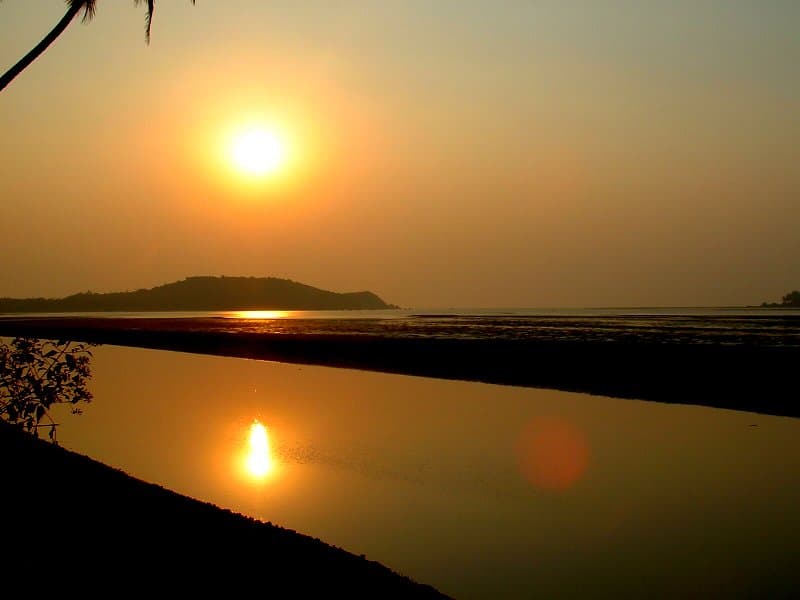 No machine-readable author provided. Zerohund~commonswiki assumed (based on copyright claims). · CC BY-SA 3.0 via Wikimedia Commons
Chapora fort
The classic: fifteen minutes uphill from the village, then the whole of North Goa laid out from Morjim's sand to the red cliffs running south. It is busy and it is worth it. There is no shade, no water and no railing in places, so bring a bottle and mind the edges as the light goes.
November to March · Arrive an hour before sunset for parking in the village; the walk up is steep and unlit on the way down, so carry a torch.
Cabo de Rama
The quiet alternative, an hour south of the resort belt: a crumbling Portuguese fort on a cliff at the top of Goa's wildest stretch of coast, with a small church inside the walls, a sheer drop to the sea and almost no infrastructure. Fewer people here at sunset than at Chapora on a Tuesday afternoon. Take the road slowly and leave before it is fully dark.
November to March
Palolem bay from the water
Palolem's crescent faces west into a bay closed by two headlands, so the sun sets into the sea inside the frame. The local boatmen run short evening trips out past Butterfly Beach and Honeymoon Island, often with dolphins on the way; go with an operator that keeps its distance from the animals rather than chasing them for a photograph.
November to March · Boats are arranged on the beach or through your hut; agree the price and the duration before you get in.
Day trips
Old Goa, Divar island and Panjim
The heritage day, and the one that makes the rest of the trip make sense. Morning at the Basilica of Bom Jesus and the Se Cathedral before the coaches, then the free ferry from Old Goa across to Divar for an hour of empty lanes, paddy and a hilltop church, back for lunch, and the late afternoon walking Fontainhas while the light is on the painted houses. Finish with a drink on the Panjim waterfront.
20 to 30 minutes from Panjim, 45 to 60 from the north beaches, 60 to 90 from the south · Full day
Dudhsagar and the Mollem forest
The long inland day: drive or train to Collem, transfer to a shared jeep run by the operators' association, and ride an hour of rough forest track inside the Bhagwan Mahavir sanctuary to the base of a 300-metre waterfall with a railway viaduct across its face. Life jackets are compulsory and swimming is confined to the pool at the base. Combine it with a spice plantation lunch at Ponda on the way back, which is what most operators do anyway.
2 to 2.5 hours each way from the north beaches, about 90 minutes from the south · Full day
The other coast, done properly
If you are based north, give one full day to the far south rather than pretending you can day-trip it twice: Cabo de Rama fort, lunch at Agonda, an afternoon on Palolem or Patnem and sunset from a boat, home late. If you are based south, invert it: Old Goa, the Anjuna market if it is a Wednesday, Assagao for lunch, Chapora for sunset. Either way it is a long day and a real drive, which is the argument for splitting your stay instead.
Two to three hours each way, depending on which end of the state you start from · Full day
After dark
The Saturday night markets
marketArpora's Saturday Night Market and Mackie's at Baga run from roughly November to April: stalls, live music, food from a dozen countries and a genuinely mixed crowd of Goans, Indian holidaymakers and long-stay foreigners. They are commercial and crowded and still the best night out in the north that does not involve a club.
A village bar and a glass of urrak
nightlifeGoa's taverna culture is its most underrated pleasure: a small licensed room in a village, plastic chairs, a plate of fried fish or chana, and feni or, in the February-to-May cashew season, fresh urrak with lime and masala. Cheap, entirely local, and the opposite of a beach club. Ask your host which one is theirs.
Fontainhas after dark
walkThe Latin Quarter is at its best once the shops close: lamplight on painted walls, a handful of small bars in old houses, and the Chapel of St Sebastian lit at the end of its lane. An hour of walking and one long dinner is the whole evening, and no car is needed.
The Mandovi casino boats
nightlifePanjim's waterfront is lined with floating casinos, which are a genuine part of the city's economy and a genuine part of its local political argument. Entry packages generally start around 1,500 to 3,000 rupees depending on the boat and the night, usually with chips included, minimum age 21, ID checked at the jetty and a smart-casual dress code. Go for the spectacle or skip it entirely; there is no middle position.
Daily itinerary
Seven days in Goa: four nights north, three nights south, one move
The split that respects the geography instead of fighting it. Four nights based in the Assagao and Anjuna belt for the markets, the cliffs and the restaurants, one heritage day in the middle built around Old Goa and Panjim, then one clean transfer south for three nights of wide beach, the far south and the fort at Cabo de Rama.
- 1
Arrive north, first sunset at Chapora
relaxedLand at Mopa (GOX) or Dabolim (GOI), and take the pre-booked transfer or the KTCL airport shuttle to Mapusa for the north beaches.A fish thali at a village restaurant near your base; Vinayak in Assagao if the timing works.Settle in, swim at Vagator or Anjuna, and walk the lanes to get your bearings.The climb to Chapora fort for the whole coast at once.Assagao, where most of the north's good kitchens are.Early night; the jet lag and the heat both land tomorrow.Mopa to Assagao is about 45 to 60 minutes; Dabolim is closer to 90. Arrange the transfer with your hotel or use the licensed app before you land.Estimate: Arriving late: skip the fort and take the sunset from wherever you are staying. It will still be good.
- 2
The north beaches, at your own speed
relaxedCross the Chapora river to Morjim, Ashwem and Mandrem and walk as much of the continuous sand as you like.A shack on the Ashwem stretch, seafood by weight; confirm the price before it goes on the grill.Swim, read, and do nothing in particular. This is the day the trip is for.From the sand where you already are.Back in Assagao or Siolim.If it is Saturday, the Arpora night market instead of a restaurant.The river crossing is by road bridge at Siolim, about 20 minutes from Assagao to Morjim. A scooter makes this day; a taxi makes it expensive.Estimate: Rough sea or a grey day: the Aguada jail museum and Fort Aguada instead, then Candolim for lunch.
- 3
Old Goa, Divar and Fontainhas
moderateBe at the Basilica of Bom Jesus by 09:30, before the coaches; then the Se Cathedral and the ruins of St Augustine.Panjim: Goan home cooking, and the widest menu you will see all week.The free ferry to Divar for an hour of empty island, then back for Fontainhas on foot.The Panjim waterfront, or the Mandovi from the Ribandar causeway.In the Latin Quarter, then walk it off.A drink in an old house in Fontainhas, or the casino boats if that is your idea of a night.From the north beaches this is 45 to 60 minutes each way; consider a car for the day rather than three separate app rides.Estimate: Rain: the whole day works wet, which is why it sits here rather than on the beach days.
- 4
Inland: spice country, or Dudhsagar in season
fullFrom roughly late October, the jeep safari to Dudhsagar from Collem. Outside the season, a Ponda spice plantation tour instead.The plantation buffet, which is Goan vegetarian food done properly.Drive back the slow way through the Ponda temples, or take the last swim of the northern half of the trip.Anjuna's low cliffs, which are quieter than Chapora.The Assagao restaurant you have been meaning to book.Pack; tomorrow you move.Dudhsagar is a full day from the north (2 to 2.5 hours each way plus the jeep leg). If that sounds long, it is, and it is the argument for doing the falls from the southern half instead.Estimate: Monsoon or shoulder-season closure: the falls are visible from the Vasco-Londa train, and the jeep safari is simply not running.
- 5
Move south, and stop moving
relaxedTransfer down the coast to the Majorda-to-Benaulim belt, or straight on to Agonda or Palolem if you want the far south.Somewhere on the way: Panjim or Margao both work as a break.Arrive, walk the beach, and register how much wider and emptier it is than the north.On the sand in front of wherever you are staying.Martin's Corner at Betalbatim, booked ahead.Nothing. That is the south.Assagao to Benaulim is around 90 minutes and to Palolem two and a half to three hours. One transfer with your bags, not a day trip.Estimate: Short on time: skip the move and stay north for seven nights. Splitting a five-night trip is not worth it.
- 6
The far south: Cabo de Rama, Agonda, Palolem
moderateDrive south to Cabo de Rama for the cliffs and the fort, early enough to have it to yourself.Agonda: a long beach, a short menu, and no reason to hurry.Palolem or Patnem, and a swim in a bay calm enough for it.A boat out past Butterfly Beach with an operator that keeps its distance from the dolphins.A Palolem shack, feet in the sand.Walk back along the beach. This is the trip's best hour.From Benaulim, Cabo de Rama is about an hour and Palolem about 90 minutes. Taxi-app coverage is thin down here, so arrange the car for the whole day.Estimate: Based in Palolem already: reverse the day and go north to Cabo de Rama for sunset instead.
- 7
Slow morning, then out
relaxedBread from the poder, coffee, and a last swim before the heat.Light, near Margao or on the airport road.Fly out of Dabolim, which is about 45 minutes from the southern resort belt, or allow at least two and a half hours for Mopa.Departure.Check which airport your flight uses before you book the last night's room: Mopa and Dabolim are about 70 km and up to two hours apart.Estimate: Late flight: Margao's municipal market in the morning, which is the least touristy hour of the week.
Getting around
- Two airports, 70 km apart, and getting this wrong costs you two hours. Manohar International (GOX) at Mopa in the far north opened in January 2023 and now handles most domestic traffic plus a growing share of international flights; Dabolim (GOI) in the south serves the rest. Check which one your flight uses before you book your hotel, not after.
- Mopa is roughly 40 to 60 minutes from the north beaches and two and a half to three hours from Palolem; Dabolim is about 40 minutes from the southern resort belt, about 90 minutes from Palolem and around 90 from Assagao. KTCL runs airport shuttle buses from Mopa to Panaji, Mapusa, Calangute and Margao, with the Panaji run at about 200 rupees, which is a fraction of a taxi.
- The Konkan Railway is the underrated arrival: overnight trains from Mumbai reach Madgaon (Margao) in the south, Karmali near Panjim and Old Goa, and Thivim for the north beaches. Book well ahead, because Goa trains sell out weeks in advance around holidays.
- In 2025 Goa took 189 charter flights carrying 40,336 foreign visitors, down from 266 flights the year before, alongside 1,784 scheduled international flights split between the two airports. Charter capacity is shrinking and scheduled international capacity is growing, which mostly means fewer package deals and more flexibility.
- There is no Uber, Ola or Rapido in Goa, and this is policy rather than an accident: the state licenses its own platforms, GoaMiles (2018) and the Goa Taxi app (2023), and the Chief Minister has publicly ruled out letting outside aggregators in. Roughly a third of Goa's taxi fleet was signed up to the local apps as of mid-2025. Coverage is reasonable around Panjim and the north strip, patchier in the far south.
- Off-app, taxis are negotiated. Fares are set by the operator rather than a meter, cross-state runs are expensive, and the honest way to control the cost is to agree the price and the waiting time before you get in, or to hire one car for a whole day.
- Rented scooters and motorcycles are how most people actually move here, and they are cheap. Rent from a licensed operator with correctly registered vehicles rather than off the street, helmets are compulsory for rider and pillion with a 1,000-rupee fine for going without, and foreign visitors need an International Driving Permit alongside their home licence. Driving on the beach is prohibited.
- The river ferries are Goa's best free service: the River Navigation Department runs 17 routes across the Mandovi, Zuari and Chapora, and pedestrians, two-wheelers and three-wheelers cross free (cars pay roughly 7 to 27 rupees). Ribandar to Chorao runs four ferries from 06:00 until 02:00, and Old Goa to Piedade on Divar three from 06:00 until about 02:15.
- Kadamba (KTCL) buses cover the state cheaply and slowly, connecting Panjim, Mapusa, Margao and the bigger coastal villages. Fine for a one-off hop between towns, impractical as the backbone of a beach holiday.
Things worth knowing
- · Booking a hotel in the far south and a flight into Mopa, or the reverse. The two airports are up to two hours apart and the transfer will cost more than a night of your room.
- · Assuming a ride-hailing app will be there. It will not; plan the transport before the itinerary, and hire one car for a full day rather than stacking single rides.
- · Trying to do north and south from one base. Ninety minutes each way turns two good days into one long one.
- · Drinking on the open beach. It is banned under the state tourism acts and enforced, with penalties running from 5,000 to 50,000 rupees for public drinking and for dumping bottles.
- · Planning a beach holiday for June, July or August. The shacks are dismantled, swimming and water sports are suspended, and the coast shuts down for the monsoon.
- · Renting a scooter without an International Driving Permit if you are a foreign visitor, or riding without a helmet. Both are routinely checked and fined.
Budget
| Low | Expected | Comfortable | |
|---|---|---|---|
| Accommodation style / per night | ₹1,800≈ $19 | ₹6,500≈ $68 | ₹22,000≈ $231 |
| Food style / per day | ₹700≈ $7 | ₹1,800≈ $19 | ₹5,000≈ $52 |
| Local transport / per day | ₹400≈ $4 | ₹1,600≈ $17 | ₹4,500≈ $47 |
| Estimate / per day | ₹0≈ $0 | ₹600≈ $6 | ₹2,000≈ $21 |
Estimate · INR · 2026-08-22. Per room per night for two sharing, outside the mid-December to mid-January peak, when rates across the state climb steeply. The spread is enormous: a seasonal beach hut at Agonda and a villa at Taj Exotica are both "a room in Goa". Food is where Goa is genuinely cheap, because a village fish thali costs a fraction of a resort dinner and is usually better. Transport is where it is not: with no ride-hailing competition, a full-day car with driver commonly runs 2,500 to 4,000 rupees, and a one-way north-to-south transfer more. A rented scooter at a few hundred rupees a day is the single biggest saving available. Goa levies GST on hotel rooms and restaurants at the national rates, and alcohol is taxed lightly, which is why drinks here cost roughly half what they do in Mumbai. · 1 USD = ₹95 (14 Oct 2026)
Things worth knowing
Frequently asked questions
North Goa or South Goa?
North if you want restaurants, markets, nightlife and short distances between things; south if you want a wide, quiet beach and early nights. The concrete version: Assagao, Anjuna, Vagator and Ashwem are the north's best bases and put you within twenty minutes of dozens of good kitchens; Majorda to Benaulim is the southern resort belt and Agonda, Palolem and Patnem the far-south hut coast. They are about two and a half hours apart, so pick one for a trip of five nights or fewer and split a longer one down the middle.
How many days do you need in Goa?
Six to eight. That is enough for a proper heritage day at Old Goa and Panjim, one inland day for Dudhsagar or the spice country, and four or five days of actual beach without spending half of them in a car. Four nights works if you stay on one coast and accept that you are seeing a third of the state. Two weeks is not too many if you are the sort of person who settles into one village.
When is the best time to visit Goa?
Mid-November to February for the classic version: dry, calm sea, every shack and market open. October and March are the value months at either end of it, with most of the same weather and far fewer people. Mid-December to mid-January is peak and priced like it. June to September is the monsoon, when swimming and water sports are suspended and the shacks are dismantled; it is beautiful, cheap and not a beach holiday.
How do you get around Goa without Uber?
You do not use Uber, because as of August 2026 it does not operate here and the state government has publicly ruled out admitting it. The options are the state-licensed apps GoaMiles and Goa Taxi, which work reasonably around Panjim and North Goa and less well in the far south; a negotiated taxi, where you agree the fare before getting in and hire one car for a full day rather than stacking single rides; or, best of all, a rented scooter for a few hundred rupees a day. Foreign visitors need an International Driving Permit to ride legally, and helmets are compulsory and enforced.
Is Goa expensive?
Food is cheap, transport is not, and accommodation is whatever you want it to be. A village fish thali costs less than a coffee in Europe and drinks are taxed far more lightly than in the rest of India, so eating and drinking here is a bargain. Getting around is where the money goes, because with no ride-hailing competition a day with a car and driver commonly runs 2,500 to 4,000 rupees. Rooms span a seasonal hut at under 2,000 rupees to resort villas at twenty times that, and rates climb sharply between mid-December and mid-January.
Has Goa been ruined?
That depends entirely on which Goa you go looking for. The Calangute-to-Baga strip is as developed and as crowded as any beach in India, arrivals hit an all-time high of 10.8 million in 2025, and the villa boom in Assagao has priced parts of the north out of Goan reach, which is a live local argument rather than a traveller's complaint. But Old Goa's churches, Fontainhas, the Chorao mangroves, the far-south bays, the village tavernas and most of the interior are intact and quiet, and the state is regulating rather than expanding, with new bottle rules, higher fines and a closed taxi market. Go with a shorter list of places and more time in each, and the answer is no.
Is Goa safe, and what should we not do?
It is broadly safe and heavily touristed, with the usual caveats about crowded beaches and night-time drives. The specific things Goa Police warn about: do not buy or carry drugs, because the NDPS Act is severe and enforcement around the north's nightlife is real; do not drink on the open beach; do not swim at night or after drinking; do not go in where the flags say not to, because the currents on this coast are stronger than they look; and do not ride without a helmet. Solo women travellers report Goa as easier than most of India, but the same rules apply around isolated beaches after dark.
Sources (9)
- Goa recorded 1,08,02,410 tourist arrivals in 2025 (1,02,84,608 domestic and 5,17,802 foreign), an all-time high, against 80,64,400 in 2019 · government · 2026-08-22
- The Goa state festival calendar for 2026-27 lists Carnaval in February 2027 at Porvorim, Panaji, Margao, Vasco, Mapusa and Morjim, Shigmo in March 2027, the Sea Food Festival in December 2026 and the Ramponkaranche Fest at Arambol in December 2026 · tourism-board · 2026-08-22
- Goa Police advise that drinking alcohol on beaches and in public places is banned and punishable, nudity is forbidden, helmets are mandatory, vehicles are not permitted on beaches and specified single-use plastics are banned · government · 2026-08-22
- Goa's deposit-refund scheme for beverage containers begins on 1 September 2026, adding a refundable deposit of about Rs 5 to Rs 10 on glass liquor bottles, beer bottles, PET bottles, metal cans and other packaging, refunded via UPI at authorised collection points · reputable-local · 2026-08-22
- Fines of Rs 5,000 to Rs 50,000 apply to public drinking and the careless discarding of bottles in public spaces and tourist places under the Goa Registration of Tourist Trade Act, 2001 and the Goa Tourist Places (Protection and Maintenance) Act, 2001 · reputable-local · 2026-08-22
- Goa's beach shack policy runs the shack season from 1 September to 31 May with a fixed annual allotment of licences, and the policy was extended for a further year in June 2026 on the same terms · tourism-board · 2026-08-22
- The River Navigation Department operates 17 ferry routes across Goa's rivers, with pedestrians, two-wheelers and three-wheelers exempt from tolls · government · 2026-08-22
- The Churches and Convents of Goa, including the Basilica of Bom Jesus and the Se Cathedral at Old Goa, are a UNESCO World Heritage Site · unesco · 2026-08-22
- Morjim, Mandrem, Galgibaga and Agonda are Goa's officially protected Olive Ridley turtle nesting beaches, with Forest Department hatcheries operating through the winter nesting season · reputable-local · 2026-08-22