India · Kerala
Kerala Backwaters
Come between November and February, fly into Kochi, base yourself at Kumarakom rather than in the Alappuzha boat queue, take one certified houseboat night with a village mooring, spend one dawn in a country canoe through the Kuttanad canals, give one morning to the Kumarakom Bird Sanctuary or Pathiramanal island, eat karimeen grilled in a banana leaf and drink the tea, and finish with two flat days on Marari beach or a train up to the hills.
 Hans A. Rosbach / CC BY-SA 3.0 via Wikimedia Commons
Overview
Behind the beaches of Kerala runs a second country made of water: a chain of lakes, lagoons, rivers and hand-dug canals stretching most of the length of the state, parallel to the Arabian Sea and separated from it by a few hundred metres of coconut palm. Its centre is Vembanad, the longest lake in India, and the wetland around it carries a Ramsar listing of international importance. Around and inside the lake sits Kuttanad, one of the very few places on earth where rice is farmed below sea level, behind mud bunds, on land pumped dry every season. What makes it travel rather than geography is that the water is still a road. School children commute by ferry, shops float, fishermen set nets across the channels at dusk, and the rice barges that once carried the harvest to Kochi now carry visitors instead. You come here to move at the speed of the water and to watch a working landscape work.
We would not spend two nights on a houseboat. One is the right dose, and only on a boat that can show you its Certificate of Prevention of Pollution and a Kerala Tourism classification, because that certificate is now the single fastest way to tell a run business from a cheap one. Spend the rest of the money on land at Kumarakom, where the lake is wide, the birds are loud at 6am and nobody is idling a diesel engine outside your window. Then do the thing the brochures leave out: hire a country canoe with an oarsman for a morning and go where the houseboats physically cannot fit. That is the backwaters. The big boat is the hotel; the small boat is the trip.
Best for
Slow travel · Couples and honeymoons · First trips to South India · Bird watchers · Food travelers · Families with older children · Ayurveda and recovery weeks
Daily itinerary
3 to 4 nights in the backwaters, which sits naturally inside a 9 to 12 day Kerala trip with Kochi at one end and the hills or a beach at the other
Most water destinations sell you the view. The backwaters sell you a village seen from its front door, because the canal is the front door. That also means the backwaters can be got badly wrong: the standard package, one night on a diesel houseboat in the busiest channel out of Alappuzha, puts you in a floating queue with a hundred identical boats and shows you the least interesting water in Kerala. 2026 has forced a reckoning on exactly that. A Kerala High Court order in January required the houseboats on Vembanad, though not the small shikaras, to obtain a pollution-prevention certificate, inspections started in April, and the whole industry is now sorted into boats that can produce paperwork and boats that cannot. For a visitor this is unexpectedly good news: for the first time there is a clean question to ask an operator, and asking it puts you on a better boat in a quieter place.
Best time to visit
The backwaters have two useful seasons and one difficult one. November to February is the answer for most people: dry, 24 to 32 degrees, migratory birds in the wetlands, and water levels that keep the cruising channels open. March to May is hot and increasingly humid, cheaper, and still perfectly workable if you accept early mornings and a fan. June to September is the southwest monsoon, which arrived over Kerala on 4 June in 2026 and turns the region green, cheap, spectacular and unreliable in roughly equal measure; it is also when Kerala holds Onam and its snake boat races, which is a genuine reason to come in the wet. October is the transition and often lovely.
- November to February: The reliable stretch. Warm days, cool enough nights to sleep with the shutters open, low rain, and the Kumarakom and Pathiramanal wetlands at their peak for migratory birds. Book lake-facing rooms and any houseboat well ahead over Christmas and New Year, when the region is at its fullest and its most expensive.
- March to May: Heat builds through March and by May the middle of the day is for shade and a ceiling fan. Water levels drop and the shallower channels close to houseboats first, while a shallow-draught canoe still gets through. In exchange, prices soften and the crowds thin out; plan everything for before 10am and after 4pm.
- June to September: Monsoon. The southwest monsoon reached Kerala on 4 June in 2026, and June and July carry the bulk of the rain. The landscape is at its greenest and the region at its cheapest, Ayurveda clinics run their traditional monsoon programmes, and August brings Onam and the big snake boat races. Expect broken days rather than washed-out weeks, and check whether your operator suspends cruises in heavy weather.
- October: The retreating monsoon leaves warm, washed, dramatic skies and a landscape still full of water. Rain is fading but not finished. One of the best value months of the year if you can accept an afternoon shower and want the backwaters without the season crowd.
Things worth knowing
- Nehru Trophy Boat Race (22 August 2026): the 72nd edition of the biggest snake boat race in Kerala, run on Punnamada Lake at Alappuzha. More than a hundred-foot chundan vallam rowed by upwards of a hundred oarsmen to a chanted vanchipattu, watched by a crowd measured in the hundreds of thousands. Tickets run from a few hundred rupees in the wooden galleries to around 3,000 rupees for a Nehru Pavilion seat at the finishing line, sold on the official site and at district government counters; the pavilion tickets include a free ferry out from the jetty by the DTPC office. Book accommodation months ahead, and expect the town to be impassable by car.
- Onam (Atham 16 August, Thiruvonam 26 August 2026): Kerala's harvest festival and the state's biggest holiday, with four official holidays from 25 to 28 August. Houses get flower carpets, temples get processions, and lunch becomes a sadya of two dozen dishes on a banana leaf. It is the most alive Kerala gets and also the least functional: government offices, many shops and some restaurants close for days, and domestic travel books out.
- Aranmula Uthrattathi Boat Race (30 August 2026): the most ceremonial of the snake boat events, rowed on the Pamba river at the Aranmula Parthasarathy temple as a temple ritual rather than a sport, with no trophy at the end. Worth the drive from the backwaters for anyone who prefers the religious original to the stadium version.
- Champakulam Moolam Boat Race (June, by the Malayalam calendar; 29 June in 2026): the season opener, held on the Pamba at Champakulam deep in Kuttanad, and traditionally the oldest snake boat race in Kerala. Smaller crowds, better access, and a village setting the Nehru Trophy lost decades ago.
- Payippad Jalotsavam (three days in early September): a three-day water festival near Haripad with snake boats racing a narrow river between packed banks. The most local-feeling of the big races.
- Champions Boat League (roughly August to December): Kerala Tourism's league format strings the season's snake boat races into a circuit across Alappuzha, Kollam, Kochi and beyond, so from late summer there is usually a race somewhere within an hour of the lake. Check the current fixture list before assuming a date.
Where to stay
 Harish .P · Pexels
Alappuzha (Alleppey) town and Punnamada
The working capital of the backwaters and the place most houseboats start from: a grid of 19th-century coir warehouses and canals laid out when this was a colonial port, a long flat beach with a ruined pier, and the Punnamada finishing line where the Nehru Trophy is rowed every August. It is busy, unpolished and genuinely useful, with the cheapest boats, the widest choice of operators and the best street food in the region.
Best for: Boarding a houseboat · Budget and mid-range travelers · The August boat race · Local food and coir-town texture
The main departure channel is congested at midday and the noise and diesel of a hundred boats leaving together is nobody's idea of serenity. Board early or late, and treat the town as a starting point rather than a stay.
 P.K.Niyogi · Public domain via Wikimedia Commons
Kumarakom
The eastern shore of Vembanad in Kottayam district: a strung-out village of lake-facing resorts, a bird sanctuary in old rubber-plantation land, and a horizon of water wide enough to lose the far bank. Where Alappuzha is a port, Kumarakom is a shoreline. This is where the best land properties are, where the sunsets are widest, and where you can watch the lake all day without being on it.
Best for: The best resorts on the lake · Couples · Birding at dawn · Travelers who want the water as a view rather than a corridor
Not a village you walk around: the resorts are spread along a few kilometres of road with little between them, and eating outside your hotel usually means an auto-rickshaw. Prices sit a clear band above Alappuzha.
 Yoann Lechaux · Pexels
Kuttanad villages: Champakulam, Nedumudi, Pallathuruthy
The farmed heart of the backwaters, south and east of Alappuzha: paddy fields lying below the level of the canals that drain them, held back by mud bunds and pumped dry every season, with villages strung along the embankments. Champakulam has a very old church and the boat sheds where snake boats are kept; the canals here are narrow enough that a houseboat cannot follow you.
Best for: Canoe mornings · Homestays · Seeing the farming system that makes this landscape · Photographers
Accommodation is homestays and small guesthouses rather than resorts, roads are single-lane and the last stretch is often on foot or by boat. Come for a night or two of texture, not for a spa.
 General Kenobi · Pexels
Marari and the coast at Mararikulam
Fifteen kilometres north of Alappuzha the backwaters stop and a long, empty, palm-backed beach starts, still fronted by an actual fishing village with morning catch auctions on the sand. It is the natural second half of a backwater trip: flat days, sea air, seafood, and Ayurveda centres that are not just spa menus.
Best for: Decompressing after the boat · Beach days without a resort strip · Ayurveda weeks · Families
The Arabian Sea here has real currents and no consistent lifeguard cover; swim where the resort tells you and treat the monsoon months as look-only. Beyond your hotel and the village there is nothing to do, which is rather the point.
 Arjun Venugopal · Pexels
Kollam, Ashtamudi and Munroe Island
The southern end of the system, ninety minutes below Alappuzha: Ashtamudi, an eight-armed lake reaching inland between wooded fingers of land, and at its top the cluster of islets called Munroe Island where the Kallada river meets the lake in a maze of canals narrow enough to paddle. Far fewer houseboats, far more canoes, and a version of the backwaters that still feels found rather than sold.
Best for: Canoe and kayak trips · Travelers who did their homework · Quiet homestays · Second visits
Thin on comfortable accommodation and short on restaurants; this is homestay country. Getting here means a train or a two-hour drive from Alappuzha, so it works as a base or a long day, not as a detour.
 Rangan Datta Wiki · CC BY-SA 4.0 via Wikimedia Commons
Fort Kochi, the gateway
Not the backwaters but the door to them: a peninsula of Portuguese, Dutch and British leftovers at the mouth of the harbour, with the cantilevered Chinese fishing nets on its seafront, a spice-warehouse quarter at Mattancherry, and the art scene that grew around the Kochi-Muziris Biennale. Two nights here at the start or end of a trip sets up everything that follows.
Best for: Arrival and departure nights · Architecture and history · Art and cafes · A city meal before the villages
Hot, humid and touristed along the seafront, and the famous fishing nets are a working photo-op that comes with a sales pitch. The good parts are one street back.
Where to sleep
Kumarakom Lake Resort
luxury · Kumarakom, on the eastern shore of Vembanad
Best for: The flagship lake stay · Honeymoons · Traditional Kerala architecture without a museum feel
- Built as a village of relocated and rebuilt heritage Kerala houses along its own canal, so the grounds read as architecture rather than resort blocks
- Several pools, a serious Ayurveda centre and a lakeside seafood restaurant looking straight down Vembanad
- The lake frontage is wide open here: sunset from the property needs no boat and no plan
- Priced at the top of the region and it knows it; the villa categories with private pools carry a very steep premium
- Large enough that quiet depends on which wing you get, and the wedding and conference trade is real in season
Taj Kumarakom Resort & Spa
luxury · Kumarakom, beside the bird sanctuary
Best for: Birders who want the sanctuary at the fence · Colonial-era history · Reliable five-star service on the lake
- Built around a 19th-century Baker family bungalow on the estate that later became the Kumarakom Bird Sanctuary, so the setting is old growth rather than landscaped lawn
- Position on the sanctuary boundary makes the 6am bird walk a matter of leaving your room
- Lake-facing pool, Jiva spa and the operational consistency of the Taj group
- Rooms and villas vary a lot in age and outlook; the lake-view categories are worth the difference and the garden ones are not
- The heritage-property atmosphere is quiet to the point of sleepy, which suits some travelers and bores others
Coconut Lagoon, CGH Earth
boutique · Kumarakom, on a canal off Vembanad, reached by boat
Best for: Arriving at your hotel by boat · Heritage architecture · Travelers who care how a property is run
- The property is only reachable by boat from the jetty, which starts the stay properly and keeps road noise out entirely
- Guest pavilions are 18th and 19th-century tharavadu mansions dismantled elsewhere in Kerala and rebuilt here, around canals, paddy and a butterfly garden
- CGH Earth's environmental practice is the real thing rather than a towel card: on-site biogas, waste treatment, a herd of Vechur cattle and resident naturalists who run the lake trips
- Heritage buildings mean smaller windows, older bathrooms and more insects than a new-build resort; that is the trade
- Half board is close to compulsory in practice, because leaving for dinner means a boat and a rickshaw
Purity at Lake Vembanad
boutique · Muhamma, on the western shore of Vembanad
Best for: A small house rather than a resort · Design-minded couples · Long slow stays with a cook
- A small lakeside house from the Malabar House group, a handful of rooms and suites under one roof, so the whole place feels privately taken
- The lake terrace, pool and kitchen are the property's centre of gravity, and dinner with the water in front of you is the thing people remember
- Being on the quieter western shore puts you across the lake from the Kumarakom resort strip and closer to the Alappuzha canals
- Tiny by design: no gym, no kids club, no alternative restaurant, and if the house is booked by one group the atmosphere is theirs
- The Muhamma road position means every outing is a drive or a boat, and there is nothing walkable nearby
Raheem Residency
boutique · Alappuzha, on the beach road
Best for: Staying in Alappuzha properly · Heritage on a sensible budget · The night before a houseboat
- An 1868 seafront house restored as a recognised heritage hotel, with a courtyard pool, verandahs and a library that make the town heat disappear
- A short walk from Alappuzha beach and the old pier, and ten minutes from the boat jetty, which makes it the obvious first or last night of a backwater trip
- Its restaurant is the most serious kitchen in town and is open to non-residents, which says something about both
- A period house on a busy coastal road: rooms are characterful rather than large, and street noise is part of the deal
- Alappuzha beach is for walking and sunsets, not for swimming; do not book this expecting a beach resort
Marari Beach, CGH Earth
resort · Mararikulam, on the coast 15km north of Alappuzha
Best for: The beach half of a backwater trip · Ayurveda weeks · Families and long stays
- Thatched fishing-village-style cottages spread through about thirty acres of palm garden behind an unusually empty beach
- A four-acre organic garden and a herb garden supply the kitchen and the Ayurveda centre, and the fishing village next door still auctions its catch on the sand in the morning
- The most convincing decompression stop in the region, and close enough to Alappuzha to combine with the lake in one trip
- Deliberately low-tech: expect insects, no television in some categories and a village pace that some travelers read as boredom
- Sea swimming depends on conditions and is off the table for much of the monsoon; the pool does the work then
Xandari Riverscapes
unique · Pallathuruthy, Alappuzha, cruising Vembanad
Best for: A houseboat run like a hotel · Couples who want one night afloat · Travelers who would rather not audit a boat themselves
- A small managed fleet of houseboats with en-suite air-conditioned bedrooms, a full kitchen and a chef aboard, run as one property rather than as individually owned boats
- Boats cruise by day and moor lakeside in the evening, which is the legal pattern anyway and is done here with some thought about where
- Having an owner with a reputation to protect is the practical shortcut around the certification question the region is currently working through
- Comfortably more expensive than the boats touted at the jetty, and you are still paying resort money for one night in a cabin
- Air conditioning on most Kerala houseboats runs on a generator and only overnight; anyone expecting cool air at 2pm will be disappointed
Essential experiences
 Rainer Halama · CC BY-SA 4.0 via Wikimedia Commons
Vembanad Lake
The spine of the whole system and the longest lake in India, running roughly 96 km north to south and reaching about 14 km across at its widest. The wetland around it, the Vembanad-Kol system, was listed under the Ramsar convention in 2002 and is one of the largest such sites in the country, fed by around ten rivers and split by the bund into a freshwater half and a tidal one. Understanding the lake as an estuary rather than a lagoon explains most of what you see: the clam divers, the stake nets, the chinese-style dip nets, and the way the water changes character between Kumarakom and Kochi.
 Anil R.V · CC BY-SA 3.0 via Wikimedia Commons
Kuttanad and the below-sea-level farms
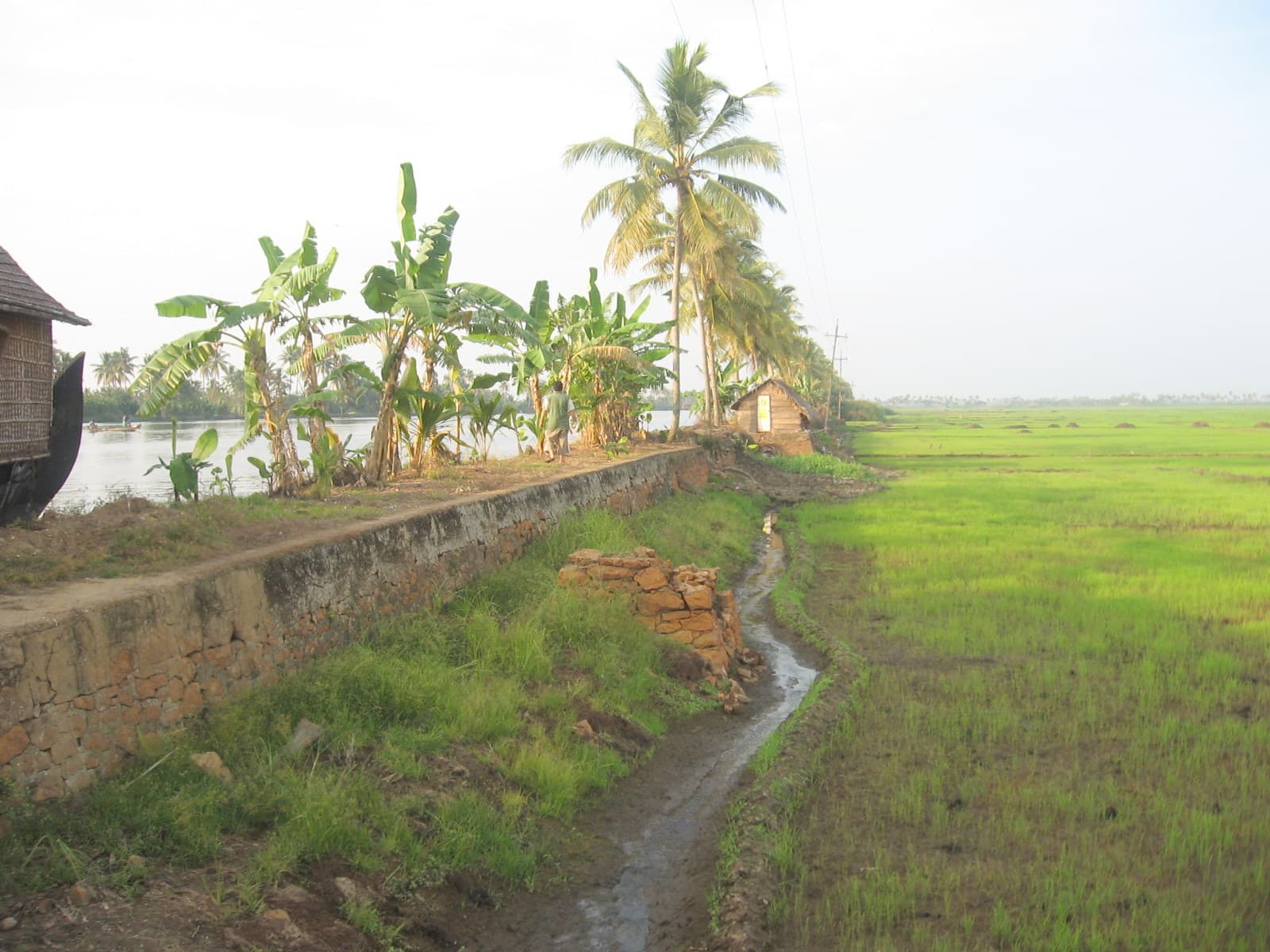
The agricultural landscape that surrounds the southern lake, where paddy is grown on land lying below sea level behind earth bunds, drained by pumps and worked on a calendar set by the water rather than the sun. The FAO recognised the Kuttanad Below Sea Level Farming System as a Globally Important Agricultural Heritage System in 2013; it produces a large share of Kerala's rice and is the reason the canals exist at all. You do not visit Kuttanad so much as travel through it: the best of it is seen from a canoe on a small canal at 7am, with the fields on one side below the level of your boat.
 Ganesh Mohan T · CC BY-SA 4.0 via Wikimedia Commons
Kumarakom Bird Sanctuary
A small sanctuary on the Kumarakom shore, laid out in what was once a rubber planter's estate, with a walkway through mangrove and old growth to a watchtower over the lake edge. It is compact, roughly fourteen acres, and its value is entirely about timing: come at opening for herons, egrets, darters, cormorants and kingfishers, and from November to February for the migratory species that arrive on the wetland. Entry is around 100 rupees for Indian adults and 250 for foreign nationals, open daily from 6am to 6pm, and a guide is worth the extra because the birds are heard long before they are seen.
 Rajkrishnan R · CC BY-SA 4.0 via Wikimedia Commons
Pathiramanal island
A small uninhabited island out in Vembanad between Kumarakom and Muhamma, reachable only by boat, whose name translates as sands of the night. It runs to under thirty hectares and carries a bird list of about ninety resident species and around fifty migratory ones, which makes it the best pure birding stop in the lake. Boats run from Muhamma and from Alappuzha; Muhamma is much the shorter crossing at roughly 10 to 20 minutes by motorboat, while from Alappuzha it is about 90 minutes by motorboat or half an hour by speedboat. Go early, take water, and accept that facilities on the island amount to a path.
 Brendanpuck · CC BY-SA 3.0 via Wikimedia Commons
Thanneermukkom bund
The barrage thrown across the narrow waist of Vembanad in the 1970s to stop salt water reaching the Kuttanad paddy fields in the dry season, and the single most consequential structure in the backwaters. Walking or driving the embankment gives you an unbroken view down the lake in both directions, best at either end of the day. It also explains an argument you will hear locally: the bund protects the harvest and is widely blamed for the weed growth, silting and fish decline in the freshwater half above it. Worth twenty minutes and a conversation with whoever is fishing off it.
 Frank van Dijk · Pexels
Alappuzha town, its canals and the old pier
The town they used to call the Venice of the East when the coir trade filled its warehouses, laid out around canals that still carry boats through the middle of it. What is left is very photogenic and quite unrestored: the 1862 sea pier standing in ruins off the beach, the lighthouse behind it, coir workshops where the fibre is still spun, and a long grey-sand beach that fills every evening with local families. Half a day on foot, or a canal walk with a guide, is the right dose, and the food is the best in the region.
 Patricia Luquet · Pexels
Champakulam and the snake boat sheds
A Kuttanad village on the Pamba river with an ancient Syrian Christian church at its centre and, more to the point, the palm-thatched sheds where chundan vallam snake boats are kept between races. These are hundred-foot war boats built without nails from anjili wood, oiled with fish oil and treated by their villages as something between an heirloom and a saint. Champakulam hosts the season's first race in June and is quiet the rest of the year, which is when you can actually look at a boat properly. Ask before entering a shed; these are village property, not exhibits.
 Harsh Suthar · Pexels
Munroe Island canoe maze
A cluster of small islands where the Kallada river runs into Ashtamudi Lake, threaded by canals too narrow and too low-bridged for anything with an engine. The standard trip is two or three hours in a paddled canoe through mangrove tunnels, past coir-making yards, prawn traps and lime-shell divers, usually ending with tea in someone's house. It is the antithesis of the Alappuzha houseboat: no diesel, no menu, no queue. Water levels matter, so November to March is the comfortable window.
 Ravindra Nadkarni · Pexels
The Chinese fishing nets at Fort Kochi
The cantilevered shore-operated dip nets on the Fort Kochi seafront, counterweighted with stones and worked by teams of four or five, are the image of Kerala that everyone arrives with. They are genuinely old technology and genuinely still fished, though the catch is thin and the operators now make more from letting visitors haul on the ropes. Go at first light or last light when the nets are silhouetted and the sales pressure is lowest, and buy your fish somewhere with a fridge.
The Alappuzha to Kollam public boat
The State Water Transport Department runs a long tourist boat between Alappuzha and Kollam, about 55 km and roughly eight hours of open water, canal and lake for a fare in the region of 600 rupees. It is a bench, a roof and a lot of time, and it is the cheapest and least filtered way to see the whole southern system in one go. Service is seasonal and route-dependent, generally running in the dry months and stopping when water or demand says so, so confirm the current timetable and fare with SWTD before you plan around it. Depart Alappuzha late morning, take a hat, and eat before you board.
 Ravikiran Rao / CC BY-SA 3.0 via Wikimedia Commons
 P.K.Niyogi / Public domain via Wikimedia Commons
Food & drink
 Anupama1002 · CC BY-SA 4.0 via Wikimedia Commons
Karimeen pollichathu
Pearl spot, the fish that lives in these backwaters and was named Kerala's state fish in 2010, rubbed with a chilli and shallot masala, wrapped in a banana leaf and cooked until the leaf chars and the fish steams inside it. Eaten within sight of the water it came from, it is the single most site-specific dish in Kerala. Bones are many and small; take your time.
 Triv.rao · CC BY-SA 4.0 via Wikimedia Commons
Appam with stew
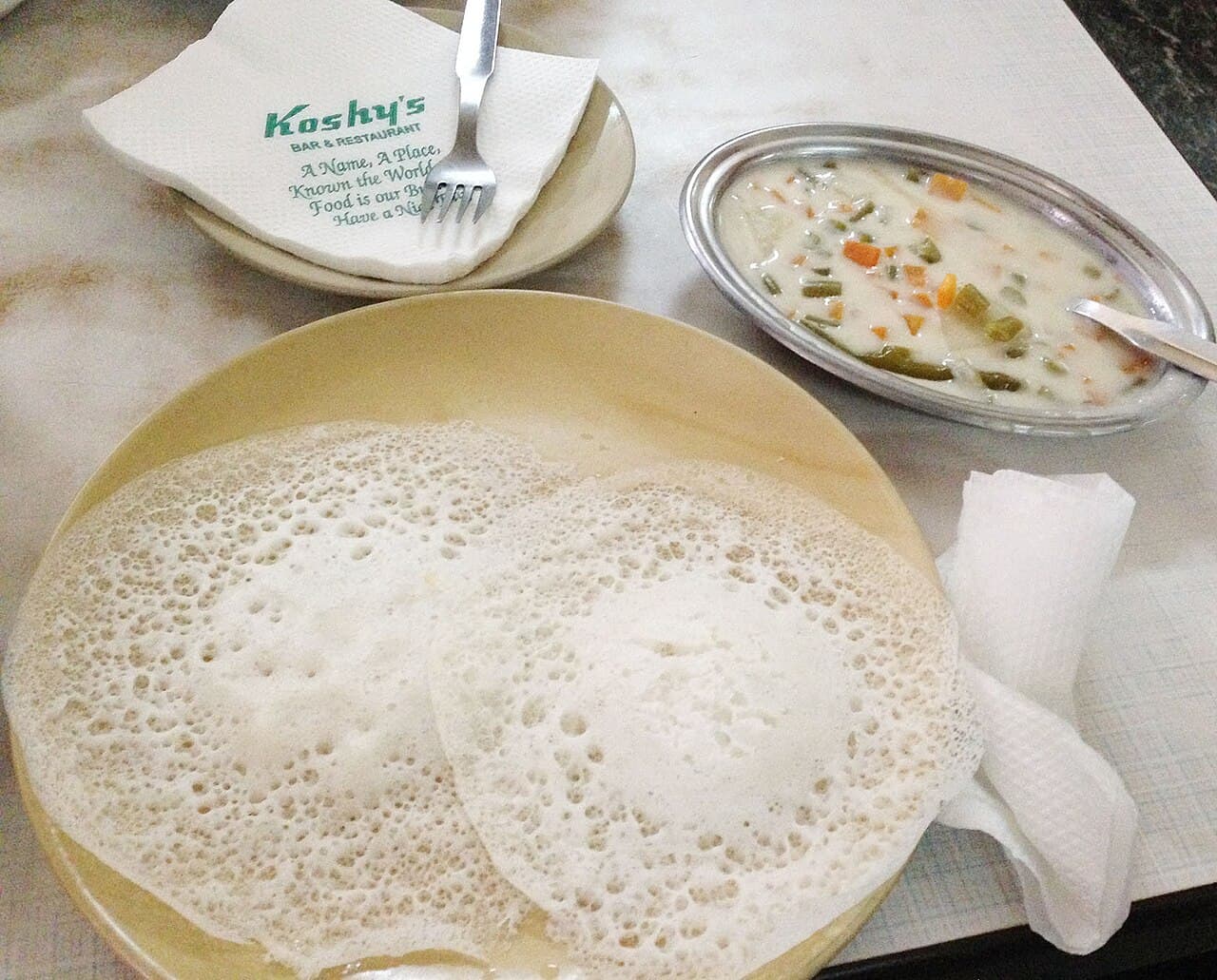
A bowl-shaped rice-and-coconut pancake, lacy at the edge and spongy in the middle, fermented overnight and cooked in a curved pan, served with a mild coconut-milk stew of chicken, mutton or vegetables. Breakfast in Kerala, and the best argument for eating your first meal of the day in a local restaurant rather than a hotel buffet.
 Jackson John 10 · CC BY-SA 4.0 via Wikimedia Commons
Puttu and kadala curry
Steamed cylinders of ground rice layered with grated coconut, pushed out of the mould in one piece and eaten with a black chickpea curry, or with banana and sugar if the table votes sweet. The other Kerala breakfast, heavier than appam and better on a morning that starts with a boat.
 BinoyCN · CC BY-SA 4.0 via Wikimedia Commons
Kappa and meen curry
Boiled and mashed tapioca with a fiery red fish curry, usually sardine or kingfish soured with kudampuli, the smoked fruit rind that gives Kerala fish curry its particular tang. This is toddy shop food and workers' lunch, and it is delicious in a way that no hotel version quite reproduces.
Duck roast and duck mappas
Kuttanad keeps ducks in the paddy fields, so the region cooks them properly: roasted dry with pepper and shallots, or in a mappas of coconut milk with green chilli and curry leaf. Ask for it in the villages rather than in a resort dining room, and expect a plate of appams alongside.
Toddy, and the kallu shaap
Sap tapped from the coconut palm at dawn, mildly alcoholic by noon and sharply so by evening, drunk in licensed shacks called kallu shaaps that double as some of the best kitchens in the state. Shaap food is cooked harder and hotter than restaurant food: clams roasted with coconut, prawns fried dry, fish head curry. Go at lunch, take a local if you can, and check that the shop is licensed.
 Tinu alby · CC BY-SA 4.0 via Wikimedia Commons
Onam sadya
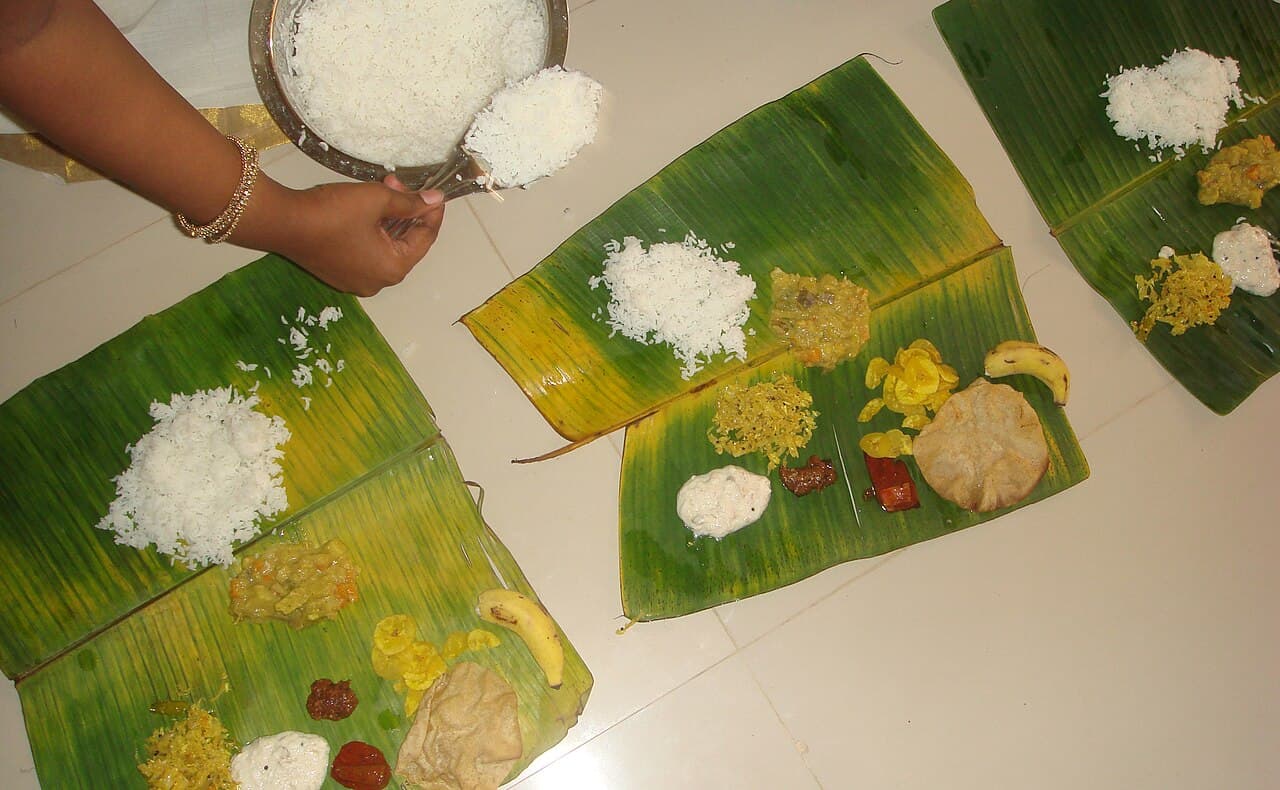
The banana-leaf feast that peaks at Onam but is served year-round at lunch in many places: rice at the centre and twenty-odd vegetarian dishes around it, eaten with the right hand in a fixed order, from the pickles at the top left inwards. Entirely vegetarian, largely vegan apart from ghee and curd, and the most complete thing on any Kerala table.
Banana chips and Kerala tea
Nendran bananas sliced and fried in coconut oil, sold hot by weight, and strong sweet milky tea pulled between two beakers at every junction shop. The backwater snack economy in two items, and the correct thing to buy from a shop boat that pulls up alongside a canoe.
Kerala eats early and eats rice. Lunch, between about noon and 2:30pm, is the big meal and the best value: an unlimited rice meal on a banana leaf costs a few hundred rupees at most, and vegetarian versions are everywhere. Dinner runs from about 7pm and kitchens outside the resorts wind down by 9:30 or 10. Eating with your right hand is normal and welcomed rather than expected of you; a spoon is always available for the asking. Tipping is not built into the culture the way it is in Europe or America, and rounding up or leaving 5 to 10 percent at a sit-down restaurant is generous. On a houseboat all meals are usually included and cooked aboard, and the crew will ask in advance how much chilli you actually want, so answer honestly. Alcohol is a state matter here rather than a restaurant matter: the first of every month is a dry day for retail, bars are attached to licensed hotels rather than to every restaurant, and only three-star and above, heritage and boutique hotels can apply for a one-day exemption on that first-of-month rule. Carrying your own bottle onto a houseboat for personal consumption is permitted.
Where to eat
Chakara at Raheem Residency
fine-diningThe restaurant of the 1868 heritage house on the beach road, open to non-residents and a genuine step above the rest of the town: Kerala seafood cooked accurately alongside a shorter international menu, served on a rooftop and a verandah rather than in a dining hall. Book ahead in season, particularly around the August race, and take the table upstairs.
Last researched 2026-08-15
Thaff Restaurant
casualA long-standing Alappuzha favourite that fills every night with a mix of local families and travelers: Kerala fish and prawn dishes alongside grilled chicken, biryani and shawarma, in a plain downstairs room and a cooler air-conditioned one upstairs with the same menu and the same prices. Portions are large, the bill is small, and the fish of the day is the order.
Last researched 2026-08-15
Kream Korner Art Cafe
cafePart cafe, part gallery, with local paintings on every wall and a menu that runs from appam and stew through Indian standards to sandwiches and cold coffee. It is the reliable middle-of-the-day stop in a hot town, and a good first meal for anyone still calibrating their chilli tolerance.
Last researched 2026-08-15
Halais Restaurant
budgetA plain, busy, no-nonsense local restaurant of the kind Kerala towns do well: biryani, fish curry meals and fresh juices, served fast to a room that turns over constantly. There is no atmosphere to speak of and no need for one at these prices.
Last researched 2026-08-15
Kayees Biryani, Mattancherry
institutionA Mattancherry institution that sells mutton and chicken biryani until it runs out, which on a good day is early afternoon. The room is small and functional, the queue is part of it, and the point is a rice that tastes of the pot rather than of a spice cupboard. Go at opening, take cash, and do not plan anything strenuous afterwards.
Last researched 2026-08-15
Pepper House Cafe
cafeA cafe in the courtyard of a restored Dutch-era spice warehouse that doubles as a gallery, library and one of the main venues when the Kochi-Muziris Biennale is running. Good coffee, a short menu that leans European with Kerala ingredients, and a shaded garden opening onto the water. The most civilised hour in Fort Kochi.
Last researched 2026-08-15
Sunrises
 McKay Savage from London, UK · CC BY 2.0 via Wikimedia Commons
Dawn from a moored houseboat deck
The reason to accept that houseboats cannot move before 8am: you wake up already in the middle of the water with mist on it, fishermen collecting the nets they set at dusk, and the first ferry of the day going past with school children on it. Coffee arrives, the crew starts the kitchen, and nothing happens loudly for an hour. It is the best part of the whole houseboat proposition and most people sleep through it.
November to February for still air and mist; year-round for the ferry traffic
 Abhinav Goswami · Pexels
Kumarakom Bird Sanctuary at opening
The gates open at 6am and the first hour is the only one that matters: darters drying their wings, egrets working the shallows, kingfishers going off like alarms, and from November the migratory arrivals. The walkway is short and the watchtower gives you the lake edge; a guide doubles what you notice. By 9am the light is flat, the birds are quiet and the day is elsewhere.
November to February for migratory species · Entry around 100 rupees for Indian adults and 250 for foreign nationals; the sanctuary is a short rickshaw ride from the Kumarakom resorts.
The Thanneermukkom embankment at first light
Standing on the bund with Vembanad running away in both directions is the only place you see the lake as a single object rather than as a channel. At sunrise the water goes metallic, the far shore is a line of palms, and the fishermen working off the barrage are already an hour into their day. Ten minutes of walking, a long look, and a conversation if you want one.
Year-round; clearest from December to March · On the Alappuzha to Cherthala road; easiest as a stop on a drive rather than a destination in itself.
Sunsets
 Frank van Dijk · Pexels
Punnamada Lake by shikara
A small covered boat, an hour or two before dark, out of the Alappuzha jetty and north into Punnamada where the snake boats race in August. The houseboats are heading in to moor, the light goes orange over open water, and you can go into the small canals a big boat cannot reach. Around 600 to 800 rupees an hour for a small boat is the going rate, and it is the cheapest good hour in the region.
Year-round; October to March for the clearest evenings
 P.K.Niyogi · Public domain via Wikimedia Commons
The wide water at Kumarakom
Kumarakom faces west across the broadest part of Vembanad, which means the sun goes down over open water with nothing in the way. From a resort lawn, a jetty or the deck of a small boat, this is the postcard sunset of the backwaters and it needs no ticket and no plan. Stay for the twenty minutes after the sun has gone, when the whole lake turns the colour of the sky.
November to March
Marari beach
A long, straight, palm-backed beach on the Arabian Sea where the fishing boats come in at the end of the day and the sunset is unobstructed all the way to the horizon. Walk north from the resort strip until the umbrellas stop, which does not take long. The contrast with the enclosed green light of the canals is the reason to give this coast a day.
November to April; the sea is rough in the monsoon · About 30 minutes by road north from Alappuzha.
Ashtamudi from a Munroe Island canoe
The southern lake at dusk, from a paddled canoe in the channels around Munroe Island: mangrove tunnels going dark, prawn traps being checked, and the open water of Ashtamudi opening up at the end of it. Quieter than anything in Alappuzha and much less photographed. Evening trips depend on water level and operator, so ask when you book the morning one.
November to March
Day trips
 Ravi Roshan · Pexels
Munroe Island canoe morning
The best half day in the southern backwaters: two to three hours in a paddled wooden canoe through canals barely wider than the boat, under low bridges, past coir yards where coconut husk is beaten into fibre, lime-shell divers working the lake bed and prawn traps set across the channels. Most tours end with tea in a family house. No engine, no diesel, no queue, and a completely different scale of landscape from the Vembanad houseboat circuit.
About 2 hours by road from Alappuzha, or a train to Munroe Thuruth halt · Half day, or overnight in a homestay
 ROCKY . · Pexels
Alappuzha to Kollam on the public boat
Eight hours, 55 kilometres and about 600 rupees on the State Water Transport Department's long tourist service: canals, open lake, coconut groves and a slow parade of backwater life from a wooden bench under a tin roof. It is not comfortable and it is not narrated, and it shows you more of the system in one day than any private cruise. Service is seasonal and the fare and departure time move, so confirm with SWTD before building a day around it.
About 8 hours, departing Alappuzha late morning · Full day, one way
 SANTRAM GAYAKVAD · Pexels
Fort Kochi and Mattancherry
The gateway city as a day out: the Chinese fishing nets on the seafront, St Francis Church where Vasco da Gama was first buried, the Dutch Palace murals and the Paradesi synagogue in the old spice quarter, and the warehouse cafes and galleries in between. The Kochi-Muziris Biennale, whose sixth edition ran to the end of March 2026, has left a permanent art scene behind it. Add the water metro across the harbour, which is a commuter boat that happens to be a harbour cruise.
About 1.5 to 2 hours by road from Alappuzha or Kumarakom · Full day, better as an overnight
 Ambareesh Sridhar Photography · Pexels
Marari beach and the fishing village
Thirty minutes north of Alappuzha the water changes from fresh to salt and the pace drops again: a wide beach, a working fishing village with a morning catch auction on the sand, coir workshops in the lanes behind, and Ayurveda centres that take the treatment seriously. The natural decompression after a houseboat night, and easy to turn into two or three nights instead of one day.
About 30 minutes by road from Alappuzha · Half day, or two to three nights
 george thomas · Pexels
Up to the hills: Munnar or Thekkady
The classic Kerala pairing, because three hours inland the landscape changes completely: tea estates at 1,600 metres around Munnar, or the Periyar reserve at Thekkady with its lake, its spice plantations and its elephants. Neither is a day trip in any comfortable sense, both are worth two nights, and either turns a backwater stay into a full Kerala itinerary. Take the drive as part of the trip and stop at the viewpoints.
3.5 to 4.5 hours by road from Kumarakom or Alappuzha · Two nights minimum
After dark
A night moored in a village channel
boatHouseboats cannot cruise after dusk, so where your boat ties up decides your evening. A good operator moors off a village or in a quiet side channel, which means frogs, a temple loudspeaker somewhere, fireflies in the palms and the occasional canoe going home. A bad one ties up in a rank of thirty boats with generators running. This is worth asking about before you book, and it is the difference between the two versions of this trip.
 Mahesh Anil · CC BY-SA 4.0 via Wikimedia Commons
Kathakali, and the makeup before it
cultureKerala's classical dance-drama, with its green faces, huge skirts and stylised eye and hand language, is performed nightly for visitors in Fort Kochi and in Alappuzha. The performances are abridged and explained, which is the right call for a first encounter, and the best part is arriving an hour early to watch the performers paint their own faces. Some venues pair it with a kalaripayattu martial arts demonstration.
Dinner at a kallu shaap
foodToddy shops serve fresh palm sap and the hardest-hitting food in Kerala: clams roasted with coconut, dry-fried prawns, kappa with fish curry, duck when there is duck. They are plain, loud, mostly male and entirely welcoming to anyone who turns up politely. Go early evening rather than late, ask your driver or homestay host which shop is worth the trip, and check that it is licensed.
 Manoj Karingamadathil · CC BY-SA 3.0 via Wikimedia Commons
The snake boat sheds and a practice row
localFrom about June through the racing season, villages across Kuttanad take their chundan vallam out to train in the evenings, a hundred oarsmen finding a rhythm to a chanted vanchipattu across water going gold. You cannot book it and it is not on any schedule; you ask locally where a crew is training and stand on a bank. In August, around the Nehru Trophy, it is happening somewhere most evenings.
Daily itinerary
Four days in the backwaters: one night afloat, three ashore
The version we would book: Kochi at the front, a certified houseboat night in the middle, Kumarakom for the lake and the birds, and a canoe morning that makes the whole thing make sense.
- 1
Land at Kochi, drive south to Alappuzha
relaxedArrive at Cochin International Airport and drive south, about two hours to Alappuzha with a stop for a rice meal on the way.A banana-leaf lunch at a roadside restaurant, which is where the good ones are.Settle in, then walk Alappuzha: the canals, the coir workshops, the beach and the ruined 1862 pier.On the beach with half the town, or a shikara hour out into Punnamada.Chakara at Raheem Residency for the good version, or Thaff for the local one.Early night: the boat boards before noon tomorrow and the mornings are the point here.Pre-book an airport taxi; the drive is two to two and a half hours depending on traffic through Cherthala.Estimate: Landing late? Sleep at Fort Kochi instead and drive down in the morning, moving the town walk to the last day.
- 2
The houseboat night
relaxedSlow start, then board around 11am or noon: this is when every boat leaves, so the first hour is the busiest water of the trip.Aboard, cooked by the crew: rice, a fish curry, thoran, pappadam.Cruise east and north out of the crowded channel toward the open lake, stopping at a village jetty; the good operators know where to get off the main route.On the deck as the boat finds its mooring, since nothing moves after dark.Aboard, and this is where the karimeen belongs.Stars, frogs and a village somewhere. Ask the crew for the quiet mooring rather than the boat rank.Confirm before booking that the boat holds a current Certificate of Prevention of Pollution and ask where it moors overnight.Estimate: Prone to seasickness or travelling with small children? Skip the overnight and take a full-day cruise instead, sleeping ashore both nights.
- 3
Off the boat, across to Kumarakom
relaxedWake for the mist and the ferries; disembark around 9am and transfer to Kumarakom, about an hour by road around the lake.At the hotel, or a village toddy shop if the driver approves of one.Nothing. This is the flat afternoon the trip is built around: the lake, a book, a pool.Straight west over the widest part of Vembanad from the shore.At the hotel; Kumarakom is not a place you go out to eat.A short lake trip in a small boat, or an Ayurveda treatment booked earlier in the day.Your houseboat drops at Alappuzha or a nearer jetty; agree the transfer to Kumarakom in advance rather than at 9am on a jetty.Estimate: Prefer the sea? Go to Marari instead of Kumarakom and swap the birds for the beach.
- 4
Birds at six, canals at nine, out in the afternoon
moderateKumarakom Bird Sanctuary at opening, then a country canoe with an oarsman through the small canals behind the village.A last Kerala lunch, ideally a sadya if the day allows one.Drive back to Kochi, about two hours, or on to the hills if the trip continues.Fort Kochi seafront under the Chinese fishing nets if you are staying the night.Kochi, where the choice widens considerably.Kathakali in Fort Kochi, arriving early for the makeup.Book the sanctuary guide the evening before and the canoe through your hotel; both want a 6am start.Estimate: Flying out at night? Pathiramanal by speedboat from Muhamma is a better use of the morning than a second hotel breakfast.
Nine days: Kochi, the backwaters, the hills and the coast
The full Kerala loop with the backwaters at its centre: two nights in Fort Kochi, the lake and a houseboat, two nights in tea country, and a beach finish at Marari.
- 1
Fort Kochi
relaxedLand, transfer to Fort Kochi, about an hour and a half, and sleep off the flight.Kayees in Mattancherry if you land early enough, before the biryani runs out.The seafront, St Francis Church and the lanes behind the nets.The Chinese fishing nets in silhouette.Fort Kochi carries one of the broadest restaurant ranges in Kerala.Kathakali, with the makeup hour beforehand.Pre-booked airport taxi; Fort Kochi is walkable once you are in it.Estimate: Jet-lagged? Trade the afternoon for the harbour on the water metro, which is a cruise disguised as a commute.
- 2
Kochi properly
moderateMattancherry: the Dutch Palace murals and the Paradesi synagogue, then the spice warehouses around them.Pepper House or one of the warehouse cafes.Galleries, the laundry quarter, and a long slow coffee out of the heat.A water metro crossing at golden hour for the price of a bus ticket.Seafood on the Fort Kochi side.Walk the seafront once the day trippers have gone.Ferries and the water metro beat taxis for anything crossing water; fares run 20 to 40 rupees.Estimate: Rain? The Kerala Folklore Museum and the Indo-Portuguese museum absorb a wet afternoon.
- 3
South to the lake
relaxedDrive to Kumarakom, about two hours, and check in on the lake.At the hotel, then nothing strenuous.The lake from a lounger, a swim, an Ayurveda consultation if that is your trip.Straight across the widest water in Kerala.At the hotel.Early, because the sanctuary opens at six.Cochin to Kumarakom is about 75 km and two to two and a half hours depending on traffic.Estimate: Arriving on a Sunday? The Kumarakom road is busiest with day trippers; go straight to the hotel and do the village later.
- 4
Birds, then the small canals
moderateKumarakom Bird Sanctuary at 6am with a guide, then breakfast.Village lunch or the hotel.A country canoe through the canals behind Kumarakom, or a boat out to Pathiramanal from Muhamma.From the water on the way back in.At the hotel.A quiet one. Tomorrow starts on a boat.Both the sanctuary and the canoe want an early start and both are ten minutes from the resorts.Estimate: Birded out? Swap in the Thanneermukkom bund and a drive along the northern lake.
- 5
Houseboat
relaxedTransfer to Alappuzha and board around midday.Aboard.Cruise the Kuttanad channels, off the main departure route, with a stop at a village jetty.Mooring up, because nothing sails after dark.Karimeen, cooked aboard.The quiet mooring you asked for when you booked.Ask for the certificate and the mooring plan when you book, not when you board.Estimate: Two people rather than a group? A smaller one-bedroom boat is cheaper, quieter and easier to moor in a small channel.
- 6
Off the water and up to the hills
fullDisembark at 9am and drive east into the Western Ghats, four hours or so to Munnar or Thekkady.On the road, at a viewpoint if you are lucky with the timing.Arrive, and let the temperature drop ten degrees.Over tea estates, which is a different kind of green entirely.At the lodge; hill towns eat early.A fire, or a jacket on a verandah. It is genuinely cool up here.This is the long drive of the trip; leave the boat on time and break it once.Estimate: Short on time? Cut the hills, go straight to Marari and add two beach nights instead.
- 7
Tea or wildlife
moderateA tea estate and factory tour around Munnar, or a dawn boat on the Periyar lake at Thekkady.Local, and hotter than the coast.A hill walk, or a spice plantation and the Kumily market.From a ridge, with the valley filling with mist.At the lodge.Kalaripayattu in Thekkady if you are there, which is worth the ticket.Everything up here is a drive; keep the car and driver for the full day.Estimate: Rain in the Ghats is heavier than on the coast; the tea museum and a plantation tour still work wet.
- 8
Down to the coast at Marari
relaxedThe long drive back down to the sea, about four hours, arriving in time for lunch.Seafood, in sight of where it landed.The beach, and the first genuinely empty hours of the trip.Straight into the Arabian Sea with nothing in the way.Grilled fish and a cold drink.Nothing at all, which is the point of the day.Marari is about 30 minutes north of Alappuzha and roughly two hours from Cochin airport, traffic depending.Estimate: Prefer town? Sleep in Alappuzha instead and use the beach by day.
- 9
The catch auction, then out
relaxedDown to the village beach for the boats coming in and the catch being auctioned on the sand, then a last swim.Early, at the hotel.Drive to Cochin airport, about two hours, allowing for the Alappuzha to Cherthala stretch.From the air, if the schedule is kind.Airport, or onward.Home, smelling faintly of coconut oil.Leave three and a half hours before an international departure; the road north is unpredictable.Estimate: Late flight? A morning Ayurveda treatment is the correct use of the extra hours.
Getting around
- Cochin International Airport (COK) at Nedumbassery is the gateway, about 30 km northeast of Kochi, with wide Gulf, Southeast Asian and domestic connections. It is the right airport for Alappuzha, Kumarakom and the central backwaters; for Kollam, Ashtamudi and Munroe Island at the southern end, Thiruvananthapuram can be the easier arrival. It is roughly 75 km and two to two and a half hours by road to Kumarakom, and about 83 km and a similar time to Alappuzha; both drives run through busy small towns rather than open highway, so build in more time than the distance suggests. Pre-book a transfer through your hotel or use the airport prepaid taxi counter rather than negotiating at the kerb.
- Trains are the underrated option. Alappuzha and Kottayam both sit on main lines with frequent services from Ernakulam, and the coastal run is cheap, punctual by Indian standards and much more comfortable than the parallel road. Kottayam is the station for Kumarakom (about 30 minutes by taxi), Alappuzha station is 10 minutes from the boat jetty, and Mararikulam is a request stop for the beach. Book on IRCTC ahead in season, since sleeper and chair car both fill.
- From Kochi city, the Kochi Water Metro is a pleasant way to reach the ferry side of the trip before the trip has started: electric catamarans on harbour routes such as High Court to Vypin and Fort Kochi for roughly 20 to 40 rupees a journey, with a discount on the Kochi1 card. It is a commuter service that happens to be the best value boat ride in the state.
- Long-distance buses (KSRTC and private operators) connect Kochi, Alappuzha, Kottayam and Kollam constantly and cost very little; they are fine for short hops and unpleasant with luggage. For anything longer, a car with a driver for the day, typically 3,000 to 5,000 rupees depending on distance, is the standard way visitors move around Kerala and is worth the money.
- The backwaters have four kinds of boat and choosing between them is most of the planning. Houseboats (kettuvallam) are floating hotel rooms that cruise by day and moor overnight, priced from around 10,000 rupees for a one-bedroom overnight up to 25,000 and well beyond for the luxury tier. Shikaras are small covered motorboats hired by the hour, about 600 to 800 rupees for a small one, and are the right tool for a sunset or a short canal trip. Country canoes are paddled, cost less, go where nothing else fits, and are the best value on the water. Public ferries are the local bus and cost a few tens of rupees.
- No houseboat cruises after dark. By long-standing rule boats stop moving around 5:30pm and stay moored until about 8am, so that fishermen can set and collect their nets without engines in the channels. This is not negotiable and it is the single most important thing to understand about a houseboat night: you are buying a day of cruising and a night at anchor, so where the boat anchors matters as much as the boat.
- Auto-rickshaws handle everything on land within a town. Agree the fare before getting in, since meters are theoretical in tourist areas; short hops in Alappuzha run 50 to 150 rupees. Ride-hailing apps work in Kochi and are patchy to non-existent in Kumarakom and Kuttanad, where your hotel's driver or a local taxi is the answer.
- Self-driving is not the move here. Roads are narrow, unlit at night, shared with buses that own the centre line, and parking at jetties is chaotic. A car with a driver costs little more than a rental and removes the entire problem; drivers also know which toddy shop is worth stopping at, which is a service in itself.
- Distances are short and slow. Alappuzha to Kumarakom is about 35 km by road but an hour or more around the lake, Alappuzha to Kollam about 85 km and two hours, Kumarakom to Kochi about 75 km and two hours plus. Plan two moves a day at most and let the water do the rest.
Things worth knowing
- · Booking a houseboat on price alone. Since the January 2026 High Court order every boat on Vembanad is supposed to hold a Certificate of Prevention of Pollution from the Kerala Maritime Board, and inspections started in April. Ask to see it, along with the Kerala Tourism classification, before you pay a deposit. Boats that cannot show either are the ones being pulled off the lake.
- · Booking two nights on a houseboat. The boat cannot move for fourteen hours of every twenty-four, the second day repeats the first, and the money buys much more on land. One night is the dose.
- · Expecting air conditioning all day. On most boats the air conditioning runs off a generator and only overnight, typically 9pm to 6am. Midday on a houseboat in April is hot, and that is normal rather than a failure.
- · Starting from the Alappuzha jetty at noon without asking where the boat moors. Departure hour is a traffic jam of identical boats, and a bad operator will tie up for the night in a rank of thirty with generators running. A good one heads for a village channel. The question is free to ask.
- · Treating the backwaters as a beach holiday. This is fresh water, it is not for swimming, it carries agricultural runoff and boat traffic, and the sea is a 30-minute drive away at Marari if you want to get in the water.
- · Underestimating the mosquitoes. Dusk on the water is their hour, screens on boats vary, and dengue is present in Kerala. Repellent, long sleeves at dusk and a plug-in in the cabin cover it.
- · Planning a big-ticket trip over Onam or the Nehru Trophy without booking months ahead. Late August fills the whole region, roads around Alappuzha close for the race, and government offices and many businesses shut for the four Onam holidays.
- · Assuming a drink is always available. The first of every month is a dry day for retail sales, bars are attached to licensed hotels rather than to every restaurant, and only higher-classified hotels can apply for a one-day exemption. Carrying your own bottle onto a houseboat is permitted.
Budget
| Low | Expected | Comfortable | |
|---|---|---|---|
| Accommodation style / per night | ₹2,500≈ $26 | ₹9,000≈ $94 | ₹45,000≈ $472 |
| Food style / per day | ₹600≈ $6 | ₹2,000≈ $21 | ₹6,000≈ $63 |
| Local transport / per day | ₹200≈ $2 | ₹1,500≈ $16 | ₹5,000≈ $52 |
| Estimate / per day | ₹200≈ $2 | ₹1,500≈ $16 | ₹5,000≈ $52 |
Estimate · INR · 2026-08-15. Accommodation is per room per night for two sharing, and the spread here is enormous: a clean homestay in Kuttanad runs a few thousand rupees, a good Kumarakom lake room sits around 9,000 to 15,000, and the flagship villas at the top properties clear 45,000 in season. A houseboat is not accommodation in this sense, it is a package: a one-bedroom overnight with all meals starts around 10,000 rupees and the luxury tier starts around 25,000, with the full range running roughly 7,000 to 40,000 depending on category, season and how hard you negotiate at the jetty. Food is the cheapest part of the trip, since a banana-leaf lunch costs a few hundred rupees and even a very good dinner rarely passes 2,000 a head outside the resorts, whose restaurants price internationally. The lines that inflate a real budget are the car and driver (3,000 to 5,000 a day), resort dining, Ayurveda packages and the houseboat itself. Mid-December to mid-January carries a hard peak with minimum-stay rules at the good properties; the monsoon months are half the price of the same room in February. · 1 USD = ₹95 (14 Oct 2026)
Things worth knowing
Frequently asked questions
How many days do you need in the Kerala backwaters?
Three to four nights is the right size: one on a houseboat, two or three on land at Kumarakom or Marari, with a canoe morning and a bird sanctuary dawn in there. Two nights works if you are passing through. Anything more and you want to be adding a different landscape, either the hills at Munnar or Thekkady, or the coast, rather than more of the same water. Inside a Kerala trip of nine to twelve days, the backwaters are the middle section, not the whole thing.
When is the best time to visit the Kerala backwaters?
November to February: dry, warm rather than punishing, migratory birds on the wetlands and the cruising channels all open. February into early March is nearly as good and quieter than the Christmas peak. March to May is hot and cheaper, June to September is monsoon with the boat races and Onam as compensation, and October is an underrated shoulder month with green landscape and softening rain.
Is one night on a houseboat enough?
Yes, and in our view it is the correct number. Boats cannot cruise between roughly 5:30pm and 8am, so a second night mostly buys you a second morning in the same channel. One night gives you the arrival, an afternoon cruising, dinner cooked aboard, a night at a mooring and the dawn, which is the best part. Spend the rest of your budget on a good room on the lake, where the view is the same and the plumbing is better.
Are Kerala houseboats safe and are they legal in 2026?
The good ones, yes, and 2026 made that easier to check. A Kerala High Court order in January required every houseboat on Vembanad to hold a Certificate of Prevention of Pollution issued by the Kerala Maritime Board, with enforcement inspections starting in April. Ask any operator for that certificate and for their Kerala Tourism classification before paying. Also check life jackets are aboard and that the boat does not overload; the accidents that make the news generally involve unregistered vessels and too many people.
Alleppey or Kumarakom: which should you choose?
Kumarakom to sleep, Alappuzha to board. Alappuzha is the working town with the boats, the food, the beach and the August race; Kumarakom is the wide-open eastern shore with the best resorts, the bird sanctuary and the sunsets. Most good trips use both: a night in Alappuzha at the start or end, the houseboat out of Alappuzha, and the land nights at Kumarakom. If you only get one, and you are not counting rupees, take Kumarakom.
Is a houseboat worth it at all, or is there something better?
It is worth exactly one night for the experience of sleeping on the water and waking in the middle of it. The better experience, and almost nobody books it, is a paddled country canoe for two or three hours through canals a houseboat cannot enter. Do both. If you have to pick one, take the canoe and sleep ashore, particularly at Munroe Island or in a Kuttanad homestay where the whole scale of the place is smaller and quieter.
What does a Kerala backwater trip cost?
Wide range. A one-bedroom houseboat overnight with all meals starts around 10,000 rupees and the luxury tier starts around 25,000. Land accommodation runs from a few thousand rupees for a homestay to 15,000 or so for a good lake room and well past 45,000 for a flagship villa in season. Food is cheap outside the resorts, at a few hundred rupees for a banana-leaf lunch, and a car with a driver runs 3,000 to 5,000 a day. A comfortable couple's trip lands around 12,000 to 20,000 rupees a day all in, and can be done for far less.
Can you swim in the backwaters?
You can, and we would not. It is fresh water carrying agricultural runoff, boat traffic and village drainage, with weed growth in the section above the Thanneermukkom bund. Locals swim, visitors mostly regret it. The sea at Marari is a 30-minute drive from Alappuzha and is the answer for actual swimming, with the caveat that the Arabian Sea here has currents and no consistent lifeguard cover, so swim where the resort says and stay out during the monsoon.
What should you eat in the backwaters?
Karimeen pollichathu, the pearl spot from these lakes grilled in a banana leaf, is the dish of the place and belongs on your houseboat dinner. Beyond that: appam with stew or puttu with kadala curry for breakfast, a rice meal on a banana leaf for lunch, kappa and fish curry or duck roast in the villages, and a sadya if you catch one. Drink the tea, buy the banana chips hot, and eat one meal at a licensed toddy shop, which is where the best hard-edged Kerala cooking lives.
How do you get to the backwaters from Kochi airport?
By road in two to two and a half hours to either Alappuzha (about 83 km) or Kumarakom (about 75 km), which is what most people do and is worth pre-booking rather than negotiating on arrival. The alternative is train: airport to Aluva, then a service down the coastal line to Alappuzha, or to Kottayam for Kumarakom, which is cheap and often faster than the road at peak times. Kochi itself is worth two nights at one end of the trip rather than a transit stop.
Sources (15)
- Kerala High Court order of 27 January 2026 requiring houseboats on Vembanad to obtain a Certificate of Prevention of Pollution from the Kerala Maritime Board within one month, barring non-compliant boats after three months, with shikaras exempt · reputable-local · 2026-08-15
- Houseboat inspections began in Alappuzha in April 2026 over waste-treatment and certification lapses, with non-compliant boats not permitted to operate on Vembanad · reputable-local · 2026-08-15
- Vembanad-Kol wetland designated a Ramsar site of international importance in 2002, fed by around ten rivers and split by the Thanneermukkom bund into freshwater and saline zones · unesco · 2026-08-15
- Kuttanad Below Sea Level Farming System designated a Globally Important Agricultural Heritage System by the FAO in 2013, the only system in India cultivating rice below sea level and producing around a quarter of Kerala's rice · government · 2026-08-15
- Kerala Tourism houseboat classification scheme with Gold Star, Silver Star and Green Palm categories covering safety, service and eco-friendly standards · tourism-board · 2026-08-15
- 72nd Nehru Trophy Boat Race on Punnamada Lake, Alappuzha on 22 August 2026, with tickets sold online and through district government counters · event-organizer · 2026-08-15
- Onam 2026 with Atham on 16 August and Thiruvonam on 26 August, and Kerala government holidays from 25 to 28 August · tourism-board · 2026-08-15
- Aranmula Uthrattathi boat race on the Pamba river at Aranmula on 30 August 2026, run as a temple ritual rather than a competitive race · tourism-board · 2026-08-15
- Kumarakom Bird Sanctuary open daily 6:00 to 18:00 with entry around 100 rupees for Indian adults and 250 rupees for foreign nationals, migratory season November to February · tourism-board · 2026-08-15
- Kerala State Water Transport Department seasonal tourist boat between Alappuzha and Kollam, about 55 km in roughly eight hours, fare reported around 600 rupees and to be confirmed with the operator · transport-operator · 2026-08-15
- Kochi Water Metro operating harbour routes with fares of about 20 to 40 rupees per journey and a Kochi1 card discount · transport-operator · 2026-08-15
- Kerala relaxed its first-of-month dry day rule in 2025 to allow three-star and above, heritage and boutique hotels to apply for a paid one-day licence to serve liquor · reputable-local · 2026-08-15
- Southwest monsoon onset over Kerala on 4 June 2026 against a normal onset date of 1 June · government · 2026-08-15
- Vembanad Lake has lost a substantial share of its historic area to reclamation, with siltation, weed growth and declining fish catch documented above the Thanneermukkom bund · reputable-local · 2026-08-15
- Kochi-Muziris Biennale sixth edition, For The Time Being, ran from 12 December 2025 to 31 March 2026 across venues in Fort Kochi, Mattancherry, Willingdon Island and Ernakulam · event-organizer · 2026-08-15