Greece · Southern Greece
Peloponnese
Land in Athens, cross the canal, and give Nafplio three nights for Mycenae, Epidaurus, Nemea wine and the town itself. Drive south past Sparta to Mystras, sleep under the rock at Monemvasia, then round the Laconian Gulf to the Mani for tower villages, the Diros caves and the walk to the lighthouse at Cape Tenaro. Base at Kardamyli or Limeni for the end, with Ancient Messene and the beaches of the Navarino coast as the last day out, and leave from Kalamata or drive back to Athens. Buy site tickets on the Ministry’s e-ticket portal, watch the half-monthly closing times from September, and do not plan anything around the Kalavryta train.
 C messier / CC BY-SA 4.0 via Wikimedia Commons
Overview
The Peloponnese is the big hand-shaped peninsula that hangs off the bottom of mainland Greece, joined to the rest of the mainland by the bridges over the Corinth Canal, an hour west of Athens, and cut off from it again by three fingers of mountain that run south into the sea. It holds more of the ancient Greece people come for than anywhere else in the country: Mycenae, Epidaurus, Olympia, Corinth and the Byzantine hill city of Mystras, four of them on the UNESCO list. It also holds Nafplio, the handsomest small town in Greece, the tower villages of the Mani, the fortified rock of Monemvasia and a west coast of long sandy beaches that most visitors never reach. What changed for 2026 is the way in and the way around. Kalamata airport, the southern gateway, went to a Fraport-led consortium on a 40-year concession signed in June 2026, with a new terminal in the investment plan and over 90 percent of its passengers already arriving on international flights. The Patras to Pyrgos motorway opened in full in December 2025, so the west-coast loop through Olympia no longer means a day on a two-lane road. And at the border, the EU Entry/Exit System went fully live on 10 April 2026, which means Israeli and other non-EU passports are now fingerprinted and photographed on first entry instead of stamped. Against that, two attractions went the other way: the Corinth Canal was shut to shipping from mid-November 2025 until 17 June 2026 for slope repairs, and the Kalavryta rack railway has been suspended since March 2026 with no reopening date we could find.
The single most useful thing we found in planning this trip is on the Ministry of Culture’s own pages and in almost no guidebook: from 1 September the big sites close earlier every fortnight. Mycenae, Epidaurus, Mystras, Palamidi and Ancient Messene all shut at 19:30 in the first half of September, 19:00 in the second, 18:30 in early October and 18:00 in late October, and then at 15:30 from 1 November until the end of March. A late-afternoon Mycenae in October, which is the best light there is, has a hard stop. Plan the sites for the morning and the driving for the afternoon, and you will have the ruins nearly to yourself. The second thing: the headline tickets are now 20 euros at Mycenae, Epidaurus, Olympia, Mystras and Palamidi, and at Mycenae and the Palamidi there are no reduced tickets at all from June to September, so a couple doing Mycenae, Epidaurus, Mystras and the Palamidi is spending 160 euros on admission before wine. The last weekend of September, 26 and 27 September in 2026, is free at every state site under the European Heritage Days rule, and so is 28 October. If your dates can bend, bend them. And the third: choose two main bases, not a loop. Nafplio in the north and the Mani in the south, with Mystras on the road and two nights at Monemvasia as the bridge between them, is the trip we would book.
Best for
Couples · Road trips · History and archaeology · Food and wine travelers · Walkers and hikers · Autumn and spring travel
Daily itinerary
7 to 10 days
Most Greek trips are islands and ferries. The Peloponnese is a car and a road, and the road keeps changing character: orange groves and Mycenaean citadels in the Argolid, the Venetian waterfront at Nafplio, high Arcadian gorges an hour inland, the olive country of Messinia, and then the Mani, where the villages are stone towers built to shoot at each other and the coast drops straight into a sea the colour of ink. It is also the part of Greece that works in autumn and spring. The sites are open, the sea stays swimmable into October, the mountain villages have fireplaces, and nothing needs a ferry. The price of that flexibility is distance: the peninsula is roughly the size of Israel, and the temptation to see all of it in a week is exactly the mistake this guide is built to prevent.
Best time to visit
Late April to mid-June and September to October are the Peloponnese at its best, and this guide was published in the second of those windows for a reason. September has warm sea, quiet sites and the Nemea grape harvest; October keeps the sea swimmable on the sheltered gulfs into its second half while the mountain villages turn towards fireplace weather. July and August are hot, the marble at Mycenae and Olympia radiates it back at you by eleven, and the FCDO lists wildfire as a high risk from April through October, which in 2026 meant fires near Sparta in August. Winter is quiet, cheap and often clear, with sites on short hours and many Mani and Monemvasia hotels closed.
- April to May: Sites on long hours from April, wildflowers on the Mycenaean walls, and the Mani at its greenest. Orthodox Easter falls on 2 May in 2027, a wonderful and fully booked weekend everywhere in the peninsula. The sea is still cold outside the sheltered bays.
- June: Full summer hours of 08:00 to 20:00 are in force everywhere by June, from 1 April at Mystras, Messene and Olympia and from 2 May at Mycenae, Epidaurus and the Palamidi, and they run to the end of August, the sea warms, and from 1 June the reduced tickets stop being sold at Mycenae and Palamidi until October. Long evenings: the sun sets after 20:50 at Nafplio at midsummer.
- July to August: Peak heat and peak crowds. Epidaurus Festival performances in the ancient theatre ran 1 to 29 August in 2026. Do the sites at 08:00, sleep at midday, and keep the emergency alert on your phone switched on: 2026 brought fires near Sparta and across the southern Peloponnese in August.
- September to October: The exhale. Nemea harvest, warm sea, empty ruins, and the closing hours ticking down every fortnight. The last weekend of September is free at all state sites; so is 28 October. Clocks go back on 25 October and the sun then sets before 18:00.
- November to March: Short site hours, Tuesday closures at Messene and Nemea in winter and at Methoni all year, seasonal hotels shut in the Mani. Olive harvest through the winter, free Sundays twice a month at the sites, and the clearest air of the year on Taygetos.
Things worth knowing
- Athens Epidaurus Festival (June to August; performances at the ancient theatre of Epidaurus ran on August weekends, 1 to 29 August in 2026): ancient drama in the 4th-century BC theatre, which is the single best reason to be here in high summer. 2027 dates were not announced when we published.
- Nemea grape harvest (September): the Agiorgitiko vintage comes in around the villages of Koutsi and Nemea, and the estates that welcome visitors are busy but open.
- European Heritage Days (last weekend of September, 26 and 27 September in 2026): free entry at every state archaeological site and museum in Greece.
- Ohi Day (28 October): a national holiday with parades, and a free-entry day at the state sites.
- Olive harvest (November to January): Messinia and Laconia pick the Kalamata olives and press the new oil; a quiet, working season worth seeing if you are here in winter.
Where to stay
 George E. Koronaios · CC0 via Wikimedia Commons
Nafplio
The first capital of modern Greece and the base for everything ancient in the Argolid. A Venetian and neoclassical old town on a headland between two fortresses, the Palamidi above and the Bourtzi on its islet in the harbour, with Mycenae, Epidaurus, Tiryns, Nemea and Ancient Corinth all under an hour away. It is also a real town: an evening promenade along the waterfront, a proper market on Wednesdays and Saturdays, and Athenians down for the weekend.
Best for: First-time visitors · A base for the ancient sites · Couples · Evenings on foot
Parking inside the old town is close to impossible; leave the car on the waterfront lots. Weekends and Greek public holidays fill the hotels and the squares. The nearest real beach is Karathona, a short drive south; Arvanitia below the fortress is a pebble cove.
Kardamyli and the outer Mani
A stone village on the Messinian Gulf under the wall of Taygetos, forty-five minutes south of Kalamata, where Patrick Leigh Fermor built the house he wrote in and the Benaki Museum now opens on Mondays. Kardamyli has the old fortified quarter with its tower houses, a handful of tavernas at the water, Ritsa beach at the north end and Foneas and Stoupa a few minutes south. It is the gentle Mani: olive terraces, footpaths up the Viros gorge, and a sea that is easy to get into.
Best for: A southern base · Walkers · Couples · Swimming from rocks and coves
Small and popular: the good rooms and Lela’s tables book out months ahead for June and September. Everything south of here is a winding coast road; give the deep Mani a full day rather than an afternoon.
 Lydia Griva · Pexels
Areopoli, Limeni and the deep Mani
The stern half of the peninsula. Areopoli is the tower-house town where the 1821 revolt was raised; Limeni, five minutes below it, is a tiny stone harbour on a west-facing bay with fish tavernas on the water. South of here the land dries out into a moonscape of walled fields and empty tower villages, the Diros caves at the sea’s edge, the old port of Gerolimenas, the near-abandoned towers of Vathia, and finally the walk out to the lighthouse at Cape Tenaro, the southern tip of mainland Greece.
Best for: Tower villages · Sunsets over the water · The Diros caves · Drivers who like empty roads
Restaurants and hotels are few and seasonal: Tainaron Blue, the four-room tower hotel near Vathia, publishes its 2026 season as 29 May to 31 October, and others follow a similar rhythm. Fuel up in Areopoli. Shade does not exist on the Tenaro path.
 Adrien Olichon · Pexels
Monemvasia
A rock the size of a small mountain tethered to the Laconian coast by a causeway, with a Byzantine walled town hidden on its seaward face. Cars stop at the gate; inside is a single stepped lane of stone houses, a dozen churches, the ruins of the upper town on the summit and the sea below. The mainland village of Gefyra across the causeway has the supermarket, the car parks and the cheaper rooms. The Malvasia sweet wine that carried the name Malmsey across medieval Europe was revived here and won its own PDO in July 2010.
Best for: One or two unforgettable nights · Sunrise over the sea · Couples · Elafonisos day trips
Luggage goes in by hand or on a porter’s trolley along a cobbled lane; pack accordingly. Day-trippers fill the lane from late morning to late afternoon in season. It sits at the far end of everything: nearly three hours from Nafplio, about an hour and a half from Mystras, and the road on to the Mani goes round the gulf through Gythio.
 Klaidi Gkini · Pexels
Pylos and the Navarino coast
The southwest corner, where a bay large enough to hold a fleet is closed off by an island, and the beaches face west into the Ionian. Pylos is a small Venetian-and-French town under its castle; Voidokilia, ten minutes north, is a near-perfect horseshoe of sand backed by a lagoon; Methoni’s castle runs out into the sea a short drive south. Costa Navarino, the resort estate at the top of the bay, is now four hotels, a Westin, a W, a Mandarin Oriental and the Romanos, all of which reopened for 2026 between late February and early April.
Best for: Sandy beaches · Resort stays · Sunsets over the sea · Families
Resort prices in resort season, and the estate is a car ride from anything that is not the estate. Kalamata airport is 45 minutes away, which is the point; Nafplio is three hours.
 Maarten van den Heuvel · Pexels
Dimitsana, Stemnitsa and the Arcadian mountains
An hour inland from Tripoli, the road climbs into the Lousios gorge country: two stone villages on opposite lips of the canyon, monasteries built into the cliff face, and the open-air water-power museum at Dimitsana, where the region’s gunpowder mills armed the 1821 revolution. This is the Peloponnese of fireplaces, mushrooms and mountain honey, and the natural winter alternative to the coast.
Best for: Autumn and winter stays · Hikers · Monasteries · A break from the heat
Mountain roads and mountain weather: fog in autumn, snow chains in a hard winter, and long stretches with no fuel. A detour, not a base, unless walking is the holiday.
Where to sleep
Amphitryon Hotel
boutique · Waterfront, Nafplio
Best for: Nafplio without a car problem · Sea views of the Bourtzi · A first base for the ancient sites
- 45 keys, 43 rooms and 2 suites, every one facing the harbour and the Bourtzi islet from the foot of the Acronafplia rock
- A three-minute walk into the old town, so the car stays parked from check-in to check-out
- Run by the same group as the Nafplia Palace on the acropolis above it, whose pool and restaurant sit up the hill
- A mid-century block rather than a stone mansion; the setting is the luxury, not the architecture
- Rates are only quoted through the booking engine and climb steeply on Greek holiday weekends
- Its sister property, the Nafplia Palace, blocks automated checks on its own website, so we could not verify its rooms or its season; ask what is open before you book a villa there
Aetoma
value · Old town, Nafplio
Best for: An 18th-century mansion on a normal budget · Sleeping inside the old town · Couples
- A restored 18th-century house on a small square below the Acronafplia, with a handful of rooms and a family running it
- Everything in Nafplio is on foot from the door, including the Palamidi steps if you insist
- A fraction of the waterfront prices for a better address
- Few rooms, so it sells out early for weekends and holidays
- Old-town streets mean no parking at the door and stairs inside
- The site is in Greek only, which says something about who mostly stays here
Amanzoe
luxury · Above Porto Heli, Argolida
Best for: The grand Argolid splurge · Honeymoons · A beach club and a private pool with Epidaurus an hour away
- Freestanding pavilions of about 210 square metres with private pools, terraced across a hilltop of olive groves above the Argolic coast
- A beach club down on the water, a full Aman spa and several restaurants, with Nafplio and Epidaurus both within about an hour
- Villas from two to nine bedrooms for groups who want the estate to themselves
- Seasonal: the resort closes for the winter, in recent years from mid-November to the end of March, so check the dates before you build a trip around it
- The best part of the Peloponnese for a road trip is south and west of here, two to three hours away
- Rates are enquiry-only and among the highest in Greece
Kinsterna Hotel
unique · Agios Stefanos, facing the Monemvasia rock
Best for: The rock in the window without the luggage haul · Winter and shoulder-season stays · Food and wine travelers
- A restored Byzantine, Ottoman and Venetian mansion estate of about 25 acres on the mainland, with its own vineyards, olive and citrus groves and a cistern the house is named after
- Centuries-old fireplaces in most rooms and the public spaces make it one of the few luxury addresses here that genuinely works in winter
- Bread, soap and wine are made on the estate and the activities are built around them
- It is not inside the walled town: the rock is a ten-minute drive away across the causeway
- Room count and rates are not published outside the booking engine
- Remote enough that dinner will mostly be at the hotel
Moni Emvasis Luxury Suites
boutique · Inside the castle town, Monemvasia
Best for: Sleeping inside the walls · Sunrise from the terrace · Couples
- Three restored stone houses in the lower town turned into suites, so you are inside the gate after the day visitors leave
- Its own restaurant, Chrisovoulo, on the lane, which solves dinner on a rock with limited choice
- The east-facing seaward side of the rock is the sunrise side, and the terraces look straight at it
- Cars stop at the gate: luggage goes in on foot along cobbles
- A JavaScript-heavy site that publishes neither room count nor seasonal dates, so confirm both when booking
- Stairs everywhere, inside and out
Kyrimai Hotel
unique · Gerolimenas old port, deep Mani
Best for: The deep Mani as a base rather than a day trip · Vathia and Cape Tenaro at dawn · Couples who like stone and silence
- A 19th-century merchant’s warehouse and tower complex on the quay of a tiny fishing port, restored and run by the Kyrimis family
- Suites and tower rooms named by type, a restaurant serving all three meals on Maniot heritage cooking, and the sea at the end of the terrace
- Twenty minutes from Vathia and about forty minutes from the Tenaro car park, which nowhere else this comfortable can say
- Seasonal operation: the site talks of a new season each year without publishing dates, so ask before booking outside May to October
- Gerolimenas has a couple of tavernas and nothing else; this is a place to stay put
- An hour of bends from Kardamyli and about the same from Gythio
Tainaron Blue Retreat
romantic · Near Vathia, Cape Tenaro
Best for: Sleeping in a Mani tower · The last stop before the end of mainland Greece · Two or three nights of nothing
- An early 19th-century stone watchtower on the last slope of Taygetos before the sea, restored into just four rooms and suites
- Views south over the cape and west over the water, which is the sunset side
- A season published on its own site for 2026, 29 May to 31 October, which is more than most Mani hotels manage
- Four rooms: it books out and it closes for the winter
- Rates are enquiry-only
- Nothing within walking distance; you will drive to eat unless you eat in
Kalamitsi Hotel
value · Kalamitsi, outside Kardamyli
Best for: A Kardamyli base without Kardamyli prices · Families and longer stays · Walkers
- Half a kilometre outside the village in its own olive grove, with rooms, studios and apartments with kitchens
- The Leigh Fermor house is a short walk away, and Ritsa beach and the village tavernas ten minutes on foot
- The kind of place you stay a week and drive the Mani from
- The old .com domain is dead; the live site is kalamitsi-hotel.gr, and its own price fields read zero, so book through the embedded engine and check the rate there
- No seasonal dates published; assume a spring-to-autumn operation and ask
- Simple rather than styled
Mandarin Oriental, Costa Navarino
resort · Navarino Bay, Messinia
Best for: A resort ending to a road trip · Kalamata airport departures · Couples who want the quietest of the four Costa Navarino hotels
- The smallest and newest of the estate’s four hotels, with about a hundred keys, roughly half of them earth-sheltered villas with private pools cut into the hillside above the bay
- Shares the estate’s beaches, golf, the Navarino Agora dining and shopping quarter and the open-air cinema with the Westin, the W and the Romanos, though the estate is two sites: this hotel and the W are at Navarino Bay, while the Agora, the Romanos and the Westin are at Navarino Dunes about nine kilometres north, so that sharing means a shuttle
- Forty-five minutes from Kalamata airport, whose 2026 concession promises a new terminal
- Seasonal: the four hotels reopened for 2026 between 27 February and 8 April and close again for winter on unpublished dates, so confirm before booking a late-autumn stay
- Everything is a resort price, and everything outside the estate needs the car
- Nafplio, Mystras and the Mani are all two to three hours away; this is a beginning or an end, not a base
Euphoria Retreat
luxury · Mystras, below the Byzantine city
Best for: A spa stop between Nafplio and the south · Mystras at opening time · Travelers who want one still day in the middle of the drive
- 45 rooms and suites in a wellness hotel at the foot of the Mystras hill, with the UNESCO site a few minutes away
- Published starting rates on its own site, from 505 euros for a classic double with breakfast to 2,770 for the grand suite, which is rare honesty at this level
- The one place on this route where the point is to do nothing for a day
- Those rates are the entry point, and the programmes cost more
- Sparta town, five minutes away, is a working provincial town rather than a pretty one
- Wellness hotels have rules about children and noise; check them if you are travelling with either
Essential experiences
 Zde · CC BY-SA 4.0 via Wikimedia Commons
Mycenae
Agamemnon’s citadel, or the one Homer gave him: cyclopean walls, the Lion Gate, the grave circle where Schliemann found the gold masks, and the beehive Treasury of Atreus down the road, all on one 20-euro ticket with the site museum. UNESCO-listed with Tiryns since 1999. Go at opening or in the last two hours; the hill has no shade and the closing time drops every fortnight from September.
 Vassilis St · Pexels
Epidaurus
The best-preserved theatre of the ancient world, 4th century BC, in a pine-covered sanctuary of the healing god Asklepios. UNESCO-listed since 1988. The 20-euro ticket covers the theatre, the sanctuary and the museum. Guides drop coins on the stage for the top row; treat that as a demonstration rather than a law of physics, and go early before the coaches from the cruise ports.
Ministry of Culture: Epidaurus ↗Athens Epidaurus Festival ↗View on map ↗
 Marek Matula · CC BY-SA 3.0 via Wikimedia Commons
Palamidi fortress
The Venetian fortress on the 216-metre rock above Nafplio, built in a hurry between 1711 and 1714 and lost to the Ottomans within a year. Eight bastions, a chapel, the cell where Kolokotronis was held, and the whole Argolic Gulf laid out below. The stair from the town is said to have 999 steps; nobody who has counted agrees, and the honest number is somewhat under that. There is a road to the top gate too. 20 euros, no reduced tickets from June to September.
 Farzona Comnas · Pexels
Bourtzi
The little Venetian fort on its islet in Nafplio harbour, reached by shuttle boat from the waterfront. Entry is 7 euros, and the hours are the most generous of any state monument here: daily 09:00 to 21:00 in July and August, to 20:00 in September, and until 17:00 on October weekdays with 18:00 at weekends. There is a cafe inside the walls. From the town quay it sits west-northwest, on a bearing of about 291 degrees, so in high summer the sun drops a little to the right of it.
 Daciana Cristina Visan · Pexels
Ancient Corinth and Acrocorinth
The Roman city where St Paul preached, with the seven standing columns of the Temple of Apollo, the Peirene fountain, and a good museum, on a 15-euro combined ticket. Above it, the Acrocorinth is the largest and oldest fortress in the Peloponnese, and it is free, but it keeps short hours all year, 08:30 to 15:30, so do it first. Together they are the natural first stop out of Athens.
Ministry of Culture: Ancient Corinth ↗Ministry of Culture: Acrocorinth ↗View on map ↗
 Elgaard · CC BY-SA 4.0 via Wikimedia Commons
Corinth Canal
The 6.4-kilometre cut through the isthmus, opened in 1893, that turned the Peloponnese into an island in all but name. You cross it on the motorway without noticing; the stop is the old road bridge at Isthmia, where you look 80 metres down at the water between sheer limestone walls. The canal was closed to shipping from mid-November 2025 to 17 June 2026 for slope repairs, and reopened mainly to yachts and tour boats. Bungee operators use the bridge in season.
 Mark Landon (photographed in 1991; digitized in 2021) · CC BY 4.0 via Wikimedia Commons
Nemea: the sanctuary, the stadium and the wine
A 10-euro ticket covers the museum, the Temple of Zeus with its re-erected columns, and the ancient stadium with its vaulted athletes’ tunnel half a kilometre away, where the Nemean Games were run. The valley around it is Greece’s biggest red-wine appellation, PDO since 1971 and 100 percent Agiorgitiko; Gaia Wines at Koutsi opens Wednesday to Sunday with tastings from 20 euros, and is shut on Mondays and Tuesdays all year. The archaeological site itself closes on Tuesdays in winter.
Ministry of Culture: Nemea ↗Gaia Wines, Nemea ↗View on map ↗
 Ronny Siegel · CC BY 3.0 via Wikimedia Commons
Mystras
The Byzantine city on a spur of Taygetos above Sparta, capital of the Despotate of the Morea, abandoned in the 1830s and UNESCO-listed since 1989: frescoed churches, the restored Palace of the Despots, a Frankish castle on top and a nunnery still inhabited. 20 euros. Two gates: park at the upper one and walk down if your knees prefer it, but remember the car is then at the top, so either climb back for it or send one of you up by taxi. In summer hours the palace opens at 11:00 on Tuesdays rather than with the site.
 Ingo Mehling · CC BY-SA 3.0 via Wikimedia Commons
Monemvasia
The walled Byzantine town on the seaward side of a rock joined to the coast by a causeway. No cars, one lane, and the climb through the upper gate to the ruined citadel and the 12th-century church of Agia Sofia on the summit, which is the best hour of the day if you do it before the heat. Free to walk; the churches and the small museum keep their own hours. The rock faces due east, so sunrise from the sea walls is the thing to set an alarm for.
Visit Greece: Monemvasia ↗PDO Monemvasia-Malvasia ↗View on map ↗
 No machine-readable author provided. MarkosAlexandrou assumed (based on copyright claims). · Public domain via Wikimedia Commons
Diros caves
A boat through a flooded cave system on the Mani coast, stalactites a hand’s width from the water, and a short walk out through the dry section: about 1.5 kilometres in all, most of it afloat. The short tour is 12 euros, or 9 for the land section alone. Open 09:00 to 17:00 from April to October with the booth closing at 16:15, and 08:30 to 16:30 in winter. The operator noted in January 2026 that tours were running the land section and the small lake route, so ask which route is on before you queue.
 Lydia Griva · Pexels
Vathia and the walk to Cape Tenaro
Vathia is the tower village on its ridge that stands for the whole Mani: dozens of stone towers, nearly all empty, above a sea that goes on to Africa. Twenty minutes further the road ends at a car park by a taverna, and a rough path runs about two kilometres out to the lighthouse on the southernmost point of mainland Greece, 45 minutes each way with no shade and a swim in the cove by the ruined temple of Poseidon on the way back.
 George E. Koronaios · CC BY-SA 4.0 via Wikimedia Commons
Ancient Messene
The least visited great site in Greece: a whole 4th-century BC city with its stadium, theatre, agora and nine kilometres of walls in a green valley below the village of Mavrommati, still being excavated and restored. 15 euros, open to 20:00 through the summer and stepping down through the autumn like the rest, and closed on Tuesdays from November to March. An hour from Kardamyli, and worth every minute of it.
 Lydia Griva · Pexels
Ancient Olympia
The sanctuary where the Games were run for over a thousand years, UNESCO-listed since 1989: the Temple of Zeus, the workshop of Pheidias, the stadium you can run in. One 20-euro ticket now covers the site, the archaeological museum, the museum of the ancient games and the museum of the excavations, valid for one day, with no single-area ticket sold. Open daily 08:00 to 20:00 from 1 April 2026. It is a long detour from the two-base plan, about two hours from Kalamata; the new Patras to Pyrgos motorway makes the western loop back to Athens the sensible way to include it.
 Valentinos Loucaides · Pexels
Methoni castle and Voidokilia
Two ends of the same coast. Methoni’s Venetian castle walks out into the sea on a causeway to its own little island tower, 5 euros, closed Tuesdays, and faces due west. Voidokilia, 25 minutes north past Pylos, is the horseshoe bay in every Greek tourism poster: fine sand, a lagoon behind, Nestor’s cave on the headland and the old castle above it. No facilities, no shade, and a west-facing sunset.
Ministry of Culture: Methoni ↗Visit Greece: Pylos and Voidokilia ↗View on map ↗
 Lydia Griva · Pexels
The Patrick Leigh Fermor house, Kardamyli
The stone house the travel writer and his wife Joan built above a cove at Kalamitsi in the 1960s, left to the Benaki Museum in 1996 and run as a writers’ retreat. The Benaki opens it to the public on Mondays only, from 12:00 to 13:00, for a 5-euro ticket booked online in advance, and the slots go early. If your Kardamyli days do not include a Monday, you can still see the garden wall from the path to the beach.
 Andreas Trepte / CC BY-SA 2.5 via Wikimedia Commons
 Orlovic / CC BY-SA 4.0 via Wikimedia Commons
Food & drink
 Daniela Elena Tentis · Pexels
Kalamata olives and Messinian oil
Both carry EU protected designations. The almond-shaped Kalamata olive is cured in brine and red-wine vinegar; the oil from the Koroneiki trees around it is the peppery green stuff that arrives with bread everywhere in Messinia. Taste it in November, when the new pressing is bitter and alive.
 C messier · CC BY-SA 4.0 via Wikimedia Commons
Siglino
The Mani’s pork: salted for days, then smoked over sage and other herbs and preserved in its own fat with orange. It turns up in an omelette at breakfast, on a plate with fried eggs at lunch, and in a bean stew at dinner, and it is the taste of the tower country.
Sfela
A hard, salty, brine-aged cheese of sheep and goat milk from Messinia and Laconia, PDO since 1996. Sharper than feta, and what the locals crumble over their salad instead.
 C messier · CC BY-SA 4.0 via Wikimedia Commons
Gogges
Hand-rolled eggless pasta shells from the Argolid and Laconia, thicker than orecchiette, served with browned butter and grated mizithra. The dish to order in a village taverna above Nafplio.
Lalagia
Ribbons of fried dough, sometimes with orange zest or cinnamon, crisper than a breadstick and eaten from a paper bag in Kalamata and the Mani. A breakfast, a snack and, with honey, a dessert.
 Yesim G. Ozdemir · Pexels
Tsakonian aubergine
A small, striped, sweet aubergine from Leonidio on the east coast with its own PDO, and the reason a plate of fried aubergine in Arcadia tastes like something else entirely.
 ulrichstill · CC BY-SA 3.0 de via Wikimedia Commons
Agiorgitiko and Moschofilero
The peninsula’s two great grapes. Nemea’s red, PDO since 1971 and made only from Agiorgitiko, ranges from soft and plummy to serious; Mantinia’s Moschofilero, from the high Arcadian plateau, is the pink-skinned grape behind the aromatic dry whites and sparkling wines you will see on every good list.
Malvasia of Monemvasia
The sweet wine that medieval Europe called Malmsey, named for the rock it was shipped from, revived by local growers and given its own PDO in July 2010: sun-dried grapes, at least half of them the Monemvasia variety, aged for years. A glass on the sea walls after dinner is the right way to end the town.
Lunch is late, from about 14:00, and dinner later still: Greek families sit down at 21:00 or after, and a taverna that looks empty at 19:30 is not closed, it is waiting. Menus are for sharing, so order a spread of mezedes and one main between two. Bread and a cover of a euro or two are standard. Cards are accepted almost everywhere now, but tips left on a card terminal rarely reach the waiter; leave a few euros in cash. In villages, expect the day’s dishes to be in trays in the kitchen and to be invited to look. Seafood is priced by the kilo; ask the weight before it goes on the grill.
Where to eat
3Sixty Grill Dining
modernThe dining room and wine bar of a neoclassical mansion from the 1860s, run by the same Nafplio group as the adjoining hotel and the all-day Xenon on Syntagma Square. Grill-led, with premium beef on the card and a Greek list that goes deep on Nemea and Mantinia. Book for the courtyard.
Last researched 2026-09-11
Lela’s Taverna
institutionOpened on 13 August 1983 by Lela Giannakeas, who had kept house for Patrick Leigh Fermor, and now in the family’s fourth generation, on the rocks beside the old olive-oil factory with the port and the islet in front. Dinner only, Tuesday to Saturday from 18:00 to 23:00, so it is closed on Sunday and Monday and you should plan the Kardamyli nights around that.
Last researched 2026-09-11
Gaia Wines, Nemea
marketOne of the estates that put Nemea on the map, at Koutsi in the heart of the PDO zone. Open all year, Wednesday to Sunday, 10:30 to 16:30, with a guided tasting of four to seven wines lasting about an hour from 20 euros a head and premium flights up to 70. A two-hour wine-paired village lunch is offered too. Closed Monday and Tuesday.
Last researched 2026-09-11
Kyrimai restaurant
modernThe restaurant of the hotel in the old warehouse on the Gerolimenas quay, serving breakfast, lunch and dinner on Maniot heritage recipes with a named cuisine consultant behind the menu. Siglino, local greens, fish off the boats in front. Non-residents can eat here; book in season.
Last researched 2026-09-11
Chrisovoulo
modernThe restaurant of the Moni Emvasis suites on the main lane of the lower town, and the most reliable serious dinner on the rock, where choice is otherwise limited to a few tavernas. Laconian ingredients, a local list with the sweet Malvasia at the end of it, and terraces above the sea.
Last researched 2026-09-11
Grand Bistro at the Grand Hotel Kalamata
fine-diningThe restaurant of the 23-key hotel built on the site of the 1920s Hotel America on Kalamata’s waterfront, with a menu curated by a Michelin-starred chef around Messinian ingredients. The live site is grandhotelkalamata.com; the old .gr address is dead, and the unrelated grandhotel.gr is a different resort altogether.
Last researched 2026-09-11
Pirgos Mavromichali
sunset-venueThe restored 18th-century tower of the Mavromichalis clan, who raised the 1821 revolt from Areopoli up the hill, now a small hotel with a Greek and Mediterranean restaurant on the bay. Limeni faces due west, and the fish tavernas along the same few metres of shore fill from late afternoon for the same reason.
Last researched 2026-09-11
Sunrises
 C messier · CC BY-SA 4.0 via Wikimedia Commons
The sea walls of Monemvasia
The rock faces due east into open water, and the lower town sits on that seaward face, so sunrise comes straight up out of the Myrtoan Sea in front of the walls with nothing in the way. In September that is around 07:00 to 07:20 by Greek time, and creeps to about 07:45 by 24 October; the clocks then go back and it drops to around 06:50 for the rest of the month. Either way it is a civilised hour, and the lane is empty. Walk to the far end of the sea wall by the church of Panagia Chrysafitissa for the widest horizon.
Year-round; September and October give the calmest sea · The sun rises very close to due east at the equinoxes and about 30 degrees south of that in December, all of it over open water from here.
 Adrien Olichon · Pexels
Arvanitia promenade, Nafplio
The paved path around the base of the Acronafplia rock, from the harbour to the Arvanitia cove, looks south-southeast over the Argolic Gulf, which makes it Nafplio’s morning walk rather than its evening one. Nobody is on it at seven except swimmers heading for the cove.
Autumn to spring for the sun over the water; year-round for the walk · From late October the sun comes up around 06:50 by winter time, well after the fortress lights go off; in June it is before 06:10. Note the bearing before you promise yourself a sunrise: it rises at about 119 degrees in December, over the gulf and straight down the path, but at about 59 degrees in June, which is behind the headland from here.
Sunsets
 Zigomitros Athanasios · CC BY-SA 4.0 via Wikimedia Commons
Limeni
The stone harbour below Areopoli sits at the head of a bay that opens due west, so the sun goes down over the water for most of the year, sliding toward the northern headland at midsummer and toward the far shore of the gulf in winter. The tavernas on the water are the reason to be here at that hour; the water itself, clear over white pebbles, is the reason to be here an hour earlier.
Year-round · At Nafplio’s latitude, which is close enough, the sun sets around 300 degrees at midsummer, 270 at the equinoxes and about 240 in December, so in June it drops close to the northern headland and in December well to the south of the bay’s mouth, behind the far shore of the gulf.
 Fæ · CC BY-SA 3.0 via Wikimedia Commons
Voidokilia
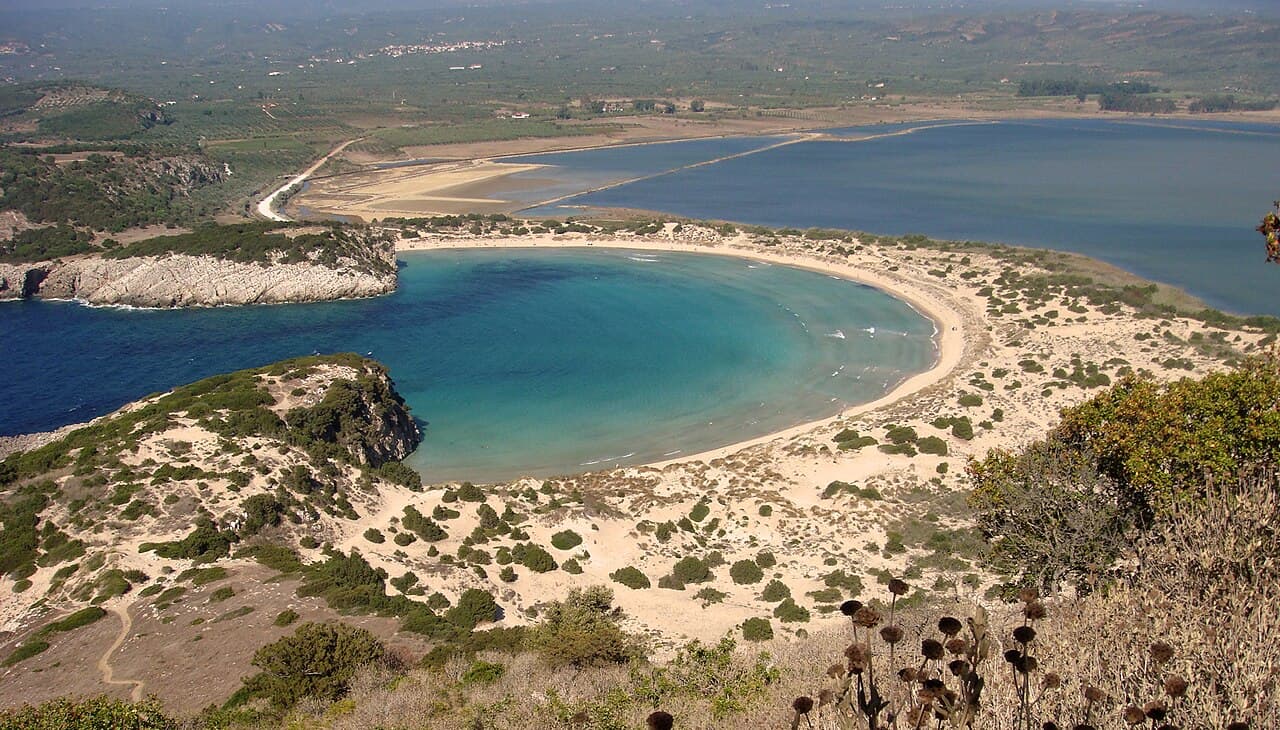
The horseshoe bay north of Pylos opens west into the Ionian, so the sun sets into the gap between the two arms of the bay. There is nothing here, which is the point: no bar, no loungers, a dune track from the car park, and the lagoon behind turning pink. Take water and something warm.
May to October · The bay faces almost exactly west, so the equinox sunsets in late March and late September sit dead centre in the gap.
 Arian Zwegers · CC BY 2.0 via Wikimedia Commons
Nafplio waterfront and the Bourtzi
From the town quay the islet fort sits to the west-northwest, on a bearing of about 291 degrees, and the midsummer sun sets at about 300, so for a few weeks either side of June the sun goes down just to the right of the Bourtzi, close enough to put the fort in the afterglow. The rest of the year it sets to the left of it, over the hills across the gulf, which is still the best free evening in Nafplio.
June for the alignment; year-round for the walk · Late June sunset is around 20:54, the latest of the year; by mid-October it is around 18:50, and after the clocks change on 25 October it is before 17:40.
 AlMare · CC BY-SA 3.0 via Wikimedia Commons
Methoni castle
The Venetian walls run out to sea on a causeway to the Bourtzi tower at the tip, and the whole thing faces due west. The castle closes with the site hours, 20:00 in high summer and earlier through the autumn, so the sunset itself is usually watched from the beach beside it, with the walls and the tower in silhouette.
April to October · The tower at the end of the causeway is the foreground; walk south along the beach until it sits against the sun.
Day trips
 Ivan Georgiev · Pexels
Mycenae, Nemea and a winery
The classic Argolid day from Nafplio: Mycenae at opening, before the heat and the coaches, then twenty minutes to Nemea for the stadium tunnel and the temple, then lunch and a tasting in the vineyards at Koutsi. Back in Nafplio for the evening walk.
25 minutes to Mycenae, 20 more to Nemea · Full day
 Tom D'Arby · Pexels
Epidaurus and the Argolid coast
The theatre and sanctuary in the morning, then down to the coast at Palaia Epidavros for a swim and a fish lunch, or on to Porto Heli and the Amanzoe beach if that is where you are heading. In August, come back in the evening for a festival performance under the stars.
35 minutes to Epidaurus · Half day, or a full day with the coast
 Giannis Chatzivrettas · Pexels
Corinth: canal, city and Acrocorinth
Best done on the way in from Athens or on the way out. The canal bridge at Isthmia first, then straight up to the Acrocorinth for the fortress walls and the view of both gulfs at once, because it closes at 15:30 all year and has to go before lunch, then down to Ancient Corinth and its museum.
50 minutes from Nafplio; 80 from Athens airport · Half day
 Norbert Paglia · Pexels
Mystras and the Sparta road
The bridge between the two halves of the trip rather than a day trip in the strict sense: leave Nafplio after breakfast, cross the Arcadian plateau on the motorway past Tripoli, and spend the middle of the day walking down through the Byzantine city from the upper gate. Sleep in Mystras, or push on an hour and a half to Monemvasia for sunset on the rock.
About 1 hour 45 from Nafplio; 1 hour 30 on to Monemvasia · Full day
 Lydia Griva · Pexels
The deep Mani loop
From Kardamyli or Limeni: Areopoli’s tower town, the Diros caves by boat, the old port at Gerolimenas for lunch, the empty towers of Vathia, and the walk out to the Cape Tenaro lighthouse and back before the light goes. A full day with about four hours of driving and an hour and a half on foot; fuel and water in Areopoli, because there is little after it.
40 minutes Kardamyli to Areopoli; 1 hour 15 on to the Tenaro car park · Full day
 Grzontan · CC BY-SA 3.0 via Wikimedia Commons
Ancient Messene and the Navarino coast
From Kardamyli: inland an hour to the city of Messene under Mount Ithome, then west through the olive country to Pylos, Voidokilia for a swim and the sunset, and back along the gulf road. Or make it one way and end at Costa Navarino for the last nights before a Kalamata flight.
1 hour to Messene; 1 hour more to Pylos · Full day
 Dimitris Mourousiadis · Pexels
Elafonisos and Simos beach
From Monemvasia, forty-five minutes round the coast to the Pounta quay, a ten-minute ferry crossing with the car, and the long twin crescents of Simos beach on the south side of the island, the best sand in the Peloponnese. Boats run continuously through the day in season and tickets are bought at the quay; we could not confirm 2026 fares on the operators’ own sites, so check them at the quay.
45 minutes to Pounta, 10 minutes on the water · Full day
After dark
 C messier · CC BY-SA 4.0 via Wikimedia Commons
The Nafplio volta
walkThe evening walk everyone in town takes: along the Akti Miaouli quay as the sun goes down behind the hills across the gulf, through Syntagma Square with its Venetian arsenal and cafe tables, and up into the lanes for an ouzo. It costs nothing and it is the best thing Nafplio does.
 Adrien Olichon · Pexels
A play at Epidaurus
performanceOn August weekends the Athens Epidaurus Festival stages ancient drama in the 4th-century BC theatre after dark, with the audience arriving through the pines at dusk. Performances at the ancient theatre ran 1 to 29 August in 2026; 2027 dates were not announced when we published. Book the moment they are.
 Adrien Olichon · Pexels
Monemvasia after the day-trippers leave
eveningFrom about six the lane empties, the stone goes gold, and the town belongs to the people sleeping in it. Climb to the upper town for the last light, come down for dinner on a terrace over the sea, and end with a glass of the local Malvasia on the walls.
 Lydia Griva · Pexels
Dinner on the Limeni water
diningThe tavernas on the harbour at Limeni put their tables a metre from the water, the bay faces west, and the sun goes into it while the fish is on the grill. Arrive an hour before sunset for a table at the front.
Daily itinerary
Nine days, two bases, one long bridge
The plan we would book: three nights in Nafplio for the Argolid, a day-long transfer south through Mystras to Monemvasia for two nights, then round the gulf to the Mani for three nights at Kardamyli or Limeni, and out through Kalamata. It assumes an Athens arrival and a Kalamata or Athens departure. Two rules govern the order: Lela’s is closed Sunday and Monday, and the Leigh Fermor house opens only on Mondays at noon, so if a Monday falls in the Mani, spend its lunchtime at Kalamitsi. The other constraint is the light: from September the sites close half an hour earlier every fortnight, so the ruins go in the mornings.
- 1
Athens to Nafplio by way of the canal
moderateCollect the car at Athens airport and take the motorway west. Israeli licence holders should carry an international driving permit alongside it; rental desks ask. Coming through passport control for the first time since 10 April 2026 means fingerprints and a photograph for the Entry/Exit System rather than a stamp, so allow the extra minutes.At the old bridge over the Corinth Canal at Isthmia, or at Ancient Corinth below the fortress.The Acrocorinth first if you can be at its gate comfortably before 15:30, which is its closing time all year, then Ancient Corinth and the museum on the 15-euro combined ticket. On to Nafplio, about 50 minutes.The Akti Miaouli quay, looking out at the Bourtzi.In the old town; the courtyard at 3Sixty if you have booked.Athens airport to Nafplio is about two hours of driving plus stops. Tolls on this stretch are under ten euros for a car in 2026. Park on the waterfront lots; the old town is not for cars.Estimate: If the flight lands late, skip Corinth and drive straight to Nafplio in about two hours
- 2
Mycenae, Nemea and wine
fullMycenae at 08:00: the Lion Gate, the grave circles, the cistern stair if you have a torch, then the Treasury of Atreus on the way out. 20 euros, museum included.In Nemea, twenty minutes on, or at the winery.The Nemea stadium and museum on the 10-euro ticket, then a tasting at Gaia in Koutsi, which opens Wednesday to Sunday from 10:30 to 16:30. If this is a Tuesday, swap this day with day three; if it is a Monday, day three is a Tuesday and Gaia is shut both days, so do the tasting on day one instead: Koutsi is fifteen minutes off the motorway at Corinth and the estate opens on Sundays until 16:30.Back in Nafplio.A taverna in the lanes; order the gogges.About 80 kilometres of driving in a loop. Buy the Mycenae ticket on the Ministry portal the night before to skip the booth.Estimate: Tiryns, ten minutes from Nafplio, opens 08:30 to 15:30 all year and is free of crowds if you want a second citadel
- 3
Epidaurus, then the fortress
moderateEpidaurus at opening: the theatre first, while it is quiet enough to test, then the sanctuary and the museum. 20 euros for all three.Fish at Palaia Epidavros on the coast, fifteen minutes away, and a swim.Back to Nafplio for the Palamidi, either up the stair from the town or by car to the top gate. In September it closes at 19:30 in the first half of the month and 19:00 in the second; in October 18:30 and then 18:00.From the fortress if the hours allow, otherwise the Arvanitia path.Somewhere simple; tomorrow is a long day.Epidaurus is 35 minutes east. Doing it and the Palamidi on the same day works because they are in opposite directions from the same hotel.Estimate: On an August festival weekend, do the Palamidi in the morning and Epidaurus in the evening for the play
- 4
South to Mystras and on to the rock
fullLeave Nafplio by nine, or by half past seven from November to March when Mystras shuts at 15:30 and the light goes early, and take the motorway across Arcadia past Tripoli to Sparta, about an hour and three-quarters. Tolls on this leg come off the Moreas 2026 sheet, 2.80 at Nestani, 2.30 at the Manari bridge and 3.45 at Petrina on the Sparta branch; the 2.95 at Spathovouni is the Corinth-end gate, which you join the motorway below when you drive from Nafplio.In the village of Mystras below the site.Mystras from the upper gate down: the castle, the palace, the frescoed churches, the nunnery. 20 euros, closing on the same autumn schedule as the rest. Then an hour and a half southeast to Monemvasia; park at Gefyra, walk the causeway, and carry the bags in.From the upper town of Monemvasia, reached through the gate above the main lane.On the rock; Chrisovoulo if booked.About 210 kilometres and three and a half hours of driving with the Mystras stop. If you would rather split it, Euphoria Retreat at Mystras is the spa night, and Monemvasia becomes day five.Estimate: Sleep at Kinsterna on the mainland instead of inside the walls and drive in for dinner
- 5
Monemvasia and Elafonisos
relaxedSunrise from the sea walls, then the climb to Agia Sofia on the summit before the heat.On Elafonisos, after the 45-minute drive to Pounta and the ten-minute ferry.Simos beach until the light goes soft.Back on the rock, or on the ferry quay looking west.A taverna on the lane.The Elafonisos ferry is turn-up-and-go with tickets at the quay; check the last boat back when you buy the first one.Estimate: Skip the island and do nothing on the rock, which is a perfectly good use of a day · A Malvasia tasting at one of the wineries around Monemvasia and Molai
- 6
Round the gulf to the Mani
moderateMonemvasia to Gythio, about an hour and twenty minutes, for a coffee on the harbour, then over the neck of the peninsula to Areopoli, half an hour more.On the water at Limeni.The Diros caves, fifteen minutes south: 12 euros for the boat and the walk, booth closes at 16:15. Then north up the coast road to Kardamyli, about an hour, or settle at Limeni if that is the base.Limeni, which faces due west, or the Kardamyli waterfront, which does too.Lela’s if it is a Tuesday to Saturday and you booked; otherwise a taverna on the Kardamyli shore.About 150 kilometres and three hours of driving, all of it on two-lane roads once you leave Gythio. Fuel in Gythio or Areopoli.Estimate: Break the day at Gerolimenas and sleep at Kyrimai, then do the deep Mani from there tomorrow
- 7
The deep Mani and the end of mainland Greece
fullSouth again, past Areopoli and Gerolimenas to Vathia, about an hour and twenty minutes from Kardamyli, then to the Tenaro car park and the two-kilometre path to the lighthouse.At the taverna by the car park after the walk, or back at Gerolimenas at Kyrimai.The swim in the cove by the ruined temple on the way back from the lighthouse, then the slow drive north with stops at whichever tower village pulls you in.Limeni on the way home.Kardamyli.About four hours of driving and an hour and a half on foot. Take water; the path has no shade and no water at the end.Estimate: If day seven is a Monday, the Leigh Fermor house is open today and only today: do it at noon, keep the afternoon for the outer Mani and the Viros gorge, and move the deep Mani and Tenaro to day eight, picking up Messene on the drive out
- 8
Messene, Voidokilia and the west
fullInland an hour to Ancient Messene: the stadium, the agora, the Arcadian gate. 15 euros; closed Tuesdays only in winter.In Mavrommati above the site, or in Pylos on the square.West to Pylos and Voidokilia for the afternoon on the sand, with the climb to the old castle on the headland for the view.Voidokilia, into the gap between the bay’s two arms.Back in Kardamyli, an hour and a half, or at Costa Navarino if you have moved there for the last night.About 200 kilometres as a loop from Kardamyli. If flying from Kalamata tomorrow, sleep tonight at Costa Navarino or in Kalamata instead and skip the drive back.Estimate: Methoni castle instead of Voidokilia, 5 euros, closed Tuesdays · A rest day in Kardamyli with the Viros gorge walk
- 9
Out through Kalamata
relaxedKalamata is 45 minutes from Kardamyli on the coast road. The market by the port, a bag of olives and a bottle of oil, then the airport ten minutes west of town, or the motorway north.Fly from Kalamata, or drive the motorway to Athens: about two and three-quarter hours, with tolls of roughly sixteen euros across seven plazas.Home.Kalamata airport runs a seasonal international schedule, roughly May to October; check the one-way rental fee before choosing it over Athens. If the flight is early, sleep in Kalamata the night before.Estimate: Add two nights and loop out west via Olympia and the new Patras to Pyrgos motorway, crossing the Rio-Antirrio bridge, 15.90 euros, to the mainland side of the Corinthian Gulf and back to Athens
Five days from Nafplio
For a short trip or an add-on to Athens, unpack once in Nafplio and do the Argolid properly: the four ancient sites, the fortress, the wine, and one long day south to Mystras, or two with a night at Monemvasia. The Mani deserves its own trip; do not try to fold it into five days.
- 1
Arrive via Corinth
moderateAthens airport to the Corinth Canal bridge, then the Acrocorinth before its 15:30 close and Ancient Corinth below it afterwards; on a late landing, skip the fortress.On to Nafplio, check in, and the Arvanitia path around the rock.The quay.Old town.Two hours of driving plus the Corinth stops.Estimate: Straight to Nafplio if you land after midday
- 2
Mycenae and Nemea
fullMycenae at opening.Nemea.The stadium and a winery tasting; Gaia is Wednesday to Sunday.Nafplio.Gogges somewhere simple.Estimate: Tiryns on the way back, free of crowds, 08:30 to 15:30 · If day two is a Tuesday, swap it with day three; if it is a Monday, Gaia is shut today and tomorrow, so do the tasting on the way in on day one, since Koutsi is fifteen minutes off the motorway at Corinth and the estate opens on Sundays until 16:30
- 3
Epidaurus and the Palamidi
moderateThe theatre and sanctuary.Palaia Epidavros, with a swim.The Palamidi before its autumn closing time.From the fortress or the quay.Book 3Sixty.Estimate: A festival night at the theatre in August
- 4
The long day south
fullMotorway to Sparta and Mystras, an hour and three-quarters.Mystras village.The Byzantine city from the top gate down, then back the same way; or push on to Monemvasia and sleep there, returning tomorrow.On the drive back over Arcadia, or on the rock.Nafplio, late, or Monemvasia.About three and a half hours of driving as a return; roughly six if you add Monemvasia and come back the same night, which is why sleeping there is better.Estimate: Dimitsana and the Lousios gorge instead, an hour and a half each way over the mountains
- 5
Bourtzi and out
relaxedThe shuttle boat to the Bourtzi, 7 euros, open from 09:00, and the Wednesday or Saturday market if the day fits.Drive to Athens, two hours.Fly.Estimate: Karathona beach for a last swim, ten minutes south of town · If you slept at Monemvasia last night, the Bourtzi is not happening: drive straight to Athens, about four hours, and keep the boat for another trip
Getting around
- Athens is the gateway. Tel Aviv to Athens is about two hours in the air, flown by El Al, Aegean, Arkia, Israir and several others, with dozens of weekly rotations in summer 2026. From the airport the Attiki Odos and the Olympia Odos motorway put you on the Corinth Canal bridge in about eighty minutes and in Nafplio in about two hours.
- Kalamata is the southern gateway, and the news of 2026. A 40-year concession for the airport was signed in June 2026 with a consortium led by Fraport, on a 45-million-euro initial payment and an investment programme expected to reach 125 million euros, including a new terminal. Over 92 percent of its passengers already arrive on international flights, and the schedule is seasonal, roughly May to October, with Aegean, Ryanair, easyJet, Jet2, Condor, Transavia and Wizz among the carriers. Flight aggregators list an Arkia service from Tel Aviv for summer 2026; we could not confirm it on the airline’s own site or on the airport’s published route lists, so treat Athens as the reliable way in and Kalamata as a bonus to check with the airline.
- Since 10 April 2026 the EU Entry/Exit System has been fully operational at every external Schengen border, Greece included. Non-EU short-stay travellers, Israelis among them, are registered with a facial image and fingerprints on first entry and passport stamping has ended. It adds minutes at the booth on a first visit and less afterwards. ETIAS, the pre-travel authorisation, was still not in operation when we published and had no confirmed start date.
- Israeli passport holders travel visa-free in the Schengen area for up to 90 days in any 180. The Israeli driving licence is not on Greece’s list of exempt foreign licences, so carry an International Driving Permit with it; rental companies ask, and so can the police.
- A car is the trip. Book it for the airport, expect a one-way fee if you drop it in Kalamata, and take the full insurance: the Mani and Arcadian roads are narrow, the FCDO describes Greek driving as fast and chaotic, and drink-driving is enforced at two-thirds of the England limit. Automatic cars are scarcer and dearer; book them early.
- Motorway tolls are per plaza, cash or card, no vignette. The Moreas motorway from Corinth to Kalamata and Sparta published its 2026 car tariff on its own site: 2.95 euros at Spathovouni, 2.80 at Nestani, 2.30 at the Manari bridge, 1.45 at Veligosti, 2.25 at Kalamata and 3.45 at Petrina on the Sparta branch, with smaller side-station charges of 0.55 to 0.90. Athens to Kalamata runs to about 16 euros across seven plazas including the Olympia Odos stretch; Athens to Nafplio is under ten. The Rio-Antirrio bridge, if you loop out west, is 15.90 one way for a car from 1 January 2026.
- The Patras to Pyrgos motorway opened in full on 4 December 2025, all 74.8 kilometres, which for the first time makes Olympia a motorway drive from the north and turns the western loop from Kalamata to Athens via Olympia and the bridge into a realistic single day.
- Buses exist and are good on the trunk routes: KTEL Argolida runs Athens to Nafplio in a little over two hours from the Kifisou terminal, and KTEL Messinias runs Athens to Kalamata in about three and a quarter. Their own sites refused our connections, so we cannot print 2026 fares; expect the low teens to Nafplio and the twenties to Kalamata. There is no direct bus to Monemvasia; you change at Sparta. The Mani, the Navarino coast and the ancient sites are not practical by bus.
- There is no passenger train into the Peloponnese interior. The Athens suburban rail reaches Kiato on the Corinthian coast and no further, and the Corinth to Kalamata line has been out of use for years. The Kalavryta rack railway from Diakopto was suspended on 12 March 2026 after rockfalls on Mount Chelmos; a reopening was being studied in April and we found no confirmed date by September. Do not build a day around it.
- The Elafonisos ferry from Pounta takes about ten minutes, runs continuously through the day in season, carries cars, and sells tickets at the quay rather than online. We could not reach the operators’ own pages for 2026 fares, so confirm the passenger and car prices at the ramp; they are modest.
- Fuel is roughly 1.80 to 2.00 euros a litre and stations thin out south of Areopoli and in the Arcadian mountains. Fill up in towns.
Things worth knowing
- · Trying to drive the whole peninsula in a week. Nafplio to the Mani and back is 500 kilometres of mostly two-lane road; pick two main bases and let the rest go.
- · Arriving at a site at half past five in October, when it shuts at 18:30 in the first half of the month and 18:00 in the second, or at four in November, when it closed at 15:30. From 1 September the state sites close earlier every fortnight; the Acrocorinth closes at 15:30 all year.
- · Assuming a reduced ticket in summer. At Mycenae and the Palamidi there are none from June to September.
- · Planning Kalavryta around the rack railway, which has been suspended since March 2026.
- · Turning up at Lela’s on a Sunday or Monday, at Gaia on a Monday or Tuesday, at Ancient Messene or Nemea on a winter Tuesday, or at Methoni on any Tuesday.
- · Driving into Monemvasia or the old town of Nafplio. Neither has room for you; park outside and walk.
- · Booking a Mani tower hotel for November without checking its season. Tainaron Blue closes on 31 October and it is not alone.
Budget
| Low | Expected | Comfortable | |
|---|---|---|---|
| Accommodation style / per night | €70≈ $81 | €150≈ $173 | €450≈ $518 |
| Food style / per day | €30≈ $35 | €60≈ $69 | €130≈ $150 |
| Local transport / per day | €25≈ $29 | €40≈ $46 | €80≈ $92 |
| Estimate / per day | €10≈ $12 | €25≈ $29 | €45≈ $52 |
Estimate · EUR · 2026-09-11. Quoted in euros per person per day, except accommodation, which is per room per night on a double-occupancy basis. The Bank of Israel put the euro at 3.514 shekels and the dollar at 3.023 on 10 September 2026, so the expected daily figure of about 125 euros a head before the room is roughly 440 shekels. Local transport assumes a shared rental car, fuel and tolls split between two; the comfortable band assumes an automatic and one-way drop fees. Attractions reflect the 20-euro headline sites: a couple doing Mycenae, Epidaurus, Mystras and the Palamidi spends 160 euros on admission alone, and the free days listed above are worth planning around. Add the climate resilience fee on every night from April to October: 15 euros per room per night at a 5-star hotel, 10 at a 4-star, 4 at a 3-star, 2 at a 1- or 2-star, and 8 for a short-term rental, with far lower rates from November to March. The day-trip figure covers the Elafonisos ferry or a wine tasting plus fuel and replaces that day’s transport and attraction lines rather than adding to them. · 1 USD = €1 (17 Sep 2026)
Things worth knowing
Frequently asked questions
Do I need a car for the Peloponnese?
Yes. Nafplio can be reached by KTEL bus from Athens in a little over two hours and works as a car-free town for a few days, but Mycenae, Epidaurus, Mystras, the Mani and the west coast do not work without one. Book an automatic early if you need one, take full insurance, and carry an International Driving Permit alongside an Israeli licence, which is not on Greece’s exemption list.
Which base should I choose: Nafplio or the Mani?
Both, if you have a week or more; Nafplio alone for five days. Nafplio puts the four great ancient sites, the fortress and the Nemea wineries within an hour. The Mani, based at Kardamyli or Limeni, is towers, caves, sea and the walk to Cape Tenaro, with Ancient Messene and Voidokilia a day out. The day between them, over Arcadia to Mystras and on to Monemvasia, is the best drive in the region.
When is the best time to go?
Late April to mid-June and September to October. In autumn the sea is still warm, the sites are quiet and the vintage is in; the catch is that from 1 September the sites close half an hour earlier every fortnight and at 15:30 from November, so mornings are for ruins. July and August are hot, busy and the wildfire months, though August is when Epidaurus stages plays. Winter is cheap and clear, with free Sundays at the sites and many Mani hotels closed.
How much do the ancient sites cost in 2026?
The big ones are 20 euros each: Mycenae, Epidaurus, Olympia, Mystras and the Palamidi, with the museums included at Mycenae, Epidaurus and Olympia. Ancient Corinth and Ancient Messene are 15, Nemea and the Pylos castle 10, the Bourtzi 7, Methoni 5, and the Acrocorinth free. A couple doing the four headline sites pays 160 euros. Reduced tickets are not sold at all in summer at Mycenae and the Palamidi. Free days include the last weekend of September, 28 October and the first and third Sundays from November to March.
Can I fly from Tel Aviv to Kalamata?
Not reliably as of September 2026. Flight aggregators list an Arkia summer service, but we could not confirm it on the airline’s own site, which blocks automated access, or on Kalamata airport’s published 2026 route lists, which name Aegean, Ryanair, easyJet, Jet2, Condor, Transavia and Wizz among others. Athens is two hours from Tel Aviv on El Al, Aegean, Arkia and Israir, and Kalamata is under three hours from Athens airport by motorway. Kalamata’s new Fraport-led concession, signed in June 2026, may change the route map; ask the airlines.
Is the Corinth Canal open?
To ships, yes, again: it was closed from mid-November 2025 to 17 June 2026 for slope repairs. To you, it was never closed: you cross it on the motorway and stop at the old bridge at Isthmia to look down. Boat trips through the canal and the bungee platform on the bridge run in season.
Is the Kalavryta rack railway running?
Assume not, and check before you go. Service on the Diakopto to Kalavryta line was suspended on 12 March 2026 after rockfalls on Mount Chelmos, studies were under way in April, and we found no reopening announcement by September, which is not the same as a confirmed closure. Kalavryta, the Mega Spileo monastery and the 1943 memorial are all reachable by road; the train was the attraction, and it is worth checking again before a spring 2027 trip.
What changed at the border in 2026?
The EU Entry/Exit System became fully operational on 10 April 2026. Non-EU travellers, including Israelis, now have their facial image recorded on first entry, with fingerprints from the age of twelve, and the passport stamp has gone. Allow extra time at Athens on a first visit. ETIAS, the online pre-authorisation, was still not in operation when we published, with no confirmed date.
How many days do I need?
Nine is the number in this guide: three in Nafplio, two at Monemvasia with Mystras on the way, three in the Mani, and one to leave. Five works for Nafplio and the Argolid alone. Eleven lets you add Olympia and the western loop home over the Rio-Antirrio bridge on the new motorway, and twelve buys a stretch at Costa Navarino on top. A week that tries to cover everything sees most of it through a windscreen.
Sources (29)
- Mycenae: EUR 20 full, EUR 10 reduced, ticket covers the site, museum and Treasury of Atreus; reduced tickets valid 1 October to 31 May only; winter 08:30 to 15:30, April 08:00 to 19:00, 2 May to 31 August 08:00 to 20:00, then 19:30, 19:00, 18:30 and 18:00 closing in half-month steps through September and October 2026; free days 6 March, 18 April, 18 May, last weekend of September, 28 October, and first and third Sundays November to March · government · 2026-09-11
- Sanctuary of Asklepios at Epidaurus: EUR 20 full, EUR 10 reduced for the theatre, site and museum; summer hours 08:00 to 20:00 from 2 May 2026, closing 19:30, 19:00, 18:30 and 18:00 through September and October 2026 · government · 2026-09-11
- Olympia: EUR 20 full, EUR 10 reduced, one-day ticket covering the site, the Archaeological Museum, the Museum of the History of the Olympic Games of Antiquity and the Museum of the History of the Excavations, no single-area ticket; open daily 08:00 to 20:00 from 1 April 2026, last admission 20 minutes before closing · government · 2026-09-11
- Mystras: EUR 20 full, EUR 10 reduced, POS at both gates; 08:30 to 15:30 from 1 November to 31 March, 08:00 to 20:00 from 1 April to 31 August, then 19:30, 19:00, 18:30 and 18:00 through the half-months of September and October; Palace of the Despots opens at 11:00 on Tuesdays in summer hours · government · 2026-09-11
- Fortress of Palamidi: EUR 20 full, EUR 10 reduced, reduced valid 1 October to 31 May only; winter 08:30 to 15:30, summer 08:00 to 20:00 from 2 May 2026 with autumn closing at 19:30, 19:00, 18:30 and 18:00 in half-month steps · government · 2026-09-11
- Bourtzi: EUR 7 full, EUR 5 reduced; July and August daily 09:00 to 21:00, September daily 09:00 to 20:00, October weekdays 09:00 to 17:00 and weekends 09:00 to 18:00, November and December daily 09:00 to 17:00 · government · 2026-09-11
- Ancient Corinth: EUR 15 full, EUR 8 reduced on a combined ticket for the site and museum · government · 2026-09-11
- Acrocorinth: free admission, open 08:30 to 15:30 every day of the week in both the summer and winter seasons · government · 2026-09-11
- Ancient Messene: EUR 15 full, EUR 8 reduced; 1 November to 31 March 08:30 to 15:30 closed every Tuesday; 1 April to 31 October 08:00 to 20:00 with September and October closing at 19:30, 19:00, 18:30 and 18:00 in half-month steps · government · 2026-09-11
- Archaeological Museum of Nemea: EUR 10 full, EUR 5 reduced, combined ticket for the museum, the Temple of Zeus site and the ancient stadium · government · 2026-09-11
- Castle of Methoni: EUR 5 full, EUR 2.50 reduced; summer 08:00 to 20:00, winter 08:30 to 15:30, closed on Tuesday; Archaeological Museum in Niokastro of Pylos: EUR 10 full, EUR 5 reduced combined with Pylos castle · government · 2026-09-11
- Visit Greece describes Voidokilia, just outside Pylos in western Messenia beside the Gialova Lagoon, as a near-perfect semicircle of fine pale sand and turquoise water, part of the mythological realm of Nestor’s kingdom, with the lagoon in the Natura 2000 network · tourism-board · 2026-09-11
- Diros caves: short tour of lake and land sections EUR 12 regular and EUR 10 reduced, land section EUR 9 and EUR 6; 09:00 to 17:00 from 1 April to 31 October with the booth closing 16:15, 08:30 to 16:30 from 1 November to 31 March with the booth closing 15:45 · official · 2026-09-11
- Moreas motorway 2026 toll announcement dated 2 December 2025: category 2 car rates from 00:00 on 1 January 2026 of EUR 2.95 Spathovouni, 2.80 Nestani, 2.30 Manari bridge, 1.45 Veligosti, 0.90 Paradeisia and Arfara side stations, 2.25 Kalamata, 0.55 Thouria side station and 3.45 Petrina · transport-operator · 2026-09-11
- The Entry/Exit System became fully operational on 10 April 2026 following a progressive start of operations from 12 October 2025, replacing passport stamping with digital records and registering facial image, fingerprints and travel-document data of non-EU short-stay travellers · government · 2026-09-11
- Bank of Israel representative rates on 10 September 2026: EUR 3.514 and USD 3.023 shekels · government · 2026-09-11
- FCDO travel advice for Greece states a high risk of wildfires from April to October, asks visitors to register phones for emergency alerts and not to light fires, warns that local drivers regularly ignore speed limits and do not always stop at crossings, and that drink-driving above two-thirds of the England limit brings fines and possible imprisonment · government · 2026-09-11
- Greece signed a 40-year concession for Kalamata International Airport with a consortium led by Fraport AG, with an initial consideration of EUR 45 million and an investment programme expected to reach EUR 125 million including a new terminal building; over 92 percent of the airport’s passengers arrive on international flights · airport · 2026-09-11
- The Corinth Canal was fully reopened to maritime traffic as of Wednesday 17 June 2026 after a closure since mid-November 2025, according to the managing company · reputable-local · 2026-09-11
- The Diakopto to Kalavryta rack railway was suspended on 12 March 2026 until further notice after landslides and rockfalls · reputable-local · 2026-09-11
- The Patras to Pyrgos motorway opened in full on 4 December 2025, completing the 74.8 km project · reputable-local · 2026-09-11
- Wildfires in the Peloponnese in August 2026 included Kremasti near Sparta on 20 August, with a national burned area for 2026 reported at 31,517 hectares, 37 percent below the twenty-year average · reputable-local · 2026-09-11
- Performances at the Ancient Theatre of Epidaurus in the 2026 Athens Epidaurus Festival ran from 1 to 29 August 2026 · event-organizer · 2026-09-11
- The climate resilience fee under Law 5162/2024 is charged per room per night: EUR 15 at 5-star, 10 at 4-star, 4 at 3-star and 2 at 1- and 2-star hotels from April to October, with lower rates from November to March, and EUR 8 in high season for short-term rentals · reputable-local · 2026-09-11
- PDO Nemea, ratified in 1971, requires 100 percent Agiorgitiko · reputable-local · 2026-09-11
- PDO Monemvasia-Malvasia was established in July 2010 over Monemvasia, Asopos, Vies and Molai, for sweet wines from sun-dried grapes of at least 51 percent Monemvasia, oxidatively aged a minimum of two years · reputable-local · 2026-09-11
- Tainaron Blue Retreat, a restored early-19th-century tower with four rooms near Cape Tenaro, operates from 29 May to 31 October 2026 · official · 2026-09-11
- Gaia Wines at Koutsi, Nemea opens all year Wednesday to Sunday 10:30 to 16:30 with guided tastings from EUR 20 to EUR 70 per person · official · 2026-09-11
- Lela’s Taverna in Kardamyli, family-run since 13 August 1983, opens Tuesday to Saturday 18:00 to 23:00 · restaurant-official · 2026-09-11