Greece · Cyclades
Naxos
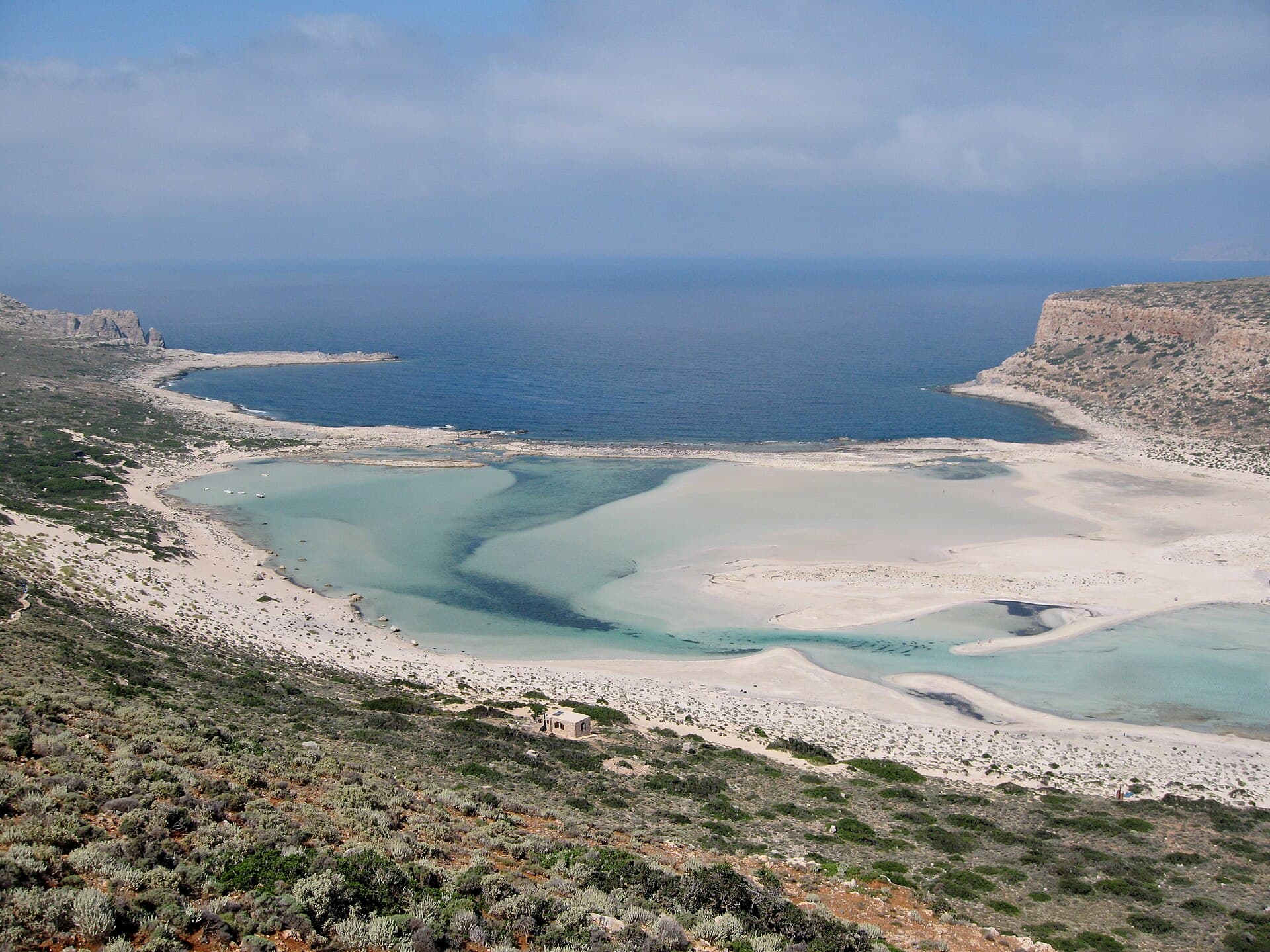
Stay on the west coast, where the beaches from Agios Georgios down to Plaka face Paros, whose hills stand 9 to 19 kilometres off across the strait. Hire a car and spend the middle of the trip inland: the Tragaea valley and Halki for the kitron distillery, Filoti and the path up Mount Zas, Apiranthos for its marble lanes and small museums, and the kouroi at Flerio and Apollonas. Watch one sunset from the Portara, knowing it now stands behind a fence you look through, and one from the top of Zas. Eat graviera, arseniko and Naxos potatoes where they are made. Note that the Archaeological Museum is closed for works and its collection is shown free in a temporary exhibition at Agia Ursula in the Kastro, 09:00 to 14:00, closed Tuesdays.
 TimOve / CC BY 2.0 via Wikimedia Commons
Overview
Naxos is the largest island in the Cyclades and the highest, with Mount Zas at 1,004 metres in the middle of it, and it is the one that does not have to sell you its view to pay its bills. It feeds itself: the graviera cheese has been a protected designation of origin since 1996, the hard aged arseniko joined the EU register in 2020, the potato carries a protected geographical indication across the whole island, and Kitro Naxou, the citron liqueur distilled in Halki since the nineteenth century, is one of Greece’s registered spirit drinks. That farming economy is visible from the road. Behind the west-coast beaches the island rises into the Tragaea, an inland valley of olive groves, Venetian tower houses and Byzantine chapels, and above it sit the marble villages of Filoti and Apiranthos and the three unfinished colossal statues that the Archaic sculptors abandoned in their quarries, one of them 10.45 metres long. Chora, the port town, has the Portara, the marble gateway of a temple of Apollo begun in 530 BC and never finished, standing alone on an islet joined to the harbour by a causeway. There is no direct flight from Tel Aviv: you come through Athens, or through Mykonos or Santorini and a ferry, which filters out some of the crowd and is part of why the island still feels like a place where people live.
Pick Naxos for the island behind the beach. The Tragaea villages, Mount Zas and the unfinished kouroi are what the neighbours do not have, and a week here should give them at least half its days. Then treat the sunsets with the same care we did. Computed from SRTM terrain against NOAA sun positions, the Portara never catches the sun inside its gate: from 27 August to 15 April the sun goes down behind the hills of Paros, and behind Profitis Ilias, the Parian summit, from 23 January to 8 February and 2 to 19 November; from mid-April to late August it sets over the low north-east tip of Paros, which reads as a sea sunset with a dark sliver of land under it. Plaka is the only west-coast beach we checked with a true sea sunset, and only in two short winter windows, 28 November to 5 December and 6 to 13 January. Apiranthos loses the sun 54 to 84 minutes before the almanac every day of the year, behind the Fanari ridge a few hundred metres west of the village. The summit of Zas does the opposite: from 1,004 metres the sea horizon drops away and the sun sets 4 to 6.5 minutes after the almanac time. Apollonas on the north coast has an open-sea sunrise from 12 May to 1 August. And in Chora first light on 21 June reaches the Portara 13 minutes after the official sunrise, because the island’s own mountains stand in front of it. These are computed figures, good to about a minute; the terrain is the reason Naxos has a sunset worth planning, and the reason not to believe the postcard caption.
Best for
Couples · Families · Food travellers · Walkers · A first Cyclades island with a car · Island hoppers heading to the Small Cyclades
Daily itinerary
5 to 8 days
Most Cycladic islands are a harbour, a ridge and a sunset, and the sunset is the product. Naxos is big enough to have an interior, and the interior is the reason to choose it over Paros, Mykonos or Santorini: a valley that grows what you eat at dinner, villages at 300 to 600 metres where the air is cooler in August, a summit you can walk to in a morning, and archaeology that sits in fields and quarries without a queue. The second difference is honesty about the famous postcard. We computed the sun against the terrain for every day of 2026, and the picture of the sun setting through the Portara gate is framed, not aligned: the doorway faces about 320 degrees, roughly nineteen degrees north of the farthest-north sunset of the year, so the sun never sets on its axis. What the Portara actually offers is still very good, and this guide tells you what it is and when.
Best time to visit
Naxos is a sea and walking destination, and the two want different months. The Hellenic National Meteorological Service averages at the airport put the daily high at 25.9C in June, 27.1C in July, 27.0C in August and 25.1C in September, mild for the Aegean because of the meltemi, the northerly that blows from the north sector on about nine days in ten in July and August. Modelled sea temperatures off Chora for 2021 to 2025 peak at 25.6C in August and hold 24.7C in September, warmer than July, while June is still around 22C. Rain is almost absent from June to August and returns in October. For swimming, September is the best month; for walking the interior and climbing Zas, May, June and late September into October are better, because the hills have little shade.
- April to May: Green hills and cool water, around 17C to 19C at sea. The walking season, and the Mount Zas summit has an open-sea sunset from 12 to 22 April. From 12 May the sun rises straight out of the open sea at Apollonas on the north coast, and keeps doing so until 1 August.
- June: The month we would pick for a walking-and-beach trip. Highs near 26C, sea around 22C, and the longest days: sunrise 05:58 and sunset 20:41 in Chora on the 21st. From 24 May to 18 July the sun sets into open sea as seen from the summit of Zas, and the off-axis Portara photographs, the sun framed inside the gate, work best from late May to mid-July.
- July to August: Hot on still days inland, windy on the coast. The meltemi blows from the north on about 91 percent of days in both months, and around one day in five reaches force 5 or more in modelled data that tends to under-read the gusts. Agios Nikodimos, the island’s patron saint, on 14 July; the Festival of Naxos through the summer; 15 August in Filoti; Maria Farantouri was on the Bazeos Tower programme for 5 August 2026.
- September: The best sea of the year after August and the start of the good walking weather. From 16 to 29 September the sun sets behind Profitis Ilias on Paros as seen from Plaka, 12 to 13 minutes before the almanac. The Festival of Naxos closed its 2026 season on 16 September. The last weekend is free entry at the state sites.
- October to November: Sea still around 22.7C in October, then the season folds: clocks change on 25 October, rain returns, hotels start closing. The Portara sunset goes behind Profitis Ilias itself from 2 to 19 November, about 11 to 12 minutes early.
- December to March: Quiet, wet and cheap, with highs of 14C to 16C. Plaka has its open-sea sunset windows, late November to early December and 6 to 13 January. Delos is shut in winter. From 23 January to 8 February the Portara sunset falls behind the Profitis Ilias summit block on Paros.
Things worth knowing
- Festival of Naxos (26th edition in 2026, Bazeos Tower near Sangri): the island’s cultural season since 2001, in a seventeenth-century tower. The 2026 programme ran from late May to mid-September, with Maria Farantouri on 5 August, Nikos Xydakis on 2 August and a Maria Callas evening closing the season on 16 September; evening shows start at 21:00 or 21:30. The AFI collective exhibition in the tower runs 31 May to 11 October 2026, 10:00 to 17:00. Avoid bazeostower.gr, which is now a casino spam site; the festival’s real site is naxosfestival.gr.
- Agios Nikodimos (14 July): the patron saint of Naxos, celebrated in Chora and Glinado, with the 2026 Nikodimeia running 6 to 14 July and the big procession on the 13th and 14th.
- August panigiria: Sotiros on 6 August in Glinado, Damarionas and Kourounochori; the Panagia on 15 August across the island and above all in Filoti, with the Filoti association’s own festival on 17 August; the ninth-day feast on 23 August; Ai Giannis on 29 August at Apeiranthos, Apollonas and Agersani.
- Kalami Festival at Mikri Vigla (August): open-air concerts by the beach, a 15-euro ticket for the 5 August 2026 night.
- European Heritage Days (last weekend of September, 26 to 27 September 2026): free entry at every state site on the island and at Delos.
- Dionysian Carnival of Naxos: held on Sunday 22 February 2026, announced by the municipality. The 2027 date follows Orthodox Easter and was not published when we checked.
- A summer wine festival called the Dionysia is widely listed with conflicting dates, and we found no 2026 edition on the municipality’s own pages, so we print no date for it.
Where to stay
 Manfred Werner (Tsui) · CC BY-SA 4.0 via Wikimedia Commons
Chora: Bourgo, Kastro and Grotta
The capital and the port, built over a town inhabited since about 4000 BC. The Venetian Kastro of 1207 sits on the hill with its lanes and the Agia Ursula building where the archaeological collection is now shown; Bourgo, the Greek lower town, runs between it and the harbour with the old market street where Metaxi Mas keeps its tables; Grotta is the seafront district to the north, below the cathedral, facing the Portara islet and its causeway. It is the only base on the island that works without a car: every ferry docks here and every bus leaves from here.
Best for: A first night off the ferry · No car · Evenings in lanes rather than on a beach · The Portara at sunset
It is very busy in high summer, and the Kastro is a building site for the Museum Island project: the Glezos Tower is closed for works and the archaeological museum building is shut. Driving and parking in the centre is hard in July and August, and parking on the main roads near the port is fined. First light reaches the harbour front 35 minutes after the official sunrise in June, because the Kastro hill stands in front of it.
 Bgabel · CC BY-SA 3.0 via Wikimedia Commons
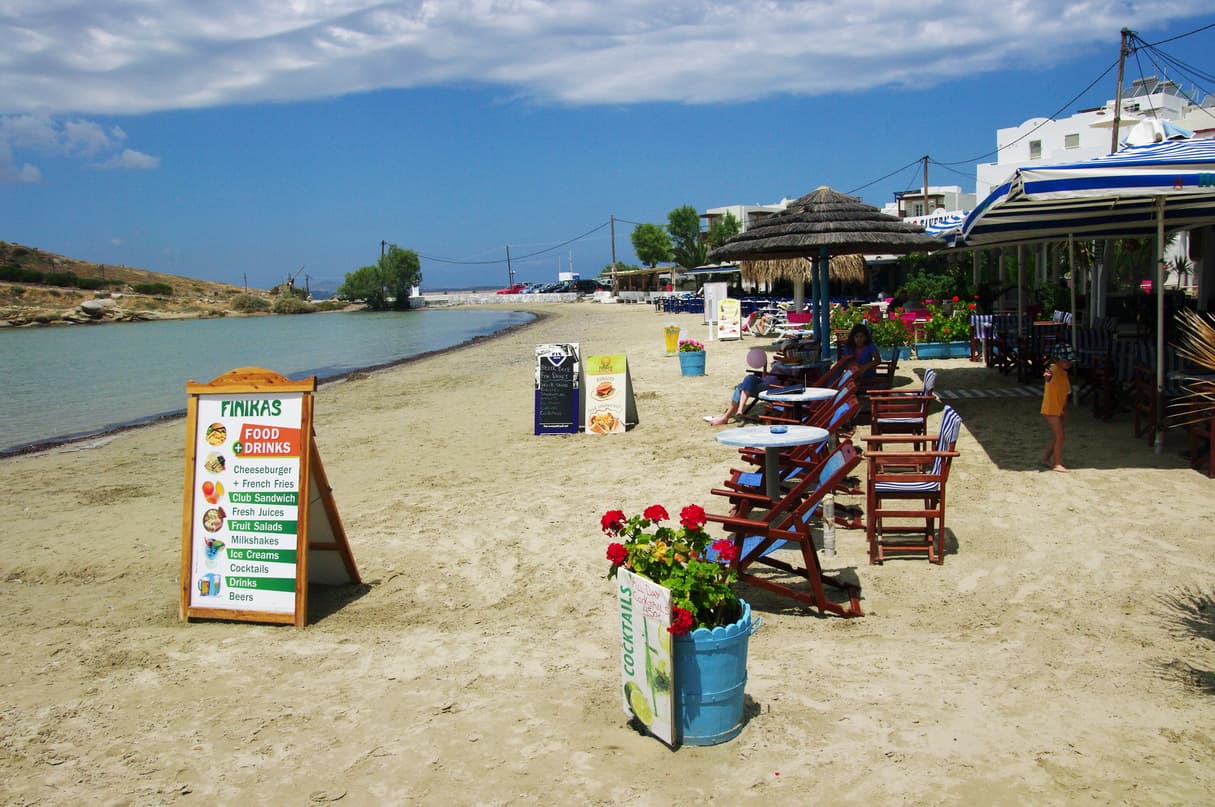
Agios Georgios, the town beach
The long, shallow sandy bay immediately south of Chora, a walk from the old town, lined with small family hotels and cafes and with the windsurf school at its southern end. It is the easiest place on the island to have a beach and a town in the same evening. The sunset faces Paros: from 28 April to 14 August the sun goes down over the low north-east tip of Paros, costing a minute or two against a flat sea, while from 10 November to the end of January the Stelida hill, 2.6 kilometres to the south-west, takes it about ten to fourteen minutes early, except from 12 to 31 December, when southern Paros takes it about nine minutes early.
Best for: Families with small children · A beach you can walk to from Chora · Budget and mid-range hotels · Learning to windsurf
A town beach, organised and busy, with the airport about three kilometres away. Do not confuse it with the southern hamlet of Agios Georgios, which some map searches return first.
 Jules Verne Times Two · CC BY-SA 4.0 via Wikimedia Commons
Agios Prokopios and Stelida
A kilometre and a half of golden sand six kilometres from Chora, a Blue Flag beach many times over, calm at its northern end even when the meltemi is up, with beach bars and watersports to the south and a small pink salt lake behind. Stelida, the hill between it and Agios Georgios, carries most of the island’s design and luxury hotels, and, according to the Villa Marandi site, has turned up stone tools dated to about 270,000 years ago. Line 1 buses run to Chora roughly every half hour into the night in summer.
Best for: The best all-round beach base · Couples · Design hotels on the Stelida hill · A bus to Chora instead of a car
From the middle of the beach the Stelida headland, less than a kilometre north-west and only 24 to 38 metres high, takes the sun 5 to 14 minutes early from 20 April to 21 August; the rest of the year Paros takes it 5 to 15 minutes early. Walk to the southern end or up the Stelida hill for the evening. The coastal road on to Agia Anna was damaged in the February 2026 storms.
 Herbert wie · CC BY-SA 4.0 via Wikimedia Commons
Agia Anna and Plaka
The beach continues south from Agios Prokopios into Agia Anna, with its small harbour, fish tavernas and the pier where the south-coast boat trips leave, and then into Plaka, four kilometres of sand and dunes that has been the island’s free-spirited beach since the 1960s, quieter and partly nudist at its southern end. Buses run from Chora every half hour to after midnight in June. Plaka is the one west-coast beach we checked where the sun ever sets into open water, and that only happens in winter.
Best for: Long beach walks · Couples · Beach hotels a step from the sand · The water taxi across to Paros
Eight kilometres from Chora, so evenings are local unless you take the bus. From 19 January to 22 November the sun sets behind Paros, and from 16 to 29 September behind its summit, Profitis Ilias, twelve to thirteen minutes before the almanac time.
 Tsui · CC BY-SA 4.0 via Wikimedia Commons
Mikri Vigla and Kastraki
Further south the coast breaks up into long, empty stretches. Mikri Vigla sits on a headland: the northern side, Parthena, is exposed to the meltemi and is the island’s international kitesurf and windsurf spot, while the southern side is sheltered and gentle enough for families. Kastraki beyond it is long, mainly unorganised and windy. Naxos sees winds of 15 knots or more on over 250 days a year, and this is where that becomes an asset.
Best for: Kitesurfing and windsurfing · Space on the sand · Self-catering stays · Travellers with a car
You need a car, services are thin, and the settlement is spread out. From 28 October to 13 February the sun sets behind the beach’s own low headland, 400 metres south-west, two to six and a half minutes early.
 C messier · CC BY-SA 4.0 via Wikimedia Commons
Halki, Filoti and the Tragaea valley
The heart of the island and the heart of the case for Naxos. Halki, once the island’s capital, sits among the olive groves of the Tragaea with the Gratsia and Markopolitis tower houses, the ninth-century Panagia Protothronos and the Vallindras kitron distillery on its square. Filoti, further up the valley, is the largest village on the island, about eighteen kilometres from Chora, with a plane-tree square, the eighteenth-century Panagia Filotitissa, a bank and a post office, and the trail up Mount Zas starting above it. Buses run from Chora to both about seven times a day, 30 and 35 minutes.
Best for: Food and the kitron distillery · Walkers · A cooler night in August · Village life that is not staged
No beach: every swim is a drive of half an hour or more. Halki sits below a ridge 1.5 to 2 kilometres west, so from 10 March to 2 October the sun goes behind it 4 to 28 minutes early, 28 minutes on 21 June.
 Holger Uwe Schmitt · CC BY-SA 4.0 via Wikimedia Commons
Apiranthos and the mountain villages
Apiranthos is the marble village: stone-paved lanes, arches and a car-free centre on a hill at about 600 metres, with the Panagia Aperathitissa, a state archaeological collection and a cluster of small municipal museums of folk art, natural history, geology and visual arts. Further north, Koronos sits at 540 metres in seven neighbourhoods, about 28 kilometres from Chora. This is the part of the island that is least like the Cyclades of the brochures.
Best for: Village walks · Small museums · A late lunch on a terrace · Photographers who like stone more than sea
Steep, and you park at the edge and walk. It is not a sunset village: the Fanari ridge, a few hundred metres to the west, stands 10 to 15 degrees above the horizontal from the square and takes the sun 54 to 84 minutes before the almanac every day of the year.
 Olaf Tausch · CC BY 3.0 via Wikimedia Commons
Apollonas and Moutsouna, the far coasts
Two small harbours on the other side of the mountains. Apollonas, on the north coast 36 kilometres from Chora, is a fishing village with the 10.45-metre colossal statue lying in the quarry above it and an open-sea sunrise from 12 May to 1 August. Moutsouna, on the east coast 37 kilometres out, was the island’s emery port, with an old loading quay, a sandy cove and a few seaside tavernas, and the long empty beaches of Azalas, Psili Ammos and Klidos to the south.
Best for: A day away from the west coast · Sunrises · Fish by the water · Empty beaches
Remote: the bus to Apollonas runs twice a day and takes 1 hour 45 minutes, and the north coast takes the meltemi head-on. Both are day trips from a west-coast base more than bases themselves.
Where to sleep
Naxian Collection
luxury · Stelida, above Agios Prokopios
Best for: Villas with private pools · Honeymoons · Families who want space
- A family-run member of Small Luxury Hotels of the World, in suites and villas, not rooms: the 100-square-metre Luxury Villa has a private pool and sleeps four adults and two children, and the Elegant Villa has two pools
- Farm-to-table cooking from its own organic vegetable garden, with a wine cellar and a whisky library
- The same family runs Naxian on the Beach at Plaka, so a stay can be split between hill and sand
- The number of units is not published on the official site, and neither are the 2026 season dates
- A hillside estate: the beach is a drive or a walk down, not a step
- We found no OpenStreetMap object for the property, so use the address when you navigate
Naxian on the Beach
romantic · Plaka beach
Best for: Couples · A room on the sand · Quiet
- Ten sea-view suites designed for couples, directly on Plaka beach
- A beach bar and restaurant of its own, with the Naxian Collection family behind it
- Plaka is the one west-coast beach with a true sea sunset window, 28 November to 5 December and 6 to 13 January, if the hotel is open then
- Couples only by design, so no children
- An OTA listing says the menu is by a Michelin-starred chef; the hotel’s own homepage does not say so, and no Naxos restaurant is in the Michelin Guide, so do not book on that line
- No published season, and no OpenStreetMap object to pin
Kouros Art Hotel
unique · Stelida, Agios Prokopios
Best for: An adults-only stay · Couples · A short hop from the airport
- Adults only, on the Stelida hillside, 850 metres from Agios Prokopios beach and 2 kilometres from Agia Anna
- Room types from garden doubles to an Art Sea View Suite
- Three kilometres from Chora and one and a half from the airport, which makes a late arrival painless
- Not the Kouros Village hotel, which is on Antiparos: check the name and the domain, kouros-naxos.com, before you pay
- The claim that it is the only adults-only hotel on Naxos comes from a third-party summary and we could not confirm it
- A walk to the beach, not a beachfront, and no room count or season on its own site
Villa Marandi Luxury Suites
boutique · Stelida coast, between Chora and Agios Prokopios
Best for: A quiet beach below the room · Couples · Stelida without a hill climb
- Fully renovated suites on a quiet beach in Stelida, from Cycladic Standard doubles to a 51-square-metre Cycladic Grand
- 4.5 kilometres from Naxos Town, 2.5 from the airport and 1.5 from Agios Prokopios beach
- An all-day bar, Icons, and families accepted
- The figure of 16 suites and the five-star rating come from third-party listings, not the hotel’s own pages
- Small, so the facilities are small too
- No published season
Kavos Naxos
villa · Above Agios Prokopios beach
Best for: Families and groups · Villas for four to six · Sea views to the southern islands
- Villas for four to six people plus studios and suites, in gardens above Agios Prokopios with views towards Ios, Sikinos, Santorini and Paros
- An easy ten-minute walk down to the beach, with a pool on site
- Its own Stelida restaurant cooking Greek fusion
- Ten minutes down means a climb back up
- No unit count, season or rates published
- Use the bare domain kavos-naxos.com; the other variants only redirect to it
Lagos Mare Boutique Hotel
boutique · Agios Prokopios village
Best for: Couples · Families with children under 12 · Drivers with an electric car
- Thirty rooms and suites at the entrance to Agios Prokopios, including sea-view suites with jacuzzis
- The 1924 Restaurant and the Eastern Star Bar by the garden and pool, a gym and massage
- Children up to 12 stay free, and there is free parking with an EV charger
- 350 metres from the beach, not on it
- The site gives the distance to Chora as both 5 and 6 kilometres, and its contact page carries summer and winter dates that are reservations-office hours, not the hotel’s season, alongside a stray editing note; ask directly when it opens and closes
- Four-star by its own structured data
Naxos Island Hotel
resort · Agios Prokopios
Best for: Families who want a pool as well as the beach · A spa · A rooftop sunset drink
- A five-star hotel 30 metres from Agios Prokopios beach, with a rooftop pool and roof bar and restaurant
- Two spas, a gym and 24-hour reception; family rooms and deluxe doubles with private jacuzzis
- Rooms themed on the island’s villages, which is a nice way in to the interior
- It is in Agios Prokopios, not Agios Georgios, whatever some listings say
- The site calls itself Naxos Blue Island Hotel in one paragraph, a name inconsistency worth knowing when you match a booking
- From the middle of the beach below, the Stelida headland takes the summer sun 5 to 14 minutes early, so the rooftop is the place for the evening
Nissaki Beach Hotel
boutique · Agios Georgios beach, Chora
Best for: Beachfront within walking distance of Chora · Couples · A small five-star
- Twenty-four rooms and suites on Saint George beach, entirely renovated, five-star
- A pool with hydromassage, a beachfront restaurant and bar, and private parking, which in Chora is worth money
- Children aged 4 to 12 are charged 20 percent of the room rate
- A town beach, busy in summer
- The contact page prints the overnight stay tax as 10 euros a room a night, which is the four-star rate under the law, not the 15 euros charged at a five-star from April to October; ask which you will pay
- No season dates published
Aeolis Boutique Hotel & Suites
family · Agios Georgios, Chora
Best for: Families · Apartments for four or five · Walking to both the beach and the old town
- Classic and superior rooms, honeymoon and junior suites and apartments for four or five people
- An outdoor pool with hydromassage and a separate children’s pool, plus a bar
- About 150 metres from Saint George beach and a short walk from Protodikeiou Square
- Not a beachfront hotel
- The name Aeolis Tower Resort that turns up online does not exist; book through aeolishotel.com, not the clone pages that copy its listing
- No room count or season on the official site
Hotel Grotta
boutique · Grotta, Chora
Best for: A view of the Portara from the room · Walking everywhere in Chora · A spa pool in the shoulder season
- Family-run by the Lianos family on the hillside of the Grotta quarter, looking over the sea, the town and the Portara at sunset
- An indoor spa pool, hamam, sauna and hot tub, which is rare at this price and useful in October
- Known for Mama’s Breakfast, and with a sister property, Casabella, a few metres away for families who need a two-room apartment
- No beach at the door: the sand is at Agios Georgios on the other side of town
- Doubles and triples only in the main hotel
- No room count or season published
Plaza Beach Hotel
family · Plaka beach
Best for: Families on the long beach · A pool as well as the sea · Plaka without the price of a couples’ hideaway
- A few steps from Plaka beach, with a pool and jacuzzi, a pool bar, a sauna and gym and a restaurant
- Online check-in and an EV charger on site
- On the bus line to Chora, which runs every half hour into the night in high summer
- No room count or season published
- The award on its page is a 2016 Tripadvisor certificate, which says nothing about 2026
- Eight kilometres from Chora
Saint George Hotel
value · Agios Georgios beach, Chora
Best for: Ten metres from the sea at a modest price · Self-catering · No car
- On Saint George beach, about ten metres from the water and near the main square
- Recently refurbished, with rooms and self-catering rooms for up to three
- Everything in Chora on foot, and the port a short walk
- Simple: no pool or spa is advertised
- A busy town beach in front of it
- No season dates published
Hotel Galini
value · Agios Georgios, Chora
Best for: A budget base by the beach · Families of up to five in one room · Homemade breakfast
- Family-run by George and Manolis, 30 metres from Saint George beach
- Rooms from singles to five-person family rooms, plus interconnecting and honeymoon rooms
- Known for its homemade breakfast
- Basic by design
- Booking-feeder sites run pages in its name, including a subdomain on visit-naxos.com; use hotelgalini.com
- We could not match it with certainty to a map pin, so navigate by the address
Essential experiences
 Stepanps · CC BY-SA 4.0 via Wikimedia Commons
The Portara, and what the sun does behind it
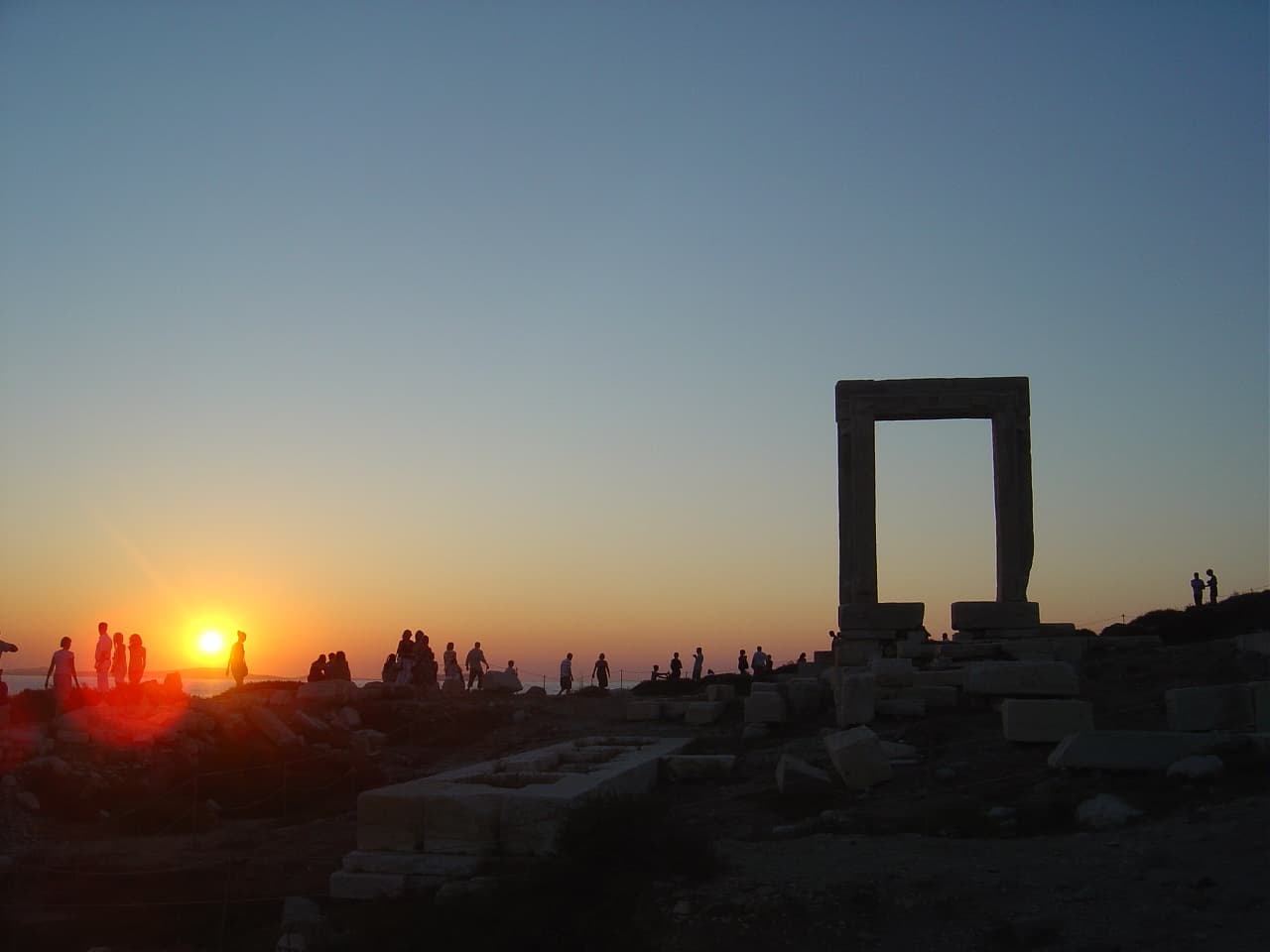
The marble gateway of a temple of Apollo begun around 530 BC under the tyrant Lygdamis and never finished, standing on the Palatia islet at the mouth of the harbour and reached by a paved causeway. It is free, unstaffed and has no set hours. Since 26 September 2025 it has stood behind a permanent fence, the sequel to a tourist’s misbehaviour at the monument on 29 July 2025, so you now look at the gate from outside it. The sunset is the reason for the crowd, and here is what it really does, computed from SRTM terrain against NOAA sun positions. The doorway faces about 320 degrees; the farthest-north sunset of the year is 300.7 degrees, so the sun never sets on the gate’s axis, and the famous photographs are taken off-axis, stepping sideways until the sun sits in the opening, which works best from late May to mid-July. From 27 August to 15 April the sun sets behind the hills of Paros, 12 to 19 kilometres away, 1 to 13 minutes before the almanac time, and behind the Profitis Ilias summit block from 23 January to 8 February and 2 to 19 November. From 16 April to 26 August it goes down over the low north-east tip of Paros, which from here looks like a sea sunset with a dark line under it: on 21 June at 20:42.
 Jean Housen · CC BY-SA 4.0 via Wikimedia Commons
The archaeological collection at Agia Ursula, Kastro
The Archaeological Museum of Naxos, in the old Jesuit school in the Kastro, is closed while the building is consolidated and restored for the EU-funded Museum Island project. Since 15 May 2021 its collection, including Early Cycladic figurines and finds from Naxos, Keros, Koufonisi and Donousa, has been shown next door in a temporary exhibition at the Agia Ursula cultural centre, a former Ursuline convent. Entry is free, 09:00 to 14:00, closed Tuesdays, per the Ephorate’s 2026 list. Do not go to the old door and do not pay for a ticket. A 2023 interview promised the Museum Island would open in 2026; the Ephorate still lists the temporary exhibition and no reopening date.
 Olaf Tausch · CC BY 3.0 via Wikimedia Commons
The kouroi of Flerio, Faraggi and Apollonas
Three colossal statues left where the sculptors abandoned them in the island’s marble quarries, and the single best argument for leaving the beach. The Apollonas figure, above the north-coast village, is 10.45 metres long and 2.63 wide, which the Ephorate calls the largest known sculpture of the Archaic period; it is in fact a clothed, bearded figure, perhaps Dionysus, around 540 BC, and a long crack may be why it was left. The Kouros of Flerio, near Melanes, is the easiest to reach, beside the Flerio springs, broken at the legs in transport in the first half of the sixth century BC; locals call it the Hellene. The Kouros of Faraggi lies higher up on a path from Flerio, 3.83 metres surviving of an estimated 5.50, uncovered again after a brush fire in 1990. No ticket or hours are listed for any of them.
 Zde · CC BY-SA 4.0 via Wikimedia Commons
Mount Zas and the Cave of Zas
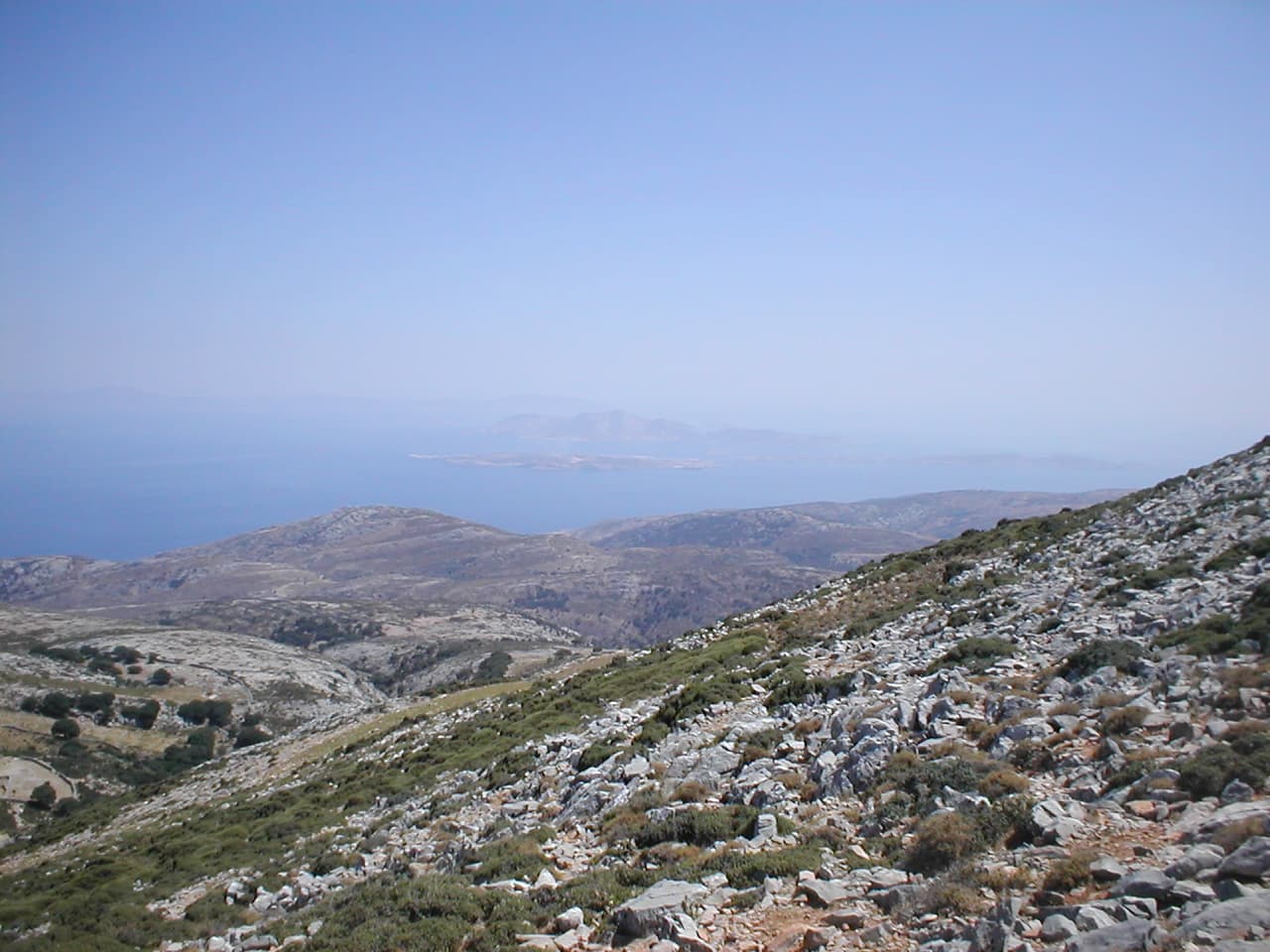
The highest point in the Cyclades at 1,004 metres, a morning’s walk from Filoti. The full loop from Filoti by the Aria spring, the cave, the summit, the Agia Marina chapel and Danakos is 12.8 kilometres and about five hours twenty, graded challenging; from the Aria spring it is 500 metres to the cave, where you want a torch, and then 1.4 steep, rough kilometres to the top on cairns and red dots. The gentler way up starts from the Agia Marina chapel on the Filoti to Apiranthos road. There is little shade: start early. At the top the geometry changes in your favour. From that height the sea horizon sits 0.94 degrees below the horizontal, Paros mostly drops beneath it, and the sun sets 4 to 6.5 minutes after the almanac time, into open sea in several windows, the longest 24 May to 18 July and 23 November to 18 January, over the Profitis Ilias massif of Paros only from 17 to 27 March and 15 to 26 September, and over far islands, Sifnos, Serifos, Kythnos or Milos at 70 to 110 kilometres, for much of the rest of the year when the haze allows. Coming down in the dark is the real risk, so plan the descent before you plan the photograph.
 Zde · CC BY-SA 4.0 via Wikimedia Commons
Apiranthos and its museums
The marble village on the mountain’s eastern flank, with lanes paved in stone and a car-free centre. The State Archaeological Collection costs 5 euros full and 3 reduced and opens 08:30 to 15:30, closed Tuesdays. The municipal museums of folklore, natural history, geology and visual arts kept a 2026 summer schedule from 6 June of 11:00 to 15:00 on Mondays and Tuesdays and 11:00 to 19:00 Wednesday to Sunday, as reported locally; their prices and winter hours we could not confirm. Come for lunch, and leave before sunset: the Fanari ridge just west of the village takes the sun an hour or more before the almanac all year round.
 Zde · CC BY-SA 4.0 via Wikimedia Commons
Halki and the Vallindras kitron distillery
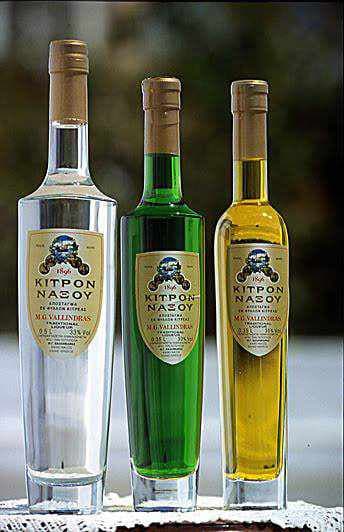
Halki is the Tragaea at its best: a village of Venetian towers and Byzantine churches among the olive groves, with the ninth-century Panagia Protothronos, a galaktoboureko shop and cafes on the square. The Vallindras distillery has made kitron here since 1896, family-run, in three strengths plus a spiced liqueur. The visit is short, five to ten minutes, entry is free and the tasting is charged. We could not read the distillery’s own site, which refuses automated requests, so its hours are unconfirmed: ring +30 2285 031220 before driving up specially.
 Holger Uwe Schmitt · CC BY-SA 4.0 via Wikimedia Commons
The Temple of Demeter at Gyroula, Sangri
An ancient marble sanctuary of Demeter in the fields at Gyroula, below Ano Sangri, with a small archaeological collection beside it, and usually quiet. Five euros full and three reduced, 08:30 to 15:30, closed Tuesdays, on the Ephorate’s 2026 list; an older ministry page gives longer Sunday hours, which the 2026 list does not. The Bazeos Tower, home of the Festival of Naxos, is about two kilometres away.
 Olaf Tausch · CC BY 3.0 via Wikimedia Commons
The Sanctuary of Dionysus at Yria
Four successive temples to Dionysus built on the same spot at Glinado, just outside Chora, from the Mycenaean period to the fourth temple of around 580 BC, the god of wine worshipped on the island that later made cheese and potatoes its fortune. Five euros full, three reduced, 08:30 to 15:30, closed Tuesdays. Ten minutes from town and usually empty.
 Atle1963a · CC BY-SA 3.0 via Wikimedia Commons
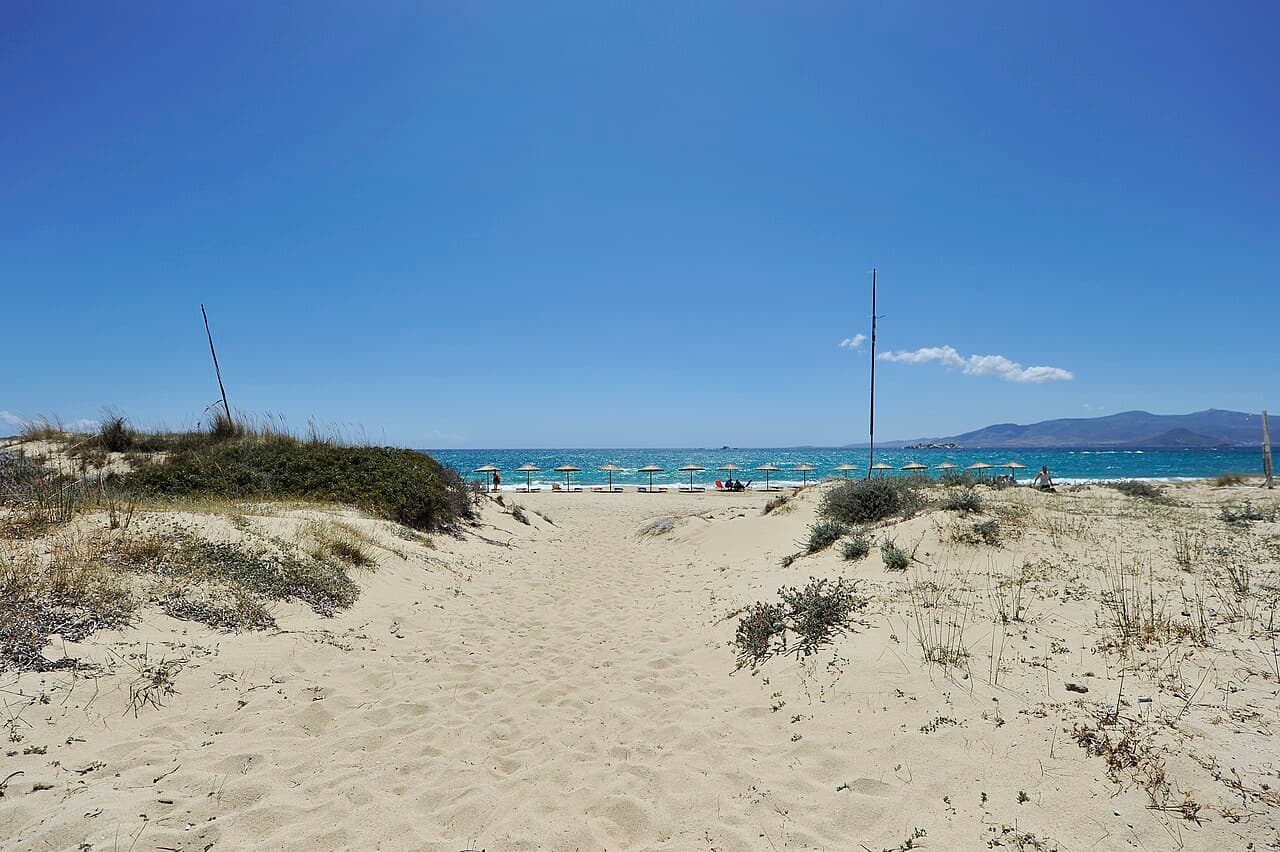
Plaka beach
Four kilometres of sand and dunes, the continuation of Agia Anna, and the long walk of the west coast. It faces Paros, and a horizon profile from the waterline shows why its sunset is a winter event: from 19 January to 22 November the sun goes down behind Paros, in June about 2.6 minutes early over the northern Parian hills, and from 16 to 29 September behind Profitis Ilias itself, twelve to thirteen minutes before the almanac. From late November to mid-January the setting point moves south past the island and the sun sets into open water, 28 November to 5 December and 6 to 13 January, or over the low southern coast of Paros between them. It is the only true sea sunset window on the west-coast beaches we checked.
 dronepicr · CC BY 2.0 via Wikimedia Commons
Aliko: the cedar dunes and the hotel that never opened
At the end of the southwest coast road, past the beach people call Hawaii, a sand peninsula of juniper and cedar runs out to sea beside the concrete shell of a hotel of roughly a thousand rooms, begun without permits around 1969 under the junta, opposed by the islanders and abandoned after 1974. Its walls are now an open-air street-art gallery. Entry is free and the ruin is unfenced, so watch your footing and your children. The south-coast buses reach Aliko about four times a day in summer.
 C messier · CC BY-SA 4.0 via Wikimedia Commons
The Kastro lanes
The Venetian upper town, built in 1207, its lanes climbing to the top of the hill above the harbour. It is free to walk and best in the morning or late evening. Parts of it are a building site for the Museum Island project, and the Glezos Tower is closed for works, so enjoy the outside and do not count on interiors.
 Holger Uwe Schmitt / CC BY-SA 4.0 via Wikimedia Commons
 Holger Uwe Schmitt / CC BY-SA 4.0 via Wikimedia Commons
Food & drink
 Ossony · CC BY-SA 4.0 via Wikimedia Commons
Graviera Naxou
The island’s protected cheese since 1996, a hard graviera made mainly from cow’s milk with no more than a fifth sheep or goat, which on a Cycladic island tells you how much grazing land Naxos has. At the table it comes as saganaki, fried in a clay pot: Metaxi Mas in Chora lists it at 8 euros.
 C messier · CC BY-SA 4.0 via Wikimedia Commons
Arseniko Naxou
The sharp one: a hard, aged cheese of raw goat and sheep milk, made across Naxos and the Small Cyclades and entered in the EU register of protected designations of origin in January 2020. Order it with bread and wine and nothing else.
Naxos potatoes
A protected geographical indication covering the whole island, grown in varieties such as Liseta, Spunta and Marfona, and served fried or roasted with almost everything. Be aware that fake Naxos potatoes are sold widely on the mainland: output has fallen from about 15,000 tonnes in the 1980s to about 5,000, with about 300 farming families left, so buy them here or look for the PGI label.
 Don Brillinger · CC BY-SA 2.5 via Wikimedia Commons
Kitron
The citron liqueur of the island, registered in EU law as Kitro Naxou, a geographical indication in the liqueur category. Vallindras in Halki has made it since 1896, in three strengths plus a spiced liqueur. It is the island’s after-dinner glass.
Xynomyzithra, myzithra and ladotyri
The island’s other, unprotected cheeses: the fresh, sour goat xynomyzithra and its dried form xynotyro, soft myzithra and anthotyro, and ladotyri kept in oil. They turn up in pies and salads across the island.
Lunch runs from about 13:00 into the afternoon and dinner starts late, 21:00 is normal and the Chora tavernas are fullest after ten. Menus are made for sharing: several small plates and one main between two. Bread and a small cover charge are normal. Cards are accepted almost everywhere, but a tip on the card terminal rarely reaches the person who served you, so carry small notes. On the west-coast strip the prices are set for July; in Halki, Filoti and Apiranthos they are village prices, and the produce comes from the fields you drove past.
Where to eat
Metaxi Mas
institutionA meze taverna on the old market street, 150 metres from the port, cooking Naxian produce and seafood: graviera saganaki in a clay pot at 8 euros, stuffed peppers at 8.50, courgette fritters, an Apiranthos-style dakos and sun-dried mackerel. Open 13:00 to midnight. Its real site is metaximas-taverna.gr; the similar-looking metaximas.gr belongs to a different taverna on the mainland.
Last researched 2026-09-25
Scirocco
institutionOpened on 24 March 1995 by the brothers Nikos and Michalis and still theirs: Greek and Mediterranean cooking built on Naxian products, certified under the Aegean Cuisine network, with vegetarian and gluten-free dishes marked and online booking, which in August you will want.
Last researched 2026-09-25
To Elliniko
casualHomemade Greek food from local products, cooked continuously since 2008 to the recipes of mama Katerina. Reservations by phone between 12:00 and 23:00, and groups of more than six book 48 hours ahead.
Last researched 2026-09-25
Maro’s Taverna
budgetA plain Greek taverna a street back from the seafront, open 11:00 to 23:00 every day according to its map listing, last checked in December 2025. It has no website of its own, so treat the hours as a guide.
Last researched 2026-09-25
Oniro Wine Bar Restaurant
sunset-venueFamily-run, on two terraces and a rooftop below the Kastro with views over the harbour and the islands, cooking Greek and international dishes. Its map listing gives 11:00 to 23:00 daily. We found no website of its own, and the pages that look like one are booking-feeder clones, so ring or walk up. From the old town the sun goes down behind Paros for most of the year, over its low northern tip in summer.
Last researched 2026-09-25
520 bar and Porta
barA small local group in the old town: 520 the bar, Porta the restaurant, Chouchouro the pastry shop and a fourth venue in Old Chora. Reservations by phone on +30 6944 680629.
Last researched 2026-09-25
Picasso
casualA Mexican kitchen on Plaka beach since 1996, which sounds wrong on a Cycladic island and has lasted thirty years regardless. Open every day from 9 a.m. for breakfast and brunch, lunch and dinner from May to September, with service out to the sunbeds.
Last researched 2026-09-25
Taverna Giannis
institutionThe village taverna on the Halki square, with a second restaurant opened in 2018 on the main road from Chora, and nights of live traditional music, according to third-party listings. It has no working website: yannistavern.gr, which search results still show, is a squatted domain now serving a casino page, so do not follow it. Ring ahead or just turn up at lunch.
Last researched 2026-09-25
Paravas Traditional Tavern
casualA Greek taverna in Halki whose map listing gives 11:00 to 23:30 every day, so it is worth trying for dinner as well as lunch. No website of its own, so treat the hours as a guide and the menu as a surprise.
Last researched 2026-09-25
Sunrises
 Zde · CC BY-SA 4.0 via Wikimedia Commons
Apollonas, out of the open sea
The one sunrise on Naxos we would set an alarm for in summer. From the beach at Apollonas the sun comes straight out of open water from 12 May to 1 August, on time to the minute, on bearings of 59 to 66 degrees: Ikaria lies north of the arc and Fourni, 90 kilometres out, is below the horizon. Outside that window the headland on the east side of the bay, with the Kalogeros spur behind it, gets in the way, and the delay grows fast: an hour and six minutes at the equinoxes, an hour and forty-four in December.
12 May to 1 August · Pair it with the colossus in the quarry above the village and a coffee in the harbour.
 Zde · CC BY-SA 3.0 via Wikimedia Commons
Moutsouna and the islands to the east
The east coast port gets the sunrise in the opposite season to Apollonas. From the seaward side of the harbour headland, the sun rises out of open sea from 28 January to 25 February and 11 October to 14 November; over the Makares islets, ten kilometres out, in March and from mid-September to early October; out of Donousa, twenty kilometres away, from 1 to 14 April and 29 August to 11 September; and out of Amorgos, 41 to 44 kilometres off, from mid-November to late January. In summer, 15 April to 28 August, the Azalas headland just north of the harbour delays it by 4 to 21 minutes: a summer sunrise here needs a spot with a clear view north-east, which we did not compute.
Autumn and winter, and Donousa in early April or early September · The old emery loading quay gives foreground; the islands give the horizon something to hold on to.
Chora: why first light is late
Chora faces west, and its sunrise is a lesson in the island’s size. On 21 June the almanac says 05:58, but the sun has to clear the mountains of north Naxos first, the Anathematistra massif about fifteen kilometres to the north-east, and first light reaches the Portara at 06:11, thirteen minutes late. At the equinoxes the Chylokastro hill, 2.7 kilometres east, makes it 33 minutes late. On the Kastro top it is 06:17 on 21 June, and down on the harbour front, where the Kastro hill itself stands in the way, 06:33. What Chora gets instead is the moment the first light reaches the Portara and the Kastro while the harbour below is still in shade.
All year, for the light on the marble, not the sun itself · Face west in the morning, not east: the gate and the islet take the first sun against a still-dark Paros.
Sunsets
 Alejo · CC BY-SA 3.0 via Wikimedia Commons
The Portara
The famous one, and the most misdescribed. The gate faces about 320 degrees and the sun never sets on its axis: the northernmost sunset of the year is 300.7 degrees, about nineteen degrees short, so the sun-inside-the-doorway pictures are framed off-axis, from the south-east side, and work best from late May to mid-July. What the sun actually does, computed from SRTM terrain for every day of 2026: from 16 April to 26 August it sets over the low north-east tip of Paros, the Naoussa peninsula and its islets nine to eleven kilometres away, land so low that it reads as a sea sunset with a dark sliver under it; from 27 August to 15 April it drops behind the hills of Paros, 1 to 13 minutes before the almanac, and behind the Profitis Ilias summit block, about 11 to 12 minutes early, from 23 January to 8 February and 2 to 19 November. Syros, Antiparos and open water never take the Portara sunset.
Late May to mid-July for the framed-gate photograph; April to August for the near-sea sunset · On 21 June the terrain sunset is 20:42 on a bearing of 300.7. On 25 September the almanac says 19:11 and Paros takes it a couple of minutes earlier. The Kastro top, 37 metres up, gets a clean open-sea sunset on a few gap days a year, 25 to 27 April, 3 to 13 June, 28 June to 8 July and 15 to 17 August.
 Jérôme Lafréchoux · CC BY-SA 3.0 via Wikimedia Commons
The summit of Mount Zas
The one place on Naxos where the sun sets late. From 1,004 metres the sea horizon dips 0.94 degrees below the horizontal, Paros mostly sinks below it, and the sun sets 4 to 6.5 minutes after the almanac time: 20:47 on 21 June against 20:41 in Chora. It goes into open sea in several windows, the longest 24 May to 18 July and 23 November to 18 January, with shorter ones in mid-April, late August and parts of February and October; behind the Profitis Ilias massif of Paros, 28 kilometres away, only from 17 to 27 March and 15 to 26 September; and over far islands the rest of the year, Kythnos in late April and May and again from late July to mid-August, Serifos in early April and early September, Sifnos from late February to mid-March and late September to mid-October, Milos and Kimolos in winter. Haze hides the far islands on most summer evenings.
24 May to 18 July for an open-sea sunset from the top · The Cave of Zas path at 668 metres gives a similar effect, 0 to 5 minutes after the almanac, and a shorter walk down. Watch the shadow of the mountain run out across the island to the east as the sun goes.
 G Da · CC BY-SA 3.0 via Wikimedia Commons
Plaka, the winter sea sunset
The one west-coast beach we checked where the sun can set into open water, and only in winter: 28 November to 5 December and 6 to 13 January, with the low southern coast of Paros under it in between. From 19 January to 22 November it goes behind Paros, and from 16 to 29 September behind Profitis Ilias itself, twelve to thirteen minutes early, which is the week this guide is published. In June the northern Parian hills take it about 2.6 minutes early, which is hardly worth complaining about.
Late November to mid-January for open sea; any summer evening for a long beach walk into the light · Four kilometres of flat sand and dunes means you can put the sun where you want it. Paros at 12 to 19 kilometres reads as a layered silhouette.
 Manfred Werner (Tsui) · CC BY-SA 4.0 via Wikimedia Commons
Agios Georgios
The easy sunset, a walk from Chora. From 28 April to 14 August the sun sets over the low north-east tip of Paros, at most 1.7 minutes before the almanac, which is as close to a sea sunset as the town beaches get in summer. From 1 February to 27 April and 15 August to 9 November it goes behind Paros, up to 13 minutes early, and from 10 November to 31 January the Stelida hill 2.6 kilometres south-west takes it about ten to fourteen minutes early, except from 12 to 31 December, when southern Paros takes it about nine minutes early.
May to mid-August · Shallow water and a long curve of sand give reflections on still evenings; the meltemi will ruin them on windy ones.
 Tsui · CC BY-SA 4.0 via Wikimedia Commons
Mikri Vigla
The wind beach has a straightforward sunset: behind Paros from 14 February to 27 October, about 5 minutes early in June and behind Profitis Ilias from 1 to 12 April and 29 August to 10 September, about 12 minutes early. From 28 October to 13 February the beach’s own low headland, 400 metres south-west, takes it 2 to 6.5 minutes early.
May to August, and kite season · Kites and windsurf sails against the low sun on meltemi evenings are the photograph here.
Day trips
 ftrc · CC BY-SA 2.0 via Wikimedia Commons
Delos and Mykonos by boat
The sacred island of Apollo, a short crossing north. One operator on GetYourGuide runs a ten-hour day from Naxos from about 91 US dollars a head: about 45 minutes to Delos, three hours on the site, then half an hour to Mykonos for four hours. Delos entry is not included: it is 20 euros full and 10 reduced in 2026, and older pages still quote 12, which is wrong. September and October hours step down from 08:00 to 19:30 in early September to 08:00 to 18:00 in late October, last entry 30 minutes before closing. The site closed for the winter from 1 December 2025 to 31 March 2026. No swimming off Delos. The port authority needs each passenger’s name, date of birth and nationality in advance.
About 45 minutes to Delos · Full day
Delos and Mykonos cruise from Naxos ↗Ministry of Culture: Delos ↗View on map ↗
 Sgroey · CC BY-SA 4.0 via Wikimedia Commons
The Small Cyclades: Koufonisia, Iraklia, Schinoussa
The low islands between Naxos and Amorgos, reached year-round by ferry: Naxos to Koufonisia takes 35 minutes to 2.5 hours from about 7 euros, on Blue Star, Seajets and Small Cyclades Lines, whose Express Skopelitis leaves Naxos at 14:30 on its daily run. As far as we can tell from the published pattern it overnights in Amorgos, so it is not a same-day return: use it one way, or stay a night. For a day out without a hotel, a wooden-boat cruise from the Agia Anna pier, 09:30 to about 17:30 at 93.60 euros, stops at Aliko, the Rina cave, lunch on Schinoussa or Iraklia and a last swim on the way back.
35 minutes to 2.5 hours by ferry · Full day, or one or two nights
Small Cyclades Lines ↗Zas Tours: Rina and Schinoussa ↗Naxos to Koufonisia ferries ↗View on map ↗
 Jean Housen · CC BY-SA 4.0 via Wikimedia Commons
Paros for the day
The island on the other side of every Naxos sunset. More than ten crossings a day in high season from Chora to Parikia, 20 minutes to 3.5 hours depending on the boat, from 5.50 euros. A water taxi also runs from Agia Anna to Piso Livadi on the east coast of Paros.
20 minutes to 3.5 hours · Full day
 Stepanps · CC BY-SA 4.0 via Wikimedia Commons
The mountain loop: Halki, Filoti, Apiranthos
The interior in a day by car, or by bus with patience. Halki for the distillery and the square, Filoti for the start of the Zas path or just the plane trees, Apiranthos for lunch and the small museums, and back by the Tragaea. The roads are winding and slow; the bus to Apiranthos takes an hour and costs 3.50 euros each way.
About 30 minutes to Halki, an hour to Apiranthos · Full day
 Jean Housen · CC BY-SA 4.0 via Wikimedia Commons
The kouroi and the north coast
Out through the Melanes valley to the Kouros of Flerio and the path up to the Kouros of Faraggi, then over the mountains to Koronos and down to Apollonas, where the 10.45-metre colossus lies in its quarry above the harbour. Fish at the harbour, a swim, and back across the island. In summer you can do it in reverse and start at Apollonas for the open-sea sunrise.
36 kilometres of mountain road to Apollonas; the bus takes 1 hour 45 minutes at 6.20 euros · Full day
After dark
 Mario Vazaios · CC BY-SA 4.0 via Wikimedia Commons
A night at the Bazeos Tower
performanceThe Festival of Naxos stages music, theatre and talks in the courtyard of a seventeenth-century tower near Sangri from late May to mid-September, evening shows at 21:00 or 21:30. In 2026 that meant Maria Farantouri, Nikos Xydakis and a Maria Callas evening closing the season on 16 September. Buy through naxosfestival.gr; bazeostower.gr is a casino spam site.
 Holger Uwe Schmitt · CC BY-SA 4.0 via Wikimedia Commons
The old town after ten
walkChora eats late. Walk up from the harbour through the Bourgo lanes into the Kastro after dinner, and end at one of the small bars in the old town, 520 or Kitron Cafe Bar.
 Stepanps · CC BY-SA 4.0 via Wikimedia Commons
A village panigiri in August
festivalThe Panagia on 15 August in Filoti, the Filoti association’s festival on the 17th, Ai Giannis on the 29th at Apeiranthos and Apollonas: long tables, violin and lute, local wine and meat, and visitors welcome if they eat and dance. It is the island at its most itself.
 Holger Uwe Schmitt · CC BY-SA 4.0 via Wikimedia Commons
A Chora sunset with a glass
diningWatch the sun go down over Paros from a terrace below the Kastro, then walk to the Portara in the blue hour when the crowd has gone. From mid-April to late August the sun sets over the low northern tip of Paros, and the afterglow behind it is the best part.
Daily itinerary
Seven days: the beach, the valley, the mountain
The plan we would book: one base on the west coast between Agios Georgios and Agios Prokopios, a car for days three to six, and the interior given as much time as the sea. It assumes arrival through Athens on a domestic flight or a ferry from Piraeus. Two rules shape the order. The state sites on Naxos close at 15:30 and the Agia Ursula exhibition at 14:00, and all of them are shut on Tuesdays, so the museums go in the mornings and days 3 and 7 should not fall on a Tuesday; and the meltemi can cancel small boats in July and August, so the boat day can trade places with the beach day.
- 1
Arrive and walk into Chora
relaxedLand at Athens. If you have not been registered in the Entry/Exit System on a trip since it started in October 2025, you will be registered now, with fingerprints and a facial image, so allow extra time at the booth; the onward flight to Naxos and the ferry are domestic, with no further border check.The Naxos flight takes under an hour; the fast ferry from Piraeus about three and a quarter, the conventional one five and a quarter or more. Every ferry docks in Chora. The airport is three kilometres from town, about 15 euros by taxi, and a bus stop serves it.Walk the causeway to the Portara, now fenced, and watch from outside it.Metaxi Mas on the old market street, 150 metres from the port.There are only 33 taxis on the island. Book one ahead on a late arrival, or take the bus.Estimate: Fly Tel Aviv to Mykonos or Santorini on an Israeli carrier and take the ferry: 35 minutes to 1.5 hours from Mykonos, from an hour from Santorini
- 2
Beach day on the west coast
relaxedAgios Prokopios, the northern end if the wind is up.On the beach at Agia Anna.Walk south along the sand into Plaka.Plaka. In late September the sun goes behind Profitis Ilias on Paros about twelve minutes early; from May to August it sets behind the northern Parian hills two to five minutes early.Picasso on Plaka beach, or back into Chora on the bus.The west-coast buses run every half hour until after midnight in high summer; 1.80 euros to Agios Prokopios and 2.00 to Plaka.Estimate: Mikri Vigla for the kitesurfers and the sheltered southern cove
- 3
The Tragaea: Halki and Filoti
moderateCollect the car. The Sanctuary of Dionysus at Yria on the way out of town, 5 euros, then the Temple of Demeter at Sangri, 5 euros, both 08:30 to 15:30 and closed Tuesdays.Halki: Paravas or Taverna Giannis on the square.The Vallindras distillery for a kitron tasting, then up to Filoti and its square.From Halki the ridge to the west takes the summer sun 20 minutes or more early; drive back to the coast or stay for dinner in the valley and skip the sunset tonight.In Halki or Filoti.Chora to Halki is about half an hour. Fuel in the Cyclades cost 2.419 euros a litre for unleaded on 23 September 2026, about 22 cents above the national average, so fill up once and drive gently.Estimate: The Bazeos Tower exhibition near Sangri, 10:00 to 17:00 until 11 October 2026
- 4
Mount Zas
fullStart early from Filoti or the Agia Marina chapel. From the Aria spring it is 500 metres to the Cave of Zas and then 1.4 steep kilometres to the summit at 1,004 metres; the full loop is 12.8 kilometres and about five hours twenty. Carry more water than you think.Back in Filoti.Rest, or a slow swim back on the west coast.If you are fit and have a head torch, go back up for the sunset: from the summit the sun sets 4 to 6.5 minutes after the almanac, into open sea from 24 May to 18 July. Otherwise, the Portara again.Scirocco in Chora, booked online.Filoti is about half an hour from Chora. Never plan the descent from Zas after dark without a torch and a known path.Estimate: Apiranthos instead of the summit, for a lower-effort mountain day
- 5
The kouroi and the north coast
fullThe Kouros of Flerio near Melanes, then the path up to the Kouros of Faraggi.Fish on the harbour at Apollonas.The 10.45-metre colossus in its quarry above Apollonas, then back over the mountains by Koronos and Apiranthos.Not in Apiranthos, where the Fanari ridge takes the sun an hour or more early all year; be back on the west coast.To Elliniko in Chora.36 kilometres each way to Apollonas on mountain roads. In summer you could reverse the day and be at Apollonas for the open-sea sunrise, which runs from 12 May to 1 August.Estimate: Stop in Apiranthos for lunch and the archaeological collection, 5 euros, open until 15:30 and closed Tuesdays
- 6
A boat
moderateEither the Delos and Mykonos day, or the Small Cyclades cruise from the Agia Anna pier at 09:30.On board, or on Schinoussa or Iraklia.The Rina cave, or Mykonos town.On the water on the way home.Late and simple in Chora.Delos entry is 20 euros and is not included in the cruise; the port authority needs your names, dates of birth and nationality in advance. On a strong meltemi day expect cancellations: watch the week’s forecast and, if the end of it looks windy, swap this day with day 2, the beach day.Estimate: Paros by ferry for the day instead
- 7
Chora in the morning, out in the afternoon
relaxedThe archaeological collection at Agia Ursula, free, 09:00 to 14:00, closed Tuesdays, then the Kastro lanes.In the old town.Buy graviera, arseniko and kitron to take home, and Naxos potatoes if the bag allows, and head for the port or the airport.Home through Athens.Leave a margin for the domestic connection: the island airport’s 901-metre runway takes only small turboprops, so seats are few.Estimate: An extra night and the Portara sunset one more time
Four days on the way through the Cyclades
For a stop on an island-hopping route, most likely between Paros and Santorini or Mykonos: one day of beach, one of the interior, one of Chora and a day to move. A car for day two is enough.
- 1
Arrive, Chora and the Portara
relaxedFerry into Chora.Check in at Agios Georgios and swim.The Portara, from behind the fence.Metaxi Mas or Scirocco.Estimate: Stay in Grotta for the view of the Portara from the room
- 2
The interior by car
fullHalki and the kitron distillery.In Halki or Apiranthos.Apiranthos, then the Kouros of Flerio on the way back.Agios Georgios or Plaka.Back in Chora.About two and a half hours of driving in all, on slow mountain roads.Estimate: The Zas summit instead, starting at dawn from Filoti
- 3
The west-coast beaches
relaxedAgios Prokopios.Agia Anna and Plaka.Plaka.Picasso on the beach, or back to the old town.Estimate: The Rina and Schinoussa boat from Agia Anna at 09:30
- 4
Onward
relaxedThe Agia Ursula collection, free from 09:00, closed Tuesdays.Ferry on: Paros in as little as 20 minutes, Mykonos from 35 minutes, Santorini from an hour, Koufonisia from 35 minutes.Estimate: Fly back to Athens in under an hour
Getting around
- There is no direct flight from Israel to Naxos, and anyone selling a charter to Naxos is selling an Athens flight and a connection. The Israel Airports Authority flight board for 24 to 28 September 2026 carried no rows at all for Naxos (JNX) and none for Paros. Athens had 154 rows in the same five days, flown by Israir, Blue Bird, Aegean, Arkia and El Al among others; Mykonos had 12, on Arkia, Blue Bird and El Al; and Santorini had 4, on El Al. The board shows only about five days ahead, so treat it as a snapshot of late September, not a season schedule.
- From Athens, the short way is the domestic flight: Olympic Air and Sky Express fly to Naxos on ATR turboprops, about five a day in September 2026, departing between about 06:10 and 19:05, 50 minutes gate to gate. The island airport’s runway is only about 900 metres long, which is why nothing larger lands. The long way is the ferry from Piraeus, which runs year-round with up to seven crossings a day in season: Blue Star’s conventional ferries take 5 hours 15 minutes to 7 hours from about 52 euros, and the Seajets high-speed boats 3 hours 15 minutes and up, from about 62. Rafina has sailings only a few months of the year.
- Through the islands: Naxos to Mykonos is seasonal, usually March to November, 35 minutes to an hour and a half, from about 20 euros; Naxos to Santorini runs year-round from an hour, 31 euros and up. For Israelis that makes the Mykonos or Santorini flights on Israeli carriers a practical alternative to Athens, ferry timetables permitting.
- Since 10 April 2026 the EU Entry/Exit System has been fully operational: Israelis are registered with a facial image and fingerprints at their first Schengen entry, which for most readers means Athens. ETIAS is still not in operation, in the European Commission’s own words, no applications are being taken, and the fee has been set at 20 euros for when it starts. Israeli passport holders can stay 90 days in any 180 without a visa.
- KTEL Naxos runs the buses from the port, and they are better than their reputation. The west-coast lines to Agios Prokopios, Agia Anna and Plaka run every 15 to 30 minutes at peak and until after midnight in June, 1.80 to 2.00 euros; children up to six ride free and students pay 25 percent less. A bus stop serves the airport roughly every half hour through the day. Inland: Halki 2.30 euros and 30 minutes, Filoti 2.60 and 35 minutes, Apiranthos 3.50 and an hour, Koronos 4.20, Apollonas 6.20 and 1 hour 45 minutes, with the mountain lines only a few times a day. Timetables change every week or two in the shoulder season, so check the current one.
- A car for at least part of the stay is what turns Naxos from a beach holiday into the island this guide is about. The interior roads are slow and winding. In Chora use the free public car parks, which are open around the clock: parking on the main roads by the port is fined regularly, and parking on the salt flats behind the beaches is banned with heavy fines. Israeli licence holders should carry an international driving permit as well: rental desks often ask for one.
- Quad bikes are everywhere and we would not rent one. On 16 May 2026 the Minister of Citizen Protection called for their complete abolition on the islands and said no tourist should rent a motorbike or ATV without a helmet and a valid licence. It is a proposal, not yet law as far as we could find, but it tells you how the authorities see them.
- Taxis are few, 33 on the whole island, and there is no Uber or Bolt. Radio Taxi is on 22850 22444 and 22850 24331; airport to town is about 15 euros by day.
- Fuel is dear here. The Ministry of Development bulletin for 23 September 2026 put unleaded 95 at 2.419 euros a litre in the Cyclades, against a national average of 2.199 and 2.181 in Attica; diesel was 2.405 and autogas 1.286.
Things worth knowing
- · Looking for a direct flight from Tel Aviv. There is none; plan Athens and a connection, or Mykonos or Santorini and a ferry.
- · Going to the old Archaeological Museum door in the Kastro. The building is closed for works; the collection is free next door at Agia Ursula, 09:00 to 14:00, closed Tuesdays.
- · Expecting the sun to set through the Portara gate. It never does: the gate faces about 320 degrees and the sun never sets further north than 300.7. The photographs are framed off-axis.
- · Planning a sunset in Apiranthos. The Fanari ridge takes the sun 54 to 84 minutes before the almanac every day of the year.
- · Staying only on the beach. The Tragaea, Mount Zas, the villages and the kouroi are the reason to choose Naxos over its neighbours.
- · Booking the Kouros Village hotel, Istoria or an Anemomilos in the belief that they are on Naxos. They are on Antiparos, Santorini and Folegandros; the Naxos hotel with a similar name is the Kouros Art Hotel.
- · Relying on the Skopelitis for a day trip to the Small Cyclades. It leaves Naxos at 14:30 and, on its published pattern, does not come back the same day.
- · Renting a quad. They are dangerous on these roads, and the government has proposed banning them.
- · Buying Naxos potatoes on the mainland and assuming they are from Naxos. Many are not.
Budget
| Low | Expected | Comfortable | |
|---|---|---|---|
| Accommodation style / per night | €60≈ $67 | €150≈ $168 | €450≈ $504 |
| Food style / per day | €30≈ $34 | €55≈ $62 | €110≈ $123 |
| Local transport / per day | €5≈ $6 | €30≈ $34 | €65≈ $73 |
| Estimate / per day | €0≈ $0 | €8≈ $9 | €25≈ $28 |
Estimate · EUR · 2026-09-25. Quoted in euros per person per day, except accommodation, which is per room per night on a double-occupancy basis; these are our estimates, not published rates, since almost no hotel here prints one. The low accommodation band is a family-run room at Agios Georgios, the comfortable band a villa at Stelida or a couples’ suite on Plaka. The Bank of Israel representative rate on 24 September 2026 was 3.4662 shekels to the euro and 3.047 to the dollar, so the expected daily spend of about 95 euros a head before the room is roughly 330 shekels. Local transport runs from bus fares of 1.80 to 6.20 euros at the low end to a shared rental car at the Cyclades pump price of 2.419 euros a litre. Attractions are cheap because the best things are free: the Portara, the Agia Ursula exhibition, the Kastro and the kouroi cost nothing, and the paid sites are 5 euros. Add the climate resilience fee to every night, charged per room, not per person: from April to October 2 euros at a 1 or 2-star, 5 at a 3-star, 10 at a 4-star and 15 at a 5-star; 8 euros at a short-term rental under 80 square metres and 15 at a larger one or a villa; 1.50 at furnished rooms for rent. From November to March it falls to 0.50, 1.50, 3 and 4 euros, and 2 or 4 at short-term rentals. The day-trip figure covers a Delos and Mykonos cruise, from about 91 US dollars plus the 20-euro Delos ticket, or the 93.60-euro Rina and Schinoussa cruise; a return ferry to Paros is the low end. It replaces that day’s transport and attraction lines rather than adding to them. · 1 USD = €1 (12 Oct 2026)
Things worth knowing
Frequently asked questions
Can I fly directly from Tel Aviv to Naxos?
No. The Israel Airports Authority board shows no flights to Naxos at all, and the island’s 900-metre runway takes only small turboprops from Athens. Fly to Athens, where Israir, Blue Bird, Aegean, Arkia and El Al all operate, then take the 50-minute domestic flight or a ferry from Piraeus, 3 hours 15 minutes on a fast boat and 5 hours 15 minutes or more on a conventional one. In season you can also fly to Mykonos or Santorini on an Israeli carrier and cross by ferry, 35 minutes to an hour and a half from Mykonos.
Does the sun set through the Portara?
No, never. The gate faces about 320 degrees and the farthest-north sunset of the year is 300.7 degrees, roughly nineteen degrees short, so the pictures of the sun inside the doorway are framed from the side, which works best from late May to mid-July. We computed the sunset from the Portara for every day of 2026 against SRTM terrain: from 16 April to 26 August the sun goes down over the low north-east tip of Paros and looks almost like a sea sunset; from 27 August to 15 April it sets behind the hills of Paros, up to 13 minutes early, and behind the Profitis Ilias summit from 23 January to 8 February and 2 to 19 November. The monument has been fenced since 26 September 2025, so you watch from outside it.
Where is the best sunset on Naxos?
For an ordinary evening, the Portara or Agios Georgios from late April to mid-August, when the sun sets over land so low it reads as the sea. For something out of the ordinary, the summit of Mount Zas, where the sun sets 4 to 6.5 minutes after the almanac time and into open sea from 24 May to 18 July, if you can manage the descent by torch. Plaka is the only west-coast beach we checked with a true sea sunset, and only in two short winter windows, 28 November to 5 December and 6 to 13 January. Avoid Apiranthos for sunsets: the ridge behind it takes the sun 54 to 84 minutes early every day.
Naxos or Paros?
Paros is the smaller neighbour across the strait, the island most west-coast Naxos sunsets go down behind. Naxos is bigger, higher and greener, with longer sandy beaches on its west coast and an interior of farming valleys, marble villages, a 1,004-metre mountain and the unfinished kouroi that Paros cannot match. If you want a base to explore from and food that comes from the island itself, choose Naxos; they are 20 minutes to a few hours apart by ferry, so many people do both.
Where should I stay on Naxos?
Agios Georgios or Chora if you want to walk everywhere without a car; Agios Prokopios and the Stelida hill for the best all-round beach and the design hotels; Agia Anna and Plaka for long sandy beaches and quiet; Mikri Vigla if the holiday is kitesurfing; and a night or two in Halki or Filoti if you want the interior at dawn and dusk. Most first-time visitors are happiest on the west coast between Agios Georgios and Plaka, with a car for three or four days.
Is the Naxos Archaeological Museum open?
Not in its own building, which is closed for works. Its collection, including the Early Cycladic figurines, is shown free in a temporary exhibition at the Agia Ursula centre in the Kastro, 09:00 to 14:00, closed Tuesdays. The Mitropolis site museum in Grotta is temporarily closed. The Ephorate gives no reopening date for the main museum.
Do I need a car on Naxos?
For the beaches, no: the west-coast buses run every 15 to 30 minutes, until after midnight in high summer, for about 2 euros. For the interior, yes, or at least it makes the villages, the kouroi and the Zas trailheads far easier: the mountain buses run only a few times a day. Rent for three or four days, not the whole stay, carry an international driving permit with an Israeli licence, and skip the quad bikes.
Is there kosher food on Naxos?
No. There is no Chabad house and no kosher restaurant on Naxos. Chabad of Greece delivers kosher meals to the islands if ordered three to five days ahead, and Chabad of Mykonos operates seasonally and closed for 2026 on 16 August. Otherwise, fish, fruit, vegetables and a kitchen are the practical approach.
When is the best time to visit Naxos?
September for swimming, when the sea averages about 24.7C and the crowds have thinned; June for a mix of walking and beaches, with the longest days of the year. July and August are the hottest, busiest and windiest months, when the meltemi can cancel boats. Late September also brings the European Heritage Days, with free entry to every state site, on 26 and 27 September in 2026.
How many days do I need on Naxos?
Five to eight. Seven is the number in this guide: an arrival evening in Chora, a beach day, three for the interior, Zas and the kouroi, one for a boat to Delos or the Small Cyclades, and a last morning in Chora. Four days work as a stop on an island-hopping route if you give one of them to the interior by car.
Sources (32)
- The Ephorate of Antiquities of the Cyclades publishes its 2026 hours and prices: the Naxos archaeological temporary exhibition free, 09:00 to 14:00, closed Tuesday; Sangri and Yria EUR 5 and EUR 3, 08:30 to 15:30, closed Tuesday; the Mitropolis site museum temporarily closed; the Glezos Tower closed for works; Delos EUR 20 and EUR 10; last entry 20 minutes before closing, with normal hours on Easter Monday, Whit Monday, 15 August and 28 October · government · 2026-09-25
- The Ephorate of Antiquities of the Cyclades states that since 15 May 2021, for the duration of the works on the Archaeological Museum of Naxos, a Temporary Exhibition operates there with free entry · government · 2026-09-25
- The Ephorate lists the Mitropolis site museum in Grotta as temporarily closed; it opened in 1999 and shows remains from the Mycenaean town to a Geometric-period tumulus · government · 2026-09-25
- The Ephorate describes the unfinished colossus at Apollonas as 10.45 m tall and 2.63 m at its widest, the largest known sculpture of the Archaic period, and the Kouroi of Flerio and Faraggi near Melanes · government · 2026-09-25
- The Ministry of Culture lists Delos at EUR 20 full and EUR 10 reduced, with hours of 08:00 to 19:30 from 1 to 15 September stepping down to 08:00 to 18:00 from 16 to 31 October 2026, closed from 1 December 2025 to 31 March 2026, no swimming on its coast, and free-entry days of 6 March, 18 April, 18 May, the last weekend of September, 28 October and the first Sunday of each month from November to March · government · 2026-09-25
- The Ministry of Culture announced that the temporary light fence around the archaeological site of the Temple of Apollo (Portara) at Palatia, put up after an incident on 29 July 2025, would remain until 27 September 2025, when it would be replaced by the permanent protective fence · reputable-local · 2026-09-25
- The Greek Ministry of Rural Development specification for the registered PGI Patata Naxou covers the whole island, names the main varieties including Liseta, Spunta, Marfona, Vivaldi and Alaska, and gives the highest peak, Zas, at 1,004 m · government · 2026-09-25
- The Israeli National Security Council rates Greece level 2, occasional threat level, citing an escalation in displays of hostility toward Israelis and Jews, harassment, threats, incitement, vandalism and at times physical assault, and recommending heightened precautions; the Foreign Ministry record reads "stay alert, follow the media"; the resource was last modified on 14 September 2026 and the record date field is empty · government · 2026-09-25
- The Israeli National Security Council page for Greece lists precautions for travellers and the numbers 02-6667444 for the NSC travel-warnings line, 02-5303155 for the Foreign Ministry situation room and 112 or 100 for the Greek police · government · 2026-09-25
- The Israel Airports Authority flight board carried 154 Athens rows between 24 and 28 September 2026, flown by Israir, Blue Bird, Aegean, Arkia, El Al and others · airport · 2026-09-25
- The Israel Airports Authority flight board carried 12 Mykonos rows between 24 and 28 September 2026, on Arkia, Blue Bird and El Al · airport · 2026-09-25
- The Israel Airports Authority flight board carried 4 Santorini rows between 24 and 28 September 2026, El Al LY 5051 and 5052 · airport · 2026-09-25
- The Entry/Exit System became fully operational on 10 April 2026 after a progressive start of operations from 12 October 2025 · government · 2026-09-25
- ETIAS is currently not in operation and no applications for travel authorisations are collected; the fee has been set at EUR 20 · government · 2026-09-25
- Bank of Israel representative rates of 24 September 2026: EUR 3.4662 and USD 3.047 shekels · government · 2026-09-25
- Hellenic National Meteorological Service averages for the Naxos station: mean daily maximum 25.9C in June, 27.1C in July, 27.0C in August and 25.1C in September; rainfall 69.0 mm in December and 0.9 mm in July; prevailing wind north in every month · government · 2026-09-25
- Average retail fuel prices in the Cyclades prefecture on 23 September 2026: unleaded 95 EUR 2.419 per litre against a national weighted average of EUR 2.199 · government · 2026-09-25
- KTEL Naxos publishes adult single fares of EUR 6.20 to Apollon, 4.20 to Koronos, 3.50 to Apeiranthos, 2.60 to Filoti and 2.30 to Halki, and beach routes at EUR 1.80 to Agios Prokopios and EUR 2.00 to Plaka · transport-operator · 2026-09-25
- The Festival of Naxos at the Bazeos Tower, held since 2001, published its 26th programme for 2026, including the AFI collective exhibition 31 May to 11 October 2026, 10:00 to 17:00, Maria Farantouri on 5 August and a Maria Callas evening on 16 September as the last performance · event-organizer · 2026-09-25
- Small Cyclades Lines runs daily routes to the Small Cyclades from Naxos at 14:30 · ferry · 2026-09-25
- Zas Tours runs a day cruise to the Rina cave and Schinoussa or Iraklia on a traditional boat from Agia Anna pier at 09:30, returning about 17:30, at EUR 93.60 · transport-operator · 2026-09-25
- A Delos and Mykonos one-day cruise from Naxos is sold from USD 91 per person, 10 hours, with about three hours on Delos and four in Mykonos; Delos entry and guiding are not included and passenger names, dates of birth and nationalities are required for the port authority · independent-travel · 2026-09-25
- Chabad of Mykonos operates seasonally until 16 August 2026, has a kosher food section and notes there is no mikvah on Mykonos, the nearest being Chabad Athens · reputable-local · 2026-09-25
- On 25 August 2025 a Naxos taverna and a group of 13 Jewish tourists from London clashed over anti-Israel posters; the tourists said the owner shouted at them to get out, the taverna said the group tore down a sticker and left without paying · reputable-local · 2026-09-25
- Naxos potatoes are widely passed off on the mainland; Naxos output has fallen from about 15,000 tonnes in the 1980s to about 5,000 tonnes, with about 300 farming families remaining · reputable-local · 2026-09-25
- Graviera Naxou has been a protected designation of origin since 1996, made mainly from cow’s milk with up to 20 percent sheep or goat milk; the island also makes xynomyzithra, xynotyro, myzithra, anthotyro and ladotyri · independent-travel · 2026-09-25
- The July 2026 list of areas in a water emergency does not include Naxos, whose seasonal water-demand increase is put at 238 percent · reputable-local · 2026-09-25
- Two Naxos communities were placed in a state of emergency after the storms of 14 to 15 February 2026, with damage to the Agios Prokopios to Agia Anna coastal road and the Almyro Nero to Moutsouna sea area · reputable-local · 2026-09-25
- The climate resilience fee under law 5162/2024 is charged per room per night: EUR 15, 10, 5 and 2 at 5, 4, 3 and 1 to 2-star hotels from April to October and EUR 4, 3, 1.50 and 0.50 from November to March; EUR 8 and 2 at short-term rentals under 80 m2 and EUR 15 and 4 at larger ones and villas; EUR 1.50 and 0.50 at furnished rooms; cruise passengers pay EUR 5, 3 or 1 at ports other than Santorini and Mykonos · independent-travel · 2026-09-25
- Naxos Island National Airport has a single asphalt runway of 901 m and is served from Athens by Olympic Air and Sky Express · independent-travel · 2026-09-25
- SRTM 30 m elevation sampling reads 742 m at Profitis Ilias on Paros (published 776 m) and 973 m at the Zas summit (published 1,004 m), and supports the horizon profiles cast for every Naxos viewpoint in this guide · independent-travel · 2026-09-25
- Solar positions and almanac sunrise and sunset times follow the NOAA solar calculator equations, giving sunrise 05:58 and sunset 20:41 in Chora on 21 June 2026 · government · 2026-09-25