Hungary · Central Hungary
Budapest
Come in May, June or September, sleep in District V or the Jewish Quarter, soak at Szechenyi before 9am and Rudas after dark, book the Parliament tour days ahead, walk Castle Hill early and the reopened Citadella at sunset, eat goulash and langos without apology, and finish in a ruin bar or on a night cruise under the floodlit Parliament.
 Godot13 / CC BY-SA 4.0 via Wikimedia Commons
Overview
Budapest is two cities stitched together by bridges in 1873: Buda, a limestone castle hill riddled with caves and hot springs, and Pest, a flat grid of boulevards built in a Golden Age hurry to look like Paris. More than a hundred thermal springs push mineral water out from under the city, which is why Romans, Ottomans and Habsburgs all built baths here and why bathing is still what Budapest does better than any capital in Europe. Add one of the largest parliament buildings in the world, a UNESCO-listed riverfront that turns to gold at night, and prices that undercut Vienna and Prague for most of what matters, and you have the great value-for-grandeur city of Europe.
Budapest is, for our money, the best-value grand city in Europe, and 2026 is a specific year to plan for rather than a generic one. The bad news first: the Gellert Baths, the Art Nouveau poster of the whole bath tradition, are closed until 2028, and no amount of turning up hopefully will change it. The good news: the Citadella, fenced off for years, is finally open again and free, the Chain Bridge and the riverfront are done, and the baths that remain, Szechenyi at breakfast time and Rudas with its rooftop pool over the Danube at night, are a better one-two than most cities ever had. Give it three nights, book the two or three things that need booking, and spend the money you save on a proper dinner: the city now has seven Michelin-starred restaurants to spend it in.
Best for
First-time visitors to Central Europe · Couples · Bath and spa travelers · Architecture lovers · Nightlife that starts in a ruin · Long-weekend city breaks
Daily itinerary
3 nights for the classic city; 4 to 5 to add the Danube Bend or a wine region and slow the baths down to their proper pace
Few European capitals ask you to pack a swimsuit next to your museum shoes, and none makes it as central as Budapest does. The baths are not an attraction bolted onto the city, they are the city: locals play chess in 38-degree outdoor pools in January steam, and the correct response to a Budapest winter is to get into hot water outdoors. 2026 finds the city mid-restoration, and this guide is organised around that: the Gellert Baths are closed until 2028, the Citadella fortress reopened in March 2026 as a free hilltop park after four years of works, and Buda Castle is rebuilding its lost wings through the decade. Knowing which icon is open, which is scaffolded and which just reopened is the difference between the trip the photos promise and the one you actually get.
Best time to visit
Budapest has four honest seasons. April to June and September to October are the sweet spots: 18 to 26 degree days, long evenings, terraces open and the river light at its best. July and August work, and the calendar is at its fullest, but heatwaves now push past 35 degrees and the city is at its most crowded, so plan the baths and hills for mornings. November to March is cold, short-daylight city-break weather with a compensation the others lack: steam rising off outdoor thermal pools, the Christmas markets running from mid-November to New Year, and the year's lowest hotel prices in January and February.
- December to February: Cold, often below freezing, with the Christmas markets at Vorosmarty Square and the Basilica running into the first days of January. This is peak bath season: outdoor thermal pools in the steam and snow, and the cheapest rooms of the year once the markets close.
- March to May: The city wakes up fast: terraces out by April, Margaret Island green by May, and the spring festival season filling the concert halls. Weather swings, so pack layers, but late May is arguably the single best fortnight of the Budapest year.
- June to August: Long hot days, everything open late, and the big calendar: Sziget Festival on Obuda Island in mid-August (11 to 15 August in 2026) and the 20 August national day, when the river hosts one of Europe's largest fireworks shows. Heatwaves past 35 degrees are now normal; do hills and baths before 10am.
- September to November: September is a local favourite: the wine festival in Buda Castle (9 to 12 September in 2026), warm afternoons, golden river light. October fades beautifully; November turns cold and grey until the Christmas markets switch on in the middle of the month.
Things worth knowing
- Sziget Festival (11 to 15 August 2026): one of Europe's biggest music festivals takes over Obuda Island in the Danube with hundreds of acts across dozens of stages. The city stays functional but hotels fill and prices rise for the week; book well ahead or aim for the weeks either side.
- St Stephen's Day (20 August): Hungary's national holiday, with free programmes across the city for the surrounding week and a 21:00 fireworks-and-drone show over the Danube between the bridges, watched by hundreds of thousands from both banks. Stake out riverbank ground by early evening, or book a river-cruise table months ahead.
- Budapest Wine Festival (9 to 12 September 2026): the 35th edition brings some 200 Hungarian wineries to the courtyards and terraces of Buda Castle. Tokaj whites to Villany reds with the city below; evening sessions are the atmospheric ones.
- Formula 1 Hungarian Grand Prix (late July): the Hungaroring, 20km northeast of the city, holds its slot on the calendar and fills the city with race traffic for the weekend. Great if you are coming for it, worth knowing about if you are not.
- Christmas markets (typically mid-November into the first days of January; each market sets its own 2026 dates): the Vorosmarty Square market, running since 1998, and the Advent market at St Stephen's Basilica, with its light show on the facade, are routinely ranked among Europe's best. Mulled wine, chimney cakes and langos in the cold; evenings beat the daytime crowds.
- Budapest Spring Festival (April): the city's classical flagship fills the Liszt Academy, the Mupa concert hall and the churches with two weeks of orchestras and opera at prices Vienna cannot match.
Where to stay
 Mehmet Turgut Kirkgoz · Pexels
District V (Belvaros-Lipotvaros)
The downtown heart on the Pest bank: the Parliament, St Stephen's Basilica, the Danube corso and the Chain Bridge all inside one walkable riverfront grid, with the city's densest run of grand hotels, cafes and wine bars between them. Almost everything a first-timer wants to see is here or visible from here, and the river-facing side is the postcard.
Best for: First-time visitors · The Parliament and Basilica on foot · Grand cafes and wine bars · Riverfront evening walks
The most touristed prices in the city, and the Vaci utca shopping spine is a place to walk through rather than eat on. Rooms facing the tram line hear it early.
 Christo · CC BY-SA 4.0 via Wikimedia Commons
District VII (Jewish Quarter)
The old Jewish Quarter of Erzsebetvaros is the city's engine room: the Great Synagogue on its edge, courtyard ruin bars behind peeling facades, street food yards, natural wine bars, and some of the best restaurants in the city old and new. By day it is history and coffee; by night it is the busiest square kilometre in Central Europe.
Best for: Nightlife and ruin bars · Food from langos to Michelin · Jewish heritage · Travelers who want everything within stumbling distance
The party quarter is genuinely loud from Thursday to Saturday: choose a courtyard-facing room or a street off the bar spine (Kazinczy and Gozsdu are the loudest). Stag parties are part of the weekend fabric.
 Andreas Poeschek, fotografikus.hu · CC BY 2.0 at via Wikimedia Commons
Castle District (Var)
The limestone hill on the Buda bank where the city keeps its medieval street plan: Matthias Church and the Fisherman's Bastion at the crown, Buda Castle at the southern end mid-way through its decade of reconstruction, cobbled lanes, and the best across-the-river views of the Parliament. Staying up here means quiet nights and empty morning streets before the day-trippers arrive.
Best for: Romantic quiet after dark · Morning photographers · History and museums · Second visits
An evening desert by Pest standards: restaurants thin out and close early, and every night out ends with a bridge crossing. Parts of the castle palace remain construction site through 2030; check what is open rather than assuming.
 Elekes Andor · CC BY-SA 4.0 via Wikimedia Commons
District VI (Terezvaros and Andrassy Avenue)
The boulevard district: Andrassy Avenue runs UNESCO-listed and tree-lined from the Basilica quarter to Heroes' Square, with the Opera House mid-way, the M1 millennium metro rattling underneath, and the cafe-dense side streets around Liszt Ferenc Square. Staying here trades riverfront for elegance, easy metro access and slightly kinder prices.
Best for: Opera and concert goers · Cafe culture · A base one step off the tourist core · Longer stays
The far end of Andrassy is a 30-minute walk from the river; you will use the little M1 metro more than you expect. Oktogon's fast-food corner is charmless at 2am.
 Antissimo · CC BY-SA 3.0 via Wikimedia Commons
District IX (Raday utca and Ferencvaros)
The reformed docklands-and-market district south of the centre: the Great Market Hall at its top, the Raday utca restaurant street running south, the Mupa concert hall and National Theatre on the regenerated riverfront, and university life keeping prices honest. A good-value base ten minutes by tram from everything.
Best for: Value hotels near the centre · The Great Market Hall at opening · Terrace dinners on Raday · Travelers on a budget who refuse hostels
Not a sight in itself beyond the market, and the blocks get residential fast south of Raday. It is a base you commute from, pleasantly.
 Marcelo Gonzalez · Pexels
Vizivaros and the Buda riverfront
The waterside strip between Castle Hill and the Danube, running north to Bem square and the Margit-negyed quarter: Baroque churches, the Batthyany square market hall with the best Parliament view in the city, and a new wave of design hotels led by the Kimpton BEM. Quieter, greener and more local than Pest, with tram 19 and 41 threading it all together.
Best for: A calmer base with river views · Design hotels · Runners along the Buda bank · Couples who prefer evenings quiet
Restaurant and bar density is a fraction of Pest's: you will cross the river most evenings, which the trams and bridges make easy until they do not (late night means a taxi).
Where to sleep
 Bjoertvedt · CC BY-SA 4.0 via Wikimedia Commons
Four Seasons Hotel Gresham Palace
luxury · District V, facing the Chain Bridge on Szechenyi Istvan square
Best for: The definitive Budapest address · Chain Bridge and castle views from bed · Art Nouveau lovers
- The 1906 Gresham Palace itself, one of Europe's great Art Nouveau buildings, restored down to its peacock gates and mosaic floors: sleeping here is sleeping inside the city's best facade
- The location is the exact centre of the postcard: the Chain Bridge and Buda Castle fill the river-facing windows, and the Danube corso starts at the door
- Consistently rated among the best city hotels in Europe, with service scaled to the building
- The most expensive rooms in Hungary, and river-view categories carry a steep premium over courtyard-facing ones
- Grand-hotel formality rather than neighbourhood character: for shophouse-style intimacy look to the boutiques
 Salome mi · CC BY-SA 4.0 via Wikimedia Commons
W Budapest
design · District VI, in the Drechsler Palace on Andrassy Avenue opposite the Opera
Best for: Design and scene · Opera-side location · Travelers who want their hotel to be part of the nightlife
- Occupies the 1886 Drechsler Palace, the neo-Renaissance landmark built opposite the Opera House and empty for decades before its 2023 conversion: one of the best building rescues in the city
- Marriott's W formula, bold interiors, DJ-led social spaces, a spa and pool in the cellars, applied to a UNESCO-avenue address
- Andrassy Avenue location puts the Opera across the street and the Jewish Quarter a ten-minute walk away
- The W scene, music in the public spaces and a party crowd at weekends, is a feature or a bug depending on the traveler
- Room views are city-street rather than river; the romance here is the building, not the window
 Voxfax · CC BY-SA 4.0 via Wikimedia Commons
Matild Palace, a Luxury Collection Hotel
luxury · District V, on the Pest foot of Elisabeth Bridge
Best for: Belle Epoque glamour · A protected-monument stay · Cocktails with a river view at the rooftop bar
- The 1902 Matild Palace, one of a pair of listed palaces guarding the Pest end of Elisabeth Bridge, reopened in 2021 after a full restoration: frescoed cafe, sweeping staircase, crowned corner dome
- The Spago restaurant and the rooftop Matild Terrace give it more destination dining than most Budapest hotels
- Vaci utca and the river corso are at the door, with the Rudas Baths and the Gellert Hill paths straight across the bridge
- The Elisabeth Bridge traffic knot at the door is the least romantic junction on the Pest riverfront; ask high and courtyard-side for quiet
- Entry-level rooms are compact for the price bracket; the building's drama lives in the public spaces
Kimpton BEM Budapest
design · Bem Jozsef square, on the Buda bank north of Castle Hill
Best for: The Buda-side base done properly · Design lovers · Quiet nights with the city one tram stop away
- A 127-room conversion of a 19th-century mansion on Bem square, opened in July 2024 with interiors by Marcel Wanders that fold Hungarian folklore into the boldest design statement on the Buda bank
- The first Kimpton in Hungary and a One Michelin Key hotel, with a courtyard garden, spa and serious in-house dining
- The Margit-negyed quarter around it is Buda's quietly reviving corner: market-hall breakfasts, riverside runs, the Parliament view from Batthyany square five minutes south
- You are one bridge from the action every evening: easy by tram until midnight, a taxi after
- Design-forward interiors are polarising by design; traditionalists may prefer the grand palaces across the river
Aria Hotel Budapest
boutique · District V, beside St Stephen's Basilica
Best for: A rooftop bar facing the Basilica dome · Music lovers · Couples who want boutique warmth in the exact centre
- A music-themed boutique built around a covered garden courtyard one street from the Basilica, with wings themed to classical, opera, jazz and contemporary music and a music director curating the piano lounge
- The High Note SkyBar on the roof looks straight at the Basilica dome and is one of the most-booked sunset tables in the city: guests skip the queue
- Breakfast, afternoon wine-and-cheese hour and the location make it the best-run boutique operation in the district
- The theme is committed: musical motifs run from carpets to room names, which charms most and cloys for some
- Rooms facing the SkyBar side carry rooftop hum on summer nights; ask for the quiet wing
Hotel Rum Budapest
boutique · District V south, on Kiralyi Pal utca near the Great Market Hall
Best for: Design per forint · The market-hall end of downtown · Independent travelers who want small and central
- A compact independent boutique in a converted apartment block on a quiet downtown side street, minimal rooms, local art, and a rooftop restaurant-bar with Basilica-to-castle views
- The southern District V position puts the Great Market Hall, Raday utca and the Danube corso all within five minutes on foot
- Prices sit a full band below the international five-stars for a comparable location
- Small operation: no spa, no gym, minimal lobby, and the rooftop bar means some evening noise on top floors
- Entry rooms are snug and some look into the lightwell; pay the difference for an outward-facing category
Essential experiences
 Pixabay · Pexels
Hungarian Parliament Building
The neo-Gothic colossus on the Pest bank, built 1885 to 1904 and inaugurated for the 1896 millennium, 691 rooms under a 96-metre dome, built to declare that Budapest had arrived and still the largest building in Hungary. The 45-minute guided tour covers the golden staircase, the dome hall where the Crown of St Stephen sits under guard, and the old upper house chamber. Tours in English sell out days and sometimes weeks ahead in summer: book on the official visitor centre site, and note the two-tier pricing (EEA citizens pay roughly half the non-EEA rate). The exterior is arguably even better than the interior, especially floodlit from the river or from Batthyany square across the water.
 Jolove55 · CC BY 3.0 us via Wikimedia Commons
St Stephen's Basilica
The city's largest church, finished in 1905 after its first dome collapsed mid-construction, holding the mummified right hand of St Stephen, Hungary's founding king, in a side chapel. The 360-degree panorama terrace around the dome is the best high viewpoint in Pest, reachable by lift most of the way. Church entry, terrace and treasury are ticketed separately or combined; the square in front hosts the Advent market and light show in December. Evening organ concerts are worth checking on the official calendar.
 Jahba · CC BY-SA 3.0 via Wikimedia Commons
Fisherman's Bastion and Matthias Church
The crown of Castle Hill: Matthias Church, its diamond-patterned Zsolnay roof over a 700-year coronation history, and the Fisherman's Bastion, the 1902 white-turreted viewing terrace built purely to frame the Parliament across the river. The bastion's lower terraces are free; the upper towers charge a small fee by day (1,700 HUF, card only) and open free in the evening, after 21:00 in summer and 19:00 in winter, which is exactly when the view is best anyway. Go before 8am or after dinner: midday belongs to the tour groups.
 Paul Colin Hennig firstdorsal.eu · CC BY-SA 4.0 via Wikimedia Commons
Buda Castle and the Hauszmann rebuild
The palace complex crowning the southern half of Castle Hill, home to the Hungarian National Gallery and the Budapest History Museum, and since 2019 the site of the National Hauszmann Programme: a wing-by-wing reconstruction of the palace's lost pre-war form running through the late 2020s. The rebuilt Riding Hall, Guard House and St Stephen's Hall are open, project announcements target the north wing for completion around the end of 2026, and cranes are part of the skyline meanwhile. The courtyards, ramparts and river terraces stay open and free; check what is visitable rather than assuming the whole palace is. The funicular from the Chain Bridge (4,500 HUF one way) is a two-minute ride with a queue; the walk up through the gardens takes ten minutes and costs nothing.
 Marc Ryckaert (MJJR) · CC BY 3.0 via Wikimedia Commons
Szechenyi Thermal Bath
The canary-yellow neo-Baroque palace of bathing in City Park, one of Europe's largest bath complexes: three outdoor pools including the famous 38-degree lagoon where locals play chess on floating boards, and fifteen-odd indoor thermal pools and saunas fed by a kilometre-deep hot spring. With the Gellert Baths closed until 2028 this is the flagship, and it knows it: go at opening (7am weekdays, 8am weekends) or after 6pm to dodge the worst crowds, book the skip-the-line ticket online, and bring flip-flops and a towel or rent them. Weekday tickets run cheaper than weekends; the morning discount before 9am is the best deal in the building.
 Globetrotter19 · CC BY-SA 3.0 via Wikimedia Commons
Rudas Baths
The Ottoman original: a 16th-century octagonal pool under a domed stone roof pierced by star-shaped skylights, built under Pasha Sokollu Mustafa in the 1560s and still steaming, now joined by a modern wellness wing whose rooftop hot tub hangs over the Danube with the Parliament in view. Weekdays keep single-sex traditions in the Turkish section on some days (check the schedule); the rooftop and wellness wing are always mixed. The Friday and Saturday night sessions, 22:00 to 3am, online tickets only, are the single best late-night thing in Budapest that is not a bar.
 K · Pexels
The Citadella, reopened
The 1854 Habsburg fortress on Gellert Hill, fenced off and crumbling for years, reopened on 28 March 2026 after a top-to-bottom restoration: the ramparts, gardens and terraces around the Liberty Statue are now a free public park with the widest panorama in Budapest, the whole river and both cities at your feet. The paid element is the Bastion of Liberty exhibition inside the western casemates with its rooftop 360 walk; the view itself costs nothing. Climb from the Gellert Hill paths (20 to 30 minutes) or arrive by bus 27; sunset up here, with the bridges lighting one by one, is the best free show in the city.
 KITSUN YUEN · Pexels
Dohany Street Synagogue
Europe's largest synagogue, a twin-towered Moorish-revival landmark of 1859 seating close to 3,000, anchoring the old Jewish Quarter. The ticket includes the synagogue itself, the Hungarian Jewish Museum, the Heroes' Temple and the memorial garden where the metal Tree of Life carries victims' names on its leaves; the raoul-wallenberg memorial park behind closes the circuit. Guided tours run through the day in English and add real depth to the quarter you will spend your evenings in. Closed Saturdays; dress modestly.
 Attila Pergel · Pexels
Shoes on the Danube Bank
Sixty pairs of iron shoes on the Pest embankment between the Parliament and the Chain Bridge, cast in the styles of the 1940s: the 2005 memorial to the Jews shot into the river by Arrow Cross militiamen in the winter of 1944 to 1945, made by film director Can Togay and sculptor Gyula Pauer. It asks for five quiet minutes, not a photo stop. Come early morning or at dusk when the tour flow thins; the Parliament tour and the synagogue give it its full weight.
 Matias Mango · Pexels
Heroes' Square and City Park
The millennium plaza at the top of Andrassy Avenue, seven mounted Magyar chieftains under the Archangel Gabriel's column, flanked by the Museum of Fine Arts and the Kunsthalle, and behind it City Park: Vajdahunyad Castle's architectural sampler, the zoo, Szechenyi Baths, and the Liget project's two headline buildings, the Sou Fujimoto-designed House of Music with its perforated floating roof and the 2022 Museum of Ethnography with its grass-ramped roof garden. Time named both among the world's greatest places; between them the park has quietly become a full museum day.
 Ch Jawad · Pexels
The Chain Bridge and the Danube Panorama
The 1849 Szechenyi Chain Bridge, the first permanent span between Buda and Pest and the symbol of the unified city, fully renovated and back to its stone-lion best. The UNESCO listing here is the whole riverscape, the Banks of the Danube with the Castle Quarter and Andrassy Avenue, and the correct way to consume it is on foot and by tram: walk the bridge at dusk, then ride tram 2 along the Pest bank, repeatedly named among the most scenic tram lines in Europe, from the Great Market Hall to the Parliament for the price of a single BKK ticket.
 Carlo Primo · Pexels
Great Market Hall
The 1897 iron-and-tile cathedral of produce at the Pest end of Liberty Bridge: paprika garlands and Tokaji on the ground floor, sausage and pickle counters run by the same families for generations, and a first-floor gallery of langos and goulash stands where the correct lunch costs a fifth of a restaurant's. Go hungry, go before 10am for the real market life, and note it closes Saturday afternoon and stays shut Sundays. The Zsolnay-tiled roof alone justifies the walk.
 K · Pexels
Margaret Island
The 2.5-kilometre car-free island in the middle of the Danube, reached from Margaret Bridge: a rose garden, a musical fountain, medieval convent ruins where a king's daughter was cloistered, a 5.3km rubberised running loop around the shoreline, and the Palatinus lido's thermal-fed outdoor pools in summer. Rent a bike or a pedal-cart at the southern tip, or just walk in and let the city noise fall away. The locals' island: at its best on a warm evening when half of Budapest is out on the grass.
 Jakub Hałun / CC BY-SA 4.0 via Wikimedia Commons
 Christine Zenino from Chicago, US / CC BY 2.0 via Wikimedia Commons
Food & drink
 Lily15 · CC BY-SA 3.0 via Wikimedia Commons
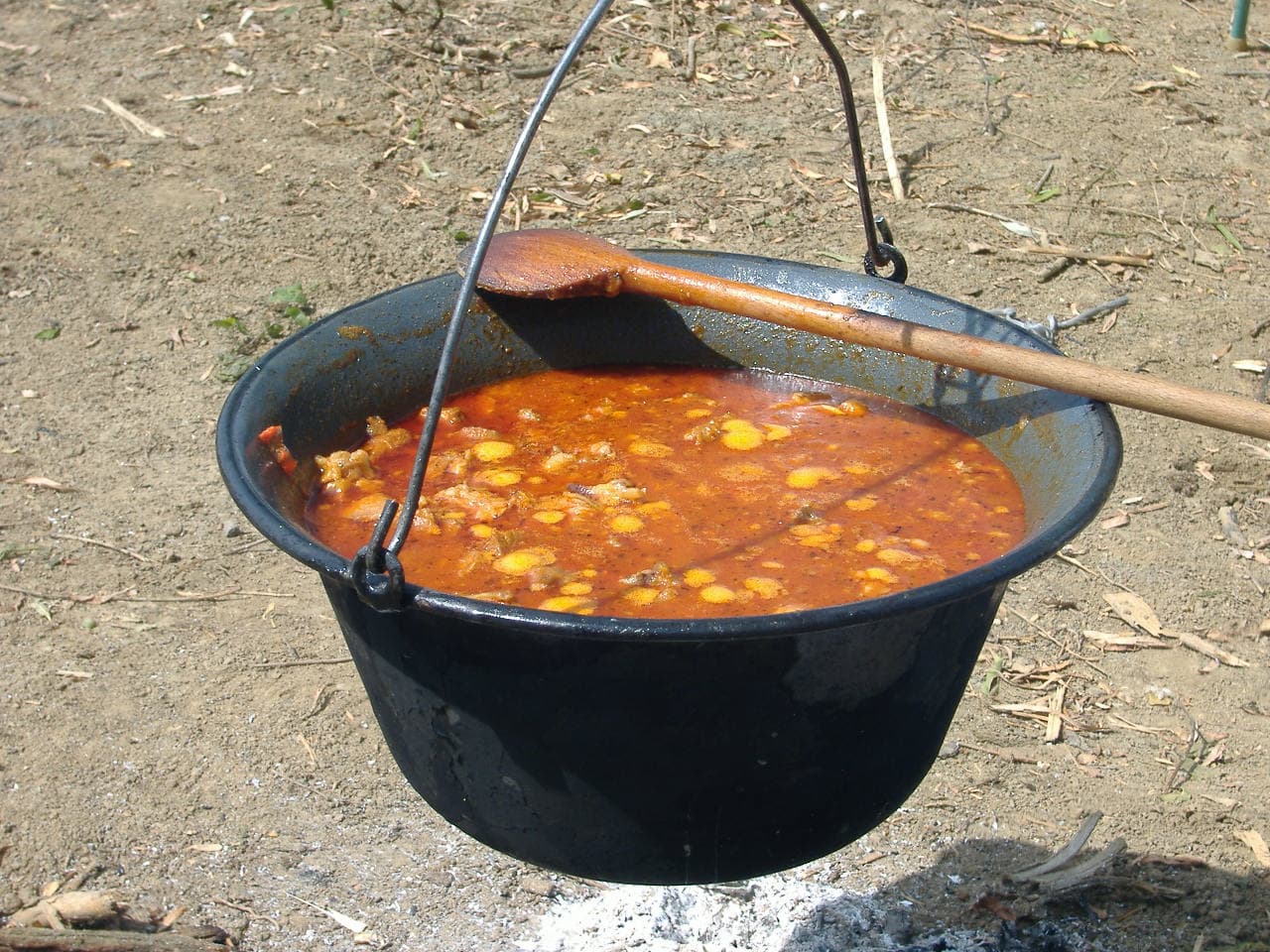
Gulyas (goulash)
The national dish and a standing correction: in Hungary goulash is a paprika-bronzed beef and vegetable SOUP, not the stew the rest of the world makes of it. The stew exists too, it is called porkolt. Order gulyas in a proper etterem or from a market-hall stand and judge it by the depth of the paprika and the tenderness of the beef.
 Kobako · CC BY-SA 2.5 via Wikimedia Commons
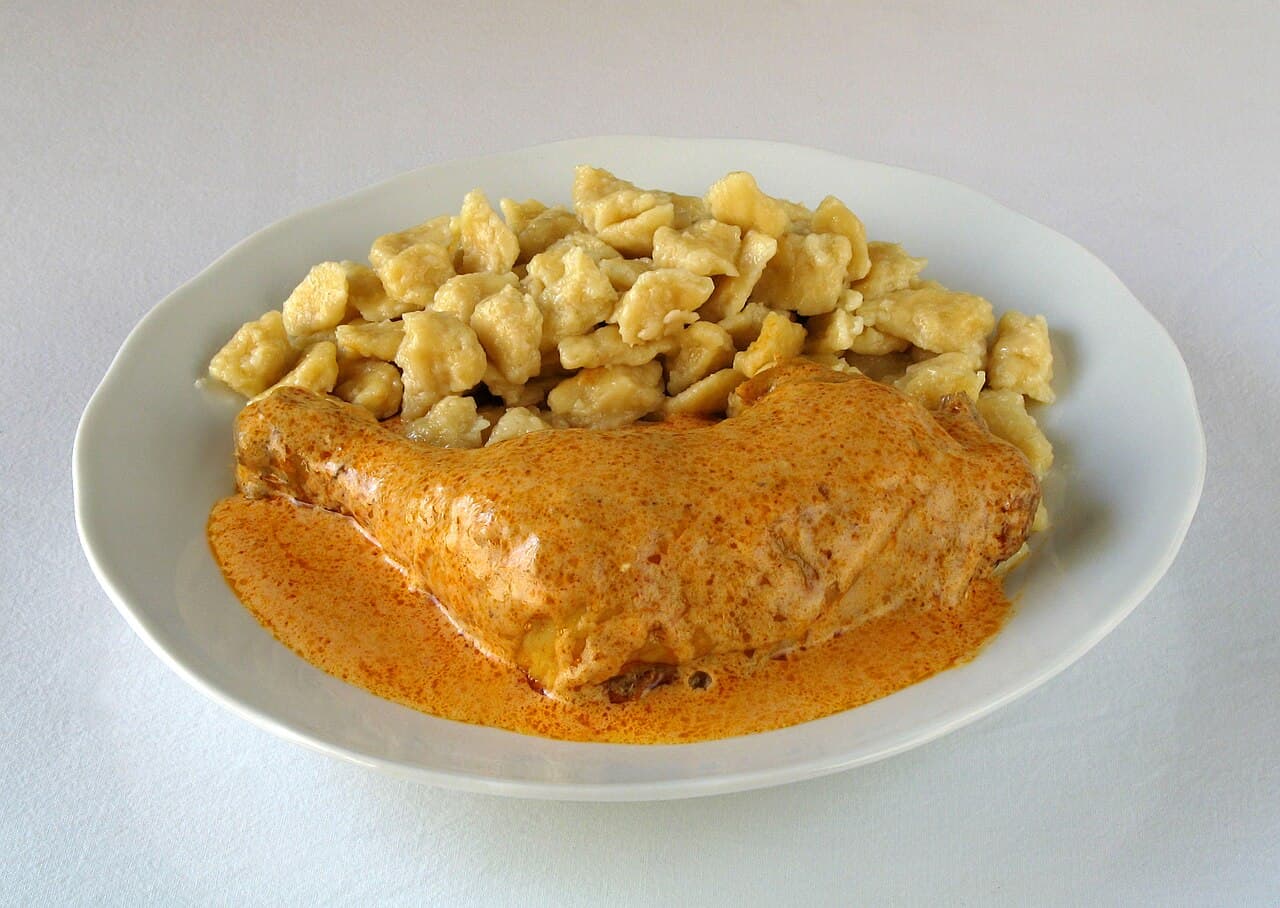
Chicken paprikash with nokedli
Chicken braised in a sour-cream-silked paprika sauce over nokedli, the small pinched dumplings Hungarians make instead of pasta. The dish that best explains why paprika is a national identity rather than a spice: sweet, smoky and comforting in equal measure.
 Politikaner · CC BY-SA 3.0 via Wikimedia Commons
Langos
A plate-sized disc of deep-fried dough rubbed with garlic and loaded, canonically, with sour cream and grated cheese. Market halls and lidos do it best; it is bath-day food, festival food and 2am food, and it costs a few thousand forints at most. One per two people is a rational starting ratio.
 Vladimir Srajber · Pexels
Kurtoskalacs (chimney cake)
Dough ribbon wound around a spit, rolled in sugar and roasted over coals until the outside caramelises into a crackling tube, then dusted in cinnamon or walnut. Transylvanian by origin, Budapest street corners by adoption, and at its best handed over too hot to hold at a Christmas market.
 Silar · CC BY-SA 4.0 via Wikimedia Commons
Toltott kaposzta
Cabbage leaves stuffed with pork and rice, slow-cooked in sauerkraut with smoked meat and finished with sour cream: the Sunday-lunch heavyweight of the Hungarian table, at its best in autumn and winter and in the old-school etterems that never modernised.
 Savannah Grandfather · CC BY 2.0 via Wikimedia Commons
Dobos torta and somloi galuska
The two dessert monuments: the Dobos, five sponge layers and chocolate buttercream under a caramel shard lid, invented in 1885 and engineered to survive travel; and somloi galuska, a trifle-adjacent heap of rum-soaked sponge, walnuts, chocolate sauce and cream. Order them in a grand cafe where they belong.
 tutu from Budapest, Hungary · CC BY-SA 2.0 via Wikimedia Commons
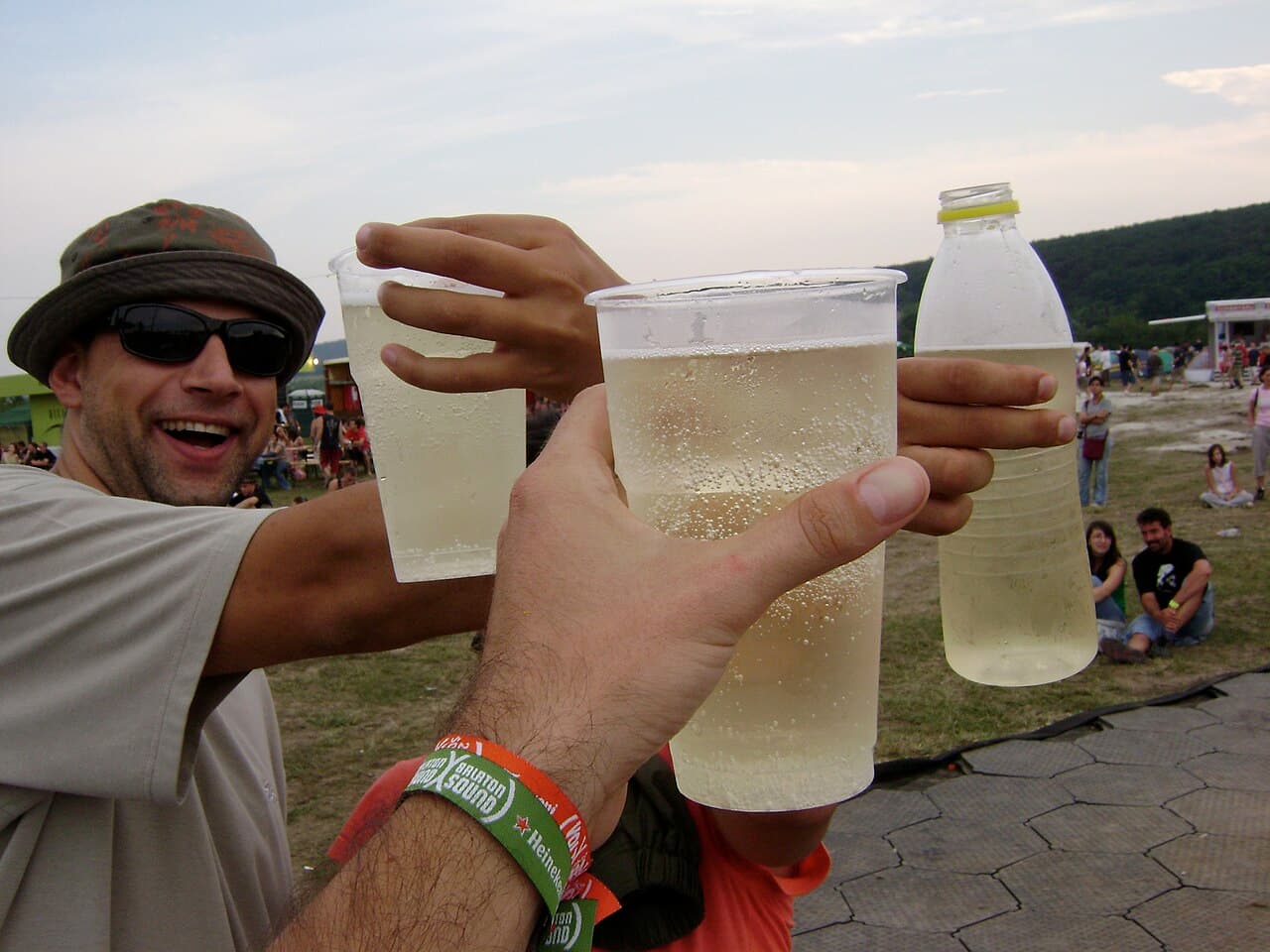
Froccs (wine spritzer)
Hungarian wine culture's summer engine: dry white or rose cut with soda water in named ratios, from the kisfroccs to the hosszulepes, ordered by the ratio at outdoor bars and garden ruins all summer. Cheap, low-proof and endlessly refillable: the correct terrace drink from May to September.
 Atai Anarbek · Pexels
Tokaji aszu and the wine list
Hungary has 22 wine regions and Budapest's wine bars pour all of them: furmint dry or noble-sweet from Tokaj, bull's blood blends from Eger, big reds from Villany. A glass of aszu with dessert is the classic; a flight of dry furmint is the modern move and the better one.
Budapest eats earlier than the Mediterranean: kitchens fill from 6:30pm and many close orders by 10. Book the good restaurants a few days ahead, and the Michelin rooms weeks ahead. Many restaurants add a clearly itemised service charge of 12 to 15 percent, so check the bill before adding more; if none is charged, 10 percent in cash is right. Cards, including contactless, are accepted almost everywhere, but pay in forints always: any terminal or menu offering to charge you in euros is running a conversion margin against you. Lunch menus (ebedmenu) are the value play, two or three courses for the price of a single evening main at the same address. Grand cafes are an institution, not a tourist trap: budget a slow hour, not a takeaway coffee.
Where to eat
Getto Gulyas
casualThe Jewish Quarter's standard-bearer for traditional Hungarian cooking at honest prices: goulash from a kettle, paprikash with hand-pinched nokedli, stuffed cabbage, duck leg with red cabbage, all in a wood-and-brick room that fills nightly. Book a day or two ahead; walk-ins queue from 7pm. Mains sit well under downtown hotel-restaurant prices.
Last researched 2026-08-13
 Globetrotter19 · CC BY-SA 3.0 via Wikimedia Commons
Stand
fine-diningBudapest's only two-Michelin-star restaurant, where Tamas Szell and Szabina Szullo rebuild Hungarian classics, goulash included, with two-star technique. The tasting menu runs around 89,500 HUF, a fraction of the equivalent room in Paris, and books out weeks ahead. This is the meal that makes the case for modern Hungarian cuisine; come with the appetite the menu deserves.
Last researched 2026-08-13
Borkonyha Winekitchen
fine-diningA Michelin star held for over a decade and worn lightly: a bistro-toned room where the a la carte changes with the market, foie gras and mangalica pork are house signatures, and the wine list runs some 200 Hungarian bottles with the staff fluent in all of them. The approachable end of Budapest fine dining, and the one we would book first.
Last researched 2026-08-13
 Yelkrokoyade · CC BY-SA 3.0 via Wikimedia Commons
New York Cafe
institutionThe 1894 coffee house of the New York Palace, gilded, frescoed and chandeliered to the edge of parody, routinely billed as the most beautiful cafe in the world and priced accordingly. Writers once ran up tabs here for decades; today you queue or book online, pay triple the going rate for coffee and cake, and get an interior no museum ticket in the city can match. Go at opening or mid-afternoon; skip the full meals and order the Dobos.
Last researched 2026-08-13
 Random photos 1989 · CC0 via Wikimedia Commons
Gerbeaud
institutionThe grande dame of Vorosmarty square since 1858, marble-tabled and brass-railed, where the Gerbeaud slice (walnut, apricot jam, chocolate) and the Dobos are the benchmark orders. More restrained and more local than the New York, with terrace seats facing the square that become front-row Christmas market seats in December. The attached confectionery counter solves every edible-souvenir question.
Last researched 2026-08-13
Karavan street food yard
street-foodA fairy-lit gravel yard of food trucks next door to Szimpla Kert: langos in its modern mutations, goulash in bread bowls, Hungarian sausages, vegan counters and craft beer, eaten at shared picnic tables as the quarter warms up for the night. Nothing here is refined and everything hits after a bar or before one; it runs afternoon to late, busiest from 8pm.
Last researched 2026-08-13
Sunrises
 Allen B · Pexels
Fisherman's Bastion before the city wakes
The most photographed terrace in Hungary is empty at 6am: the turrets to yourself, the Parliament across the river catching first light, and the lower terraces free at that hour. By 9am the coaches arrive and the same balustrade is a queue. This is the single best argument for jet lag in Budapest.
Year-round; May to September for river mist and warm light · Walk up from Batthyany square (10 minutes of stairs) or take bus 16 to Szentharomsag square.
 Elijah Cobb · Pexels
Gellert Hill and the Citadella at dawn
Climb the paths from Elisabeth Bridge as the sky lightens and reach the newly reopened ramparts for sunrise over Pest: the Danube silvering, both banks in shadow, the Parliament dome the first thing the sun finds. The park is free and open, the joggers own it at that hour, and the panorama runs the full length of the city.
Year-round; autumn mornings bring valley mist on the river · Paths climb from Dobrentei square or the Cave Church; allow 25 minutes up.
 Ejov Igor · Pexels
Tram 2 with the first commuters
Board tram 2 at the Great Market Hall just after dawn and ride the Pest embankment north: the Chain Bridge, Buda Castle and the Parliament slide past the windows in morning gold for the price of a single ticket, shared with commuters instead of tourists. Sit river-side on the left. The cheapest great view in Europe.
Year-round · Runs from about 4:30am; a single BKK ticket (500 HUF) covers the line.
Sunsets
 Aktron · CC BY 3.0 via Wikimedia Commons
The Citadella ramparts at golden hour
The reopened fortress terraces face west over Buda and east over Pest, so sunset works twice: the light dropping behind the Buda hills, then the blue hour as the Parliament, the bridges and the castle switch on their floodlights one by one. Free since the March 2026 reopening, and the best all-of-Budapest frame there is. Bring a layer; the hilltop wind is real.
Year-round; summer sunsets align up the Danube
 Furkan Akkurt · CC BY-SA 4.0 via Wikimedia Commons
The Chain Bridge and the corso at dusk
Walk the bridge from Pest as the lamps come on, the stone lions in silhouette and Buda Castle glowing above, then drift the Danube corso south with the river full of lit cruise boats. This is the UNESCO riverscape doing exactly what it was built to do; no ticket, no queue, no wrong month.
Year-round · Start at Szechenyi Istvan square 30 minutes before sundown.
 C1 Superstar · Pexels
High Note SkyBar facing the Basilica
The Aria hotel's rooftop puts the floodlit dome of St Stephen's close enough to touch, with cocktails priced for the view and heaters extending the season. The most-booked sunset table in downtown: reserve days ahead for the rail seats, or come at opening and take your chances. One drink here, then dinner at street level, is the right ratio.
April to October; heated igloos in winter
 Christo · CC BY-SA 4.0 via Wikimedia Commons
Rudas rooftop pool after dark
The wellness wing's rooftop hot tub hangs over the Danube with Elisabeth Bridge and the Pest skyline laid out beyond the water line: at dusk, and especially in the Friday and Saturday night sessions, it is the most cinematic 38 degrees in Europe. Steam, city lights and the river traffic below; book the night session online well ahead.
Year-round; winter steam is the spectacle
Day trips
 David Sablatura · Pexels
Szentendre
The Baroque artists' town 40 minutes up the Danube: cobbled lanes between Orthodox church spires, a marzipan museum, galleries in merchant houses and riverside terraces, all built by Serbian traders and adopted by painters. It is the easy, half-day-sized Danube Bend option, and the HEV suburban train makes it the only one that needs no planning at all. Weekday mornings beat the weekend crowds.
About 40 minutes on the H5 HEV from Batthyany square · Half day
 Irina Balashova · Pexels
The Danube Bend: Visegrad and Esztergom
The full-day version of the river: north to where the Danube makes its 90-degree knee turn through wooded hills. Visegrad's hilltop citadel, seat of a 14th-century royal court, owns the single best view of the bend; Esztergom's colossal basilica, the largest church in Hungary, stands where the country's first king was crowned, its dome visible for miles into Slovakia. Doable by bus and boat combinations, far easier as an organised or driven loop with Szentendre folded in.
Full-day loop, roughly 45 minutes to 1.5 hours between stops by car · Full day
 Molnár Tamás Photography™ · Pexels
Eger
The Baroque wine town two hours northeast that every Hungarian will tell you to visit: the castle that held off an Ottoman siege in 1552, a working minaret you can climb, and the Valley of the Beautiful Women, a horseshoe of rock-cut wine cellars pouring Bull's Blood (Egri Bikaver) straight from the barrel at prices that feel misprinted. Train it for the town, or join a wine-focused tour and let someone else drive home.
About 2 hours by direct InterCity train from Keleti station · Full day, or overnight to do the cellars justice
 Nikolett Emmert · Pexels
Etyek wine country
Budapest's own vineyard hills, 30 minutes west: the cool-climate source of much of Hungary's sparkling wine, with a village of press houses, weekend-open cellars and picnic terraces between the vines. Close enough for a half day, gentle enough for a lunch-anchored one; several Budapest operators run afternoon tastings with transfers, which solves the driving question entirely.
About 30 to 40 minutes by car or tour transfer · Half day
 Bence Szemerey · Pexels
Lake Balaton: Tihany and Balatonfured
Central Europe's largest lake, 90 minutes southwest: milky-green water, a wine-covered north shore, and the Tihany peninsula's 1055 Benedictine abbey looking down lavender fields to the water. Balatonfured's reform-era promenade and bathing culture pair with a ferry hop to Tihany for the classic day; in high summer the lake is Hungary's riviera and books out, in June and September it is calm and at its best.
About 1.5 to 2 hours by direct train from Deli or Kelenfold to Balatonfured · Full day, or overnight in summer
After dark
 Mihai Vlasceanu · Pexels
Ruin bar crawl in District VII
barStart at Szimpla Kert, the 2004 original that turned a condemned courtyard block into the genre: mismatched furniture, fairy lights, a Trabant to drink in, and every room a different bar. Then drift: the quarter holds dozens of variations, from garden yards to wine-focused rooms. Arrive at Szimpla before 10pm to walk straight in at weekends; Sunday morning it hosts a genuinely good farmers' market, which is the most Budapest plot twist there is.
 Tamás Mészöly · CC BY-SA 3.0 via Wikimedia Commons
A night river cruise
cultureBudapest at night is a floodlit stage set and the river is the front row: the Parliament, the castle and all the bridges lit and doubled in the water. Options run from simple one-hour sightseeing boats with a drink to dinner cruises with folk or jazz; the sightseeing tier delivers the same view for a third of the money. Book the 21:00-ish departures for full darkness in summer.
 Christo · CC BY-SA 4.0 via Wikimedia Commons
Rudas night bathing
cultureFriday and Saturday nights the 16th-century Ottoman dome and the rooftop pool run 22:00 to 3am: steam under 450-year-old stone, then hot water outdoors with the lit city across the river. Online tickets only and they sell out; book early in the week. The rare late-night plan that leaves you better in the morning, not worse.
 Sam Hofman · Pexels
Opera or a concert for the price of a cocktail
cultureThe Hungarian State Opera, restored to its 1884 gilt, sells performances at prices Vienna and Paris cannot approach, and the Liszt Academy's Art Nouveau hall does the same for concerts. Even a mid-tier seat is one of the great value nights in European culture; check both calendars before deciding any evening is unplanned. Dress smart-casual and arrive early for the buildings themselves.
Daily itinerary
Three days in Budapest: the river, the hill and the hot water
The classic city for first-timers: Pest's monuments and cafes, Buda's hill at the right hours, both flagship baths, and every evening on or above the river.
- 1
Pest: Parliament to the corso
fullThe Parliament tour, booked days ahead, then five quiet minutes at the Shoes on the Danube memorial and a walk down the embankment to Szechenyi Istvan square.Downtown lunch menu near the Basilica, the two-course ebedmenu is the deal of the day.St Stephen's Basilica and its panorama terrace, coffee and Dobos at Gerbeaud, then Andrassy Avenue as far as the Opera with the M1 metro back.Walk the Chain Bridge at dusk as the floodlights come on.Getto Gulyas for the Hungarian canon, booked a day or two ahead.First ruin-bar orientation at Szimpla Kert, or a night cruise if the legs are done.Everything on foot except the M1 hop back down Andrassy; a single 24-hour BKK pass covers the day with change.Estimate: Parliament sold out? The Opera House tour or the Ethnography Museum absorb the morning, and the building is best from outside anyway.
- 2
Buda: the hill early, the fortress at sunset
fullFisherman's Bastion and Matthias Church before 9am, then the Castle District's lanes and the National Gallery in Buda Castle, checking what the Hauszmann works have open.Castle-district cafe, or descend to the Batthyany square market hall for a market lunch with a Parliament view.Ride the funicular or walk down to the Chain Bridge, cross to Vaci utca at your own risk of souvenirs, or rest: tonight runs late.Climb Gellert Hill to the reopened Citadella for golden hour and the blue-hour light-up, the best free panorama in the city.Borkonyha if it is a book-ahead trip, or the Jewish Quarter's bistros if not.Rudas night bathing if it is Friday or Saturday (booked online early in the week); otherwise the ruin bars go on without you noticing you were gone.Bus 16 up Castle Hill saves the morning climb; the Citadella climb is 25 minutes on foot from Elisabeth Bridge; trams 19/41 and 2 stitch the riverbanks.Estimate: Rain: swap the Citadella for the Hospital in the Rock museum under Castle Hill and take the sunset from the Aria rooftop instead.
- 3
City Park: the bath, the square and the send-off
moderateSzechenyi Baths at opening, 7am weekdays, with the morning ticket: two hours of outdoor steam and chess-watching before the crowds, then coffee in City Park.Langos upstairs at the Great Market Hall (closed Sunday), shopping the paprika and Tokaji stalls after.Heroes' Square, then your pick of the park: the House of Music's exhibition, the Museum of Ethnography's rooftop ramp, or Vajdahunyad Castle's courtyards.Tram 2 along the embankment for the golden-hour ride, or the High Note SkyBar's rail seats if booked.Stand for the two-star finale if the trip earns it; Karavan's street-food yard if the budget went to the baths.One last walk on the corso: the Parliament floodlit from the Pest bank is the correct closing image.M1 metro to the park, tram 2 and 47/49 handle the market and embankment; nothing today needs a taxi until the airport does.Estimate: Sunday: the market hall is shut, so front-load Heroes' Square and give the market slot to the Ethnography Museum.
Five days: Budapest, the Bend and a wine region
The three-day city at a civilised pace, plus the Danube Bend's castles and a proper Hungarian wine day. The version that converts a city break into a small holiday.
- 1
Arrive and calibrate on the river
relaxedLand, 100E airport express to Deak Ferenc square (about 40 minutes), check in and shed the flight.First langos or a lunch menu near the hotel.The Danube corso end to end: Chain Bridge, Shoes memorial, Parliament exterior, getting the geography into your legs.Chain Bridge at dusk.Getto Gulyas or a Jewish Quarter bistro.Szimpla Kert while the jet lag still thinks it is early.The 100E costs 2,500 HUF; buy the BKK 72-hour pass at the same machines and the city is solved for three days.Estimate: Late arrival? Swap the corso walk to day 2's afternoon and go straight to dinner.
- 2
Pest in full
fullParliament tour (pre-booked), Shoes memorial, Basilica and its terrace.Ebedmenu downtown.Andrassy Avenue, the Opera, and the Dohany Street Synagogue's museum and memorial garden before it closes.High Note SkyBar facing the Basilica dome, booked ahead.Borkonyha, with the sommelier choosing the furmint.A night cruise under the lit bridges.On foot plus the M1; the synagogue closes late afternoon and all day Saturday, so slot it carefully.Estimate: Saturday: the synagogue is closed, so swap in the House of Terror or the Ethnography Museum.
- 3
Buda and the baths
fullFisherman's Bastion at 8am, Matthias Church, castle courtyards and the National Gallery.Batthyany square market hall, cheap and local with the best Parliament view in the city.Rest, then the Gellert Hill climb: Cave Church, the paths, the reopened Citadella ramparts.On the Citadella as the city lights come on.Casual in District VII; save the appetite for tomorrow's wine country.Rudas night session if the calendar cooperates; the rooftop pool at night is the trip's screensaver.Bus 16 up the hill, trams along the Buda bank, and one honest climb; everything else is short hops.Estimate: Knees vote no on Gellert Hill? Bus 27 reaches the Citadella from Moricz Zsigmond korter.
- 4
The Danube Bend
fullOut early for the full loop: Visegrad's citadel for the great river-knee panorama.Riverside in Visegrad or Esztergom.Esztergom Basilica, the largest church in Hungary, and the footbridge stroll to Slovakia and back, then Szentendre's lanes on the return leg.Back in the city, resting honest legs.Raday utca terraces, ten relaxed minutes from most District V and IX hotels.An early night or a quiet wine bar: tomorrow closes with the flagship bath.An organised Danube Bend day tour removes every connection headache; independent versions work but check return buses before committing.Estimate: Prefer wine to castles? Swap the whole day for Eger by train: castle, minaret and Bull's Blood cellars.
- 5
Szechenyi, the park and the last lap
moderateSzechenyi Baths at opening with the pre-9am ticket, then City Park: Heroes' Square and the House of Music.Great Market Hall langos and food-gift shopping (weekday or Saturday morning only).Margaret Island by bike or on foot if hours allow, or the Museum of Fine Arts if the weather argues.Tram 2's golden-hour run along the embankment.Stand, booked weeks ago, as the finale; or a last paprikash somewhere unpretentious.The corso, the floodlit Parliament, and the admission that three nights would not have been enough.M1 to the park, tram 4/6 to Margaret Island, tram 2 for the ride; the 100E runs back to the airport from Deak into the small hours.Estimate: Flying out mid-afternoon? Invert the day: bath at 7, market at 10, airport by 1.
Getting around
- Budapest Liszt Ferenc International Airport (BUD) sits 22km southeast of the centre. The 100E Airport Express bus runs direct to Deak Ferenc square in about 40 minutes for 2,500 HUF (raised from 2,200 on 1 October 2025), every 10 minutes or so by day and reduced overnight; buy it in the BudapestGO app or at the machines, as regular passes are not valid on it. Taxis run on a fixed tariff and cost roughly 9,000 to 13,000 HUF to downtown depending on traffic; use the official Fotaxi rank, never a tout inside the terminal.
- The cheaper airport route, bus 200E to Kobanya-Kispest then metro M3 in, works on a normal single-transfer or day ticket and takes about an hour: worth it on a tight budget, not with luggage at midnight.
- International trains arrive mostly at Keleti station (Vienna about 2.5 hours, Prague about 7, Belgrade overnight), with some services at Nyugati or Deli; all three stations sit on the metro. The Vienna-Budapest rail corridor is frequent enough to treat like a commuter line, which makes the two-capital trip an easy pairing.
- River cruises dock on both banks in the city centre. Long-distance buses (Flixbus and friends) use Nepliget station on the M3.
- The BKK network is dense, cheap and mostly a pleasure: four metro lines including the 1896 M1, the continent's oldest electrified underground and a heritage ride in itself, trams that count as sightseeing (2 along the river, 4/6 around the ring 24 hours a day), plus buses and the HEV suburban trains. Single ticket 500 HUF, 90-minute transfer ticket 850 HUF, 24-hour travelcard 2,750 HUF, 72-hour 5,750 HUF; buy in the BudapestGO app or at machines and validate whatever you carry (bank-card tap-in works only where specifically marked): inspectors are real, plain-clothed and unmoved.
- The 24-hour travelcard beats single tickets from the sixth ride and removes all validation friction; groups of up to five can share a 24-hour group card. Passes cover the HEV within city limits (Szentendre needs a small extension fare).
- Taxis are yellow, metered and tariff-fixed by law (about 1,100 HUF base plus per-km); Bolt and Fotaxi apps summon the same cars with none of the negotiation. Never accept an unbadged car outside a bar or the station.
- BKK has run public riverboat lines on the Danube in past seasons, a transit ticket that is accidentally a river cruise, but service comes and goes year to year: check BudapestGO for whether boats are running before planning around them.
- Walking is the default in the centre: Pest's District V, VI and VII interlock within 25 minutes on foot, and the bridges are the best part of any route. Buda's hills are the exception; bus 16 to the Castle District and bus 27 up Gellert Hill save the climbs when it matters.
- Cycling has grown into the city with riverside paths and the MOL Bubi bike-share (app-based, cheap); Margaret Island and the two embankments are the joy rides. Ride the ring boulevards only with city-cycling nerves.
Things worth knowing
- · Arriving with the Gellert Baths on the itinerary. They closed on 1 October 2025 for renovation until 2028, along with the hotel becoming a Mandarin Oriental in 2027; Szechenyi and Rudas are the answer, and the trip is not poorer for it.
- · Turning up at the Parliament without a booking. English tours sell out days to weeks ahead in season; the visitor centre releases slots online and the queue you see is for people who did not read this.
- · Doing Fisherman's Bastion at 11am with the coaches. Before 8am or after dinner it is a different, better place, and the upper towers go free in the evening anyway.
- · Paying in euros. Shops and terminals that offer euro pricing or dynamic currency conversion are charging a hidden margin every time; pay in forints on a no-fee card and let your bank do the converting.
- · Riding without a validated ticket because the gates were open. Plain-clothes inspectors board constantly and the fine conversation is long, awkward and in Hungarian first.
- · Planning a Sunday around the Great Market Hall. It is closed Sundays and winds down Saturday afternoon; go weekday-early for the real thing.
- · Treating the bath day as spontaneous. Szechenyi's queues and Rudas's sold-out night sessions both punish improvisation; book online, bring flip-flops and a towel or budget the rental, and go at opening or late.
- · Booking a party-street room by accident. Kazinczy utca and the Gozsdu courtyard are wonderful at 11pm and hostile at 4am; if you sleep light, choose District V, VI or the Buda bank instead.
Budget
| Low | Expected | Comfortable | |
|---|---|---|---|
| Accommodation style / per night | HUF 25,000≈ $77 | HUF 65,000≈ $200 | HUF 220,000≈ $676 |
| Food style / per day | HUF 8,000≈ $25 | HUF 22,000≈ $68 | HUF 80,000≈ $246 |
| Local transport / per day | HUF 1,000≈ $3 | HUF 2,750≈ $8 | HUF 12,000≈ $37 |
| Estimate / per day | HUF 2,000≈ $6 | HUF 13,000≈ $40 | HUF 35,000≈ $108 |
Estimate · HUF · 2026-08-13. Accommodation is per room per night for two sharing. Budapest remains the value capital of the grand-city circuit: 65,000 HUF (about 180 EUR) buys a genuinely good four-star double downtown, and even the palace five-stars undercut their Paris and Vienna siblings. Food splits sharply: market-hall and lunch-menu eating is 8,000 HUF a day territory, while the Michelin tier prices in international euros. The line items that inflate a real budget are bath tickets for two (25,000 HUF and up per visit at Szechenyi rates), the Parliament's non-EEA ticket tier, night cruises and the party quarter's cocktail lists. A 4 percent city tourist tax applies per night on top of room rates. August around Sziget and the 20th, F1 weekend in late July and the December market weeks lift hotel prices hardest; January and February give the same city at the year's lowest rates. · 1 USD = HUF 325 (14 Oct 2026)
Things worth knowing
Frequently asked questions
How many days do you need in Budapest?
Three nights covers the classic city well: one day for Pest's monuments, one for Buda's hills and the baths, one for City Park and the market. Four or five nights add the Danube Bend or a wine region, a second bath, and the pace the city actually rewards. Budapest also pairs naturally with Vienna, 2.5 hours by frequent train, for a two-capital week.
When is the best time to visit Budapest?
May, June and September for the best weather-to-crowd ratio; April and October as quieter, cooler seconds. July and August are hot and busy but carry the big calendar (Sziget, the 20 August fireworks). December has the Christmas markets and January-February the best bath weather and lowest prices. There is no closed season: the baths make winter a feature.
Are the Gellert Baths open?
No. The Gellert Baths closed on 1 October 2025 for a full renovation with reopening planned for 2028, and the attached hotel is being converted to a Mandarin Oriental opening in 2027. Ignore any site selling Gellert tickets for 2026. Szechenyi covers the grand-spectacle role and Rudas the historic-Ottoman one, with a rooftop pool the Gellert never had.
Szechenyi or Rudas: which bath should you choose?
Both, ideally, because they answer different questions. Szechenyi is the icon: the huge yellow courtyard pools, the chess players, the scale. Go at opening on a weekday with the pre-9am ticket. Rudas is the atmosphere: a 1560s Ottoman dome, a rooftop hot tub over the Danube, and Friday-Saturday night sessions to 3am. If you can only do one and it is a weekend, Rudas by night edges it.
Where should you stay in Budapest for the first time?
District V for the monuments and the river at your door; the Jewish Quarter (VII) for food and nightlife density, choosing a quiet-side room; Andrassy Avenue (VI) for boulevard elegance a step off the crowds. The Buda bank suits couples who want calm with a view, accepting a bridge crossing every evening. Sleeping ON Castle Hill is romantic but leaves you commuting to dinner.
Is Budapest expensive?
Against Western European capitals, no: hotels, transport, museums and everyday eating run clearly cheaper than Vienna, Paris or London, and the 500 HUF tram ticket may be Europe's best transport value. The exceptions price internationally: the Michelin restaurants, rooftop bars, river dinner cruises and the big baths for two. A couple eating well but not grandly lives comfortably on 25,000 to 40,000 HUF a day plus the room.
Is Budapest safe?
One of the safer European capitals for visitors: violent crime against tourists is rare and the centre is busy late. The actual risks are pickpockets on the 4/6 tram and in market crowds, taxi touts and unbadged cars (use Bolt or Fotaxi), euro-priced menus and conversion-margin card terminals, and the party quarter's clip-joint bars: never follow a street promoter to a "club". Standard city sense covers all of it.
Do you need to book the Parliament and the baths ahead?
The Parliament, yes, always: English tours sell out days to weeks ahead in season, and only the official visitor centre site sells at face price. Rudas night sessions: yes, online, early in the week. Szechenyi: booking skips a real queue in summer and the morning ticket is cheaper anyway. Stand and the Michelin rooms: weeks ahead. Everything else in the city tolerates spontaneity.
Can you drink the thermal water, and is the tap water safe?
Tap water is safe and good throughout Budapest. The thermal drinking cure exists, Szechenyi and Lukacs have drinking halls serving sulphurous spring water by the cup, and it is an acquired taste best acquired by someone else. In the pools, keep water out of your mouth as you would in any shared warm pool, shower before entering, and observe the swim-cap rule in lap lanes only.
Forint or euro: how should you pay?
Forint, always. Cards work almost everywhere including most market stalls and every bath, so a no-foreign-fee card in HUF is the whole strategy; when a terminal offers euros, decline and choose HUF, because the conversion margin is never in your favour. Carry 10,000 to 20,000 HUF cash for edge cases, drawn from a real bank's ATM, never the Euronet boxes by the sights.
Sources (16)
- Gellert Baths closed from 1 October 2025 with reopening planned in 2028, visitors redirected to Szechenyi · official · 2026-08-13
- Mandarin Oriental Gellert Budapest planned to open in 2027 in the renovated Hotel Gellert · official · 2026-08-13
- Renewed Citadella on Gellert Hill reopened 28 March 2026 with free park access and a ticketed Bastion of Liberty exhibition · reputable-local · 2026-08-13
- National Hauszmann Programme reconstruction of Buda Castle running 2019 to about 2030, north wing due end of 2026 · reputable-local · 2026-08-13
- Szechenyi Thermal Bath opening hours and 2026 ticket levels · official · 2026-08-13
- Rudas Baths Ottoman section, wellness wing and Friday-Saturday night bathing sessions · official · 2026-08-13
- Hungarian Parliament visitor tours, two-tier EEA and non-EEA pricing and advance sell-outs · official · 2026-08-13
- Banks of the Danube with the Buda Castle Quarter inscribed by UNESCO in 1987, Andrassy Avenue extension 2002 · unesco · 2026-08-13
- Sziget Festival 2026 dates 11 to 15 August on Obuda Island · official · 2026-08-13
- St Stephen's Day 20 August 2026 fireworks and drone show over the Danube with a week of free programmes · tourism-board · 2026-08-13
- 35th Budapest Wine Festival at Buda Castle 9 to 12 September 2026 · official · 2026-08-13
- Michelin Guide Hungary selection: Stand at two stars and six one-star restaurants in Budapest · reputable-local · 2026-08-13
- 100E Airport Express fare 2,500 HUF and BKK single, 90-minute, 24-hour and 72-hour prices · transport-operator · 2026-08-13
- Kimpton BEM Budapest opened July 2024 with 127 rooms on Bem Jozsef square · official · 2026-08-13
- Buda Castle funicular 2026 fares of 4,500 HUF single and 5,500 HUF return · official · 2026-08-13
- Vorosmarty Square and Basilica Christmas markets running mid-November to 1 January · independent-travel · 2026-08-13