Australia · Queensland
Great Barrier Reef & Cairns
Base in Cairns for reef-boat access and the Esplanade, or Port Douglas for a quieter, resort-style stay closer to the Low Isles and the Daintree. Add one rainforest day and one full-day reef trip with a certified operator.
 Ank Kumar / CC BY-SA 4.0 via Wikimedia Commons
Overview
Cairns and Port Douglas sit between two UNESCO World Heritage sites: the Great Barrier Reef offshore and the Daintree Rainforest inland. Few places put a coral reef and a rainforest of this age within the same day-trip radius. The reef is about an hour and a half out by boat, the Daintree an hour and a half north by road.
Book the reef day with a High Standard eco-certified operator, and read the environmental management charge on the ticket as part of the price. At AUD 8.50 a head it is already inside the fare, and it funds the management of the park you came to see.
Best for
Snorkelers and divers · Nature and wildlife travelers · Rainforest-and-reef combined trips · Family adventure · Long-haul trips with one big set piece
Daily itinerary
4 to 6 days
Cairns is a working port town, and the reef is reached from it on day boats out of the Reef Fleet Terminal. The rainforest is closer than the reef: an hour up the range by road, by cableway or on the Kuranda railway.
Best time to visit
Tropical North Queensland runs on two seasons rather than four. The dry season (roughly May to October) is the more reliable window for calm seas, clear water and comfortable rainforest walking. The wet season (November to April) brings heat, humidity and a real chance of cyclones affecting boat schedules. Marine stinger season overlaps it and runs longer, November through May.
- May: Transition into the dry season; humidity easing, good early visibility.
- June to August: Peak dry season; the most reliable calm-water window on the reef, and the coolest, most comfortable rainforest walking.
- September to October: Warming again, still dry-season conditions, fewer crowds than mid-year.
- November to April: Wet season: hot and humid, cyclone risk affects boat scheduling, and stinger nets go up on the northern beaches and at Port Douglas. Marine stinger season itself runs November to May.
Things worth knowing
- Cairns Festival (late winter): arts, music and a Grand Parade across the city; the council publishes the year’s dates on its festival page.
- Port Douglas Carnivale (May; 21 to 23 May in 2026): a street parade on Macrossan Street, a long lunch and a beach day.
Where to stay
 Francesco Ungaro · Pexels
Cairns CBD & the Esplanade
The regional hub: reef boats leave from the Reef Fleet Terminal, the waterfront boardwalk is lined with restaurants, and the free Esplanade Lagoon is where people swim, since the city waterfront is mudflat rather than beach.
Best for: Reef-boat access · Budget to midrange stays · Walkability
Cairns itself has no swimmable beach; the Esplanade Lagoon and reef trips are how visitors get in the water.
 Paul Pulimoottil · Pexels
Port Douglas
A quieter, more resort-style base an hour north along the Captain Cook Highway, with Four Mile Beach, closer access to the Low Isles and the Daintree, and a slower pace than Cairns.
Best for: Resort stays · Couples · Closer Daintree access
A car or transfer is needed to reach it from Cairns Airport; fewer budget options than Cairns itself.
 Relaxing Journeys · Pexels
Palm Cove
A boutique beachfront village between Cairns and Port Douglas, with a palm-lined esplanade, upscale small resorts and a calmer pace than either larger town.
Best for: Couples · A quieter luxury stay · Beachfront dining
Limited nightlife and restaurant variety compared with Cairns or Port Douglas.
 Peterdownunder · CC BY-SA 3.0 via Wikimedia Commons
Daintree & Cape Tribulation
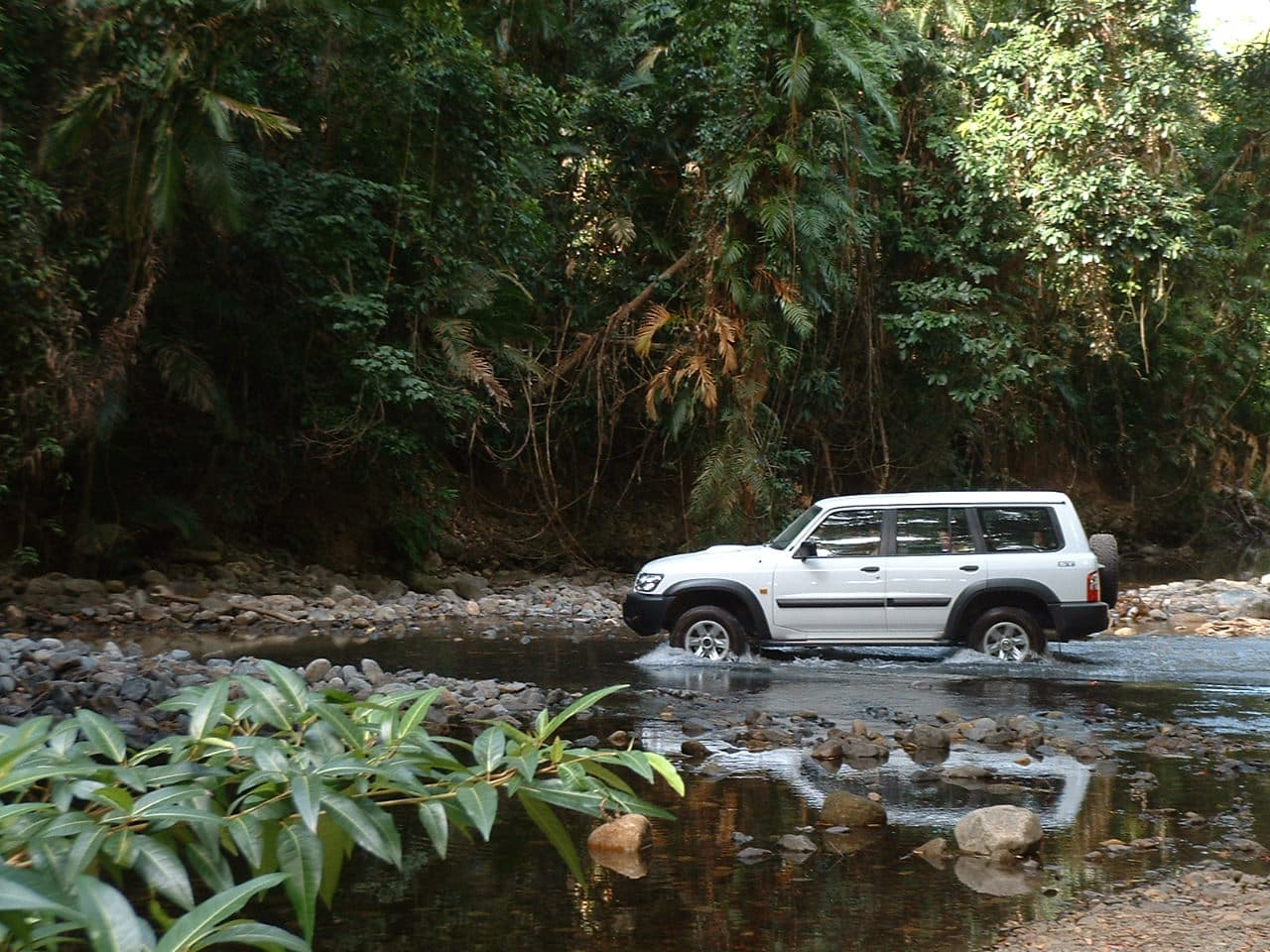
The point where the rainforest meets the reef, part of the UNESCO-listed Wet Tropics of Queensland; eco-lodges and small guesthouses sit among ancient rainforest north of the Daintree River.
Best for: Rainforest immersion · Wildlife spotting · A remote overnight
Remote and humid; river crossings and unsealed roads mean a car (sometimes 4WD) is essential, and mobile coverage is patchy.
 Lobster1 · CC BY-SA 3.0 via Wikimedia Commons
Kuranda
A rainforest village in the hills above Cairns, reached by the Skyrail cableway or the historic Kuranda Scenic Railway, with markets, wildlife parks and rainforest walks.
Best for: A rainforest day out · Families · Scenic transport as the experience
Very much a day-trip village; most visitors do not stay overnight.
Where to sleep
Sheraton Grand Mirage Resort, Port Douglas
resort · Port Douglas
Best for: Families · Lagoon-style pools · A full resort experience
- 147 hectares of tropical garden with two hectares of lagoon-style pools
- Beachfront on Four Mile Beach
- A spa, seven restaurants and bars, and children’s facilities on site
- Large and resort-generic rather than intimate
- A car or transfer is needed for reef-boat departures and the Daintree
- Premium pricing in peak dry season
Thala Beach Nature Reserve
unique · Between Cairns and Port Douglas
Best for: Eco-minded travelers · A private-bungalow feel · Wildlife on the property
- Standalone timber bungalows built into a private headland reserve
- Certified at Ecotourism Australia’s highest level; 75 bungalows across a 145-acre headland
- Beach coves reached only from the property
- Isolated: a car is necessary for reef trips, restaurants and the Daintree
- Rustic-luxury style will not suit travelers wanting a conventional big-resort experience
- Steep paths between bungalows and the main building
The Reef Hotel Casino Cairns, Handwritten Collection
luxury · Cairns CBD
Best for: Central Cairns access · Reef-boat proximity · A full-service city hotel
- Walking distance to the Reef Fleet Terminal and the Esplanade
- On-site casino and spa, with six restaurants and bars including Tamarind, Flinders Bar & Grill and Soy Kitchen
- Views over Trinity Inlet and the coastal range
- No beach; Cairns itself has none
- Casino setting will not appeal to everyone
- City-hotel feel rather than tropical-resort feel
Alamanda Palm Cove by Lancemore
resort · Palm Cove
Best for: Couples · Beachfront in Palm Cove · A quieter luxury base
- Direct beach access from the property, on the Palm Cove sand rather than across the esplanade
- Apartments of one to four bedrooms with full kitchens, in place of standard hotel rooms
- Quiet village setting away from Cairns and Port Douglas crowds
- Limited walkable dining options beyond the village strip
- A car is needed for reef-boat departures (mostly from Cairns or Port Douglas)
- Premium pricing for the space and privacy
Mantra Trilogy Cairns
value · Cairns Esplanade
Best for: Budget-conscious travelers · Families · Self-catering
- Directly on the Cairns Esplanade near the Lagoon pool and reef terminal
- Apartment-style rooms with kitchenettes for flexible eating
- A predictable apartment-hotel standard at 101-105 Esplanade, opposite the waterfront
- Simple, not luxurious
- Busy Esplanade location can be noisy on weekends
- Pool and facilities are shared with a large number of rooms
Essential experiences
 Ank gsx · CC BY-SA 4.0 via Wikimedia Commons
Great Barrier Reef Marine Park (UNESCO)
The world’s largest coral reef system, inscribed on the World Heritage List in 1981. The World Heritage Area covers about 348,000 sq km and over 900 islands; the Marine Park sits inside it, and it is the Marine Park the day boats work in.
 Relaxing Journeys · Pexels
Wet Tropics of Queensland / Daintree Rainforest (UNESCO)
One of the oldest continually surviving tropical rainforests on Earth, protected as a UNESCO World Heritage site since 1988.
 Gilberto Olimpio · Pexels
Mossman Gorge
A river gorge of granite boulders at the southern edge of the Daintree. Ngadiku Dreamtime Walks leave from the Mossman Gorge Cultural Centre with Kuku Yalanji guides.
 Gu Bra · Pexels
Skyrail Rainforest Cableway & Kuranda Scenic Railway
Two ways to cross the same rainforest range: a cableway over the canopy one way, and the other a heritage railway built in the 1880s, 37 km of it, over 55 bridges and through 15 tunnels. Check both operators before booking. Skyrail is running a Kuranda to Barron Falls loop only while upgrade works run to 25 October 2026, and the railway has maintenance cancellations in September and November 2026.
Skyrail service notices ↗Kuranda Scenic Railway ↗View on map ↗
 Relaxing Journeys · Pexels
Cairns Esplanade Lagoon
A free public swimming lagoon on the Cairns waterfront, the practical answer to the fact that Cairns has no swimmable ocean beach.
 Philippe WEICKMANN · Pexels
Michaelmas Cay
A coral sand cay and seabird sanctuary on the outer reef, reached by day-boat, combining a snorkel site with a protected bird-nesting island.
 Relaxing Journeys · Pexels
Four Mile Beach, Port Douglas
A long, patrolled sandy beach along Port Douglas, backed by the Coral Sea on one side and the town’s cafes on the other.
 MODIS Land Rapid Response Team, NASA GSF / Public domain via Wikimedia Commons
 BriMiDra / CC BY-SA 4.0 via Wikimedia Commons
Food & drink
 Farhad Ibrahimzade · Pexels
Coral trout and barramundi
The reef region’s signature fish, usually grilled or pan-fried and served simply.
 Andrew S from Brisbane, Australia · CC BY-SA 2.0 via Wikimedia Commons
Mud crab
A prized Queensland delicacy, typically served whole with a chilli or garlic-butter sauce.
 Ridiculopathy · CC0 via Wikimedia Commons
Tropical fruit
Mango, lychee, custard apple and other tropical fruit are grown locally and sold at markets and roadside stalls.
 Ponsakthi Anand · Pexels
Fresh prawns off the boat
Bought straight from marina-side prawn trawlers and eaten with nothing more than a squeeze of lemon.
Dining is casual across the region; bookings help for dinner in peak dry season (June to August) but are rarely essential outside it.
Where to eat
Prawn Star
casualA prawn trawler tied up at Marlin Marina, E Finger, Berth 31, selling and serving its own catch from 11 am to 9 pm daily. You eat on the boat.
Last researched 2026-09-18
Ochre Restaurant
modernA long-running Cairns restaurant built around native Australian ingredients such as crocodile, kangaroo and native spices, alongside reef seafood.
Last researched 2026-07-15
Salsa Bar & Grill
modernA Port Douglas restaurant open since 1995, on Wharf Street overlooking Dickson Inlet, serving reef fish and modern Australian dishes.
Last researched 2026-09-18
Sunrises
 Laurel Lodged · CC BY-SA 3.0 via Wikimedia Commons
Cairns Esplanade boardwalk
The Esplanade faces east across Trinity Bay, catching sunrise over the water before the day’s reef boats depart.
Year-round
 Hagai Agmon-Snir حچاي اچمون-سنير חגי אגמון-שניר · CC BY-SA 4.0 via Wikimedia Commons
Rex Lookout
A cliffside pull-off on the Captain Cook Highway between Cairns and Port Douglas, looking east over Wangetti Beach and the Coral Sea, with paragliders often overhead once the day warms up. The sun comes up out of the water here; it goes down behind the range at your back.
May to October (dry season, clearer skies) · A short pull-off on the highway; take care with traffic when stopping.
Sunsets
 Luis Rod · Pexels
Four Mile Beach, Port Douglas
The beach faces east into the Coral Sea, so the sun sets behind it over the ranges. What you get is afterglow on the water and colour over the hills, not a sun dropping into the sea.
Year-round
 Suthee Pakcharoen · Pexels
Palm Cove jetty
The jetty runs out past the palm-lined esplanade. The sun sets behind the village, so the draw is the afterglow on the water rather than the sun itself, and the same jetty is a stronger spot at sunrise.
Year-round
Day trips
 Reef Runner Charters · Pexels
Outer reef day trip by boat
A full day on the Great Barrier Reef itself: snorkelling or diving at outer reef sites such as Agincourt Reef or Michaelmas Cay, usually with lunch included.
About 1.5 to 2 hours each way by boat · Full day
 Relaxing Journeys · Pexels
Daintree Rainforest & Cape Tribulation
A day into the UNESCO-listed Daintree, crossing the Daintree River by ferry to Cape Tribulation, where the rainforest meets the reef at the coastline. The ferry runs from 5 am to midnight every day; its fares are set by Douglas Shire Council and updated each 1 July.
About 1.5 to 2 hours each way by car · Full day
 Gu Bra · Pexels
Kuranda via Skyrail and Scenic Railway
Ride the Skyrail cableway up over the rainforest canopy to Kuranda village and return by the Kuranda Scenic Railway, or the reverse. Check both operators’ closure pages before you book: Skyrail is running a limited Kuranda to Barron Falls loop only while upgrade works run to 25 October 2026, and the railway has maintenance cancellations in September and November 2026.
About 1 hour 45 minutes by cableway with stops, 1 hour 55 minutes by rail each way · Full day
Skyrail service notices ↗Kuranda Scenic Railway timetable ↗View on map ↗
After dark
Cairns Night Markets stroll
marketThe Cairns Night Markets sit on Abbott Street, one block back from the Esplanade: an indoor, air-conditioned arcade of around seventy souvenir and clothing stalls with a food court, open every evening of the year.
 Asad Photo Maldives · Pexels
Sunset drink at a marina bar
harbourWatch the reef boats come in at the Cairns Marlin Marina or Port Douglas Marina with a sunset drink.
Daily itinerary
Five days in Cairns and the Great Barrier Reef: reef, rainforest and a slower coast
Three nights in Cairns, one night north, out on day five. Cairns covers the reef trip and Kuranda; the move to Port Douglas or Palm Cove covers the Daintree and a slower coast.
- 1
Arrive in Cairns
relaxedArrive; settle in near the Esplanade.Casual lunch on the Esplanade boardwalk.Swim at the Esplanade Lagoon; browse the waterfront.Marlin Marina as the boats come in; the Esplanade is an east-facing sunrise walk, so save it for the morning.Fresh seafood at the marina.Early night before the reef trip.Everything walkable from a central Cairns base.Estimate: Confirm the next day’s reef-boat pickup point and time tonight.
- 2
Outer reef day
fullEarly check-in at the Reef Fleet Terminal for the outer reef boat.Lunch included on board.Snorkelling or diving at outer reef sites; a marine biologist talk if the operator offers one.Relaxed dinner back in Cairns.An early night; reef days are tiring.Boat transport only; no car needed today.Estimate: Choose a Port Douglas-departure boat instead if staying north from day 3.
- 3
Kuranda rainforest day
moderateSkyrail cableway up to Kuranda over the rainforest canopy, if the full Smithfield to Kuranda line is running; until 25 October 2026 only the short Kuranda to Barron Falls loop operates.Lunch at the Kuranda Markets.Wander Kuranda village and a short rainforest walk.Return to Cairns; dinner in town.Free evening.Skyrail one way and the Kuranda Scenic Railway the other, close to two hours each way, with no car needed. Check both operators’ notices first: the cableway is on a shortened loop to 25 October 2026 and the railway has maintenance cancellations in September and November 2026.Estimate: Add a wildlife park stop in Kuranda if traveling with children. · Drive or take a coach up the Kennedy Highway if neither the cableway nor the railway is running on your dates.
- 4
Move north to Port Douglas or Palm Cove
moderateDrive the Captain Cook Highway north, stopping at Rex Lookout.Lunch in Port Douglas or Palm Cove.Settle into the new base; Four Mile Beach or the Palm Cove esplanade.Afterglow from Four Mile Beach or the Palm Cove jetty; the sun itself goes down behind the ranges.Dinner at a long-running local restaurant.Quiet evening.Rental car for the coastal drive.Estimate: Skip the move and day-trip north from Cairns instead if not keen to change hotels.
- 5
Daintree half-day and departure
fullCross the Daintree River on an early ferry for a river cruise; estuarine crocodiles are watched from the boat.Lunch at Mossman.Mossman Gorge and the Ngadiku Dreamtime Walk on the way south, rather than pushing on to Cape Tribulation: the cape is about two and a half hours from Cairns Airport before the ferry queue, and that is the tightest drive in this guide.Return south for departure.Rental car with a river ferry crossing; the ferry runs from 5 am, so an early start is what makes the day work.Estimate: Add a sixth day and a second night north if you want Cape Tribulation itself rather than the half-day version.
Getting around
- Cairns Airport (CNS) is the regional gateway, about 10 to 15 minutes by road from the Cairns CBD, with direct flights from the major Australian cities and a short international list: Auckland, Christchurch, Bali, Fiji and a seasonal Cathay Pacific service to Hong Kong.
- Port Douglas is roughly a 1 hour drive north of Cairns Airport along the Captain Cook Highway; shuttle transfers run directly from the airport.
- From Israel it is a one-stop trip: the Ben Gurion flight board carries no nonstop to Sydney, Melbourne, Brisbane or Cairns. The working routings are El Al to Bangkok, Emirates to Dubai or Etihad to Abu Dhabi, then an Australian gateway and a domestic leg to Cairns. Singapore and Hong Kong have no Tel Aviv service at the moment, so those classic Australia connections need a second stop.
- Cairns CBD and the Esplanade are walkable; reef boats depart from the Reef Fleet Terminal in town.
- A rental car is the most practical way to reach Port Douglas, Palm Cove and the Daintree; some roads north of the Daintree River require care and, past Cape Tribulation, 4WD.
- Regional coaches and shuttle operators connect Cairns, Port Douglas and Palm Cove without a car.
Things worth knowing
- · Booking a reef trip without checking whether the operator is High Standard eco-certified.
- · Swimming in Daintree River estuaries or unmarked coastal creeks, where estuarine crocodiles are present.
- · Underestimating stinger risk and skipping a stinger suit on reef swims between November and May.
Budget
| Low | Expected | Comfortable | |
|---|---|---|---|
| Accommodation style / per night | A$120≈ $84 | A$260≈ $181 | A$550≈ $384 |
| Food style / per day | A$35≈ $24 | A$70≈ $49 | A$140≈ $98 |
| Local transport / per day | A$10≈ $7 | A$40≈ $28 | A$70≈ $49 |
| Estimate / per day | A$20≈ $14 | A$60≈ $42 | A$150≈ $105 |
Estimate · AUD · 2026-09-18. Accommodation is per room per night (two sharing). Day-trip figures reflect a full-day outer reef boat, which includes the environmental management charge, equipment and lunch: the two largest operators start at AUD 312 and AUD 338 an adult for 2026-27. Operator fares are set for 1 April to 31 March and currently carry a fuel surcharge of AUD 10 an adult; coach transfers and guided snorkel or introductory dive add-ons sit on top of that. Local transport "expected" assumes a rental car for part of the trip. · 1 USD = A$1 (14 Oct 2026)
Things worth knowing
Frequently asked questions
How many days do you need for Cairns and the Great Barrier Reef?
Four to six days works well: one full reef day, one rainforest day (Kuranda or the Daintree), and time to settle into a base rather than rushing between Cairns and Port Douglas.
Should I stay in Cairns or Port Douglas?
Cairns is more practical for budget options, walkability and reef-boat variety. Port Douglas is quieter and resort-style, with easier access to the Low Isles and the Daintree, but needs a car or transfer from the airport.
When is the best time to visit the Great Barrier Reef?
The dry season, roughly May to October, offers the calmest seas and clearest water. June to August is the most reliable window but also the busiest; May and September to October are quieter with similar conditions.
Is the Great Barrier Reef dying?
The reef has experienced significant coral bleaching events linked to warming seas, and parts of it are under real stress. It also remains a vast, living system with healthy sections, actively monitored and managed. Certified operators are audited on environmental practice and many run monitoring or restoration programs; the pressure on the reef comes chiefly from warming seas rather than from visitors.
Do I need to be a certified diver to see the reef?
No. Most reef-boat operators offer guided snorkelling suitable for non-swimmers and beginners, plus introductory dives for those without certification, alongside options for certified divers.
How do we get there from Israel, and do we need a visa?
With one stop, and yes. The Ben Gurion board carries no nonstop to any Australian city, so the working routes are El Al to Bangkok, Emirates to Dubai or Etihad to Abu Dhabi, then an onward flight to Sydney, Melbourne or Brisbane and a domestic leg to Cairns; Singapore and Hong Kong have no Tel Aviv service at the moment, even though Cairns itself has a seasonal Hong Kong flight. On the visa, Israel is on neither the ETA nor the eVisitor eligible-passport list, so an Israeli passport holder needs a Visitor visa, subclass 600, Tourist stream, applied online from outside Australia before flying. Any guide telling you an Israeli passport can get an ETA is wrong.
Sources (29)
- Great Barrier Reef is a UNESCO World Heritage site · unesco · 2026-07-15
- Wet Tropics of Queensland (Daintree region) is a UNESCO World Heritage site · unesco · 2026-07-15
- Sustainable and responsible ways to visit the Great Barrier Reef · tourism-board · 2026-07-15
- Cairns and Great Barrier Reef region overview and attractions · tourism-board · 2026-07-15
- Skyrail runs a limited Kuranda to Barron Falls loop only, 19 August to 25 October 2026; Kuranda Scenic Railway services cancelled 10 to 21 September and 2 to 6 November 2026 · official · 2026-09-18
- Skyrail fares 2026: adult AUD 74.00 one way, AUD 111.00 return, AUD 138.00 return with Cairns city transfers · official · 2026-09-18
- Kuranda Scenic Railway fares valid to 31 March 2027: Heritage Class adult AUD 58.00 one way, AUD 87.00 return · official · 2026-09-18
- Kuranda Scenic Railway timetable: Cairns 08:45 and 09:30, Kuranda 14:45 and 15:30, 1h55m each way · official · 2026-09-18
- Environmental management charge AUD 8.50 per person aged 4 and over, included in fares, 1 April 2026 to 31 March 2027 · official · 2026-09-18
- Outer reef day-trip fares 2026-27: Great Adventures AUD 312 adult plus AUD 10 fuel surcharge, from the Reef Fleet Terminal · official · 2026-09-18
- Reef boats check in from 7 am at the Reef Fleet Terminal for an 8 am departure · official · 2026-09-18
- The hotel trades as The Reef Hotel Casino Cairns, Handwritten Collection, 35-41 Wharf Street · official · 2026-09-18
- Thala Beach Nature Reserve: 75 bungalows, 145-acre headland, 45 minutes north of Cairns Airport · official · 2026-09-18
- Alamanda Palm Cove by Lancemore: current page and direct beach access · official · 2026-09-18
- Mantra Trilogy, 101-105 Esplanade, Cairns · official · 2026-09-18
- Salsa Bar & Grill, 26 Wharf Street, Port Douglas, open since 1995 · restaurant-official · 2026-09-18
- Prawn Star, Marlin Marina E Finger Berth 31, 11 am to 9 pm daily · restaurant-official · 2026-09-18
- Cairns Night Markets, 54-60 Abbott Street, indoor and air-conditioned, open every day of the year · official · 2026-09-18
- Mossman Gorge Cultural Centre and the Ngadiku Dreamtime Walks · official · 2026-09-18
- Daintree River ferry 5 am to midnight; Birdon operator from 1 July 2026; fares set by Douglas Shire Council annually on 1 July · ferry · 2026-09-18
- Cairns Airport direct international destinations: Auckland, Christchurch, Bali, Fiji and a seasonal Hong Kong service · airport · 2026-09-18
- Marine stinger season runs November through May in north Queensland · reputable-local · 2026-09-18
- Port Douglas Carnivale 2026, 21 to 23 May · event-organizer · 2026-09-18
- Israel National Security Council threat level 2 for Australia, verbatim wording, ministry מל"ל · government · 2026-09-18
- Israel National Security Council country page for Australia · government · 2026-09-18
- Israeli passports are not on the ETA subclass 601 eligible list · government · 2026-09-18
- Israeli passports are not on the eVisitor subclass 651 eligible list · government · 2026-09-18
- Visitor visa subclass 600, Tourist stream, applied online from outside Australia · government · 2026-09-18
- No nonstop Tel Aviv to SYD, MEL, BNE or CNS in the Israeli flight board; BKK, DXB and AUH all return records · government · 2026-09-18


