Thailand · Northern Thailand
Chiang Mai
Stay in the Old City or along the Ping River rather than by the Night Bazaar, go up Doi Suthep at opening time, give a full day to a genuine elephant sanctuary in the Mae Taeng valley, eat khao soi at lunch because the good shops sell out by two, and plan the whole trip for November to early February, when the air is cool and clear.
 ผู้สร้างสรรค์ผลงาน/ส่งข้อมูลเก็บในคลังข้ / CC BY 3.0 via Wikimedia Commons
Overview
Chiang Mai was the capital of the Lanna kingdom for centuries before it was Thai, and it still runs on a different clock from Bangkok: a walled and moated old city with more than thirty working temples inside it, a mountain with a golden stupa rising straight off the western edge of town, and a food culture, khao soi above all, that the rest of Thailand travels north for. It is also the base for the most credible ethical elephant experiences in Asia, which for many travelers is the whole reason to come.
Chiang Mai rewards the traveler who slows down to its pace. The mistake is treating it as a two-night checkbox between Bangkok and the beaches: temple, elephant photo, night market, airport. Give it four nights in the cool season, walk the Old City at 7am when the monks are collecting alms, and eat where the queue is Thai. If your dates land in March, when the burning season smoke settles over the valley, we would honestly move the trip.
Best for
Temple and culture travelers · Food travelers · Couples · Slow travelers and remote workers · First-time Thailand visitors pairing it with Bangkok or the islands · Ethical wildlife experiences
Daily itinerary
4 nights for the city, the mountain and an elephant day; 6 to 7 to add Doi Inthanon and a slow day in the villages
Most Chiang Mai guides list the same three temples and a rotating cast of elephant camps without telling you the two things that actually decide the trip: the season, because from late February to April the north fills with agricultural smoke that can make the city genuinely unhealthy, and the elephant question, because the difference between a sanctuary and a show is the difference between the best day of the trip and the worst. This guide is organised around both, plus the food.
Best time to visit
November to early February is the answer: dry, sunny days around 28 to 30 degrees and cool, sometimes genuinely cold nights. From late February to April the burning season fills the valley with smoke and the air quality can rank among the worst in the world, which is a health issue rather than a cosmetic one. May to October is the green season: hot, then rainy, with lush mountains, waterfalls at full flow and the best hotel prices.
- November: The start of the cool season and the month of Yi Peng and Loy Krathong, when lanterns fill the sky and the moat. In 2026 the festival nights are expected on 24 and 25 November. Book rooms months ahead for those nights.
- December and January: Peak season and deservedly so: clear skies, cool mornings, cold nights up on the mountains. Doi Inthanon can drop near freezing before dawn, which is half the fun of going up for sunrise.
- February: The Flower Festival opens the month with parades and floats, and the first half is usually still pleasant. By late February the burning starts and the haze builds; check the AQI before committing the trip.
- March and April: The smoke months. In bad years, 2026 among them, Chiang Mai ranks among the most polluted cities in the world for days at a time. Songkran (13 to 15 April) is a joyous citywide water fight around the moat, but the air is often still poor.
- May and June: The first rains clear the sky and the heat breaks. Green, quiet, and good value: the countryside comes back to life and the waterfalls start running properly.
- July and August: The green season proper: hot mornings, short heavy afternoon storms, rice paddies at their brightest. Rarely does the rain cost you a whole day.
- September and October: September is the wettest month; October dries out fast and ends with some of the clearest, greenest weeks of the year, just before the crowds return.
Things worth knowing
- Yi Peng and Loy Krathong (November, full moon of the twelfth Thai lunar month): paper lanterns released at sanctioned sites (free release is restricted in the city centre and near the airport) and krathong floats on the moat and the Ping River, Chiang Mai at its most photographed. In 2026 they are expected on 24 and 25 November.
- Chiang Mai Flower Festival (first weekend of February): flower floats, parades and the whole of Suan Buak Hard park in bloom.
- Songkran (13 to 15 April): Thai New Year, celebrated in Chiang Mai with a full-scale water fight around the moat. Expect to be soaked anywhere outdoors for three days.
- Inthakin (City Pillar) Festival (May or June, dates follow the lunar calendar): a week of offerings and chanting at Wat Chedi Luang, a genuinely local festival most visitors walk past without noticing.
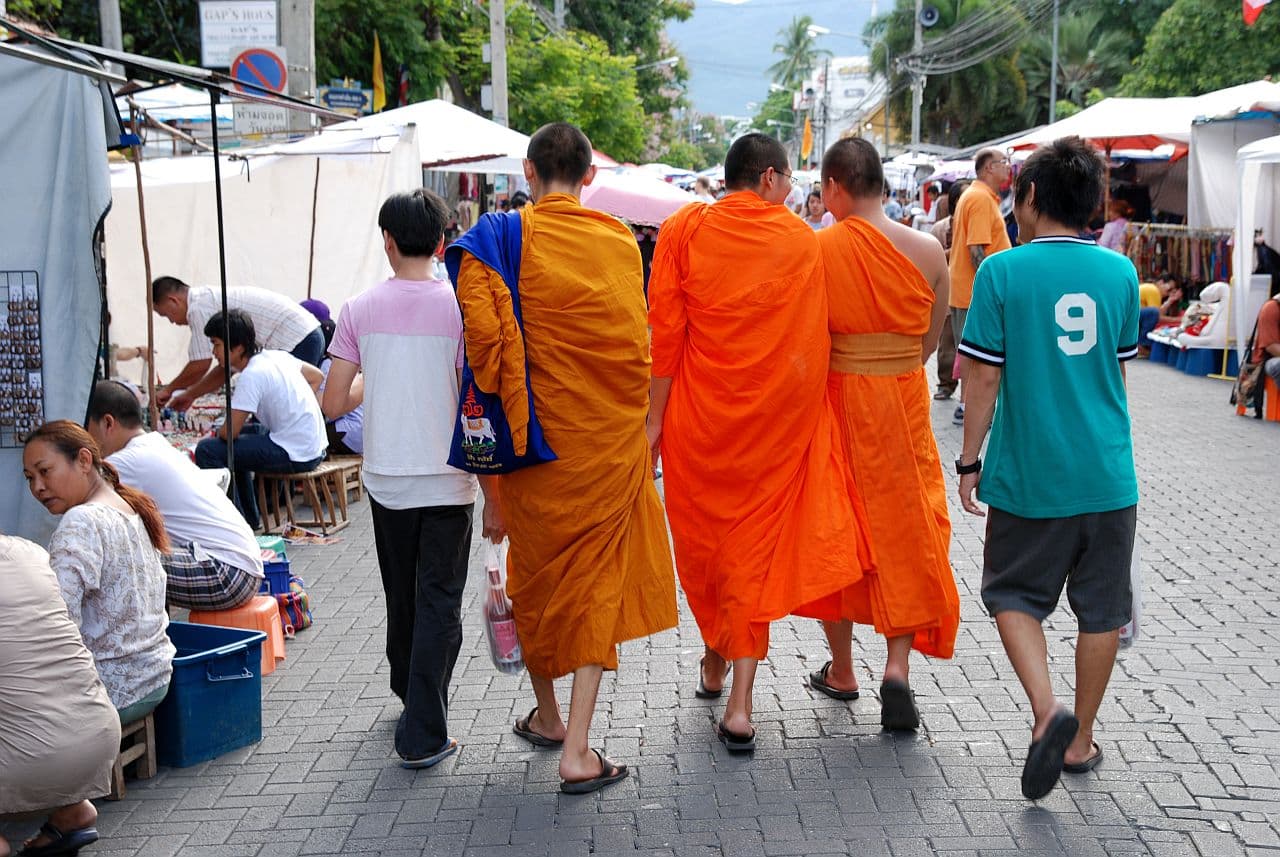
- Sunday Walking Street (every Sunday evening): Ratchadamnoen Road closes to traffic from Tha Phae Gate westward and fills with craft stalls, street food and massage chairs. The single best recurring event in the city.
Where to stay
 Takeaway · CC BY-SA 3.0 via Wikimedia Commons
Old City
The moated square kilometre and a half that was Lanna Chiang Mai, still holding Wat Phra Singh, Wat Chedi Luang and more than thirty other temples between guesthouses, cafes and massage shops. Everything inside the moat is walkable, and the Sunday Walking Street runs straight through the middle of it.
Best for: First-time visitors · Temples on foot · Guesthouses and boutique stays · Sunday Walking Street
The blocks nearest Tha Phae Gate are the most touristed in northern Thailand, and the moat roads that ring the square are busy one-way traffic. Sleep a few lanes deep, not on the ring.
 Maksim Shiriagin · Pexels
Nimmanhaemin (Nimman)
The cafe and design quarter west of the Old City, between the university and the mountain: specialty coffee, galleries, co-working spaces, the One Nimman complex and the city's most polished restaurants and bars. This is modern Chiang Mai, and it is where the remote workers live.
Best for: Cafe culture · Nightlife that ends after 10pm · Design hotels · Longer stays
Twenty to thirty minutes on foot from the Old City temples, and it can feel more like a pleasant university district anywhere than like northern Thailand. Charm is not the point here; convenience is.
 Gije Cho · Pexels
Riverside and Wat Ket
The east bank of the Ping River, the old trading quarter where the teak merchants built their houses. Now it is the city's gentlest neighborhood: heritage hotels, riverside restaurants, the Warorot market across the footbridge, and evenings that end with lights on the water.
Best for: Couples · Heritage and boutique hotels · Riverside dinners · A quieter base
You will take a songthaew or Grab to the Old City sights rather than walk to most of them, and the riverside floods occasionally at the height of the rains.
 Steffi Krauße · Pexels
Night Bazaar (Chang Klan)
The strip between the Old City and the river that hosts the nightly bazaar, a dense run of chain hotels, tailor shops and stalls. Convenient and central, with the best halal food in the city around the Ban Haw mosque, but the least atmospheric of the central bases.
Best for: Nightly market access · Larger hotels · Halal travelers
The bazaar itself sells the same goods a hundred times over, and the strip has little daytime life. It is a place to visit for an evening, not our pick for four nights.
 Markus Winkler · Pexels
Santitham
The workaday neighborhood north of the Old City where rents are low and the food is priced for locals: morning markets, khao soi shops with no English sign, and a growing handful of good cafes. The value base for a longer, slower stay.
Best for: Value · Local food · Longer stays away from the circuit
Few sights of its own and limited English; you are choosing it for price and everyday life, not convenience.
 KE PHUAH 潘国荣 · Pexels
Mae Rim valley
The resort valley 20 to 40 minutes north of the city, where the destination resorts sit among rice terraces and jungle foothills. This is where you stay when the point of the trip is the pool, the spa and the mountain view rather than the city itself.
Best for: Resort stays · Honeymoons · Combining the city with real countryside
Every trip to town is a 30-minute transfer, so plan the city as excursions from the resort rather than the other way round.
Where to sleep
Four Seasons Resort Chiang Mai
resort · Mae Rim valley, about 30 minutes north of the city
Best for: Honeymoons · A resort built around rice terraces · Combining Chiang Mai with pure rest
- Pavilions and pool villas set around working rice terraces with resident water buffalo, one of the most photographed resort settings in Asia
- Lanna architecture throughout, with a full spa, cooking school and yoga barn on the grounds
- The Mae Rim location shortens the drive toward the Mae Sa countryside and Elephant Nature Park, though the sanctuary is still a serious transfer
- Every restaurant and temple in town is a 30-minute transfer away, so it works as a resort stay with city excursions rather than a city base
- Among the most expensive rooms in northern Thailand, especially over the cool-season holidays
Raya Heritage
design · Ping riverbank, north of the city
Best for: Design lovers · Couples · Craft-led Lanna style without resort scale
- 38 river-facing suites in a contemporary take on Lanna design, filled with hand-made work by northern Thai artisans: naturally dyed fabrics, hand-carved teak, local ceramics
- A quiet riverbank setting with terraces over the Ping, plus river-facing dining rooted in northern rice culture
- Larger suites add private terraces and pool suites, generous by city-hotel standards
- The riverside location north of town means a 15 to 20 minute ride to the Old City sights
- All-suite pricing: this is a considered-splurge property, not a casual base
137 Pillars House
boutique · Wat Ket, east bank of the Ping River
Best for: Heritage lovers · Couples · A quiet garden base near the river
- Built around a restored 19th-century teak homestead that served as the northern headquarters of the Borneo Company, with a small museum of the teak-trade era on site
- 30 suites with four-poster beds, Victorian tubs and verandas, wrapped in tropical gardens in the quiet Wat Ket lanes
- Jack Bain's Bar and the Dining Room give it evenings good enough that you will skip going out at least once
- A 15 to 20 minute walk or short ride from the Old City temples
- Suite-only pricing puts it in the same bracket as the resorts without resort grounds
Rachamankha
boutique · Old City, behind Wat Phra Singh
Best for: Architecture lovers · A silent retreat inside the Old City · Couples
- Modeled on 15th-century Lanna monastery architecture by architect Ong-ard Satrabhandhu, with cloistered courtyards, antiques and a library that feels like a private museum
- A short walk from Wat Phra Singh and the Sunday Walking Street, yet completely silent inside the walls
- Only 25 rooms and suites around two acres of courtyards, with a 20-metre pool
- Rooms in the classic wings are atmospheric rather than large, and the aesthetic is deliberately spare
- The hushed, gallery-like atmosphere suits adults; families with young children will feel out of place, and the hotel generally does not take young kids
Tamarind Village
boutique · Old City, on Ratchadamnoen Road
Best for: First-time visitors who want the Old City at the door · Couples · Sunday Walking Street from the doorstep
- Built around a 200-year-old tamarind tree in garden courtyards, a genuinely calm pocket in the exact centre of the Old City
- The Sunday Walking Street sets up on its doorstep and Wat Chedi Luang is five minutes on foot
- 45 Lanna-styled rooms with a pool and a well-regarded northern Thai restaurant, at a price well below the luxury tier
- Rooms are comfortable rather than lavish; you are paying for location and gardens, not marble
- On festival and market nights the surrounding lanes are lively into the evening
Green Tiger House
value · Old City, near Chang Phueak (North) Gate
Best for: Budget travelers who still want a pool · Vegetarians and vegans · Solo travelers
- A friendly guesthouse-scale hotel with a small pool and rooftop lounge, minutes from the North Gate night food market
- The attached Reform Kafe is one of the best vegan kitchens in the city, and breakfast is far above guesthouse standard
- Old City location a short walk from the main temples at a fraction of boutique prices
- Rooms are simple and the pool is compact; this is comfort, not luxury
- The plant-based kitchen is the identity: committed carnivores will eat elsewhere, though the North Gate market solves that nightly
Essential experiences
 Alberto Capparelli · Pexels
Wat Phra That Doi Suthep
The golden hilltop stupa that watches over the city from 1,000 metres up the mountain, founded in the 14th century on a site chosen, the legend says, by a white elephant. Climb the 306-step naga staircase (there is also a funicular) for the terrace views back over the valley. Go at opening time: by mid-morning the tour buses have arrived.
 Guillaume Meurice · Pexels
Wat Chedi Luang
The ruined great chedi at the centre of the Old City, completed in the 15th century and once nearly 80 metres tall before an earthquake brought the top down in 1545. It held the Emerald Buddha, now in Bangkok, for eight decades. The evening chanting and the city pillar shrine make it worth a second, quieter visit after dark.
 Kirandeep Singh Walia · Pexels
Wat Phra Singh
The most revered working temple in the city, home of the Phra Singh Buddha image and the jewel-box Lai Kham assembly hall with its 19th-century Lanna murals. It anchors the western end of Ratchadamnoen Road, so the Sunday Walking Street literally ends at its gate.
 Pete Miller Portraits · Pexels
The Monk's Trail and Wat Pha Lat
A 45-minute forest path from behind the university up the flank of Doi Suthep, marked by monks' orange robes tied to the trees, arriving at Wat Pha Lat: a mossy jungle monastery beside a waterfall with a stone terrace looking over the whole city. The single best free morning in Chiang Mai, and most visitors never hear of it.
 Sky Vaughan · Pexels
Elephant Nature Park
The sanctuary that changed the industry: Lek Chailert's rescue centre in the Mae Taeng valley, home to over 100 elephants retired from logging, trekking and shows. No riding, no shows, no tricks; day visits are observation-led, moving through the grounds with a guide who knows each animal's rescue story, with adults-only walking programs deeper in the valley. Book weeks ahead in high season, and be suspicious of any camp that copies the word sanctuary without the ethics.
 Takeaway · CC BY-SA 4.0 via Wikimedia Commons
Sunday Walking Street
Every Sunday from late afternoon, Ratchadamnoen Road closes from Tha Phae Gate to Wat Phra Singh and fills with hundreds of stalls: hill-tribe textiles, woodcarving, silver, street food in the temple courtyards, and foot-massage chairs lined up under the trees. Come hungry, come early (it peaks around 7pm) and carry small notes.
 Manop · CC BY-SA 3.0 via Wikimedia Commons
Warorot Market (Kad Luang)
The city's real daily market by the river: three floors of northern sausage, crispy pork, chilli pastes, textiles and kitchenware, with the 24-hour Ton Lamyai flower market on the riverbank behind it. This is where Chiang Mai actually shops, and the best place to assemble an edible souvenir haul.
 Christophe95 · CC BY-SA 4.0 via Wikimedia Commons
Wat Umong
A 700-year-old forest monastery at the foot of the mountain built over a network of brick meditation tunnels, with a stupa on top, a lake with monks' huts around it, and Buddhist proverbs nailed to the trees in Thai and English. Quieter and stranger than anything inside the moat.
 Ritthichai Siangdee · CC BY-SA 4.0 via Wikimedia Commons
Wat Suan Dok
The royal temple west of the Old City where the whitewashed mausoleums of the Lanna royal family cluster beside a 48-metre golden chedi. The white chedis against the sunset, with Doi Suthep behind, is one of the city's great evening photographs, and the temple's monk chat program is the easiest place to actually talk with a monk.
 Hartmann Linge · CC BY-SA 4.0 via Wikimedia Commons
Tha Phae Gate and the moat
The rebuilt eastern gate of the 13th-century city walls, opening onto a brick plaza that serves as the city's living room: pigeons, buskers, festivals, and the start line of the Sunday Walking Street. The full moat circuit, corner bastions included, is a pleasant 6km early-morning walk or ride.
 Adam Jones from Kelowna, BC, Canada / CC BY-SA 2.0 via Wikimedia Commons
 Stefan Fussan / CC BY-SA 3.0 via Wikimedia Commons
Food & drink
 Takeaway · CC BY-SA 3.0 via Wikimedia Commons
Khao soi
The north's signature: egg noodles in a curried coconut broth, topped with the same noodles fried crisp, with pickled mustard greens, shallots and lime on the side. Usually chicken or beef. The great shops sell it at lunch and sell out by early afternoon.
 Takeaway · CC BY-SA 3.0 via Wikimedia Commons
Sai ua
The northern Thai sausage: pork packed with lemongrass, kaffir lime leaf, galangal and chilli, grilled over charcoal and sold by the length at markets. Warorot Market is full of it.
 Chainwit. · CC BY-SA 4.0 via Wikimedia Commons
Gaeng hang lay
A slow, rich pork belly curry of Burmese descent: ginger, tamarind, pickled garlic and no coconut milk. The dish to order at a proper northern restaurant.
 Võ Văn Tiến · Pexels
Nam phrik num and khaep mu
Young green chilli relish, smoky and coarse, eaten with pork cracklings and steamed vegetables. The north's favourite snack plate and a market staple.
 Meaw Zara · Pexels
Khanom chin nam ngiao
Fresh rice noodles under a tomato-and-pork-blood broth of Shan origin, sharp and deeply savoury: the local breakfast the guidebooks skip.
 Sóc Năng Động · Pexels
Khao niao (sticky rice)
The northern staple, served in woven baskets and eaten by hand, rolled into a ball and dipped. If your table has sticky rice and nam phrik, you have ordered correctly.
Chiang Mai eats early and eats at markets. Khao soi is a lunch dish: the famous shops open mid-morning and close when the pot is empty, often by 2pm, so plan it as the midday meal, not dinner. Evenings belong to the night markets, the North Gate stalls and the riverside; many kitchens wind down by 9pm, and the city is quiet by 11 outside Nimman. Sticky rice is eaten with the right hand, shoes come off in homes and some shop-house restaurants, and a 20 to 40 baht bowl of noodles is normal, not a trap. Alcohol is sold from 11am to midnight, the decades-old afternoon sales break having been scrapped in May 2026, and bars close earlier than in Bangkok.
Where to eat
Khao Soi Khun Yai
institutionA garden shack behind a temple serving what many consider the city's best khao soi for around 50 baht. Open roughly 10am to 2pm, closed Sundays, and it sells out; go before 1pm.
Last researched 2026-07-26
 Takeaway · CC BY-SA 3.0 via Wikimedia Commons
Khao Soi Mae Sai
casualA no-frills neighbourhood shop holding a Bib Gourmand in the 2026 Michelin Guide Thailand, serving khao soi and khanom chin nam ngiao. Lunchtime hours; arrive before the office crowd at noon.
Last researched 2026-07-26
Huen Phen
institutionThe Old City's long-standing northern kitchen: a canteen-style lunch operation in front and an antiques-crammed dining house at dinner. Order the hang lay curry, sai ua and nam phrik num and share everything.
Last researched 2026-07-26
Baan Landai Fine Thai Cuisine
fine-diningA family-run fine Thai kitchen that has appeared in the Michelin Guide Thailand since 2020, in a converted house in the northern Old City. Book a day or two ahead in high season.
Last researched 2026-07-26
The Riverside Bar & Restaurant
casualThe riverside institution since 1984: Thai and Western menus, terraces over the Ping and live bands from mid-evening. Not the city's most refined kitchen, and it does not need to be; book a water-side table at sunset.
Last researched 2026-07-26
Sunrises
 icon0 com · Pexels
The Monk's Trail to Wat Pha Lat
Start the forest path at first light and reach the jungle monastery as the sun clears the valley haze, with the city waking up below the stone terrace and the monks chanting above the waterfall. The best sunrise in Chiang Mai costs nothing but the early alarm.
November to February for clear air
 Chatchai Jomta · CC BY 3.0 via Wikimedia Commons
Doi Suthep temple terrace at opening
Be on the mountain for the first songthaew and climb the naga stairs while the terrace is still monks, mist and bells. The gold chedi takes the early light before the valley does, and you will have the city viewpoint essentially alone.
Cool season mornings; in the rains you may be inside a cloud
 Nguyen Ngoc Tien · Pexels
Ton Lamyai flower market at dawn
The riverside flower market works through the night, and just before sunrise it peaks: marigold garlands by the thousand, lotus buds for the morning temple trade, and the Ping River turning pink behind the stalls. Walk it, then cross to Warorot as the food floors open.
Year-round · Open around the clock on the riverbank behind Warorot Market; busiest and best before 7am.
Sunsets
 Takeaway (talk) · CC BY-SA 3.0 via Wikimedia Commons
Wat Suan Dok white chedis
The whitewashed royal mausoleums face the sunset with Doi Suthep silhouetted behind them, and the temple stays open into the evening. The classic Chiang Mai photograph, and usually only a handful of people are there for it.
Year-round; November to January for the cleanest light
 Zaonar Saizainalin · Pexels
Doi Suthep viewpoint on the mountain road
The stone-balustraded overlook partway up the temple road faces east over the whole city, which means it catches the last warm light on the valley rather than the sun itself: the city grid, the moat square and the airport runway all glowing at once.
Cool season for haze-free views
 patcharee tangtiang · Pexels
Huay Tung Tao lake
The reservoir at the mountain's northern foot where the city goes on weekends: bamboo salas over the water, grilled fish and som tam delivered to your platform, and the sun dropping behind the ridgeline. The most local golden hour available.
Year-round; fullest and liveliest on weekends · Small entry fee per person; the salas are free if you order food.
 Raven Truong · Pexels
A Ping River terrace
The east bank between Nawarat and Iron Bridge lines up bars and restaurant decks facing west across the water, so the river does the work: order early, take a rail-side table and watch the light go down over the old trading quarter.
Year-round · Shoot upriver toward the mountain as the sky colours; the water carries the reflection.
Day trips
 Messy Moe · Pexels
Doi Inthanon National Park
Thailand's highest mountain (2,565m): cloud forest at the summit, the twin royal pagodas with their gardens in the mist, Karen villages, and the great Wachirathan waterfall on the way up. In the cool season the summit can approach freezing at dawn, a genuine novelty in Thailand. The Kew Mae Pan ridge trail, the park's best short walk, closes June to October for regrowth.
About 1.5 to 2 hours each way by car or tour van · Full day
 Katie Hollamby · Pexels
Elephant Nature Park (full sanctuary day)
Worth framing as its own day trip even though we list it under attractions: the drive up the Mae Taeng valley, a morning observing the herds from the grounds and walkways, the vegan buffet lunch overlooking the river, and the afternoon with the older rescues. It sets the standard every other elephant experience should be judged against.
About 1.5 hours each way, pickup and return included from city hotels · Full day
 Pete Miller Portraits · Pexels
Chiang Rai: the White and Blue temples
A long day, about three hours each way, to see Chalermchai Kositpipat's hallucinatory all-white Wat Rong Khun and the saturated indigo Wat Rong Suea Ten. Extraordinary buildings both, and doable in a day, but consider an overnight in Chiang Rai if your itinerary can spare it; twelve hours for six of driving is a real trade.
About 3 hours each way (roughly 180km) · Full day (12+ hours) or better as an overnight
 Maksim Shiriagin · Pexels
Bua Tong sticky waterfall or Mae Kampong village
Two excellent half-days in opposite directions: the mineral-coated falls at Bua Tong, north of the city, which you can walk straight up barefoot thanks to the grippy limestone, and the coffee-growing mountain village of Mae Kampong at 1,300 metres in the hills east, all wooden houses, homestays and forest tea. Pick one for a relaxed half-day; combining both means a long full day with a driver and two to three hours of transfer between them. Free entry at the falls; weekdays are far quieter.
Bua Tong about 1.5 hours north; Mae Kampong about 1 hour east; combining both is a long full day · Half day for either; a long full day for both
After dark
 Maksim Shiriagin · Pexels
North Gate night food market
foodThe stalls that set up each evening outside Chang Phueak Gate serve the city's best-value dinner: khao kha mu (stewed pork leg over rice) from the famous cowboy-hat stall, grilled everything, and tables full of locals. Go hungry, graze widely.
 Maksim Shiriagin · Pexels
Sunday Walking Street graze
foodIf your trip includes a Sunday, dinner is solved: work down Ratchadamnoen Road stall by stall, from mango sticky rice to grilled sai ua, with temple courtyards turned into food courts along the way.
 Caleb Oquendo · Pexels
Live jazz at The North Gate Jazz Co-Op
barA shoebox bar on the moat where the city's musicians pile in nightly; the Tuesday open jam is a Chiang Mai institution that spills onto the pavement. Arrive early for a stool, or stand outside with everyone else.
 Guillaume Meurice · Pexels
Wat Chedi Luang after dark
cultureThe great chedi is lit at night and the compound stays open into the evening; catch the monks' evening chanting and you will have one of Thailand's great monuments in near silence.
Daily itinerary
Four days in Chiang Mai: temples, elephants and khao soi
The honest minimum: the Old City and the mountain, a full sanctuary day, the markets, and food at every opportunity. Built for the cool season, and best if one of the days is a Sunday.
- 1
The Old City on foot
moderateWat Phra Singh at opening, then wander east through the small temples to Wat Chedi Luang before the heat builds.Khao Soi Khun Yai near the north moat, before 1pm, because it sells out.Break at the hotel pool through the hot hours, then the Lanna lanes around Ratchamanka Road and a first massage.Wat Suan Dok, for the white chedis against the mountain.North Gate night food market, stall by stall.Wat Chedi Luang lit up, then an early night; tomorrow starts before dawn.Everything but Wat Suan Dok is walkable; that one is a 10-minute Grab west.Estimate: If today is Sunday, hold dinner for the Walking Street instead.
- 2
The elephants
moderatePickup from the hotel for Elephant Nature Park; the drive up the Mae Taeng valley takes about 90 minutes.The park's vegan buffet overlooking the river.With the herds and their keepers, hearing the rescue stories; back in the city by late afternoon.A Ping River terrace with a cold drink; you will have earned it.The Riverside Bar & Restaurant, water-side table booked.Live music where you are already sitting.The sanctuary handles all transport; book the visit weeks ahead in high season.Estimate: Care for Elephants or another of the park's adults-only programs if the main day is sold out.
- 3
The mountain
fullUp before dawn for the Monk's Trail to Wat Pha Lat at sunrise, then continue up (steeper) or take a songthaew to Wat Phra That Doi Suthep.Simple noodles near the university on the way down.Wat Umong's tunnels and lake, the quiet counterweight to the morning's gold.Huay Tung Tao lake, som tam in a bamboo sala over the water.Huen Phen's antique dining room: hang lay curry and the northern repertoire.Jazz at the North Gate Co-Op if it is Tuesday; any night works.A Grab to the trailhead pre-dawn, songthaews on the mountain, a driver or Grab out to the lake.Estimate: Skip the trail and take the songthaew straight up if dawn hiking is not your trip.
- 4
Markets and the river
relaxedTon Lamyai flower market at dawn, then Warorot Market as the food floors open: sai ua, khaep mu and chilli pastes to carry home.Khao Soi Mae Sai, the Bib Gourmand bowl, before the noon rush.The Wat Ket lanes and the teak-era houses on the east bank, coffee included.Back across the river as the terraces light up.Baan Landai, booked, for the polished version of everything you have eaten all week.A last walk through Tha Phae Gate plaza.A morning Grab to the market, then the whole day is a slow loop on foot along both banks.Estimate: Swap the afternoon for a cooking class if you would rather make khao soi than buy it.
Seven days: the city, the mountains and the villages
The four-day core at a gentler pace, plus Doi Inthanon, the sticky waterfall and Mae Kampong loop, and a Sunday built around the Walking Street.
- 1
Arrive and settle
relaxedLand at CNX, ten minutes from town; check in and get oriented with a first slow lap inside the moat.Whatever khao soi is nearest; calibration begins immediately.Tha Phae Gate, the eastern lanes and a first temple or two, unhurried.A Ping River terrace.North Gate night market.Early night.Grab from the airport is 80 to 180 baht and 15 minutes; no transfer drama in this city.Estimate: Arriving on the overnight train from Bangkok? It lands at 7am; treat this as a full day after a hotel shower.
- 2
The Old City properly
moderateWat Phra Singh and Wat Chedi Luang at opening pace, with the small temples between them.Khao Soi Khun Yai.Pool break, then the craft shops and a massage.Wat Suan Dok.Huen Phen.Wat Chedi Luang after dark.On foot except the Suan Dok run.Estimate: A monk chat at Wat Suan Dok late afternoon if the conversation appeals.
- 3
The elephants
moderateElephant Nature Park pickup and the Mae Taeng valley.The sanctuary buffet.The herds, the river platforms, the stories.Recovery drink by the river.The Riverside, table booked.The band plays where you sit.All handled by the park.Estimate: The overnight sanctuary stay if you want the valley after the day visitors leave.
- 4
The mountain
fullMonk's Trail at dawn to Wat Pha Lat, then up to Doi Suthep.Noodles by the university.Wat Umong, then rest.Huay Tung Tao lake.Nimman: pick a modern northern kitchen and see what the new generation is doing.Nimman's bars, the one part of town awake past eleven.Grab out, songthaews up the mountain, walkable Nimman evening.Estimate: Reverse it: temple at dawn by songthaew, walk down to Wat Pha Lat before the heat.
- 5
Doi Inthanon
fullEarly start so you walk the Kew Mae Pan ridge trail (November to May) before the clouds build, then the summit boardwalk and the twin pagodas.Near the pagodas or a Karen village stop.Wachirathan waterfall and the lower falls on the descent.Back toward the city as the light goes gold on the paddies.Something easy near the hotel; today was the big one.Rest.Tour van or private driver; it is two hours each way and the park roads are serious.Estimate: In the cool season, the pre-dawn departure for summit sunrise is cold, silly and worth it.
- 6
The waterfall or the village
fullBua Tong sticky waterfall early, climbing the travertine tiers before the crowds; or sleep in and head east instead.A country sala near the falls, or in Mae Kampong itself.Mae Kampong village: the viewpoint, the forest lanes, coffee where it grows. Doing both ends of this day means two to three extra hours of driving; with a driver and an early start it works, otherwise pick one.The drive down with the valley below.Baan Landai, booked, as the trip's dress-up dinner.Jazz Co-Op nightcap.A hired driver for the day is the only practical way to combine both; agree the route beforehand, or keep it to one destination and a half day.Estimate: Swap Mae Kampong for the San Kamphaeng craft villages if ceramics and paper umbrellas appeal more.
- 7
Sunday and departure
relaxedTon Lamyai flowers at dawn, Warorot for edible souvenirs, then pack.Khao Soi Mae Sai, the farewell bowl.A last massage and the Wat Ket lanes.Tha Phae Gate plaza as the Walking Street stalls set up.Graze the Sunday Walking Street end to end.Late flight out, or one more night and fly at leisure.Engineer the week so this is actually a Sunday; the market is worth the shuffle.Estimate: Not a Sunday? The nightly bazaar on Chang Klan Road is the understudy.
Getting around
- Chiang Mai International Airport (CNX) sits absurdly close to town: 10 to 15 minutes from the Old City. Frequent direct flights connect Bangkok (about 1 hour 15, from both BKK and DMK), plus regional routes from Singapore, Kuala Lumpur, Hong Kong, Taipei and more. A Grab to the Old City runs 80 to 180 baht; the airport's licensed taxis charge around 150 to 200.
- The overnight sleeper train from Bangkok is the classic approach: Train 9 leaves Krung Thep Aphiwat around 18:40 and arrives 07:15, with modern second-class berths around 940 to 1,040 baht and first-class cabins around 1,450 to 1,650. Lower berths sell out well ahead in high season; book online as soon as dates are fixed.
- Buses from Bangkok's Mo Chit terminal take 9 to 11 hours; the VIP overnight services are comfortable and cheap, but the train is the better night.
- From elsewhere in the north, the Green Bus network connects Chiang Rai (about 3 to 3.5 hours), Pai (via winding mountain minivan) and the region's smaller towns to the Arcade bus terminal, 3km northeast of the centre.
- Red songthaews (rot daeng) are the city's shared taxis: flag one down, name your destination, and pay around 30 to 40 baht within town. They also hire out privately for day trips at negotiable rates.
- Grab and Bolt both work well and cheaply: most in-town rides run 50 to 120 baht, and they are the painless answer at night and to and from the airport.
- Tuk-tuks are everywhere and charge more than songthaews for the fun of it; agree the price before boarding.
- Scooter rental (around 200 to 300 baht per day) is popular and genuinely useful for the mountain and the countryside, but ride legally: a motorcycle-endorsed licence with an International Driving Permit, a helmet always, and real insurance. Police checkpoints fine unlicensed riders routinely, and travel insurance will not cover an unlicensed crash.
- For Doi Suthep, shared songthaews leave from the zoo end of Huay Kaew Road and charge per person each way; charter the whole vehicle if you want the viewpoint stops.
Things worth knowing
- · Booking March or early April without checking the smoke. The burning season is a health issue, not a haze filter; if AQI matters to you, those weeks are the wrong weeks.
- · Treating Chiang Mai as a one-night stop between Bangkok and the islands. The city only starts working at the two-night mark, and four is the honest minimum.
- · Choosing an elephant camp by price. If it offers riding, shows or endless bathing selfies, it is not a sanctuary, whatever the sign says.
- · Renting a scooter without a motorcycle licence and IDP. The checkpoint fine is the cheap part; voided travel insurance after a mountain-road spill is the expensive one.
- · Going up Doi Suthep at 11am with every tour bus in the province. The temple belongs to whoever arrives at opening.
- · Leaving khao soi for dinner. The legendary shops are lunch places that close when the pot empties, often by 2pm.
Budget
| Low | Expected | Comfortable | |
|---|---|---|---|
| Accommodation style / per night | THB 700≈ $21 | THB 2,200≈ $66 | THB 8,000≈ $240 |
| Food style / per day | THB 250≈ $8 | THB 650≈ $20 | THB 1,800≈ $54 |
| Local transport / per day | THB 60≈ $2 | THB 250≈ $8 | THB 800≈ $24 |
| Estimate / per day | THB 50≈ $2 | THB 300≈ $9 | THB 900≈ $27 |
Estimate · THB · 2026-07-26. Accommodation is per room per night for two sharing; Chiang Mai delivers more hotel per baht than almost anywhere in Thailand, and the gap between a 700-baht guesthouse and a 2,200-baht boutique room is smaller than the numbers suggest. Food can be excellent at any budget: a benchmark khao soi is about 50 to 80 baht. The big single line items are the elephant day (2,500 to 3,500 baht at Elephant Nature Park) and organised day trips. Cool-season and festival-night rates run well above these figures; the green season runs below them. · 1 USD = THB 33 (17 Sep 2026)
Things worth knowing
Frequently asked questions
How many days do you need in Chiang Mai?
Four nights is the honest minimum: a day for the Old City temples, a full day for an elephant sanctuary, a day for Doi Suthep and the mountain, and a day for the markets and the river. A week adds Doi Inthanon, the countryside day trips and the slower pace the city is actually about.
When is the best time to visit Chiang Mai?
November to early February: dry, sunny, cool at night, with the Yi Peng lantern festival in November as the spectacular opener. Avoid late February through April, when agricultural burning can make the air genuinely unhealthy; the June to October green season is hot and occasionally wet but lush, clean-aired and cheap.
What is the deal with the burning season?
From roughly late February to April, crop and forest burning across northern Thailand and neighbouring countries traps smoke in the valley. PM2.5 levels regularly reach hazardous territory, and in bad years, 2026 included, Chiang Mai ranks among the most polluted cities on earth for stretches of March. It is a real health consideration, not a mild haze; travelers with asthma, young children or simple self-preservation should pick different months.
Where should you stay in Chiang Mai for the first time?
Inside or just off the Old City for walkable temples and the Sunday market; the Riverside and Wat Ket quarter for heritage hotels and quieter evenings; Nimman if cafes, co-working and nightlife matter more than temples. The Night Bazaar strip is convenient but charmless, and the Mae Rim valley resorts are wonderful if you accept that town becomes an excursion.
Which elephant sanctuary in Chiang Mai is actually ethical?
Elephant Nature Park in the Mae Taeng valley is the benchmark: rescue-based, observation-only, no riding, no shows, no forced bathing. Day programs run from 2,500 baht for a half day to 3,500 for the full SkyWalk day, transport included, and sell out ahead in high season. Judge any alternative by the same test: if you can ride it, bathe with it on demand or watch it perform, walk away.
Is khao soi really worth planning around?
Yes, and the planning matters: the celebrated shops, Khao Soi Khun Yai and the Bib Gourmand Khao Soi Mae Sai among them, are lunch operations that open mid-morning and close when the pot runs out, often by 2pm. A benchmark bowl costs 50 to 80 baht. Make it lunch on your first day and recalibrate everything after.
How do you get up to Doi Suthep temple?
Shared red songthaews run from the zoo end of Huay Kaew Road when full, charging per person each way; a charter costs more but stops at the viewpoint. The devout and the energetic hike the Monk's Trail to Wat Pha Lat and continue up. At the top, 306 naga-flanked steps or a funicular reach the terrace. Go at opening or late afternoon; the middle of the day belongs to the buses.
Do you need a visa for Thailand?
Most Western and many Asian passports currently enter visa-free for up to 60 days, but a reduction to 30 days was approved by the Thai Cabinet in May 2026 and is expected to take effect once formally published. Nearly all non-Thai travelers also file the free Thailand Digital Arrival Card (TDAC) online within 72 hours before arrival. Check the current rule when booking, and again the week you fly.
Sources (10)
- Elephant Nature Park single-day visit pricing, inclusions and sanctuary model · official · 2026-07-26
- Doi Inthanon National Park fees, hours and Kew Mae Pan seasonal closure · national-park · 2026-07-26
- Doi Suthep-Pui National Park fees and site information · national-park · 2026-07-26
- Khao Soi Mae Sai Bib Gourmand listing in the Michelin Guide Thailand · reputable-local · 2026-07-26
- Chiang Mai burning season PM2.5 severity and 2026 pollution rankings · reputable-local · 2026-07-26
- Thailand 60-day visa exemption and approved reduction to 30 days pending Royal Gazette publication · reputable-local · 2026-07-26
- Bangkok to Chiang Mai sleeper Train 9 schedule and fares · independent-travel · 2026-07-26
- Yi Peng and Loy Krathong 2026 festival dates in Chiang Mai · independent-travel · 2026-07-26
- Four Seasons Resort Chiang Mai property setting and accommodations · official · 2026-07-26
- 137 Pillars House heritage, suites and Wat Ket location · official · 2026-07-26


