French Polynesia · Society Islands (Leeward Islands)
Bora Bora
Fly from Papeete in under an hour, base either on a motu or near Matira Beach, give your best-weather day to a full-day lagoon tour with an operator that does not feed the sharks, ride the 32-kilometer loop road past the wartime guns, and keep every evening for the west-facing water. In whale season (late July to November), add a licensed trip outside the reef.
 The TerraMar Project / CC BY 2.0 via Wikimedia Commons
Overview
Bora Bora is a small volcanic island ringed by a 32-kilometer coastal road and wrapped in a lagoon that dwarfs it: a ring of coral motu enclosing water in blues that the brochures do not exaggerate, with Mount Otemanu's 727-meter tooth of basalt in the middle. It is the destination the phrase "overwater bungalow" was built to sell, and the honeymoon capital of the Pacific for a reason. But the lagoon, not the room, is the point: rays and blacktip sharks over white sand, coral gardens you snorkel straight off a boat, and in season humpback whales just outside the reef. The room is how you watch it; the water is why you came.
If you only take one thing from this guide: the lagoon tour decides the trip, so choose the operator, not the price. Feeding sharks is banned in the lagoon and the passes, yet the cheap circuits still cluster conditioned animals for photos; the good boats find rays, blacktips and the coral gardens without bait and add a motu lunch you will remember. And book 2026 with the map open: the InterContinental Thalasso is closed for rebuilding until roughly mid-2027, the Conrad reopened in May with new sunset villas, the Westin is the newest resort operating on the island as of mid-2026, and Bloody Mary's is scheduled to return as a boutique hotel in late 2026.
Best for
Honeymooners · Couples · Snorkelers and lagoon lovers · Luxury travelers · Once-in-a-lifetime trips · Determined budget travelers who do their homework
Daily itinerary
4 to 5 days
Many overwater destinations are flat atolls. Bora Bora gives the lagoon a mountain: bungalow decks, beaches and boat stops across the lagoon compose themselves against Otemanu, which is why photographers keep choosing it over the Maldives. It is also a real island with a real town: Vaitape's quay, food trucks and Sunday hymns sit ten minutes from resorts charging four figures a night, and a public beach at Matira lets anyone swim the same lagoon for free. The scale is the final surprise: one road, one town, one lap of the island in an afternoon by e-bike.
Best time to visit
May to October is the dry season and the safe bet: trade winds, lower humidity, the clearest water and the busiest calendar. November to April is hotter, stickier and wetter, with short hard downpours between long sunny stretches, real cyclone-season risk, and resort rates that drop far enough to put the island within reach. Whales run late July to November; Heiva fills July with dance and sport.
- May to June: The dry season arrives: winds settle, water clarity peaks, and June still books easier than the midsummer crush. A sweet spot before peak pricing.
- July to August: Driest, busiest, most expensive. Heiva i Bora Bora runs across July, whale season opens 20 July, and the northern-hemisphere summer fills every overwater category.
- September to October: Whales outside the reef, calmer bookings, and the Hawaiki Nui Va'a canoe race arriving at Matira in late October. Late-season light with dry-season reliability.
- November to December: The turn to the wet: whale season closes 20 November, humidity climbs, and the holidays spike rates. Early November can still be lovely and quiet.
- January to April: Hot, humid, showery, occasionally stormy: this is the cyclone-season window. Rates fall hard, honeymoon budgets stretch furthest, and sunny spells between downpours are long.
Things worth knowing
- Heiva i Bora Bora (roughly late June through July, with the big nights in July): weeks of traditional dance, himene singing and Polynesian sports on the Vaitape waterfront; villages compete and visitors are welcome.
- Humpback whale season (20 July to 20 November, fixed by regulation): whales calve outside the reef, and observation outside these dates is prohibited.
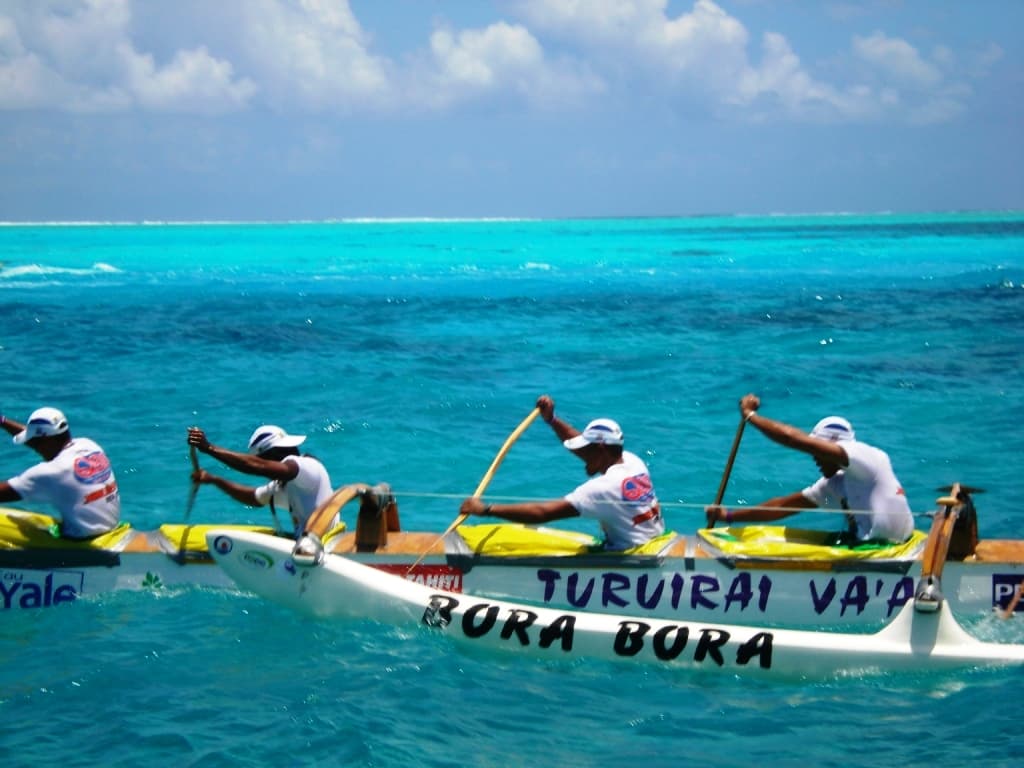
- Hawaiki Nui Va'a (late October; 28 to 31 October in 2026): Polynesia's great outrigger canoe race crosses from Huahine via Raiatea and Taha'a to finish in the Bora Bora lagoon off Matira Beach.
- Tahiti-side events matter too: Heiva i Tahiti in Papeete in July is worth planning a stopover around.
Where to stay
 SlimMars 13 · Pexels
Matira and the south point
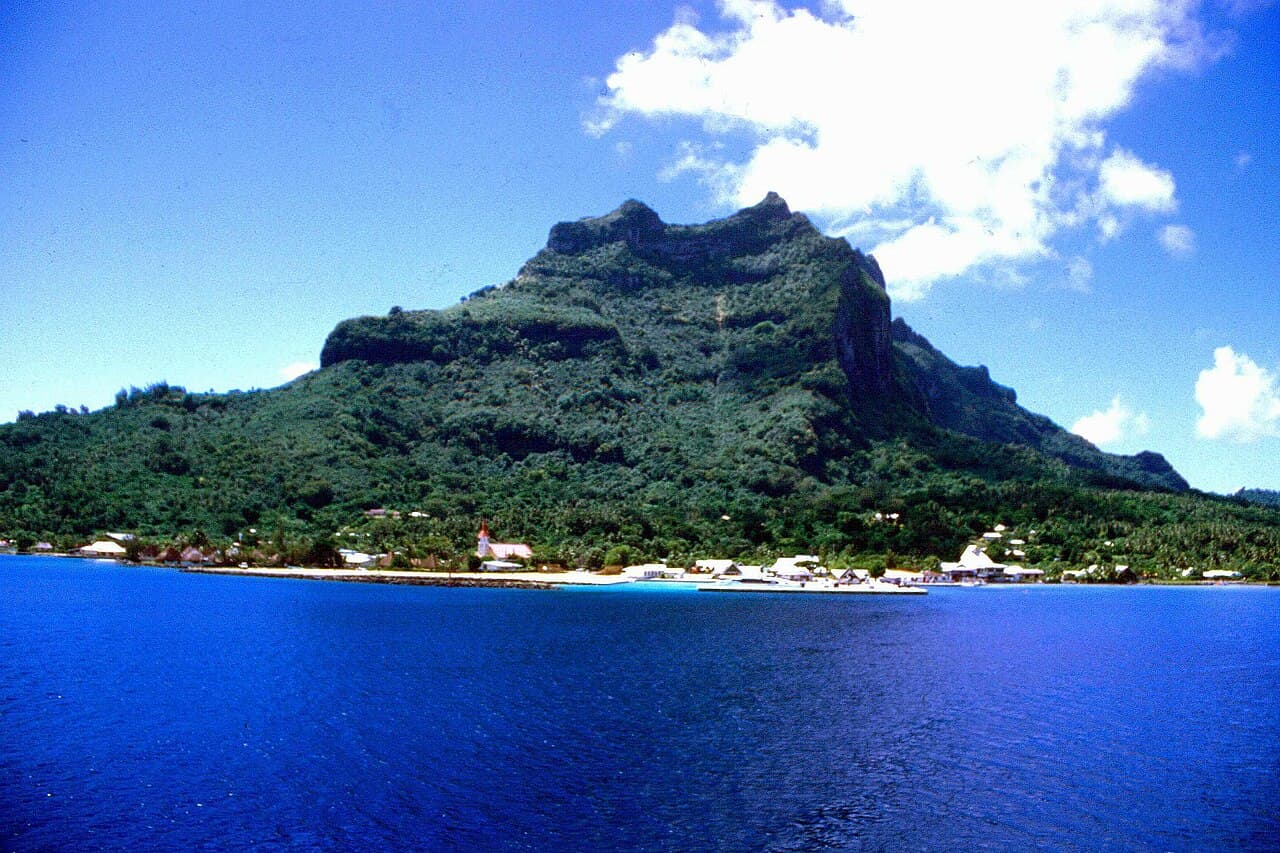
The main island's beach quarter: the long white curve of Matira, the island's one true public beach, with guesthouses, small hotels, snack bars and the InterContinental Le Moana clustered around the point. This is where Bora Bora is affordable, walkable and local all at once.
Best for: Budget to midrange stays · Beach access without a resort · Couples off the resort grid
The beach draws everyone on the island by late morning in high season; sleep here and you own it at sunrise and sunset instead.
 Makemake at de.wikipedia · CC BY-SA 3.0 via Wikimedia Commons
Vaitape
The working town and arrival quay: banks, pharmacies, pearl shops, the church whose Sunday hymns are an event in themselves, and the roulottes (food trucks) that gather near the harbor after dark. Not a beach base, but the island's only real town and the anchor of every practical errand.
Best for: Cheap eats · Shopping and errands · Ferry and shuttle connections
No swimmable beach in town; stay here only if you want the cheapest bed and do not mind riding to the water.
 SlimMars 13 · Pexels
Povai Bay
The calm west-facing bay between Vaitape and Matira, with Otemanu views back across the water, a handful of restaurants and lodgings along the shore road, and the site of Bloody Mary's, the island's most famous restaurant, scheduled to return as a boutique hotel in late 2026.
Best for: Quiet main-island stays · Sunset water views · Dinner with a mountain backdrop
The bay is mostly shallow and not a swimming beach; it is a view-and-dinner shore, with Matira a short ride south.
 Daniel Barrientos · Pexels
Anau and the east coast
The quiet side: a village strung along the lagoon facing the sunrise motu, with the manta ray cleaning station offshore and the Westin across the water. Fewer services, more dogs, more real life; the loop road's east leg is the emptiest, prettiest cycling on the island.
Best for: Manta snorkeling · Cyclists · Seeing the lived-in island
Almost no restaurants or shops; plan meals around Vaitape or Matira, and expect roadside dogs that are loud but rarely more.
 François Balédent · Pexels
Faanui and the north
The island's utilitarian corner: the cargo quay, the power station, and the deepest history. The US turned Bora Bora into a supply base in 1942 (Operation Bobcat), and its coastal guns still point out of the hillsides above Faanui Bay. Come for the relics and the empty road, not to stay.
Best for: WWII history · A quiet leg of the loop road
The Vaearai cargo ferry docks at Farepiti quay here, a couple of kilometers from Vaitape; arrange pickup if you arrive by sea.
 Brenda Holland · Pexels
The motu ring
The coral islets around the lagoon where the famous resorts live: Four Seasons and St. Regis on the northeast motu with straight-on Otemanu views, the Conrad on To'opua in the southwest facing the sunset, the Westin off Anau. Everything arrives and leaves by boat, including you.
Best for: Honeymooners · Overwater bungalows · The full postcard
You are captive to resort dining and boat schedules; budget for both, and check the 2026 renovation map before booking (the InterContinental Thalasso is closed until roughly mid-2027).
Where to sleep
Four Seasons Resort Bora Bora
luxury · Motu Tehotu (northeast)
Best for: Honeymoons · Otemanu views from bed · Polished service at scale
- About 100 overwater bungalows plus beachfront villas on a private motu, with one of the island's most photographed sightlines back to Otemanu
- A protected inner lagoon sanctuary for easy snorkeling without a boat
- An extensive resort machine: kids club, spa, multiple restaurants
- Top-of-market rates, and meals and transfers priced to match
- Big-resort scale; travelers wanting intimacy may prefer smaller properties
- Everything off-property means a boat
The St. Regis Bora Bora Resort
luxury · Motu Ome'e (northeast)
Best for: Space and privacy · Butler-service honeymoons · Long lazy stays
- 77 overwater villas and 13 beach villas, among the largest standard overwater accommodations in French Polynesia
- A private lagoonarium-style inner lagoon for calm snorkeling
- Butler service and a quieter, more residential rhythm than its neighbors
- Rates and extras at the very top of the market
- The formality suits some couples and bounces off others
- Otemanu views vary sharply by villa category; check before booking
Conrad Bora Bora Nui
luxury · Motu To'opua (southwest)
Best for: Sunsets from the deck · A hillside-and-water setting unlike the flat motu · Points travelers
- Reopened 1 May 2026 after a winter renovation that refreshed villas and added larger sunset-facing overwater bungalows
- The only luxury resort on the lagoon's west side: decks face the open sunset, not the mountain
- A hillside spa with some of the best elevated lagoon views on the island
- No Otemanu-from-bed view; the mountain sits behind you
- The motu is shared with tour stops on its far side
- Fresh-from-renovation operations can take a season to settle
The Westin Bora Bora Resort & Spa
resort · Motu off Anau (east)
Best for: A newer-build resort · Families · Slightly gentler luxury pricing
- The island's newest resort: opened September 2024 on the former Le Meridien site, the island's first resort opening since 2017
- Of about 142 units, 128 are overwater, the most on the island, plus new beach villas aimed at families
- A large lagoon-side pool scene and a more contemporary feel than the legacy properties
- The motu faces the main island's east coast rather than the classic full-face Otemanu angle from every room
- Brand-standard touches read less distinctly Polynesian than neighbors
- Still maturing: staffing and dining have been evolving since opening
InterContinental Bora Bora Le Moana Resort
resort · Matira Point (main island)
Best for: Overwater bungalows without full motu isolation · Walking to Matira Beach · Shorter transfer logistics
- Overwater and beach bungalows on Matira Point, on the main island: you can walk out of the resort to the public beach, snack bars and the loop road
- Materially gentler pricing than the motu flagships, especially outside peak season
- With its Thalasso sister closed for rebuilding until about mid-2027, this is the InterContinental experience on the island
- Bungalows and grounds are more classic than cutting-edge
- The lagoon here is busier with beach traffic than a private motu's water
- Otemanu is not the view; the point faces south
Hotel Maitai Polynesia
value · Matira (main island)
Best for: Affordable overwater bungalows · Beach access on a budget · First-timers keeping the trip realistic
- The island's established midrange option: garden and ocean-view rooms across the road plus a small set of overwater bungalows far below flagship rates
- Steps from Matira Beach, snack bars and food trucks, so meals do not require resort pricing
- The practical base for travelers who want one overwater night without the four-figure bill
- Three-star polish: simpler rooms, dated corners, no resort machine
- The overwater units sit over busier, shallower water than the motu resorts
- Road-side rooms hear the loop road
Essential experiences
 SlimMars 13 · Pexels
The lagoon by boat
The single essential Bora Bora day: a full-day tour circles the island inside the reef, stopping to snorkel coral gardens, drift with blacktip reef sharks and stingrays over white sand, and eat a Polynesian lunch on a motu, usually with coconut-husking and ukulele included. Choose the operator carefully: feeding sharks is banned in the lagoon, in the passes and within a kilometer of them, but cheap circuits still work conditioned animals for photos. The operators who refuse bait find the same animals behaving naturally, and the difference shows. Full-day group tours run roughly 15,000 to 20,000 XPF per person; private boats multiply that.
 Sba2 at English Wikipedia · CC BY 2.5 via Wikimedia Commons
Matira Beach
The island's one true public beach and one of the Pacific's famous strands: a long, gently shelving curve of white sand at the southern tip, shallow and calm enough for children, with Otemanu over your shoulder and snack bars within barefoot range. It is where the whole island, resort guests included, comes to touch the water for free, and where the Hawaiki Nui Va'a canoe race finishes in late October. Sunset from the western curve is the island's democratic five-star moment.
 rachel_thecat · CC BY-SA 2.0 via Wikimedia Commons
Mount Otemanu
The 727-meter volcanic remnant that gives every Bora Bora photograph its spine. The summit is not an established hiking objective, but guided hikes reach viewpoints and caves on its flanks (the Valley of the Kings routes need a local guide and dry weather), and every lagoon tour, bungalow deck and beach frames it differently through the day. Sunrise light on the tooth from the east side of the lagoon is the photograph people cross the world for.
 Matthew Dillon from Hollywood, CA, USA · CC BY 2.0 via Wikimedia Commons
The Coral Gardens
One of the lagoon's best-known easy snorkeling areas: shallow coral heads alive with butterflyfish, parrotfish, moray eels and the occasional octopus, in water calm enough for hesitant swimmers. Most full-day tours stop here; you can also reach it by rented boat or with a short private transfer. Fins-off discipline matters: the coral that makes it magical is exactly what careless kicks destroy, so float, do not stand.
 Franco Solari · Pexels
The Anau manta ray station
Off Anau village, reef manta rays visit a cleaning station where small fish groom them, a rare chance to snorkel with mantas inside a lagoon. Early morning is best, before boat traffic; sightings are wild-animal probabilistic, not guaranteed. Go with a guide who holds the group at a respectful distance and never touches or chases: the mantas keep returning only because the station stays worth returning to.
 Kelli Golis · Pexels
The WWII coastal guns of Operation Bobcat
In 1942 the US military made Bora Bora a Pacific supply base, bringing thousands of servicemen, an airfield on the site of today's airport, and naval coastal-defense guns that remain in the hills. The pair above Fitiiu Point near Anau and the guns above Faanui Bay reward a short, sweaty scramble with barrels aimed at an empty horizon and some of the best free views on the island. Take water, wear real shoes, and ask locally about access, as trails cross private land in places.
 Balou46 · CC BY-SA 4.0 via Wikimedia Commons
Vaitape and its quay
The island's only town earns an unhurried half day: black-pearl showrooms (Tahitian pearls are the souvenir worth researching), the church whose Sunday himene singing visitors are welcome to hear, small boutiques, and the quay where shuttles, ferries and outriggers come and go against the silhouette of To'opua. After dark the roulottes take over the harbor area and serve the island's best-value dinner.
 SlimMars 13 · Pexels
Humpback whales outside the reef (in season)
From late July into November, humpbacks calve and rest in the lee of the Society Islands, and licensed boats run observation and, with authorization, in-water encounters outside the reef. The rules tightened for 2025 onward: the season is fixed at 20 July to 20 November, approach distances and group sizes are capped, and operators need permits. Book only licensed boats, treat any sighting as a gift rather than a deliverable, and expect open-ocean conditions.
 Bianca Henry from Bora Bora, French Poly / CC BY 2.0 via Wikimedia Commons
 rachel_thecat / CC BY-SA 2.0 via Wikimedia Commons
Food & drink
 Jahra Tasfia Reza · Pexels
Poisson cru au lait de coco
French Polynesia's emblematic dish and the thing to order first: raw tuna flash-marinated in lime, folded with coconut milk, cucumber and tomato. Every kitchen from roulotte to resort makes it; the food-truck version costs far less and is often the best.
 Quang Nguyen Vinh · Pexels
Grilled lagoon and ocean fish
Mahi mahi, tuna and parrotfish grilled simply, often under vanilla butter, the Leeward Islands' signature sauce (the vanilla comes from neighboring Taha'a). The daily catch chalkboard is the menu that matters.
 bams awey · Pexels
The casse-croute
French Polynesia's baguette sandwich: crusty bread stuffed with steak-frites, chow mein or raw fish for pocket change. The magasins (small groceries) and snack counters sell them until they run out; this is how the island lunches.
 Clem Onojeghuo · Pexels
Chow mein a la tahitienne
The Chinese-Tahitian noodle plate that a century of Hakka influence made a national staple: heaping, cheap and everywhere from roulottes to family snacks.
 Larysa Stratiichuk · Pexels
Po'e
Banana (or papaya or pumpkin) baked with starch into a dense pudding and drowned in coconut milk: the traditional dessert that appears at every motu picnic and Sunday table.
 DΛVΞ GΛRCIΛ · Pexels
Firi firi
Coconut-milk doughnuts twisted into figure-eights, fried for breakfast and best minutes old with a coffee, if you can find a morning stand before the locals empty it.
 ROMAN ODINTSOV · Pexels
Tahitian vanilla and black pearls of the fruit world
Not a dish but the flavor to chase: Taha'a vanilla scents creme brulee, cocktails and fish sauces across the island, and roadside fruit (pineapple, pamplemousse, bananas) is cheap, ripe and superb.
Resort dining is international-hotel formal-casual and priced accordingly; the main island eats early, casual and cash-first. Roulottes serve from early evening until the food runs out. Sunday is family and church: many small places close, and resorts fill their brunch seatings. Tipping is not customary in French Polynesia; prices include service, and insisting can genuinely puzzle people.
Where to eat
Snack Matira
institutionThe beachfront snack (Polynesia's word for a casual eatery) on Matira's curve: generous poisson cru, grilled fish and chow mein at a fraction of resort prices, eaten at plastic tables a few steps from the water. Expect a wait at peak beach hours and bring cash.
Last researched 2026-08-11
The roulottes of Vaitape
institutionSeveral food trucks gather around the quay area in the evening: grilled fish, steak-frites, chow mein, poisson cru and crepes, cooked to order and eaten at folding tables. The island's best value by a wide margin and its most local evening; cash only, and the good ones sell out.
Last researched 2026-08-11
Le St James
fine-diningRefined French-Polynesian cooking on a terrace over the lagoon in Vaitape: fresh local fish with French technique, a serious wine list by island standards, and sunset over To'opua from the good tables. Book ahead in season; it is the main island's dress-up dinner.
Last researched 2026-08-11
Sunrises
 Wei86 Travel · Pexels
Anau and the east coast road
The sunrise side: first light comes up over the barrier motu and lights Otemanu's east face pink while the lagoon is still glass. Ride or drive the empty loop road with the water on one side and roosters announcing the day on the other.
May to October for the clearest dawns
 TheConduqtor · CC BY-SA 3.0 via Wikimedia Commons
Matira Point, east flank
From the point's eastern curve the sun rises across the south lagoon, with early paddlers out and the beach empty of everyone but people staying nearby. The quiet counterweight to Matira's famous sunsets.
Year-round
Sunsets
 Asad Photo Maldives · Pexels
Matira Beach
The island's great free show: the sun drops into the sea off the beach's western curve, the shallows go gold, and everyone from resort guests to local families gathers on the same sand. Bring a pareo and something from a magasin; no reservation can beat it.
Year-round; May to October for the most reliable skies · The western curve near the public access points fills first in high season; arrive 30 minutes early.
 Pok Rie · Pexels
Vaitape quay toward To'opua
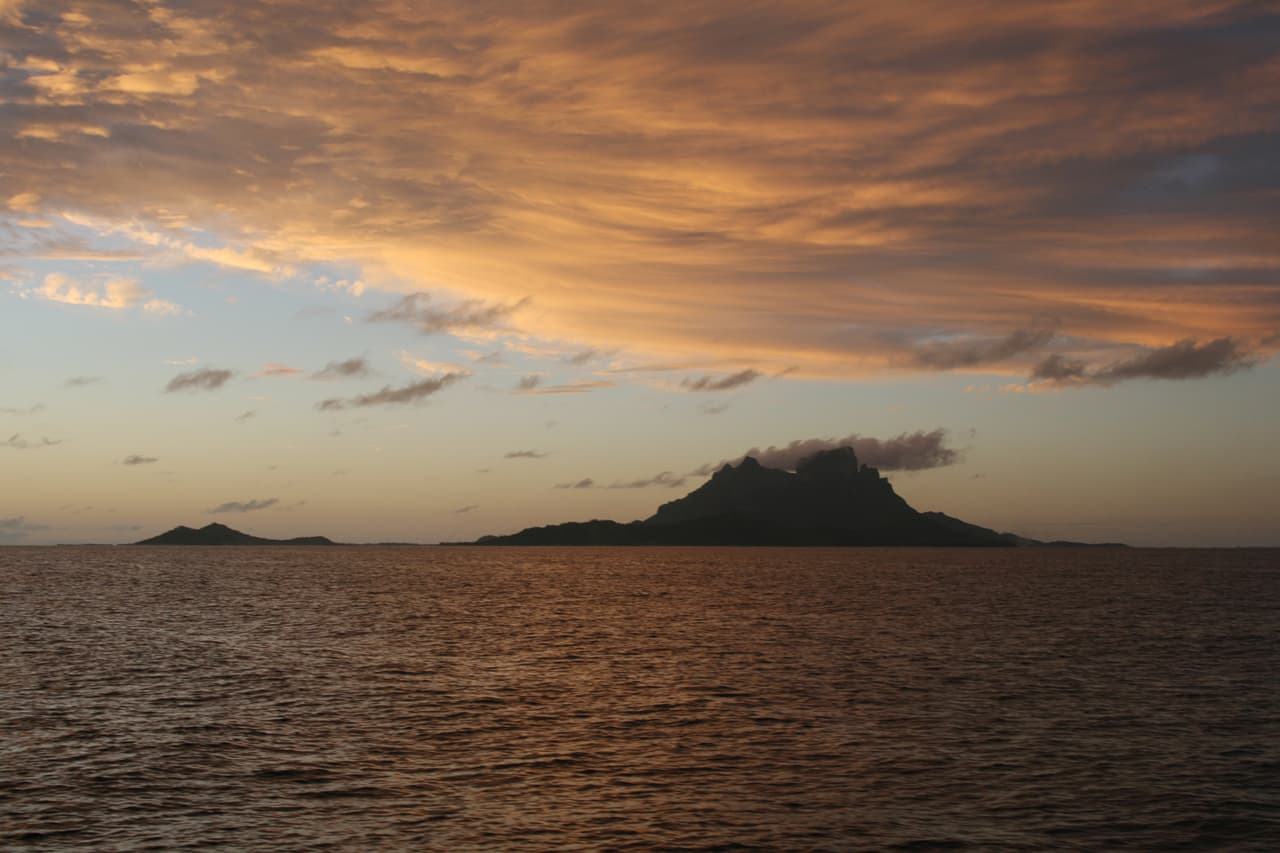
From the harbor front the sun goes down over the lagoon with Motu To'opua in silhouette, outriggers crossing the glare and the roulottes firing up behind you: the working island's sunset, dinner included.
Year-round
 Remi Jouan · CC BY-SA 3.0 via Wikimedia Commons
A sunset cruise on the west lagoon
Catamarans and outriggers run golden-hour cruises on the lagoon's open west side, many with champagne and a swim stop: the splurge version of the nightly show, and the classic proposal setting for a reason. Book a day or two ahead in season.
May to October for calm evenings · Cruises are weather-called in the wet season; hotel concierges and Vaitape operators both book them.
Day trips
 Francois Baledent · Pexels
The full-day lagoon circuit
Not optional: a day circling the island inside the reef with snorkel stops at the coral gardens, rays and blacktips over the sand flats, and a motu barbecue lunch. Group boats mix you with other travelers pleasantly; private charters set their own pace for a multiple of the price. Book the no-feeding operators and the day becomes the trip's spine.
Full day on the water, hotel pickup included · Full day
 NASA / ISS Crew · Public domain via Wikimedia Commons
Tupai, the heart-shaped atoll, from the air
About 20 kilometers north lies Tupai, the uninhabited atoll whose heart-shaped outline made it aviation-famous. Scenic flights and helicopter tours out of Bora Bora's airport overfly it on clear days, usually bundled with a circuit of Otemanu and the lagoon: brief, expensive, unforgettable, and in practice the way tourists see it, as landings are not part of standard itineraries.
15 to 30 minute flights, subject to operator schedules and weather · Half morning including transfers
 Eliza Ross · Pexels
Raiatea and Taha'a: vanilla, pearls and the sacred marae
The neighboring islands, roughly 35 to 50 kilometers southeast, share one lagoon: Taha'a grows the vanilla that flavors half of Polynesia's menus and farms black pearls in its lagoon, while Raiatea holds Taputapuatea, the marae complex at the heart of a UNESCO World Heritage cultural landscape and once the ceremonial center of eastern Polynesia. Day arrangements from Bora Bora combine short Air Tahiti hops or excursion boats; logistics take planning, so many travelers instead add an island before or after Bora Bora on the same Air Tahiti routing.
Short flight or excursion boat; a long, structured day either way · Full day, or better, a 1-2 night island add-on
After dark
 Mikael Ejdemyr · CC BY-SA 3.0 via Wikimedia Commons
Dinner at the roulottes
marketThe island's definitive cheap night out: folding tables by the Vaitape quay, grills going, poisson cru and chow mein for the price of a resort cocktail, and everyone from deckhands to honeymooners in the same line. Cash, early-ish, no reservations.
 Vincent Gerbouin · Pexels
A Polynesian dance night
showThe big resorts stage weekly Polynesian evenings: ori Tahiti dancing, fire, drumming and a buffet of island dishes. Quality varies with the troupe, but the drumming is real, and in July the Heiva competitions in Vaitape offer the unmissable authentic version, open to visitors.
 Vincent Gerbouin · Pexels
Deck, stars and the quiet lagoon
walkThe South Pacific night sky over a dark lagoon is an event in itself: the Milky Way from a bungalow deck or the Matira sand, with bioluminescent flickers in the shallows on moonless nights. The island has almost no nightlife, and stops pretending otherwise by ten.
Daily itinerary
Five days in Bora Bora: the lagoon, the loop and one splurge
A realistic once-in-a-lifetime shape: arrive via Papeete, base either on a motu or at Matira, give the best-weather day to the lagoon circuit, ride the island loop, and keep one day for the splurge that fits your trip: spa, whales in season, or the Tupai flight.
- 1
Papeete, the hop, first water
relaxedFly Papeete to Bora Bora (about 50 minutes); the airport sits on its own motu, so your resort boat or the free Vaitape shuttle finishes the arrival.Resort arrival lunch, or a casse-croute from a Vaitape magasin.First swim: your bungalow ladder or Matira's shallows. Do nothing ambitious; the jet lag is real from almost everywhere.Matira Beach's western curve, or your deck.Resort, or the roulottes if you are based on the main island.Book (or reconfirm) the lagoon tour for your best-forecast day.Airport shuttle boat to Vaitape is included with Air Tahiti; resort transfers are separate and bookable ahead.Estimate: Overnighting in Papeete first? The Papeete market and a roulotte dinner at Place Vaiete make a fine decompression before the hop.
- 2
The lagoon circuit
moderateThe full-day tour departs: coral gardens first while the light is high and the crowds thin.Motu barbecue: grilled fish, poisson cru made in front of you, po'e, coconut everything.Ray and shark sand flats, a second snorkel, the slow lap home past Otemanu's changing faces.Back in time for the show at Matira or the quay.Easy: snack dinner or resort, you will be salt-tired.Early night.Tours collect from resort pontoons and main-island docks; nothing else to arrange.Estimate: Swap to the first clear-weather day without hesitation; the lagoon in sun is a different lagoon.
- 3
The loop road
moderateRent an e-bike or scooter and ride the 32-kilometer belt road counterclockwise: Faanui Bay, the WWII guns if you are game for the scramble, the empty east coast through Anau.Picnic from a magasin, or loop back to Matira's snacks.Beach hours at Matira; the flat road means you are never more than an hour from anywhere.Vaitape quay, with To'opua in silhouette.The roulottes, at their best when you have earned them.Pearl-shop window research for tomorrow.The loop is flat and rideable in 2 to 3 unhurried hours; e-bikes flatten the one small hill near Anau.Estimate: Non-riders: split a rental car or arrange a 4x4 cultural tour that reaches the ridge viewpoints bikes cannot.
- 4
The splurge day
relaxedIn whale season (20 July to 20 November), a licensed boat outside the reef; otherwise the early manta snorkel at Anau or a diving intro.Long and shaded, wherever the morning ends.Spa (the hillside treatment rooms at the To'opua side have the views), or simply the bungalow deck you are paying for.The sunset cruise, booked two days ago.The trip's dress-up dinner: Le St James in Vaitape or your resort's signature table.Stars from the deck; the island is dark enough to make them count.All of today moves by tour boat or resort shuttle; no self-driving needed.Estimate: Big-budget alternative: the Tupai heart-atoll scenic flight instead of the cruise, weather permitting.
- 5
Vaitape morning and the goodbye lap
relaxedVaitape: pearls if you have decided, the church and quay if you have not, one last poisson cru early.Light, near the quay.Shuttle boat to the airport motu (Air Tahiti's navette leaves Vaitape about 90 minutes before departure) and the hop to Papeete.Connections home, or better, onward to another island while you are already here.Resort checkout, boat, shuttle, plane: allow generous margins, everything moves on island time.Estimate: If your international flight leaves late from Papeete, store bags and give the afternoon to the Papeete market and waterfront.
Getting around
- Almost everyone arrives via Tahiti: international flights land at Papeete's Faa'a airport (about 8 hours nonstop from Los Angeles, closer to 8.5 from San Francisco), then Air Tahiti or Air Moana fly the 50-minute hop to Bora Bora many times daily. Book the hop early in high season; one-way fares commonly run about 20,000 to 30,000 XPF.
- Bora Bora's airport occupies Motu Mute on the reef ring: there is no road onward. Air Tahiti's shuttle boat to Vaitape is included with your flight ticket (about 15 minutes); resort boat transfers are separate, bookable ahead, and often not cheap.
- By sea, the Apetahi Express fast catamaran links Papeete and the Leeward Islands (about 7 hours to Bora Bora, several sailings weekly when operating); the service has seen interruptions on the Bora Bora leg, so confirm current schedules before planning around it.
- The Vaearai passenger-and-cargo ferry sails overnight from Papeete (roughly 12 to 14 hours, about 9,500 XPF one way) and docks at Farepiti quay north of Vaitape: the budget adventure option, with basic comfort and Polynesian company.
- There is no scheduled public transport visitors can rely on: the island runs on rental cars, scooters, e-bikes, resort shuttles and a small number of taxis that are expensive and want pre-arranging.
- The belt road is a flat 32-kilometer lap: e-bikes and bicycles are genuinely practical primary transport for main-island stays, with one modest hill near Anau.
- Motu resorts run scheduled boat shuttles to Vaitape; check frequencies and last-boat times before planning a town evening, and expect some resorts to charge.
- Lagoon taxis (boat transfers on demand) exist for crossings the schedules do not cover; your accommodation books them.
Things worth knowing
- · Underbudgeting the water: resort boat transfers, lagoon tours and every activity involve boats, and boats here are priced like the destination.
- · Arriving cardless-cash-confident: resorts take cards, but roulottes, snacks, small magasins and some tour operators are cash-only, and ATMs cluster in Vaitape.
- · Booking the cheapest lagoon tour and getting a bait-and-selfie circuit; the no-feeding operators cost little more and deliver the real lagoon.
- · Expecting whale swims outside 20 July to 20 November, or with unlicensed boats: the season and rules are fixed by regulation.
- · Treating the 2026 hotel map as static: the InterContinental Thalasso is closed until about mid-2027, the Conrad reopened in May 2026, and Bloody Mary's reopens (as a hotel) only in late 2026: reconfirm anything a blog told you.
- · Skipping Papeete margins: the hop is a separate ticket, and tight international connections through Faa'a are a classic self-inflicted wound.
Budget
| Low | Expected | Comfortable | |
|---|---|---|---|
| Accommodation style / per night | CFPF 10,000≈ $94 | CFPF 45,000≈ $422 | CFPF 120,000≈ $1,126 |
| Food style / per day | CFPF 3,500≈ $33 | CFPF 10,000≈ $94 | CFPF 30,000≈ $281 |
| Local transport / per day | CFPF 500≈ $5 | CFPF 4,000≈ $38 | CFPF 12,000≈ $113 |
| Estimate / per day | CFPF 0≈ $0 | CFPF 8,000≈ $75 | CFPF 18,000≈ $169 |
Estimate · XPF · 2026-08-11. Accommodation is per room per night (two sharing): the low band is pensions and guesthouses around Matira and Vaitape, the expected band midrange hotels, and the comfortable band the entry to overwater categories; flagship motu resorts routinely run 150,000 to 300,000+ XPF in season. Food splits the same way: roulotte dinners around 1,200 to 1,500 XPF against resort mains at 4,000+ XPF. The CFP franc is pegged to the euro (1 EUR = 119.33 XPF; the US dollar floats around 108 XPF as of mid-2026), so euro prices do not move with daily rates. Boat transfers and tours are the budget line first-timers miss. · 1 USD = CFPF 107 (14 Oct 2026)
Things worth knowing
Frequently asked questions
Bora Bora or the Maldives?
Geography first: from the Americas, Bora Bora is far closer (8 hours nonstop to Tahiti from Los Angeles, then a 50-minute hop); from Europe, the Gulf or Asia, the Maldives is much easier. Scenery: Bora Bora is one lagoon around a dramatic mountain, so every view has a centerpiece; the Maldives is many flat atolls with house reefs often better for straight-off-the-deck snorkeling. Style: the Maldives is one-island-one-resort isolation with all-inclusive plans common; Bora Bora has a real town, a public beach, food trucks and a loop road alongside its resorts. Honeymooners choosing on photographs choose Bora Bora; divers and Europe-based travelers usually choose the Maldives.
How many days do you need in Bora Bora?
Four to five on the island covers the lagoon day, the loop road, a splurge and real deck time; the island is small and a week is a lot unless doing nothing is the goal. The better use of extra days is another island on the same routing: Moorea for mountains and whales, Taha'a for vanilla and quiet, Raiatea for the UNESCO marae.
Can you do Bora Bora on a budget?
A relative budget, yes. Sleep in a pension or guesthouse near Matira (from roughly 10,000 XPF a night), eat at roulottes and snacks, self-cater from magasins, get around by e-bike, swim the public beach and buy one good group lagoon tour: a week for two can land near 2,000 to 3,500 USD including the Papeete hop but before international flights, a fraction of the resort version. What you cannot do cheaply is the overwater bungalow itself; if that photo is the point, budget for one or two nights of it and base at Matira for the rest.
Do you need an overwater bungalow, and which resort side?
Need, no: the lagoon looks the same from a kayak. But if it is the dream, decide by view and light: the northeast motu (Four Seasons, St. Regis) face Otemanu across the widest water, the classic postcard; the Conrad on To'opua faces west for sunsets; the Westin gives the newest hardware at slightly gentler prices; Le Moana at Matira Point trades the mountain view for main-island freedom. Categories with direct Otemanu views sell out first and cost most.
When is the best time to visit Bora Bora?
May to October for the dry season, with May and October the value edges, July and August the busy, expensive peak, and 20 July to 20 November the regulated whale season. November to April is hotter, wetter and far cheaper, with real (if statistically modest) cyclone-season risk; many travelers find January's steep resort discounts worth the gamble.
How do you actually get there?
Fly to Papeete (Tahiti): nonstop in about 8 hours from Los Angeles, around 8.5 from San Francisco and 9.5 from Seattle, from Paris with a stop. Then a separate 50-minute Air Tahiti or Air Moana flight to Bora Bora, whose airport sits on the reef: the airlines' included shuttle boat crosses to Vaitape, or your resort collects you by boat (separately, and rarely free). Sea alternatives exist (the overnight Vaearai ferry, the Apetahi Express when its Bora Bora leg operates), but almost everyone flies.
Sources (6)
- Destination fundamentals, activities and dining context from Tahiti Tourisme, the official destination marketing organization · tourism-board · 2026-08-11
- Flight and shuttle-boat logistics between Papeete, the Bora Bora airport motu and Vaitape from Air Tahiti · transport-operator · 2026-08-11
- The InterContinental Bora Bora Resort & Thalasso Spa closed 1 June 2026 for a top-to-bottom renovation · official · 2026-08-11
- French Polynesia's whale-swimming rules from 2025: season 20 July to 20 November, authorization requirements, and approach and group limits · independent-travel · 2026-08-11
- Bloody Mary's, closed since September 2023, is scheduled to reopen as a boutique hotel with three dining venues in late 2026 · reputable-local · 2026-08-11
- Heiva i Bora Bora ran late June to early August in 2026, and the Hawaiki Nui Va'a canoe race runs 28 to 31 October 2026 finishing at Bora Bora · tourism-board · 2026-08-11


